Written by: Little Cake
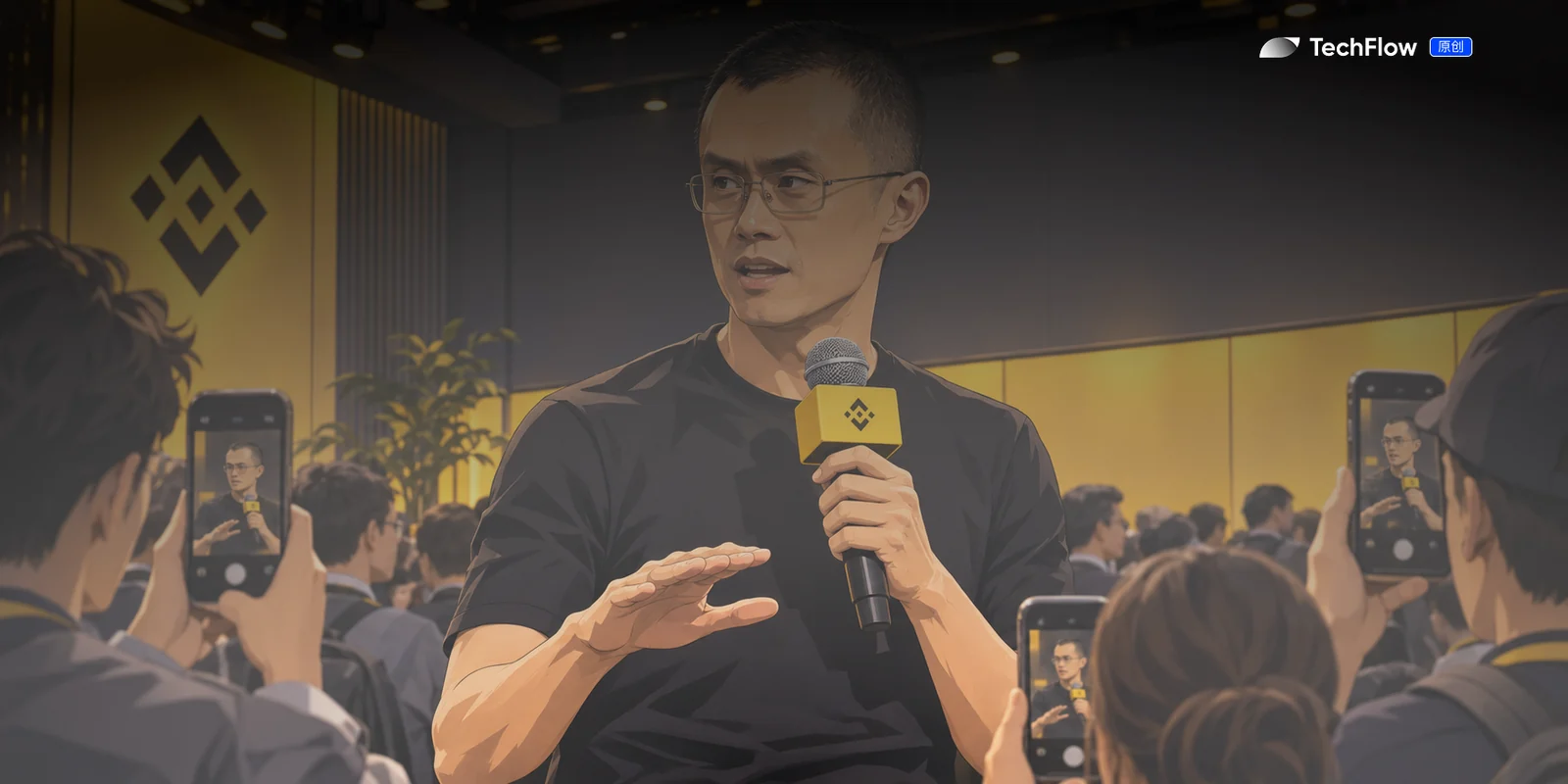
In Bangkok, the simplest way to judge whether CZ has arrived is to see where the crowd swells.
Seeing a group of people rushing over, it is very likely that CZ has come.
People drinking put down their cups, those chatting stop their conversation, and phones are raised above heads one by one. A circle takes shape in seconds, with the outer layer on tiptoes and the inner layer eager to get a bit closer, while the person in the center is unhurried, posing for photos one by one.
It has just been a month since the $6.3 billion theft incident, and the market is very cold. During and around the BBW session, CZ publicly appeared at least four times, with crowds squeezing towards him, while he repeatedly said, “First, let everyone stop and check their computers.”
Somewhat complacent
Most of the conversations at the main venue revolve around that theft.
CZ did not defend Binance. “In my view, the Binance team and ecosystem have become somewhat complacent.” After years without major incidents, everyone has been too comfortable, and safety protocols have not been continuously upgraded; company executives are busy with other matters and pay insufficient attention to security. “Many things are important, but safety is always the most important.” In his view, this incident could have been completely avoided.
The attack path he described was more patient than the outside world imagined.
Hackers contacted more than a thousand employees under the guise of real recruitment consultants, starting with non-technical positions, luring them to download a Trojan disguised as a “Zoom upgrade”; then moving horizontally within the internal network, targeting security engineers, operations, and deployment personnel. After obtaining the source code, hackers used AI for analysis, “In the past, an ordinary person would take six months to analyze, now with AI, it can be done in a day.”
The hot wallet was not directly breached; they turned to exploit vulnerabilities in Ethereum's EIP-7702 signature mechanism.
Apart from admitting mistakes, he also affirmed Binance's handling afterward: users were fully informed, VIPs and partners did not panic widely, and losses were borne by the exchange. “This extends my founding philosophy - we must protect users.” According to reports from the scene, he mentioned that Binance had used about half of the SAFU fund and contract insurance fund and emphasized that from a risk control perspective, the platform must retain enough resources to cover the most extreme scenarios.
Let Binance act as an alarm
More weighty than the analysis was the conclusion he drew.
The first conclusion is that “relying on secrecy for safety” has become ineffective. Hackers use various AIs to scan your source code, and do not care about your privacy at all. Offense and defense have never been symmetrical; the defense must identify and fix every issue, while the offense only needs to find one.
The second conclusion is that the industry must unite.
He has discussed forming an industry security alliance with peers, centered around three things: immediate response, sharing best practices, and cross-checking systems.
“I don’t care what it’s called; I care about what we should do together.” In the recovery of stolen funds, Circle, Tether, as well as the U.S. Secret Service and FBI were involved in freezing funds, and in his view, this is an opportunity for the industry to closely cooperate with global law enforcement agencies. Who should take the lead? He prefers others to do it, “If I must do it, I will push for it.”
The host likened this matter to a review of accidents in the aviation industry. CZ's response was very pragmatic: open sharing is to ensure others do not have to learn at their own cost, and he hopes Binance can learn from others' lessons. Then came the most vivid line of the whole event: “Let Binance act as an alarm. Don’t let this happen to you.”
His requirements were also very specific. In the coming months, practitioners should spend at least 30% to 50% of their time on security, “Sadly, most people are quite complacent until they suffer personally.” His forecast is that the industry still has to endure a high-risk period of 6 to 12 months, with reported attacks occurring daily at a rate of 5 to 10, and unreported cases will be even more.
In the community AMA, he also offered several practical suggestions:
Software vulnerabilities should be patched quickly; using monitoring tools to intercept external connections may cut off more than 70-80% of Trojan communication; then use AI to scan one’s code again, with a technical team of more than ten people, it is almost certain that they can find API keys and even production keys in the source code.
On the day of the conference, he also posted on X, asking multiple applications in the Binance ecosystem and BNB to pop up upgrade alerts for users using the old version of iOS, and calling on other cryptocurrency applications to follow suit.
This entire set of actions transformed Binance from “the biggest victim” to “the biggest alarmist.” After AI dramatically reduced the cost of attacks, no institution can guard its own gate alone.
When fear approaches its peak
Another unavoidable topic at this conference is price.
CZ's answer carried the calmness of someone who has gone through several cycles. He compared the recent lows of Bitcoin: around $150 in 2015, around $3100 in 2018, and around $16,000 in 2022. Nowadays, people feel that $60,000 is terrible, but in historical context, it is not extreme. At Demo Night, his statement was even more straightforward: $60,000 is already a good price; it’s just that $120,000 would be better.
“The market only bottoms out when fear is at its highest; I think we are quite close to that.” He refused to give any price predictions. His logic is inverse: “A lot of hot money has gone to invest in AI, and because of this, ‘now is actually the best time to invest in cryptocurrencies.’”
He does not believe that AI will replace blockchain. He has lived through three decisive technologies since adulthood: the internet, blockchain, and AI; they do not replace each other. “AI cannot replace money; AI will need much more money and transactions.” People need to use money, and intelligent agents need money too; the technology surrounding money will not disappear. He used SpaceX and Starlink as examples; new players will still emerge in a mature industry.
AI, new L1, and entrepreneurs’ lessons
As the helm of YZi Labs, CZ's investment lines remain the same: cryptocurrency, AI, biotechnology.
Cryptocurrency leans towards early-stage projects, focusing on incubation and hackathons; AI leans towards mid to late stages, with larger single investments, because this sector is “highly concentrated and highly centralized,” and few players can secure tens of thousands to hundreds of thousands of chips to compete at the forefront. He himself is a heavy user of the new generation of models, especially preferring open-source models for security scanning due to fewer restrictions, allowing for deeper code scans.
Another major news is that BNB Chain will launch a new L1, but no new tokens will be issued, still using the same token, addressing existing needs for high throughput, micropayments, and AI intelligent agent transactions that current chains cannot meet. He believes that there may be fewer than fifty truly useful major L1s, and perhaps there will be another wave of L1 prosperity, but currently, hot money is in AI, and blockchain has to present genuinely good underlying designs to secure good funding. He also predicts that prediction markets “will be very large,” but the speed cannot be ascertained.
His advice to entrepreneurs was very humble. The only company he has successfully built is one, and it is no longer in operation. AI has made coding easier, but the difficult part is understanding users, integration, handling cross-border payments, regulations, and licensing. To determine whether a product has value, just ask three questions: Did it save people time? Did it save people money? Did it make people happy?
Regarding policymakers, he was also very pragmatic: politicians are too busy, each topic can only get five minutes, and one cannot expect them to fully understand technology. The only way is to keep holding meetings, create think tanks, and write layman’s materials, “There are no shortcuts; you have to do your homework.”
Support founders, but not government intervention
Another surprising topic at the main venue was Jensen Huang.
CZ stated he “has always supported founders” and believes that letting Huang leave was a mistake. Without him, Nvidia could still go forward for a while due to inertia, but the probability of problems is very high; Nvidia’s near-monopolistic position in chip design is beneficial to the U.S. and the world. “Often, a company lives and dies with its founder.” He added, “The founder’s goal should be to ensure the company can continue to operate after they leave.”
He is generally opposed to government intervention in businesses: external forces intervening in the market is equivalent to supporting players with weak competitiveness, which takes away the market's ability to select the best companies and eliminate the worst ones.
This statement carries a special meaning for CZ. He himself is the founder who left the company, and Binance is currently managed by co-CEOs. He says “companies often live and die with their founders,” and also says “to let the company continue operating after the founder leaves,” the two statements reflect the true state of Binance in recent years.
A drama and the outside world's impression
The opening of the main dialogue featured a discussion on Netflix's newly released FTX-themed series “The Altruists.” In the show, CZ is portrayed as the villain.
“I am really not satisfied with their portrayal of me, so let’s see what the lawyers can do.” He mentioned that he has only seen clips on X and does not understand why he is written as a villain while SBF is portrayed as a good person, which feels to him “basically like defamation.”
He and SBF have probably only met five times, and the latter is “basically a competitor.” When asked what could be done about a “fictional drama based on real events,” he said he is still uncertain and is still listening to advice.
He also gave a judgment he explicitly marked as a “speculation”: This drama may be shaping public opinion for future clemency for SBF, “Maybe two years, maybe six years, maybe ten years, I don't know.”
What he truly cares about is the outside world. “People in the circle know, so it doesn’t matter what I say on Twitter. But they are targeting people outside the circle, and we unfortunately do not have such outreach capabilities.”
In the cryptocurrency circle, CZ is a name that draws crowds; outside this circle, he is defined by streaming media and Hollywood.
Returning to the circle formed by people at the beginning.
Those who squeezed next to CZ wanted a photo, some wanted to ask “Can we buy now?” His answers over the past couple of days are exactly the opposite of this enthusiasm: first ensure safety, and in the next six months to a year, people will be hacked every day; the market is approaching a time of peak fear, but where the bottom is, he does not predict.
The most memorable image from this weekend in Bangkok is likely this: The person most capable of generating heat in the industry stands in the center of that heat, repeatedly urging everyone to calm down.
免责声明:本文章仅代表作者个人观点,不代表本平台的立场和观点。本文章仅供信息分享,不构成对任何人的任何投资建议。用户与作者之间的任何争议,与本平台无关。如网页中刊载的文章或图片涉及侵权,请提供相关的权利证明和身份证明发送邮件到[email protected],本平台相关工作人员将会进行核查。