Author: Dong Jing, Wall Street Journal
The macro strategy team at Goldman Sachs pointed out in their latest report that the market is "looking for an anchor." The three major supports previously seen as sufficient to stop the decline—significant valuation adjustments, hedge fund deleveraging, and strong earnings growth—are all in place, yet they have still failed to support the market. Investors are eagerly searching for macro-level support, known as the "Warsh Put."
Goldman Sachs macro strategists Cosimo Codacci-Pisanelli and Rikin Shah wrote in their latest "Macro Roadmap" report issued before half-day trading on Friday (November 27) that the recent decline that began in October was initially explained as a positional and technical adjustment, a "healthy correction" before the midterm elections, but has now evolved into a deeper debate over AI trading. The forward P/E ratio of the S&P 500 has been adjusted down by 25% to 16 times this year, with year-over-year earnings per share growth exceeding 30% in the third quarter. The growth backdrop is solid, and seasonal factors toward the year-end are also slightly favorable, but this support "still exists, just not sufficiently."
The adjustment of market structure shows obvious divergence and competition. Wall Street Journal article states that Tony Pasquariello, head of Goldman Sachs' global hedge fund business, described it as "one of the largest liquidations in his career." Although the net leverage of hedge funds has fallen to a multi-year low and the net exposure to AI stocks has significantly declined, retail funds continue to flow in, with inflows into U.S. stock funds reaching $150 billion in the past month, leading to an overall market position that has not been fully washed out.
The Goldman Sachs macro strategy team summarizes the current situation as "micro-driven macro," and lists three paths to the bottom: position clearance, clarity of earnings and monetization prospects, macro policy support. The first two have been largely exhausted, and the market has therefore turned its focus to the Federal Reserve, waiting for Federal Reserve Chair Warsh to give the "market rescue signal." However, the recent significant tightening of financial conditions has not only failed to raise concerns at the Fed but has also been seen as a sign of policy effectiveness, which has made the market filled with anxiety and uncertainty ahead of the upcoming December policy meeting.
Three Paths to Finding the Market Bottom
Goldman Sachs lists three potential factors that could support the market bottoming: position clearance, increased confidence in earnings and monetization, and macro support (a dovish Federal Reserve). Scoring each, the results can at most be deemed mixed.
In terms of positions, the market structure "is indeed cleaner now": hedge fund net leverage is at its lowest since April 2025, the net exposure of prime brokers to AI stocks is at its lowest since September 2025, and AI shorts are at a multi-year high. However, Goldman noted that broader positions are far from being cleared—$150 billion has flowed into U.S. stock funds in the past month, and futures positions remain at the 82nd percentile. This reflects the divergence mentioned by Goldman’s Lee Coppersmith in "Panic Without Clearance”: professional capital is selling while slow money continues to buy.
In terms of earnings, key questions remain unanswered: export controls, licensing approvals, capital expenditure returns, token trends, financing under higher capital costs, and the sustainability of earnings after the peak growth of capital expenditures. Goldman believes that clear answers and the resulting earnings visibility for 2028 "is unlikely to appear in the short term, resulting in a wide distribution range." Their scenario matrix extends from a downward scenario at 5800 points (with trend earnings per share of $340 and an average P/E ratio of 17 over 30 years) to an upward scenario at 8100 points, with the current scenario range being 6800 to 7300 points.
The $300 Billion Question
The core of the market's doubts about AI trading lies in whether massive capital expenditures can be converted into actual income. Goldman Sachs' framework provides the numbers:
Hyperscale cloud vendors need approximately $300 billion in annualized AI revenue to achieve breakeven on capital expenditures in 2026 to 2027.
To achieve a 15% return on invested capital, approximately $1.42 trillion in revenue is needed between 2028 and 2030 (approximately $11.6 billion per gigawatt).
This requires about $1 trillion in annual user spending on AI applications.
Since the AI boom has pushed S&P 500 earnings 25% above trend levels, the earnings in 2028 "depends on a chain": hyperscale vendors' AI revenue comes from application layer revenue, and application layer revenue comes from enterprise adoption. Goldman provides four tracking indicators.
First, cloud revenue and order backlog: The three major cloud vendors accelerated their cloud business growth to a year-on-year increase of 54% in the third quarter, with order backlog close to $1.8 trillion. The focus of debate is the speed at which contracted demand translates into revenue.
Second, U.S. corporate adoption rate, which does not look optimistic: 68% of S&P 500 companies mentioned AI in their third-quarter earnings calls, but only 13% provided specific figures on the impact of a particular use case, and only 3% provided figures on earnings impact. "Bridging this gap is the signal for 2028."
Third, AI SaaS monetization: Products like Copilot and recurring revenue from model companies currently make up the majority of the application layer. Aggregated data from Epoch AI showed that Anthropic surpassed OpenAI earlier this year, with a combined annualized revenue of about $100 billion. This is about one-third of the amount needed for hyperscale vendors to break even, while the market "has begun to punish existing vendors whose AI revenues cannot offset declines in core businesses."
Fourth, token usage: The growth in usage must outpace token price deflation. Ramp (approximately 85,000 companies, primarily small and medium-sized enterprises) and OpenRouter (leaning towards open source) are "useful parts of the puzzle, but not the whole picture."
The issue lies in timing: "Capital expenditures are happening now, but it will take time to ensure that the investments will yield returns... The question is how patient the market will be with these indicators next year." Based on the past eight weeks, the answer is "not very patient."
Only the Third Path Remains: Waiting for the "Warsh Rescue"
In the absence of micro catalysts, macro policy has become the last hope. As Goldman said, now only the third path remains:
"With micro catalysts fading, and positions and prices themselves insufficient to provide support, the macro may need to take action."
The Goldman Sachs U.S. financial conditions index has tightened about 95 basis points from its low in early September, with about 50 basis points occurring after the October FOMC meeting. Goldman Sachs' chief U.S. economist David Mericle quantifies this in a report on Wednesday, with the macro team reaching the same conclusion: This is the tightening that the Federal Reserve desires.
Warsh stated in October: "The main way this policy is being implemented is that we are tightening financial conditions... This is not something we are uncomfortable with. This tells me that the policy is working."
Dissecting this, since the October meeting, the tightening has been caused by stocks (+42 basis points), rather than interest rates (long-term rates -9 basis points). The data also did not give the FOMC committee any reason to retreat: two consecutive broad core inflation data releases, robust growth, a healthy labor market, and a generally hawkish tone from Federal Reserve officials indicated that almost all members believe further rate hikes are necessary.
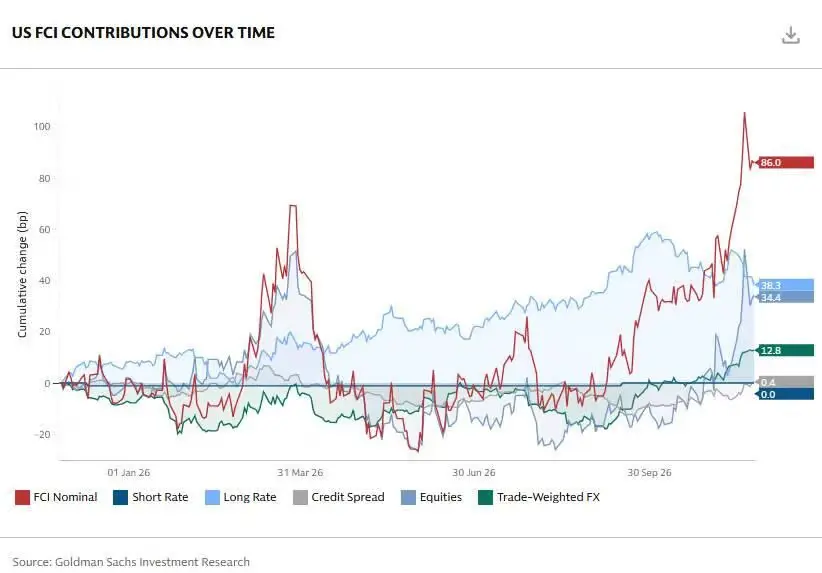
The rule of thumb suggests that a 100 basis point tightening of financial conditions could lower growth by about 1 percentage point in the following year, but Goldman estimates that if this trend continues, the drag on growth in 2027 would only be about 0.5 percentage points, which Mericle describes as "roughly in line with the 75-100 basis point rate hike that a majority of FOMC members might wish to implement."
In other words, the market is doing the work for the Federal Reserve, which the Fed appreciates.
The Ghosts of December 2015 and 2018
So what would prompt the Federal Reserve to change direction? Goldman sees two paths: one is that tightening becomes "disproportionate," more aggressively depressing forward growth ("if the stock market pullback continues, this is a real risk"); the other is that the inflation outlook changes. The timing of the latter is quite awkward—the November CPI will be released on December 10, the day after the FOMC meeting, and the committee will enter the meeting in a "blind flight" state.
Therefore, a major shift on December 9 seems unlikely, but the tone of rate hikes is very important. Goldman Sachs macro strategists quoted two traders' vivid memories of previous experiences: in December 2015 and December 2018, both Yellen and Powell did not show sensitivity to the then-existing credit spreads and stock market volatility when raising rates, leading to a tightening of financial conditions by about 75 and 35 basis points respectively within weeks, forcing the Federal Reserve to change course at the beginning of the following year. Given the low confidence in Warsh's reaction function, it is reasonable for the market to feel nervous ahead of the meeting.
But this time the situation is worse: In 2015 and 2018, inflation was low, and the Federal Reserve was only normalizing; now, with high inflation, the Federal Reserve is tightening to curb inflation, which means "there is even lower confidence about where the Federal Reserve's put option is located." The report states: "The data implies we are still some distance from the strike point, but the market needs to know roughly where the Federal Reserve's put option is. If Warsh does not define it, the market may seek it out on its own."
Bonds Resurrect as a Hedging Tool
Faced with extremely pessimistic market sentiment and high stock market volatility, Goldman Sachs put forward a clear trading strategy in the report: Increase long duration positions. As the correlation between stocks and bonds has shifted from deeply negative values mid-year back to positive, bonds have resumed their hedging role. Amid a 6% decline in the S&P 500 index, the yield on 5-year U.S. Treasury bonds has fallen over 40 basis points.
Goldman noted that given that the 5-year U.S. Treasury yield is currently in the highest decile since 2000, and the base effects of inflation will become favorable by 2027, there is a downside risk bias in dollar interest rates. Despite headwinds such as fiscal expansion and AI-related credit supply, as the risk-adjusted stock return turns negative, the case for increasing the 5-year duration allocation in portfolios is strengthening. As Goldman warned, the AI boom relies on debt; when the stock narrative falters, volatility in the credit market won't be far behind.
The report's conclusion is strikingly straightforward:
"This remains an extremely difficult trading environment. At the core is the ultimate value of AI. The distribution of outcomes remains wide and may continue to do so, as it will take another 12 months to see the income needed to justify capital expenditures... We are not yet at the position of the Federal Reserve's put option, but having a rough idea of where it is would be helpful. Sentiment is absolutely key, and the current sentiment couldn’t be worse."
免责声明:本文章仅代表作者个人观点,不代表本平台的立场和观点。本文章仅供信息分享,不构成对任何人的任何投资建议。用户与作者之间的任何争议,与本平台无关。如网页中刊载的文章或图片涉及侵权,请提供相关的权利证明和身份证明发送邮件到[email protected],本平台相关工作人员将会进行核查。