Author: Principia Research
In June 2026, a somewhat awkward refund event unexpectedly opened a gap in the massive migration of global capital market infrastructures.
At that time, SpaceX, owned by Musk, was making its debut on NASDAQ. To capture the frenzied demand from the crypto world for this century's tech stock, Binance Wallet, in collaboration with the third-party tokenization platform xStocks, launched an on-chain IPO subscription event named SPCXx. On-chain data recorded an astonishing scene: within just a few days, 27,689 independent wallet addresses rushed in, dropping as much as $557 million in USDC.
However, the outcome was a splash of cold water. Due to the highly closed nature of Wall Street's traditional primary market underwriting syndicates, upstream third-party asset merchants could not obtain adequate underlying shares of SpaceX. Ultimately, Binance had to announce the cancellation of the event, refunding the $557 million to its original source, and urgently resorted to airdropping $1 million in its SPCXB token issued by its Abu Dhabi entity to users as a form of consolation.
Most observers regarded this merely as an ordinary operational mishap; but zooming out to view Binance's series of capital, licensing, prospectus filing, and team recruitment actions in the Abu Dhabi Global Market (ADGM) from 2025 to the end of 2026, one can see a completely different picture:
That refunded $557 million proved how desperately on-chain capital craved high-quality equity assets; while the suspension of third-party channels decisively led Binance to commit fully to building a “chain-based securities exchange” in Abu Dhabi that possesses complete underwriting, clearing, custody, and trading licenses, rather than simply being a traffic entry point for external small RWA packagers.
Why Abu Dhabi? The Dual Anchor of Personnel and Sovereign Capital
The crypto industry has never lacked the slogan of “bringing stocks onto the chain.” As early as 2021, Binance and FTX attempted early equity tokens but quickly faltered under the siege of regulatory agencies in Europe and the United States. Five years later, why can Binance set up a complete securities infrastructure this time without any qualms? The answer lies in the personnel genes and sovereign ledger of Abu Dhabi (ADGM).
The first fulcrum is the institutional imprint of its leadership. Binance’s current co-CEO Richard Teng is not a scrappy crypto entrepreneur. Before joining Binance, he served as the Chief Regulatory Officer at the Singapore Exchange (SGX) and subsequently presided over the ADGM Financial Services Regulatory Authority (FSRA) for six years from 2015 to 2021. The regulatory framework for digital assets and ledger-based securities (Ledger-Based Securities) now revered globally was largely established during his tenure.
The second fulcrum is the interest binding of sovereign capital. In March 2025, the sovereign AI and technology investment institution MGX, chaired by Sheikh Tahnoon bin Zayed Al Nahyan, a core member of the Abu Dhabi royal family, injected $2 billion into Binance in exchange for a minority stake using stablecoins. This was the first time since its establishment that Binance introduced external institutional shareholders.
This $2 billion deal rewritten Binance’s fundamental color: it was no longer just a crypto company operating out of offshore islands, but formally embedded within the UAE's national fintech and capital market landscape. Just nine months later (approved in December 2025 and officially effective on January 5, 2026), Binance announced the migration of its global operational structure from the Cayman Islands entirely under the ADGM regulatory umbrella.
Dissecting Abu Dhabi's Compliance "Four-piece Set"
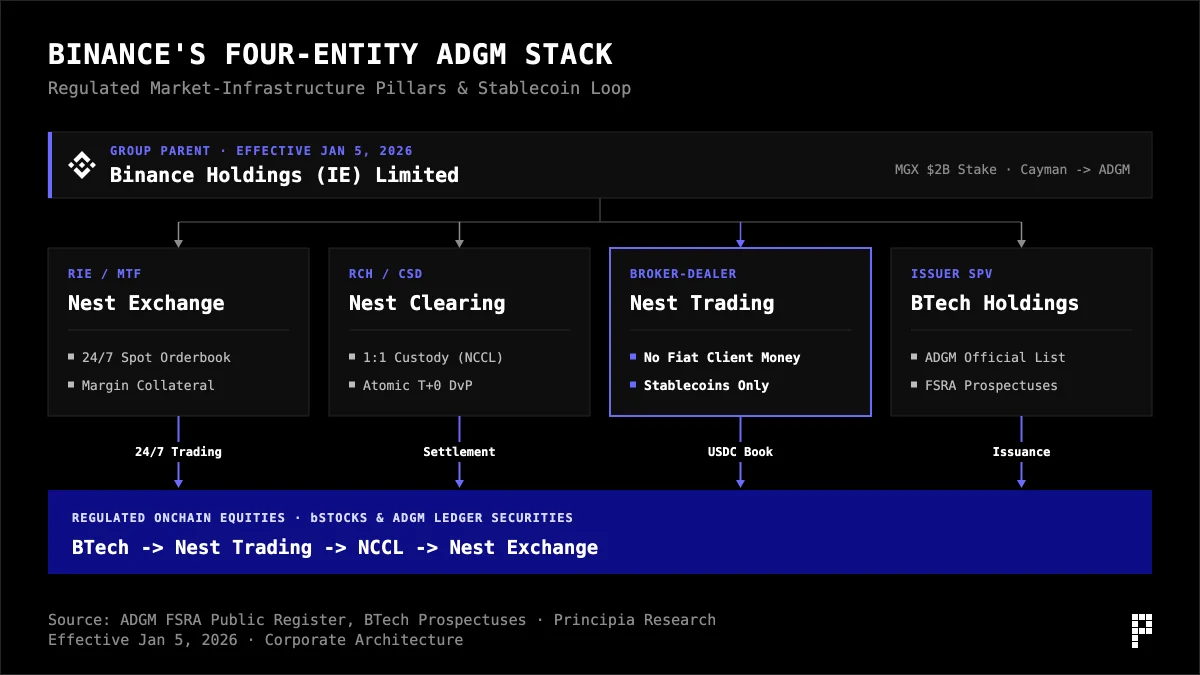
If we look through the public licensing registry and prospectus disclosure documents of the ADGM Financial Services Regulatory Authority (FSRA), we will find that Binance's operations in Abu Dhabi are fundamentally not about the conventional "crypto exchange compliance" (merely applying for a standard VASP virtual asset service provider license), but rather strictly adhere to the segmented standards of traditional financial market infrastructures (FMI) in London or New York, with the Irish holding parent company Binance Holdings (IE) Limited fully laying out a closed-loop matrix of “three licensed institutions + one issuing SPV + one on-chain service agent”:
How refined is this structure? Comparing it with traditional Wall Street makes it immediately evident:
- Nest Exchange Limited holds recognized investment exchange (RIE) and multilateral trading facility (MTF) licenses, functioning like NASDAQ or NYSE;
- Nest Clearing and Custody Limited (NCCL) holds recognized clearinghouse (RCH) and central securities depository (CSD) licenses, acting like the U.S. Depository Trust & Clearing Corporation (DTCC);
- Nest Trading Limited holds a broker-dealer license, approved to trade as both principal and agent, and arrange investment trades. It serves the role of managing underwriting and distribution seats for investment banks;
- BTech Holdings Limited (along with the minting and disclosure agent BTech Services Limited) specializes in submitting prospectuses to FSRA and applying to enter ADGM's statutory official listing.
The “abnormal” details in the licenses reveal the true intentions: on the FSRA public registry, Nest Trading Limited's license carries two intriguing restrictions: first, it is strictly prohibited from holding or controlling traditional client fiat funds (Client Money); second, its funding service authority is strictly limited to “recognized fiat-pegged tokens (like USDC).” From the perspective of traditional brokers, this seems like a crippling limitation; but from the lens of on-chain capital markets, this is precisely a native design tailored for On-chain IPOs. It directly cuts through the lengthy bank wire transfers and fiat custody accounts at the legal level, locking in a pure on-chain closed-loop of “compliant stablecoin subscription payments + Central Depository (NCCL) on-chain T+0 securities payment against (DvP) atomic settlement.”
Meanwhile, recruitment needs released by Binance in the UAE also confirm this judgment: its official recruitment system recently quietly launched positions for “0-to-1 Equity Capital Markets (traditional investment bank IPO underwriting department)” BD and research analysts, with responsibilities plainly stated as “finding and contacting prospective issuers and investment banks, conducting due diligence on issuers, building transaction pricing models, and submitting memos for internal investment committee approval.” If it were just continuing to buy U.S. stocks in the secondary market for mapping, forming a direct investment bank team to liaise with prospective issuers would be unnecessary.
From U.S. Stock Hauler to Weekly Regulatory Assembly Line
Before formally entering the primary market for new stock underwriting, Binance, in the second half of 2026, completed a closed-loop of "regulatory and infrastructure stress testing" in ADGM with its own tokenized security products bStocks.
On June 11, 2026, under the joint efforts of international law firm Gibson Dunn and Middle Eastern law firm Al Tamimi & Co., the first batch of bStocks issued by BTech Holdings was officially approved for inclusion in the ADGM Official List and opened on the Nest Exchange. This marked Abu Dhabi's historic first incorporation of tokenized digital securities operating on a public chain (BNB Smart Chain, BEP-20 / BEP-677 standard) into its official securities listing.
But this raised a critical market question: since the actual shares of companies like Tesla and NVIDIA are locked within the U.S. DTCC system, how can ADGM claim it is “1:1 Custodial”?
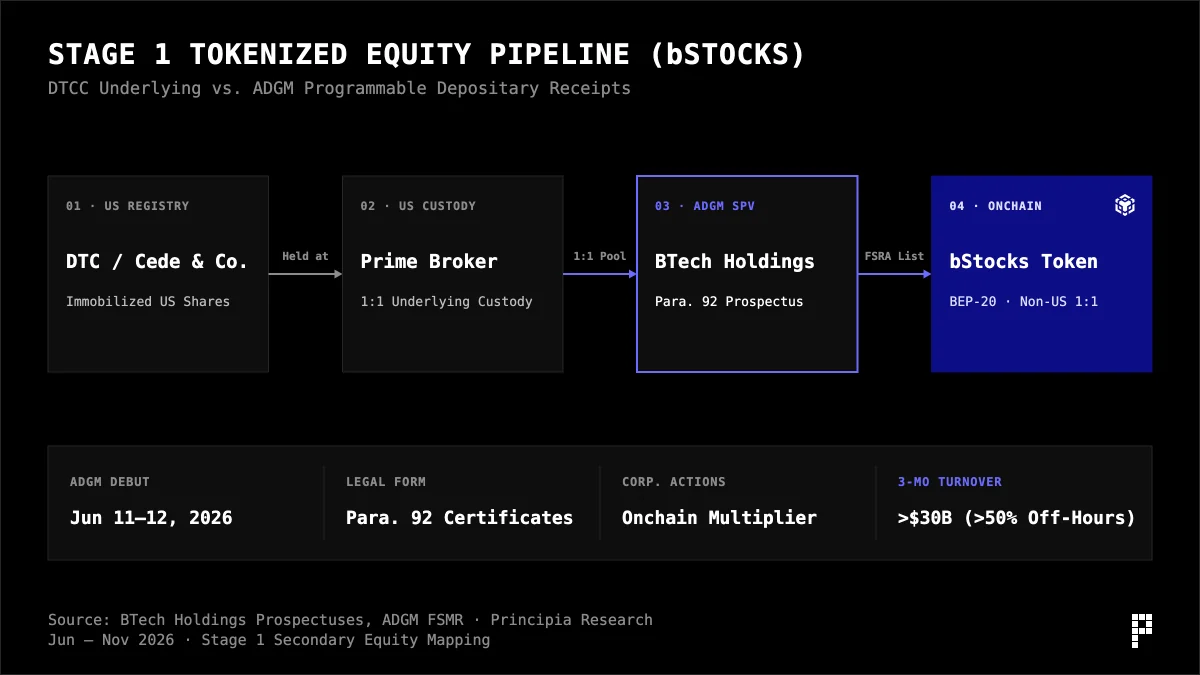
The answer lies in the honesty and transparency of legal positioning: in the first phase (on-chain of the secondary market stock), the true stocks have indeed never left the U.S. DTCC system. The legal identity of bStocks under the ADGM Financial Services and Markets Regulations (FSMR Appendix 1, Paragraph 92) is “certificate representing specific financial instruments,” essentially a type of on-chain depository receipt. The ADGM regulatory authority does not “endorse” the asset's existence on behalf of the issuer; rather, through the approval of the prospectus, it transforms 1:1 full isolation custody, periodic accounting, and reserve proof into legally binding disclosures and contractual obligations with stringent civil and criminal liabilities; on the technical layer, BTech Services implemented a multiplier adjustment mechanism built into the contracts, automating the split shares and net cash dividend reinvestment into a seamless on-chain component without currency conversion.
Even more intriguing is the expedited pace of approvals in the following five months. Traditional securities markets can take months to approve a prospectus, which cannot keep up with the typical two-week window for IPO roadshows; but reviewing the ADGM official admission announcements from June to November 2026, BTech Holdings turned this regulatory channel into a “weekly assembly line”:
- Early July: The Italian tech group Bending Spoons had just listed on NASDAQ on July 1 (Ticker BSP, priced at $29), and BTech quickly passed independent prospectus approval to launch BSPB, facilitating cross-portfolio margin collateralization, and rehearsing “IPO newly listed stock rapid follow-up+ derivative collateral assetization”;
- Late July to August: Approved a three-fold leveraged NASDAQ ETF (TQQQ) and highly volatile asset GameStop (GME), successfully running complex leverage structures and high-volatility risk control templates;
- September: Listed Hims & Hers and Salesforce on the 9th, CEA Industries on the 14th, Forward Industries on the 29th, not only shortening approval intervals to 5 to 15 days but also incorporating small- to mid-cap crypto treasury companies (DAT) for the first time, proving that non-blue-chip small caps can also rapidly pass regulatory approval;
- From October to early November: On October 13 to 14, approved a single batch of BlackBerry, MongoDB, Penguin Solutions, and Volatility Index ETF (UVXY), just six days later (October 20) passed Berkshire (BRKB) and on November 6 quickly approved the 2x leveraged Intel ETF (INTW) supplementary prospectus.
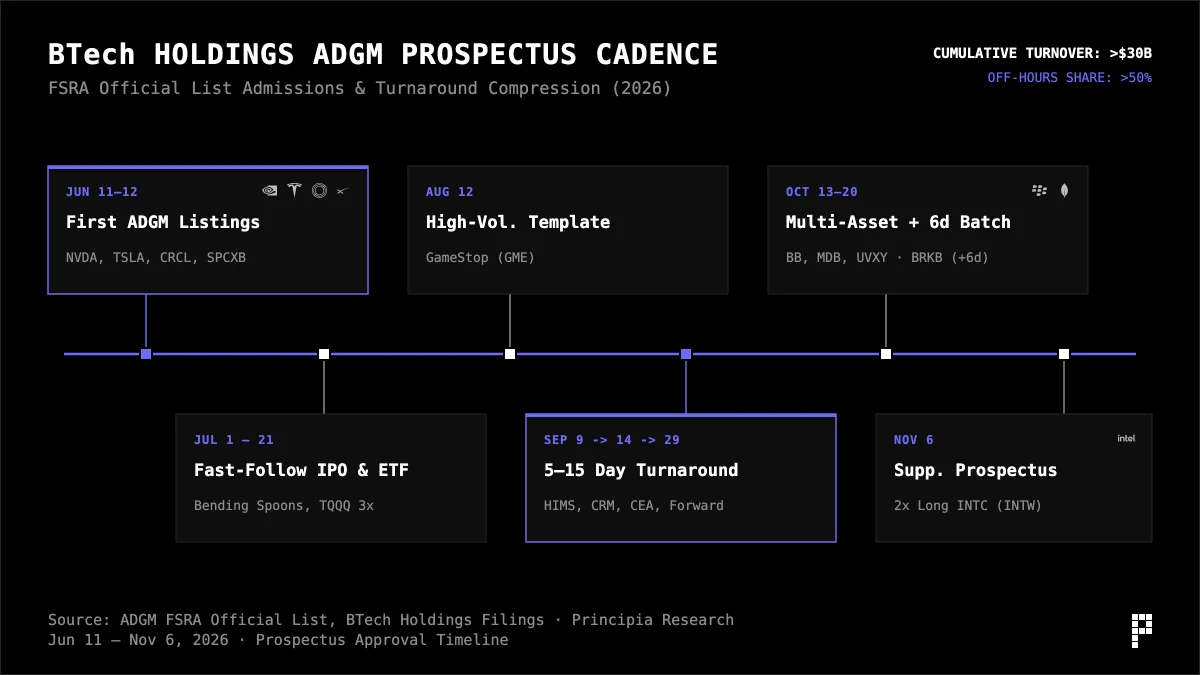
In just three months (as of early September 2026), bStocks’ cumulative transaction volume directly broke through $30 billion, with over 50% of the trading volume occurring during U.S. stock market closures (Asia-Pacific daytime, Middle Eastern trading sessions, and weekends). All the elements of pipeline, liquidity, market makers, and regulatory alignment are in place; the only remaining puzzle is transitioning from “secondary market mapping certificates” to “primary market native on-chain IPOs.”
IPO Predicament and Global Exchange Liquidity Restructuring
Why are global retail investors and issuers searching for a “third channel”? According to full empirical data on the Principia data terminal, the allocation in traditional capital markets has become imbalanced, and the liquidity siphoning effect of crypto trading platforms is evident.
Structural Looting in Traditional IPOs
Among the 650 traditional IPOs tracked by Principia (raising ≥ $50 million, excluding SPACs, with a total fundraising of $441.33 billion), two groups of notably discordant data emerge:
- Divergence between first-day surges and retail investors taking the fall: The average jump in price from issuance price to first-day opening price for traditional IPOs is as high as +29.6%, with “desktop profits” based on first-day closing prices reaching $329.14 billion. This risk-free premium of the first level is almost all allocated by Wall Street investment banks to institutional clients. Yet once retail investors enter the open market post first-day opening, 64.1% of companies eventually fall below the offering price, with median returns from the first-day open to date plummeting to -36.0%.
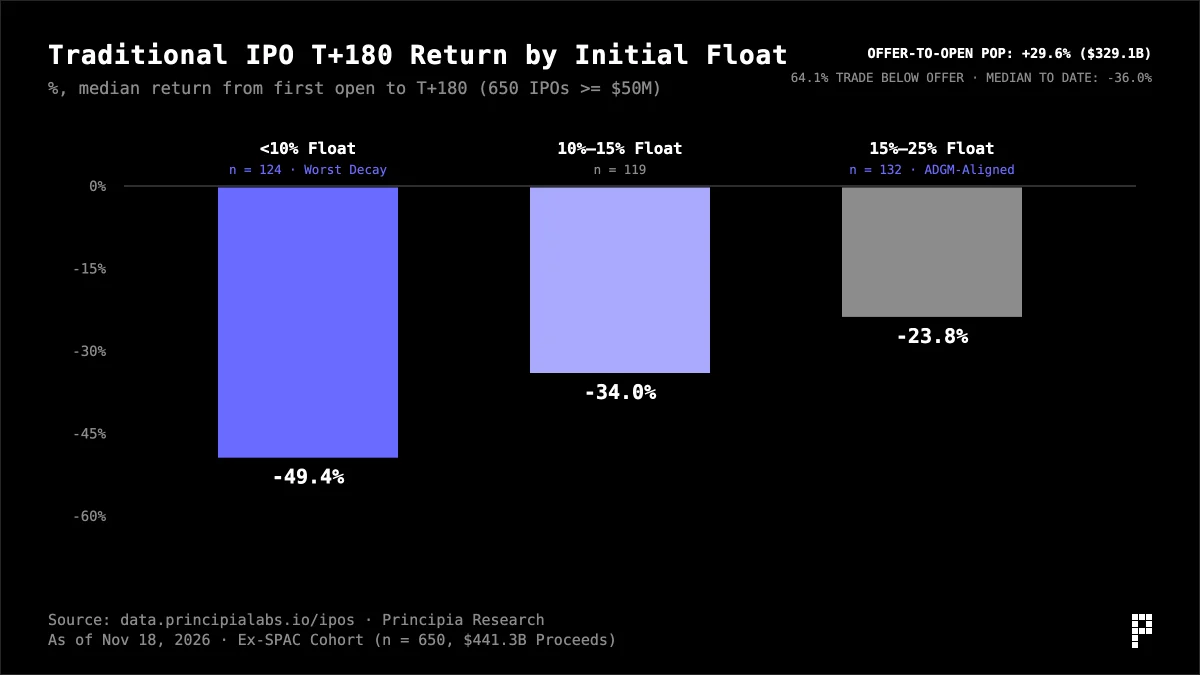
- The “slow bleeding” rule of low float: Tracking the median pullback of these 650 IPOs based on initial free float percentage reveals an astonishingly consistent pattern:
- <10% ultra-low float (124 companies): median pullback reaches -49.4% by the 180th day (currently -44.4%);
- 10% to 15% float (119 companies): median pullback is -34.0% by the 180th day;
- 15% to 25% float (132 companies): median pullback converges to -23.8% by the 180th day, halving the decline of the <10% group;
- Meanwhile, around the 180-day lockup cliff (n=319), low float stocks (Float <15%) face the most severe -10.5% selling pressure shock.
This set of empirical data not only explains why on-chain capital surged to invest $557 million in securing primary shares of SpaceX (because only securing the Offer Price can avoid the structural fall trap of -36.0% in secondary markets), but also statistically corroborates the scientific validity of ADGM MKT Rule 2.3.10, which mandates 15% to 20% genuine public holding.
What is the Real Scale of Binance?
Many traditional financial practitioners subconsciously believe that “the trading volume of crypto exchanges is far less than that of mainstream securities exchanges.” The truth is far more shocking than stereotypes:
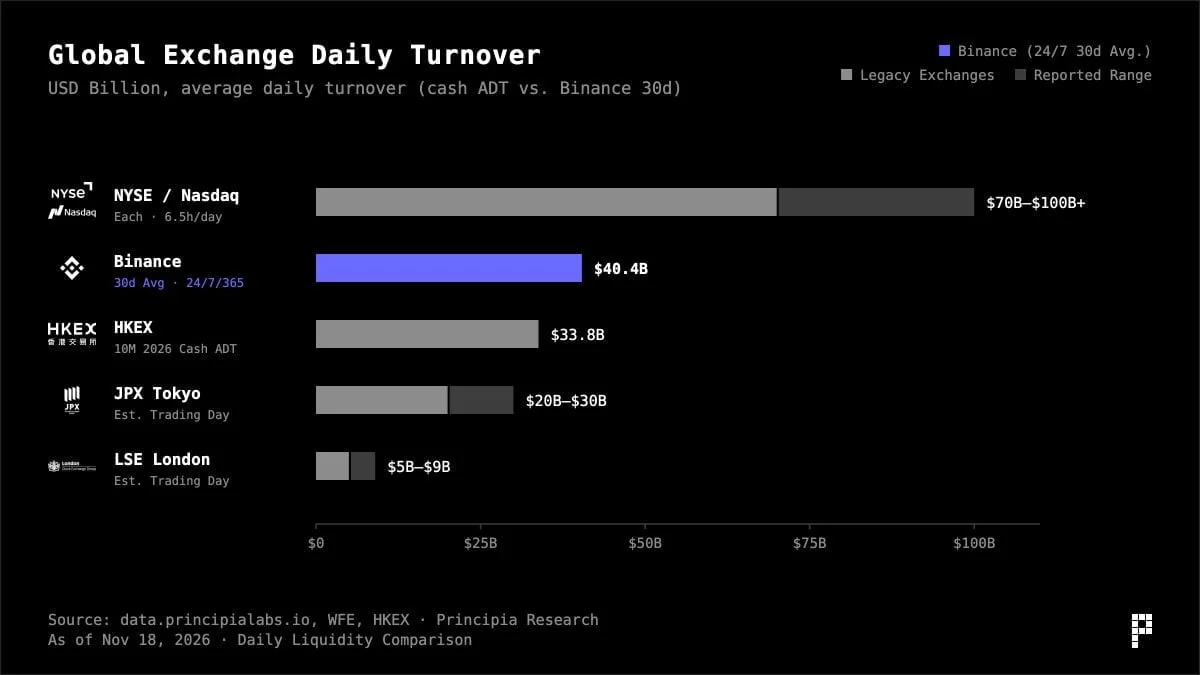
In 2025, Binance's trading volume exceeded $7.1 trillion (comparable to the Hong Kong Stock Exchange's $7.88 trillion). Binance's spot trading volume for 2025 is nearly equivalent to that of the Hong Kong Stock Exchange, and its overall liquidity and 30-day average trading volume have surpassed the daily average level of spot trading on the Hong Kong Stock Exchange.
Even more noteworthy is the specialized race track we have documented for tokenized stocks/ETFs/commodities (as of November 18, 2026, the total tokenized market value across the network reached $8.59 billion, with 804 active assets, covering 187 trading venues globally):
▪ Total spot trading of $1.79 billion and derivatives trading of $50.52 billion (derivatives being 28.3 times that of spot), with open interest at $11.22 billion;
▪ Among these, Binance alone holds a dominating 41% of the global trading share ($470.6 million in 24-hour RWA spot + $20.9 billion in derivatives + $3.47 billion in open interest, with spot reserves reaching $112.71 billion), which is 4.3 times larger than the second-largest OKX (9.5% share).
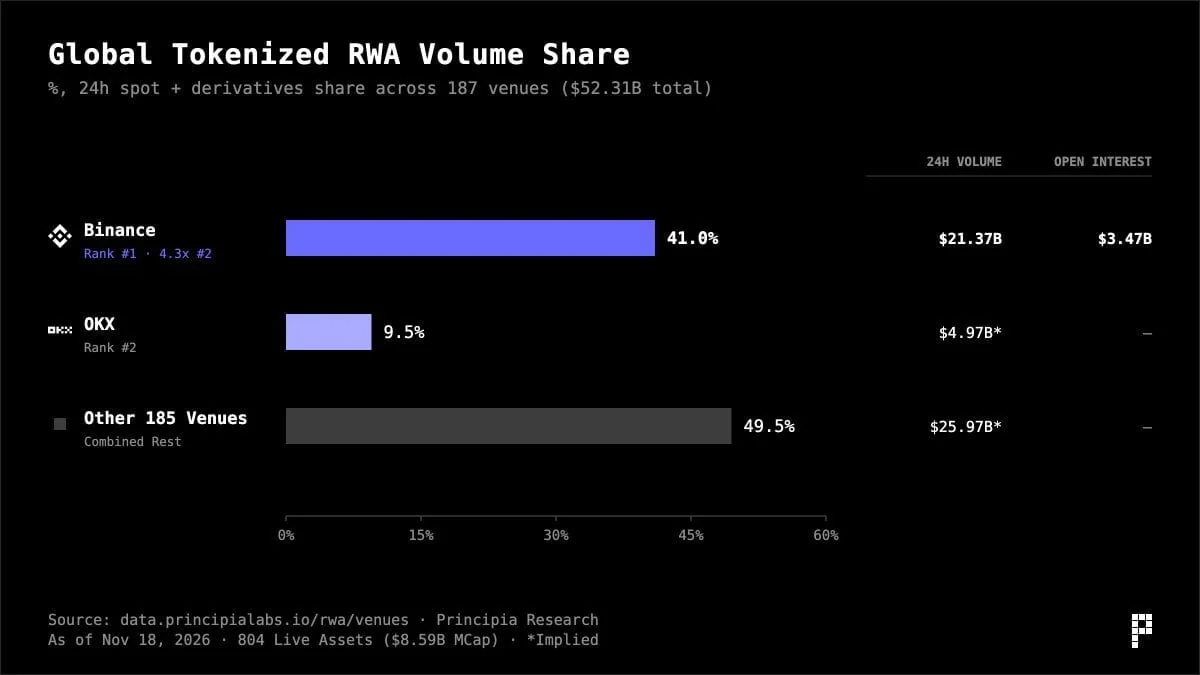
When a super exchange that operates 24/7, maintains a 30-day average trading volume exceeding $40.4 billion, and holds 41% of the global tokenized asset share officially secures legal securities exchange and broker full licenses in ADGM, the downward impact on traditional regional exchanges is just beginning.
Medium-sized Issuers Forgotten by Wall Street
In the second half of 2026, CZ publicly asserted,
CZ (@cz_binance): “IPOs will move on chain.”
Binance Research continually published heavy reports like “From IPO to Internet Capital Markets,” bringing the global on-chain equity market into direct confrontation among three routes:
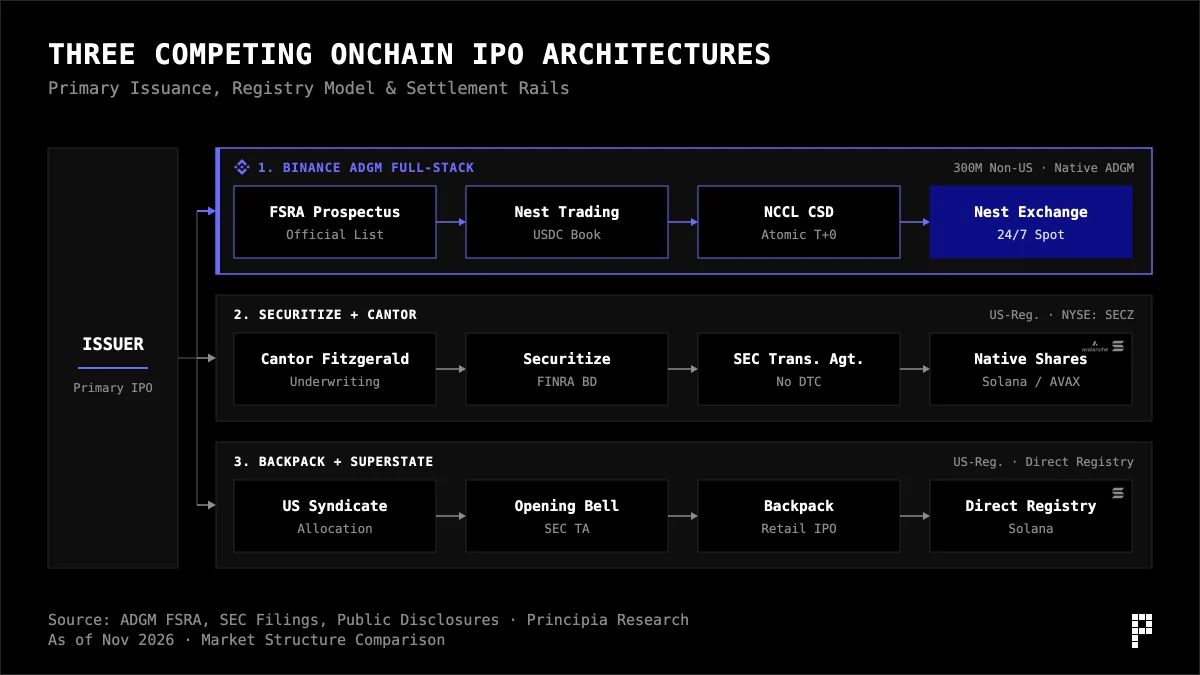
If one compares these three routes, many may fall into a misconception: thinking that Binance will compete with Wall Street for the lead underwriting rights of SpaceX or Anthropic (Ticker ANT), which is in a $74 billion fundraising sprint.
On the contrary, the real battleground that could fully unleash Binance’s ADGM on-chain IPO platform is not among the billion-dollar giants, but rather in the “mid-sized cash cow orphan band” with valuations below $3 billion.
A realistic calculation of the microstructure of the capital market reveals this:
“Structural Orphans” in Traditional Stock Markets vs. Institutional Dividends of ADGM
In today's NASDAQ or Hong Kong Stock Exchange, a high-quality company with an annual net profit of $3 million to $30 million and a valuation between $10 million to $800 million (be it overseas AI applications, cross-border payment fintech, game publishers, or cash flow-positive crypto infrastructure) faces a predicament:
- Pursuing U.S. stocks is too costly and often disregarded: Goldman Sachs and Morgan Stanley typically do not engage with IPOs below $1 billion; seeking smaller investment banks only incurs upfront legal, auditing, and compliance hard costs of $2 million to $3 million, in addition to a 7% underwriting fee that gets shaved off, and without Wall Street research coverage post-listing, institutions won’t buy. Maintaining compliance annually incurs an additional cost of $1.5 million;
- Going to Hong Kong or Singapore gets them relegated to “zombie stocks”: although the overall daily trading volume on the Hong Kong Stock Exchange peaks at $23.2 billion to $33.8 billion, the vast majority of trading is siphoned off by head-weighted stocks like Tencent and Alibaba, leading to valuations of mid-sized tech stocks being perpetually depressed to single-digit price-to-earnings ratios, often with daily trading volume plummeting to mere tens of thousands, entirely losing refinancing and shareholder exit capabilities.
However, if this company opts for an on-chain IPO in ADGM, the thresholds and costs would undergo a drastic reconstruction:
- Clear and moderate legal admission criteria: According to ADGM MKT Rule 2.3.15 (profit test), as long as the cumulative profit over the past three years is $1 million and consolidated profit over the past 12 months is $500,000 (even unprofitable tech companies can opt for the asset/market capitalization test under MKT 2.3.16: total market cap over $10 million, tangible net assets over $3 million, and preparatory operational capital over $1.5 million), they can legally cross the threshold for the official listing;
- Official regulatory fees are virtually zero: The total approval fee for the prospectus submitted to the ADGM regulatory authority ($20,000) plus the official listing entry fee ($3,000) amounts to only $23,000; even counting in international law firms, auditing, and market structure consultants, the total hard costs before ringing the bell are only a quarter to a third of U.S. stock costs.
New Wealth Effect
More subtly, it matches the scale. According to the tiered public shareholding rules of ADGM MKT Rule 2.3.10:
- For issuers with market capitalization below $500 million, the statutory public float must be ≥ 20%;
- For issuers with market capitalization between $500 million to $1 billion, the statutory public float must be ≥ 15%.
This means that a mid-sized company with a valuation between $100 million to $800 million conducting an ADGM on-chain IPO would have its first-day public fundraising and free float perfectly positioned between $2 million to $12 million USDC. For traditional stock markets, this may be a micro-cap stock that garners no attention; but for Binance, which boasts 300 million registered users and a 30-day average total trading volume of $40.4 billion, this initial circulating market value of $2 million to $12 million is a “golden sweet spot” that can easily generate multiple times over-subscription, won't drain on-site liquidity, and can achieve an extremely high 24/7 turnover rate.
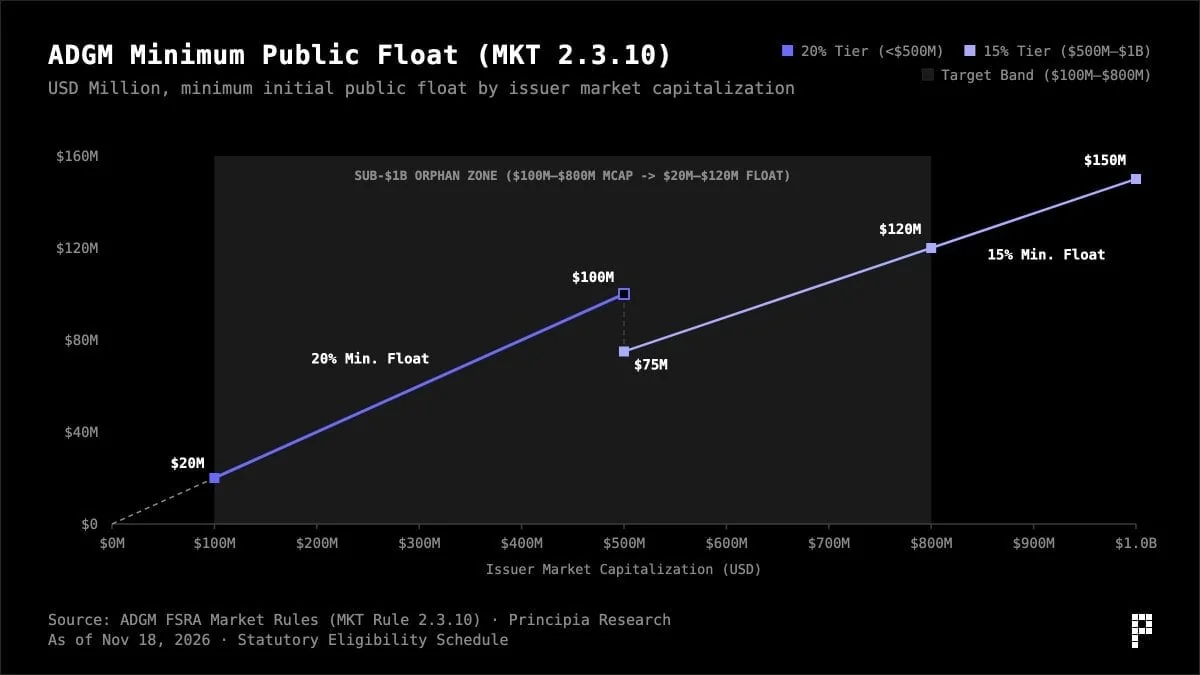
From “pseudo liquidity” to “true public holding” paradigm shift: for practitioners accustomed to Web3 token issuance, on-chain IPOs will bring a complete reshaping of rules. In past token offerings, project parties typically stuffed “tokens lent to market makers + team/ecosystem incentive pools + unallocated foundation shares” into initial circulation to meet numbers; but under the ADGM MKT Rule 2.3.10(3) securities regulations, share holdings by directors and related parties, employee stock option plans (ESOP) trust pools, shareholders owning over 5%, and non-acquisition market-making borrowed shares are expressly excluded from “public shares.” Only shares subscribed for by external unrelated investors (or unallocated shares by independent small shareholders before listing) count, thereby fully ending the crypto market's persistent issues of “high FDV, fake liquidity, and soft departures.”
Will Binance One Day Have Its Own Seat at the Table?
Amid Binance's major moves in Abu Dhabi, there’s another layer of imaginative speculation within the industry: aside from acting as an on-chain IPO underwriting platform for others, could Binance itself (or its Abu Dhabi segment) conduct a native on-chain IPO in ADGM?
Objectively speaking, co-CEO Richard Teng has publicly stated multiple times between 2025 and 2026 that Binance has ample cash flow and no immediate plans for a fundraising IPO. Reviewing the underlying equity structure disclosed in BTech Holdings' prospectus, the Irish parent company Binance Holdings (IE) Limited is still controlled by founder Zhao Changpeng (CZ) as the major shareholder and ultimate beneficial owner (UBO). The Group may face significant short-term challenges in directly issuing common stock, whether concerning global consolidated financial reporting sensitivities or historical compliance burdens.
However, “the Group as a whole may not go public” does not hinder “licensed segments from trial separation.”
Don't forget two ongoing changes: first, the $2 billion sovereign shareholder MGX, entering in 2025, naturally possesses institutional demands for mid- to long-term valuation benchmarks and capitalized exits; second, in July 2026, U.S. tokenization giant Securitize simultaneously listed on the New York Stock Exchange (NYSE: SECZ) while also issuing its native stock on the Solana and Avalanche public chains, demonstrating the feasibility of on-chain public equity to the world.
In contrast, looking at Binance’s four entities in ADGM (the Nest trading clearing system and bStocks business segment), they have been operating independently and compliantly under strict auditing by FSRA since January 2026, having shed historical offshore burdens, and currently command real trading cash flows of over $100 billion annually. If one day in the future Binance chooses to package a certain regulated financial business or joint venture segment in Abu Dhabi and initiate a dual listing of a native On-chain IPO on both the Abu Dhabi Securities Exchange (ADX) and its own Nest Exchange, it would be a natural and strategic move to account for its sovereign shareholders as well as to establish its reputation in the on-chain capital market.
The Birth of a New Species Often Accompanies the Rise of a New Ecosystem
Looking back over the past decade, the crypto capital market has swung back and forth on a volatile pendulum: from the unregulated chaos of ICOs in 2017, toward the distorting “overvalued VC coins” from 2021 to 2025, and ultimately converging in 2026 at the intersection of “real enterprise cash flows + statutory securities prospectuses + 24/7 stablecoin on-chain settlement.”
With this infrastructure of “exchange + central custody + stablecoin broker + modular prospectus” laid down by Binance in ADGM, it essentially opens a third public capital formation channel (on-chain capital markets) for global growth enterprises, beyond Wall Street and the Hong Kong Stock Exchange.
And in this emerging industry chain, opportunities extend far beyond the exchanges themselves. After all, when the bell of the securities exchange first tolls on a 24/7 blockchain ledger, all pricing languages, underwriting paradigms, and liquidity rules will be rewritten, and a new wealth effect may quietly arise. Binance's next goal is to serve 3 billion people, which represents a brave attempt that could reshape existing financial rules for humanity.
免责声明:本文章仅代表作者个人观点,不代表本平台的立场和观点。本文章仅供信息分享,不构成对任何人的任何投资建议。用户与作者之间的任何争议,与本平台无关。如网页中刊载的文章或图片涉及侵权,请提供相关的权利证明和身份证明发送邮件到[email protected],本平台相关工作人员将会进行核查。