Author: imToken

On November 19, 2026, Anthropic officially landed on NASDAQ with an issuance price of $83 per share. This highly anticipated AI giant IPO has not only been the focus of traditional capital markets but has also become a real pressure test for the Crypto market.
Even before the listing, the price of Anthropic Pre-IPO contracts on OKX once surged to about 103 USDC, representing a premium of about 24% over the issuance price. After the official listing, several cryptocurrency trading platforms quickly followed suit, launching corresponding tokenized stock products that allowed on-chain users to directly access the hottest targets in the traditional capital market.
This is also an interesting microcosm. Since 2025, a competition surrounding RWA infrastructure has unfolded from traditional exchanges in the US to crypto trading platforms and various financial regulatory agencies.
Does RWA bring incremental funds or a reallocation of existing funds?
In the past, RWA has been more viewed as a bridge connecting traditional finance and Crypto.
From U.S. Treasury bonds, money market funds, to gold, private credit, and now publicly listed stocks and unlisted company equity, an increasing number of traditional assets are starting to enter the on-chain world in tokenized form (extended reading: "Crypto moves towards 'external circulation,' why is RWA the 'historic shuttle' of Web3?").
The case of Anthropic is highly representative. Within the traditional system, investors participating in a company's IPO usually need to go through multiple barriers such as brokerage accounts, investor qualification reviews, and subscription allocations, while the Pre-IPO and tokenized stocks on crypto platforms allow users to directly participate in trading with stablecoins, saving the need for funds preparedness in traditional securities accounts; some products even support round-the-clock trading.
It can be said that in the past year, tokenized stocks have visibly grown into a considerable market.
According to CoinGecko's November 2026 report, as of October 21, the total market capitalization of tokenized stocks has increased from $1.25 billion in July to $2.71 billion, with an average daily trading volume reaching approximately $402 million, not including the scale of derived perpetual contract trading.
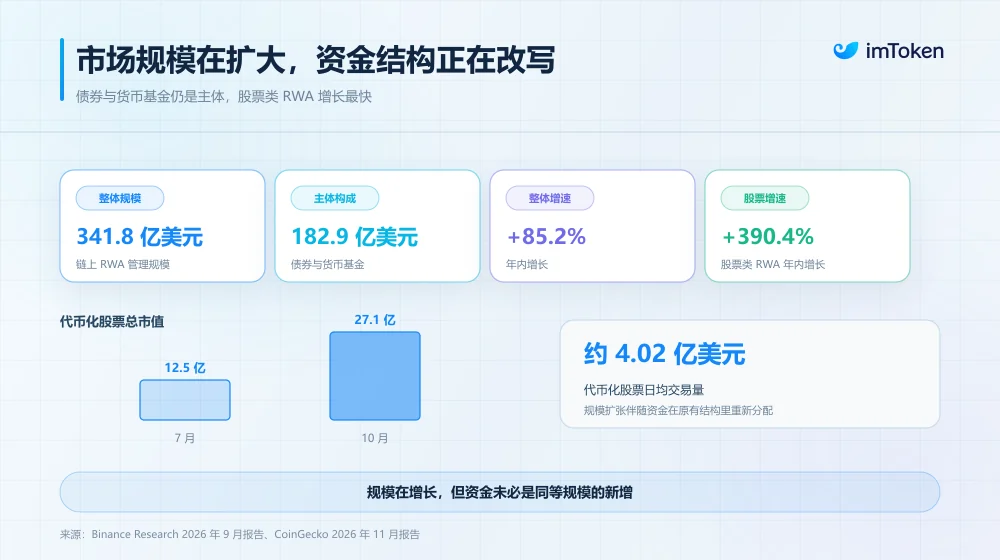
However, market expansion does not equate to Crypto acquiring a new influx of funds of the same scale.
These types of assets indeed provide new allocation exits for idle funds on-chain and might have the opportunity to attract some investors used to traditional brokerage systems into crypto platforms; on the other hand, funds may also flow out from the existing DeFi lending, liquidity mining, and native crypto asset trading, shifting to tokenized government bonds, money market funds, and stock products.
In other words, the RWA phenomenon brings not only incremental expansion but also a reallocation of existing fund structures.
According to statistics from Binance Research, the current capital activation rate of on-chain RWA is still limited. After a large number of assets have been tokenized, they mainly remain in holding and trading stages, not fully entering more complex financial applications like lending, collateral, and portfolio investments.
This also means that the next stage for RWA is to truly solve how to ensure these assets continuously flow on-chain and generate more financial activities.
If the demand for RWA mainly comes from existing crypto market participants, its growth may reflect more a reallocation of existing funds. The ability to continuously attract external capital and expand on-chain financial applications will be an important dimension to measure the long-term value of RWA.
Infrastructure competition from asset issuance to trading settlement
If early RWA projects focused on "how to bring assets on-chain," the current competition has shifted to who can master the core hubs of issuance, rights confirmation, trading, clearing, and fund settlement.
For this reason, traditional financial giants, crypto exchanges, and retail brokerages have all entered the field, rapidly differentiating into three clear paths.
NYSE and ICE: "Native" traditional securities markets brought on-chain
In January 2026, the parent company of the NYSE, Intercontinental Exchange (ICE), announced the development of a tokenized securities trading platform, planning to support 24-hour trading of U.S. listed stocks and ETFs, fractional shares trading, and instant settlement, allowing stablecoins for fund settlement.
The core idea is to combine the NYSE's existing Pillar matching engine with post-trade processing, settlement, and custody systems on the blockchain, while supporting "tokenized stocks interchangeable with traditional stocks" and "natively issued digital securities," which are fundamentally different from common price-tracking tokens, allowing holders to continue enjoying real stock dividends and corporate governance rights.
On November 2, the NYSE further announced the list of transfer agent partners, including Securitize, tZERO, Superstate, as well as traditional giants like Broadridge, Computershare, and Equiniti, which indicates that TradFi institutions are connecting their existing issuer relationships, shareholder registration, and securities service systems with blockchain infrastructure.
OKX and ICE: "Dual-track" extension of crypto trading platforms
In contrast to the NYSE's traditional-to-on-chain extension, OKX represents a two-way exploration of crypto platforms towards traditional securities entry.
One path is the compliant infrastructure route. In June 2026, OKX and ICE established a joint venture, OKXICE, and submitted a trading venue plan to the SEC in October, while OKXICE officially launched its tokenized securities trading venue on November 23, 2026.
The other path focuses on product distribution for existing crypto users. The Unified Tokenized Stocks launched in November integrates similar stocks from different issuers under the xStocks framework into a unified order book and corporate action processing rules, supporting 24-hour trading with USDT and withdrawal to Solana and X Layer networks; however, these products currently do not grant actual ownership or voting rights in the underlying companies and primarily provide price exposure.
Robinhood: Brokerage entry, integrating on-chain finance downwards
As a securities broker with a large retail base, Robinhood chose a more frontend entry-focused strategy.
In July 2026, it launched a next-generation Stock Tokens through its Jersey subsidiary, essentially tokenized debt securities backed by issuers buying and holding corresponding underlying securities as collateral; holders also do not receive legal ownership or shareholder rights in the underlying stocks.
Combined with the ongoing development of Robinhood Wallet and on-chain infrastructure, Robinhood's strength lies not in reinventing the wheel but in packaging its existing securities business, user distribution capabilities, and on-chain financial services into a unified entry, especially since it already has a large stock investor community and a mature financial services system.
In summary, each of the three paths has its own objectives: traditional exchanges aim for control over issuance, registration, and clearing; crypto platforms attempt to bring stablecoins, global traffic, and 24/7 trading into traditional assets; fintech brokerages intend to integrate brokerage, wallets, and on-chain entry.
However, the increase in market participants does not mean that the market will automatically produce unified liquidity; on the contrary, the stocks of the same company may now exist simultaneously on multiple issuance platforms, different public chains, and trading venues, with each issuing entity, legal structure, custody arrangement, and redemption mechanism being incompatible, which is a long-term issue that needs to be addressed.
Regulatory boundaries: RWA development cannot bypass the basic rules of financial markets
The development of RWA involves not only technology and business models but also securities issuance, asset confirmation, investor protection, and cross-border capital flows.
From the current regulatory dynamics, different regions are exploring different institutional paths, but a basic principle is becoming clearer: asset tokenization does not automatically change the legal attributes of the underlying assets. As long as a Token essentially corresponds to securities rights, it must return to the constraints of corresponding financial rules.
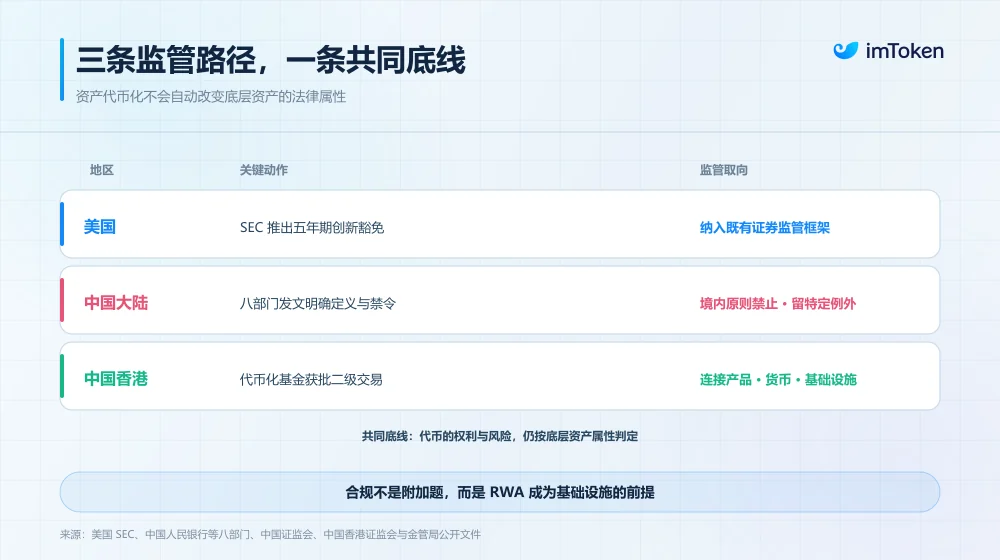
Changes in U.S. regulation are worth noting.
On September 17, 2026, the U.S. SEC issued a temporary, conditional exemption mechanism for tokenized securities trading venues called the Innovation Exemption, allowing qualified Tokenized Securities Venues to trade some U.S. listed stocks as market makers and liquidity pools under specific conditions without having to register as exchanges in the traditional manner.
However, the exemption does not imply a loosening of all regulatory requirements; the SEC has imposed several restrictions, including limitations on the types and trading scales of tokenized stocks; holders must enjoy the same rights as traditional stocks of the same category; for third-party tokenized stocks, notification and the opportunity to raise objections to the underlying securities issuer must be provided; smart contracts must be publicly auditable; and so on.
This, in fact, reflects that U.S. regulatory agencies are attempting to incorporate blockchain trading into the existing securities market regulatory framework.
In contrast, the regulatory stance in mainland China is more cautious. On February 6, 2026, the central bank, the National Development and Reform Commission, the China Securities Regulatory Commission, and other eight departments jointly issued a notice titled "Further Preventing and Dealing with Risks Related to Virtual Currencies" (Yin Fa [2026] No. 42), which first clearly defined the tokenization of real-world assets and reiterated that conducting RWA tokenization activities and related intermediary, technical services within the country is considered illegal financial activity and should be prohibited, with exceptions only for businesses "relying on specific financial infrastructure as approved by the competent authority in accordance with the law and regulations."
On the same day, the China Securities Regulatory Commission issued supplementary regulations on the "Regulatory Guidelines for Issuing Asset-Backed Securities Tokens for Domestic Assets Overseas," establishing clear filing thresholds: any issuance of relevant tokens overseas backed by cash flows from domestic assets must be filed with the CSRC, with complete materials submitted, and strict adherence to cross-border investment, foreign exchange management, and network data security regulations; activities must not be conducted without approval, filing, or safety review.
Meanwhile, Hong Kong is accelerating the transition of tokenized finance from pilot schemes to real business flows under an independent financial regulatory framework. On October 26, 2026, the Hong Kong Securities and Futures Commission approved the first two tokenized money market funds to conduct 24/7 secondary market trading on licensed virtual asset trading platforms; on November 2, the Hong Kong Monetary Authority announced that Project Ensemble has entered a new phase, supporting interbank 24/7 settlements of tokenized central bank currencies for tokenized deposits, with participating banks increasing to 12 and industry institutions reaching 20.
As emphasized by the Hong Kong Monetary Authority and the Securities and Futures Commission at a joint event in November, the Hong Kong tokenized market is transitioning from the experimental phase to commercialization, and the next focus is on generating real business flows between tokenized investment products, digital currencies, and financial infrastructures.
In conclusion
Looking back at the development of RWA, a noticeable change can be observed.
In the early stages, the industry focused more on how to map real assets onto the blockchain, enabling government bonds, gold, real estate, and stocks to exist in the form of Tokens; thereafter, the market began to explore how to achieve asset trading through stablecoins, complete yield distribution using smart contracts, and how to integrate tokenized assets into DeFi lending and collateral systems.
Now, with major players like the NYSE, ICE, OKX, and Robinhood making their moves, competition has officially entered the core areas of issuance, registration, custody, trading, and clearing within the financial market.
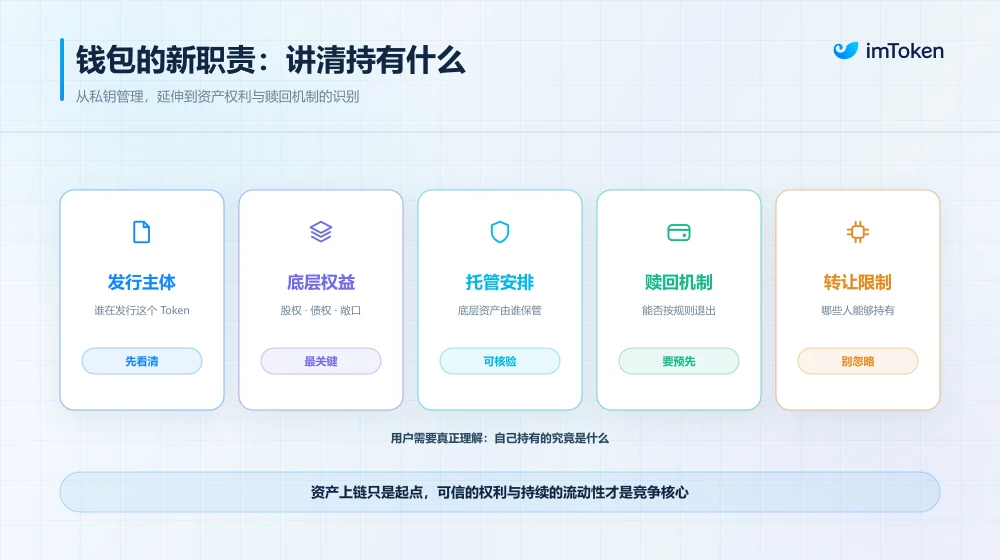
For wallets, this also means that their future responsibilities may no longer be limited to managing private keys and displaying on-chain assets.
As users begin to interact with tokenized stocks, funds, and other real-world assets through wallets, wallets need to help users identify asset issuers, underlying rights, custody arrangements, redemption mechanisms, and transfer restrictions, allowing users to truly understand what they actually hold.
In this sense, RWA not only brings more tradable assets to Crypto but also pushes the entire industry to rethink the relationship between wallets, payments, trading, and asset management.
免责声明:本文章仅代表作者个人观点,不代表本平台的立场和观点。本文章仅供信息分享,不构成对任何人的任何投资建议。用户与作者之间的任何争议,与本平台无关。如网页中刊载的文章或图片涉及侵权,请提供相关的权利证明和身份证明发送邮件到[email protected],本平台相关工作人员将会进行核查。