Author| Hualin Dance King
Editor| Jing Yu
In 2010, a small company called Instagram was acquired by Facebook for $1 billion. Many people at the time did not understand why so much money was spent on a filter app. The story that followed is well known—Facebook was not buying a product but purchasing a species that could threaten it, while conveniently turning it into its own weapon.
Mike Krieger, the co-founder who helped Instagram grow from zero to hundreds of millions of users. In May 2024, Mike joined the thriving Anthropic as Chief Product Officer.
On April 14, 2026, Krieger resigned from the Figma board. Three days later, Anthropic announced the release of Claude Design.
This timing does not seem like a coincidence.
01 In three days, the landscape of an industry changed
Figma's stock price fell by over 7% that day, dropping from $20.32 to $18.84. Market reactions are always more honest than press releases.
Claude Design is an experimental product powered by Anthropic's latest flagship model Opus 4.7, developed by the internal Anthropic Labs team. What can it do? Prototypes, slides, one-page summaries, and various visual content—these are precisely the tasks that designers and product managers engage with daily when using Figma or Canva.
However, if Claude Design is viewed merely as "another AI design tool," the significance of this matter is underestimated.
What truly alerted industry insiders is the "handoff" mechanism between Claude Design and Claude Code.
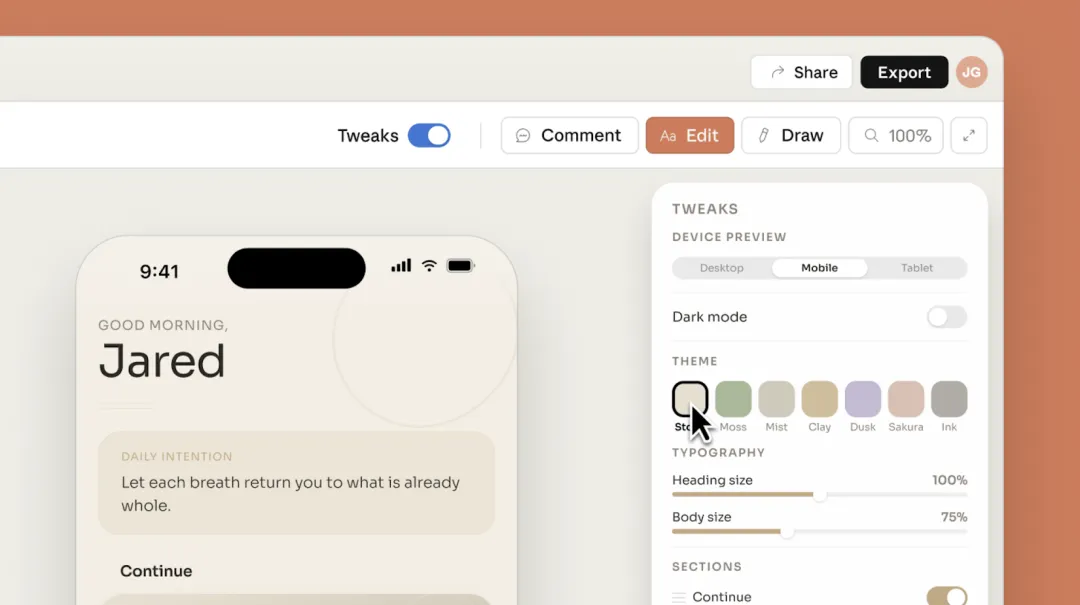
Claude Design page|Image source: Anthropic
When you complete a user interface prototype with Claude Design, the system automatically packages the complete design specifications into a "handoff package," which can be directly transferred to Claude Code for further development.
More importantly, Claude Design reads your codebase and existing design files upon activation, automatically constructing a design system tailored to your team—fonts, colors, layout standards, brand governance rules—all read in one go and applied throughout.
A developer commented on Reddit that this resolves the "most annoying part" of using AI for design tools—having to repeatedly explain your brand guidelines to AI for each new project.
Designing and developing used to involve two tools, two processes, and two groups of people. Now Anthropic wants to turn this chain into a closed loop.
02 Clear strategic rhythm
If you place Claude Design within the recent timeline, you will see a rapidly accelerating Anthropic.
At the beginning of April, Anthropic announced a restricted release of Claude Mythos Preview. This model can discover and exploit vulnerabilities hidden within key software systems for decades, with security risks so high that the company decided not to make it public—opting instead to provide access in the form of "Project Glasswing" to over 50 top institutions including Amazon, Apple, Microsoft, Google, and JPMorgan Chase, each with an attached usage allowance of $100 million specifically for defensive cybersecurity research.
On April 14, Opus 4.7 was officially released, introducing stronger coding capabilities, clearer visual understanding, and a new "self-checking" ability. Anthropic itself acknowledged that Opus 4.7’s performance is not as good as Mythos—but Mythos has not been publicly released due to security considerations.
On April 17, CEO Dario Amodei met with White House officials to discuss the cybersecurity concerns raised by the Mythos model. On the same day, Claude Design was released.
Also on April 17, foreign media reported that Anthropic's valuation had reached $800 billion, and it was in preliminary discussions about an early IPO with Goldman Sachs, JPMorgan Chase, and Morgan Stanley, with the potential for it to go public as soon as this October.
This is no longer the action of a "model-selling company." This is the move of a company preparing for an IPO, needing to clarify to the capital market "why we are worth this price," systematically filling out its product matrix.
From disrupting the developer tools market with Claude Code to integrating Claude Design into the design workflow, Anthropic's logic is very clear: identify tool scenarios that specialized populations use frequently each day, redo them in a native AI manner, and then use "model capabilities" as a moat, making it difficult for competitors to catch up.
03 Challenging Figma, but also facing reality
However, there is often a gap between the ideal closed loop and practical usage.
Some reviewers found that after actually using Claude Design, simply building a design system, creating a prototype website, and making a few adjustments consumed over 50% of the weekly quota. Exceeding the quota incurs additional token charges. For design scenarios that require frequent iterations, this cost pressure cannot be ignored.
There are also noticeable bugs at present, such as the design system preview sandbox failing to properly read image files, resulting in broken image links.
At this stage, Claude Design's positioning resembles an accelerator for internal demonstrations and rapid prototypes rather than a production-level design tool ready for delivery.
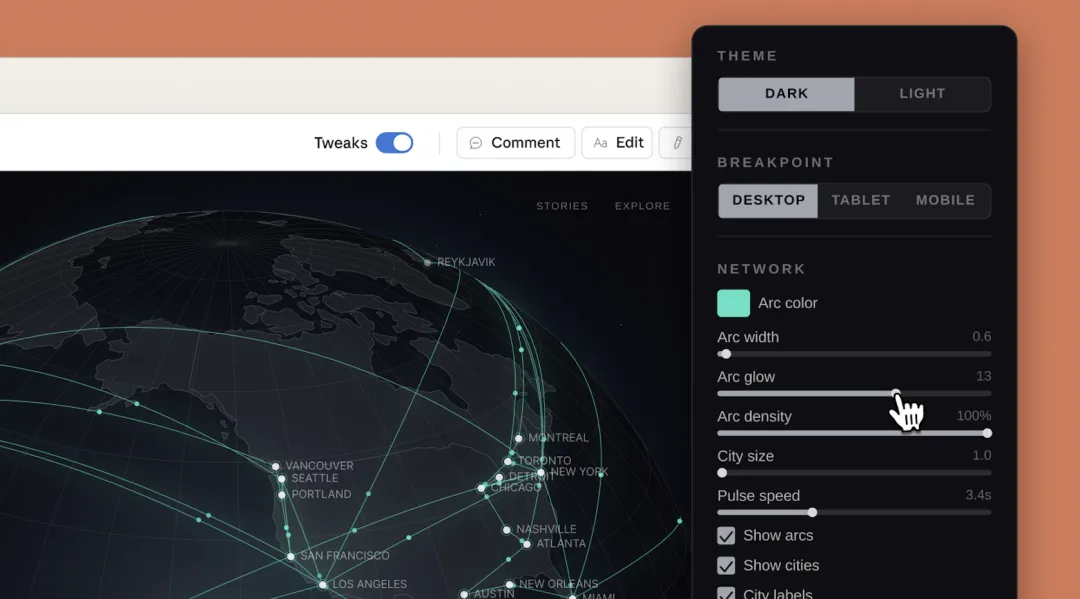
Claude Design page|Image source: Anthropic
This also means that Canva and Figma are not powerless. Figma has accumulated years of advantages in collaborative features, meticulous management of design systems, and the workflows of professional designers; Canva's strengths lie in its template ecosystem and usability for non-professional users. In the short term, production-level content still requires manual fine-tuning.
But "short term" is becoming increasingly brief in the AI field.
Anthropic's true ambition this time may not be to directly replace Figma—but to redefine "who Figma's target users are." When an independent developer, a small team product manager, or an entrepreneur needing to quickly create a demo can use Claude Design to build a "usable" prototype in minutes and then seamlessly hand it over to Claude Code for implementation, do they still need to spend time learning Figma?
This is the real reason for Figma's 7% stock drop.
04 From selling shovels to mining
There is a long-standing analogy in Silicon Valley that says in the gold rush, the most profitable are not the gold diggers, but the shovel sellers. In the early wave of AI, OpenAI and Anthropic played the role of "shovel sellers"—providing APIs for developers and enterprises to build applications.
But now, Anthropic has started to mine itself.
Claude Code and Claude Design are two shovels, also two entry points that occupy user time. When Anthropic directly makes developer and design tools, its relationship with companies that previously built products based on its API shifts from "partners" to "competitors."
This path has been taken by Microsoft, Google, and Apple most thoroughly. The difference is that those companies have platforms first and applications later, whereas Anthropic builds trust through model capability first, then expands upstream into the application layer with that trust.
Mike Krieger turned Instagram into a platform, and later watched Facebook use that platform to suppress competitors. Two years ago, he joined Anthropic to start making products.
History does not repeat itself simply, but sometimes, participants do.
Anthropic's IPO could potentially be finalized as soon as this October. Before that, it is likely to "release" a few more times, allowing the capital market to clearly see what this company truly wants to become.
免责声明:本文章仅代表作者个人观点,不代表本平台的立场和观点。本文章仅供信息分享,不构成对任何人的任何投资建议。用户与作者之间的任何争议,与本平台无关。如网页中刊载的文章或图片涉及侵权,请提供相关的权利证明和身份证明发送邮件到support@aicoin.com,本平台相关工作人员将会进行核查。


