Author: Zhong Chudi
Introduction: Early on April 18, Pato Molina, the CTO of the Argentine startup Belo app, collapsed. On this day, the Claude accounts of over 60 employees in their company were collectively suspended.
Belo app, founded in 2020, is one of the first companies in Argentina to launch physical cards supporting cryptocurrency exchanges. The team’s daily development, code generation, and process automation relied almost entirely on Claude, which they treated as a core productivity tool long ago.
Suddenly, the workflow of over 60 people was abruptly severed: all integrations, custom skills, and chat histories were either completely lost or stuck in indefinite suspension. For a startup that needs rapid iteration, this was almost equivalent to hitting the pause button on the entire project.
All of this stemmed from Claude's new policy announced on April 15: the initiation of KYC verification. This is a financial-grade identity verification that requires users to hold government-issued physical documents and undergo real-time selfie checks.
Once the news broke, many vibe coding entrepreneurs panicked. In the AI era, many who were originally not good at coding had already treated Claude as their most handy tool. Without it, both product iteration speed and development efficiency would significantly drop. However, it strictly limited service areas, leaving many heavy users long hovering on the edge of bans, playing a cat-and-mouse game with the system all day.
This wave of panic quickly spread domestically. Many users were on edge, fearing their accounts would become the next “optimized” targets. Some didn’t even wait for the verification pop-up before being quietly suspended for other reasons. At the same time, a second-hand platform quickly launched “KYC proxy verification” services.
Every policy adjustment by Claude is like throwing a stone into the AI industry, creating waves upon waves on the surface of the water. For those involved, no matter how skilled the technology or rich the experience, it's hard to avoid being swept along, torn repeatedly between anxiety and dependence.
At 3 PM on April 15, when Lao Zhang saw the news that Claude required real-name verification, he nearly spilled his coffee on the keyboard.
Lao Zhang is from Shanxi and works in Beijing. At the same time, he is also “a Japanese person working in Taiwan.” This is the persona Lao Zhang created in front of Claude to avoid account suspension. To achieve this, he has kept his IP in Taiwan for years, used foreign credit cards, purchased Japanese area Apple recharge cards on Amazon Japan, and then subscribed to Claude through the Apple Store.
Creating a persona is an important strategy in Claude’s “account nurturing guide.” Lao Zhang’s script is rather simple.
To avoid being banned, netizens have built up symbols of political correctness higher and higher. On social platforms, a user shared her experience in “dealing with Claude.” She crafted herself as a girl from a low-income single-parent family, trapped in the China time zone, while also being a Muslim and a vegetarian, and struggling with gender identity disorder.
This is still far from enough. Maintaining a persona is a long-term battle. First, the IP must stay clean, and the account cannot be shared by multiple people; second, one must speak a foreign language. To avoid revealing any flaws, every few days Lao Zhang chats with Claude in Japanese. He has also developed a habit of suddenly asking, “Where am I now?” from time to time, testing whether the model has seen through him.
No matter how good the “acting,” under the platform's iron fist, it is merely paper-thin. After learning that a passport is needed for KYC verification, Lao Zhang lamented in his circle of friends: “The sky has fallen!”
Unable to provide a Japanese passport, he had no choice but to press pause on his plan to upgrade to Pro and began researching the specific groups targeted by this verification. He then opened a second-hand platform to search for “KYC proxy verification,” hoping to ride out the storm with the help of the AI gray market.
Lao Zhang is a copywriter who usually uses Claude to search for information and outline articles, practically using a sledgehammer to crack a nut. But at this moment, the whole internet is shrouded in the panic of an “account battle royale.” Even light users cannot avoid the surprises that come with such a situation.
The “proxy verification” trick is not reliable. Currently, there are numerous related selling pages on second-hand platforms, with prices varying from 80 to 180 yuan. The operating process is very simple: after purchasing the product, wait for the “proxy verifier” in applicable regions to come online, then send the certification link popped up by Claude to the seller.

Image|A second-hand platform shows numerous “proxy verification” product links
Most sellers only guarantee passing verification and do not take responsibility for whether problems will arise later due to IP or chat records. Lao Zhang asked three or four sellers in a row, and they were even more alert than him, repeatedly emphasizing, “No refunds for account bans.”
KYC sellers are not new. KYC is a commonly used verification method for cryptocurrency exchanges, and buying and selling KYC has long been a large and mature industry chain, with the price of a KYC account ranging from 10 to 50 yuan.
On social media, jokes about this business are flying everywhere. Some mockingly say, “Five dollars to find a local in Nigeria to take a verification photo, then sell it for a hundred dollars to an engineer at a big factory on Jiuchun Road in Beijing.” Others are even harsher: “Once Claude implements KYC, the biggest beneficiaries are the homeless on the streets of America.”

Image|Sellers emphasize, no responsibility for account bans
Amid the shouting above the water’s surface, the reality beneath it remains very calm.
At the same time, digital nomad Xiao Hai is at a hackathon competition. He was completely unaware when the KYC news flooded the group chat. After seeing the discussions later, he joked a bit and then put his phone down.
Xiao Hai is an AI project entrepreneur and a heavy user of Claude. He not only integrates AI into his workflow but has completely transformed his workflow with AI. Including the membership subscription fee of up to $200, his hard costs on Claude exceed 1500 yuan each month.
Spending money is just the foundation. To ensure stable usage, Xiao Hai has set up a dedicated technical pipeline. He and his friends even reverse-engineer Claude's source code to find out what data it collects, which parts may leak real identity, and minimize this data's output during subsequent use to reduce the risk of being banned.
Even so, Xiao Hai has been banned twice. The last time he was banned was in early March. After receiving the email, he posted a complaint on social media, which garnered eight hundred likes and became his best-performing post. There were over four hundred comments below the post, almost all complaining about Claude's “capriciousness.”

Image|Xiao Hai's post is filled with complaints
Unlike Lao Zhang's anxiety, being banned has instead motivated Xiao Hai to explore ways to hack the system. He believes that every time Claude intercepts, it will become a threshold for future users. He compares using Claude to being a turkey that eats happily while feed is available, without needing to waste energy guessing what the farmer is thinking. After all, Thanksgiving might come tomorrow.
During this KYC incident, nobody around Xiao Hai received the pop-up. Since all important data related to productivity is stored locally and only called through the interface with Claude, his Claude is in a zero state during every interaction. He does not genuinely care whether he will be banned; for him, being banned is like losing a hammer, and he can just buy another one when he goes out.
Big factory programmer Drake is in a different state. He is a heavy user of Claude and spent 5.6 billion tokens on Claude within two weeks. After the KYC news came out, he and his colleagues could still use it normally, so he judged that ordinary user accounts might not be within the scope targeted by Claude this time.
He believes the subscription model that Claude has always adopted is easy to be exploited by gray or black markets, and KYC can precisely solve this problem. Considering himself in a “safe position,” he felt not only no panic but even upgraded to the $200/month Max 20x membership package. However, the next day, when he switched his IP to log onto Claude, he received a ban email.
When the KYC news flooded the chat, architect Carson from Beijing received a ban email almost immediately. At that moment, his mind had only one thought: what was bound to come has finally arrived.
Carson has never followed the “account nurturing rules.” During his conversations with Claude, his IP roamed from Singapore all the way to Japan, and he suspects this is one of the reasons for his ban. Just two days before being banned, he had asked Claude to analyze the Claude code and relay models. To the platform, this behavior resembles technical distillation—this is also a mainstream guess on social media.
Fortunately, Carson has another account. After topping up with the $20 Pro subscription, he still does not plan to follow any usage rules and decides to go with the flow.
“The metaphysics of bans” is not without patterns. On social media, users have summarized several behaviors most likely to trigger risk control: repeatedly jumping IP addresses, using virtual credit cards of unknown origin, and logging into the same account from multiple devices within a short period.
Some have also figured out a set of “safety rules”: one device, one browser, one fixed IP, and try not to switch. Use international credit cards under one’s own name, ensuring that the billing address matches the IP location.
However, even strictly following this set of rules, some have still been mistakenly banned within the safety range. AI project entrepreneur Patrick Star is one of the few who actually received the KYC pop-up.
On April 15, upon seeing the news, Patrick Star found his account still in normal status. He refreshed the page several times, feeling somewhat puzzled: why hasn’t Claude banned me yet? In the evening, the verification page finally popped up. After receiving the pop-up, he felt as if the boot finally dropped from above his head, taking a long sigh of relief—it turned out, everything was as expected.
After being banned, he did not hesitate and directly switched to CodeX. For him, Claude is a more expensive and sharper knife; while other AIs may be duller, they are cheaper, and spending some time sharpening them won’t yield much lesser results.
As long as Claude's ban issue remains unresolved, he will no longer continue to use it.
Patrick Star is not the only one who has “run away.” After Drake was banned by Claude, he similarly switched to CodeX. In his view, CodeX's engineering capabilities are outstanding, and the key point is that CodeX does not impose bans.
Even Xiao Hai, who spends hundreds of dollars a month on Claude, has tools like GPT, Gemini, and CodeX always at hand. In this rapidly developing industry, most of these wave riders are result-oriented, using whoever works best. However, most of the time, that “whoever” points to Claude. Xiao Hai compares Claude to the purest “green poison”—once used, it is very hard to return to a world without it.
On the other side of the Atlantic, Pato Molina chose to defend his rights through a “hard confrontation.” On the morning of April 18, he angrily posted on platform X, tagging Claude’s official account, accusing the company of only receiving a template email from Anthropic's security team. The email stated that the system detected numerous signals of violations of the terms of use and, after manual review, directly revoked all permissions, with a complaint channel only being a Google form, which was appallingly poor.
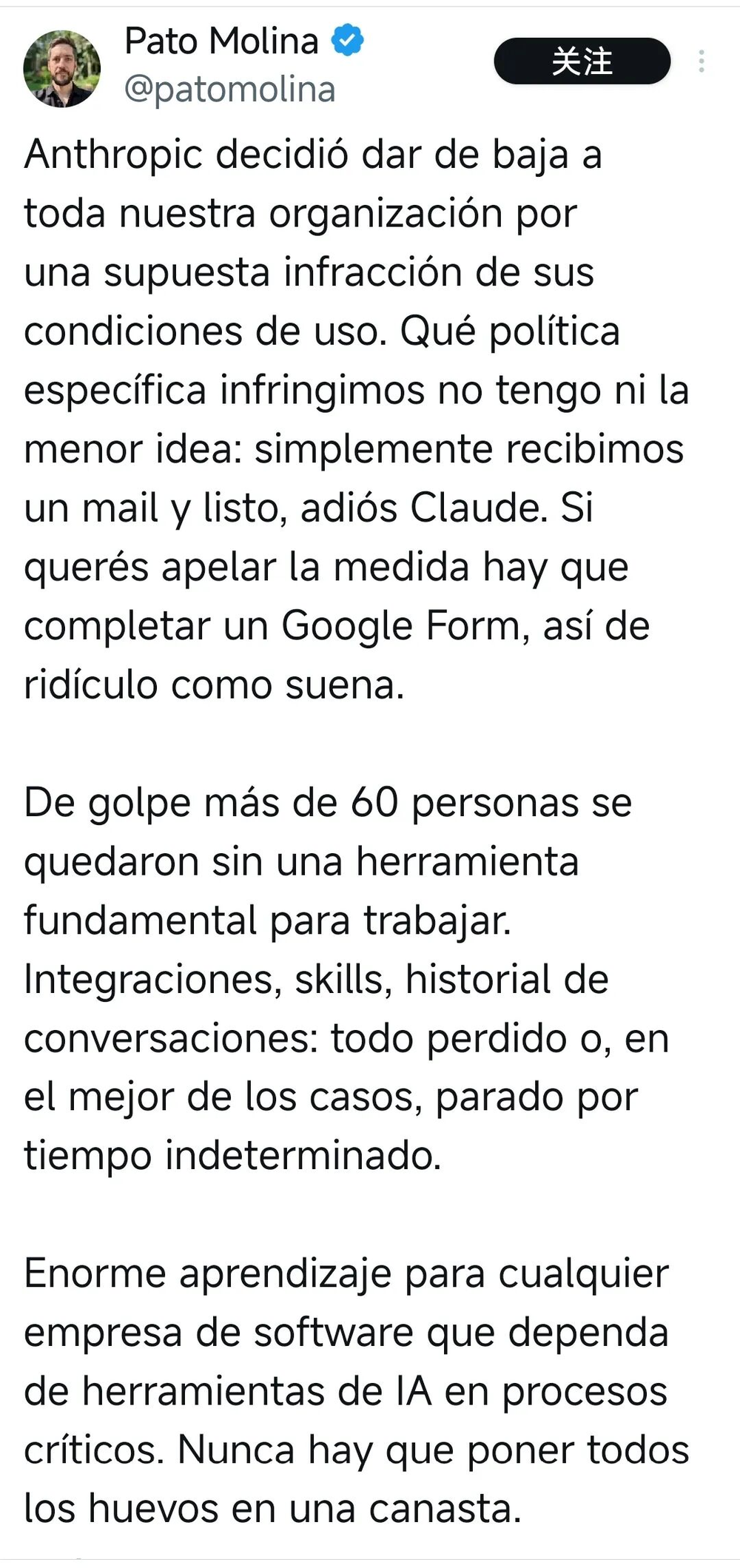
Image|Pato Molina posts to defend his rights
This scene felt familiar to many: accounts inexplicably banned, official responses dismissive, legitimate complaints going nowhere, and ultimately relying on public opinion to ferment to force the platform to compromise. Many previously thought this was a characteristic of domestic internet, only to find it now occurring in Anthropic as well.
Fortunately, Pato's post quickly gained traction, with views surpassing one million in a short time. A little over ten hours later, Anthropic restored all accounts and sent an apology email, explaining it was a “misjudgment.” But that brief stoppage was already enough to leave the vibe coding entrepreneurs feeling apprehensive.
Over 60 people lost their most essential work tools overnight, a bloody lesson for any software company deeply embedding AI into critical processes. Pato Molina lamented: “Never put all your eggs in one basket.”
For this group of practitioners in the AI industry, their relationship with Claude reflects more on the productivity level. From the moment of registration, Claude requires the use of foreign phone numbers; payment must be made with foreign credit cards, and account bans are common and completely unpredictable. Ordinary people hardly use Claude, while the real user base that can utilize it has long since stopped caring about these troubles. For them, this KYC is merely an added procedure and some material for jokes.
But for ordinary users like Lao Zhang, what keeps him addicted to “nurturing accounts” is not only Claude's powerful technical capabilities but also the anxiety of constantly hovering on the edge of being banned.
Lao Zhang's account is still alive to this day. He continues to maintain the persona of “a Japanese person in Taiwan,” chatting with Claude in Japanese about the weather every day, keeping his IP meticulously locked in Taiwan. On April 17, Claude Opus 4.7 officially launched, and Lao Zhang did not dare to pay. He posted a status in his circle of friends saying: “Just hanging in there for now.”
免责声明:本文章仅代表作者个人观点,不代表本平台的立场和观点。本文章仅供信息分享,不构成对任何人的任何投资建议。用户与作者之间的任何争议,与本平台无关。如网页中刊载的文章或图片涉及侵权,请提供相关的权利证明和身份证明发送邮件到support@aicoin.com,本平台相关工作人员将会进行核查。


