Author:Zuo Ye Web3
Reinventing DeFi, the Revival of AI Narrative
Looking back 500 years, the conflict between labor and capital in the capitalist system has always been marked by the continuous victory of capital.
On the production side, the involvement of labor has gradually shrunk to the level of operating machines; on the consumption side, user value lies in producing usage data for the platform.
Together, they support the valuation of companies in the capital market.
However, the organizational models of humans have long been difficult to quantify entirely; the white-collar KPI/OKR is still hierarchical, and a million-dollar salary and piecework wages are both variants of Taylorism.
Without a clear formula, capital cannot be valued, thus affecting capital efficiency. Whether algorithmic stablecoins are the holy grail of DeFi is still unknown; the computability of organization is indeed the measuring cup for financial leverage.
Large models decide to violently crack with Token volume, the collapse of secure SaaS is just a surface phenomenon. Designing products is also on the way; replacing niche professional capabilities and scaling them is the life-and-death issue, as innovation drives into uncharted territories.
This brings us endless insights, especially as the DAO model of DeFi gradually collapses and token economics faces bankruptcy.
In a word, why are AI organizational models and Token models more efficient than DeFi?
How did this all start?
Token devaluation, Agent practicality.
For 300% profit, capitalists can sell their own noose;
To keep their current job, workers can write Skills for Agents.
At the capital level, Agents equipped with Skills hold a sacred status equal to profit.
Agents represent “human capabilities” refined into Skills; moreover, human organization transforms into an interaction ritual chain centered on Agents.
What is called Prompt, Context to the present Harness engineering is transforming human organizational models into uncharted territory, at least reducing human involvement.
Your next colleague might not be a robot; it could also be “capability” instinct.
This is not a fantasy; the Scaling Law at the data level is gradually failing. However, data collection and production are no longer important. Before the success of AGI, new valuation targets are needed.
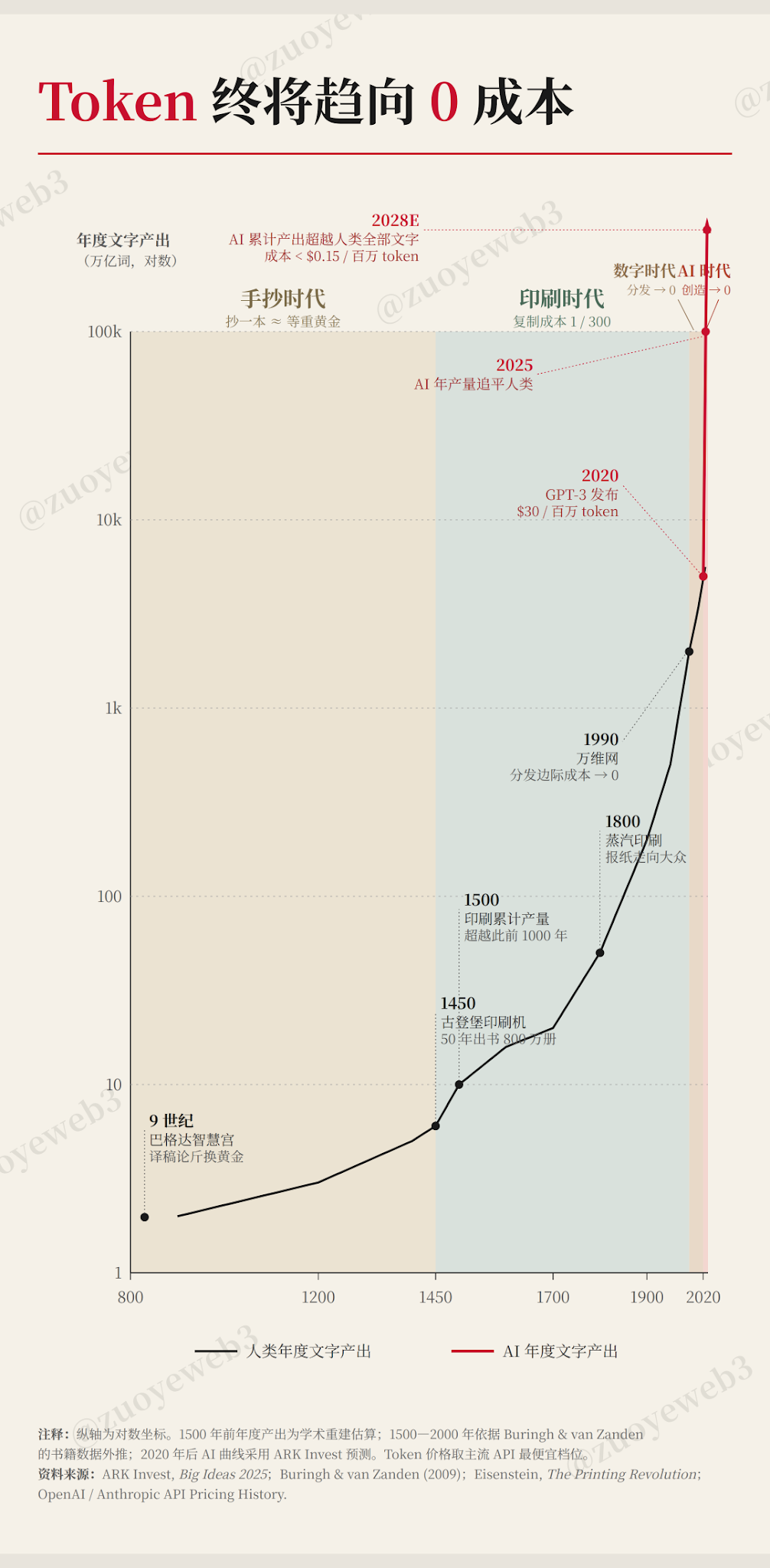
Image Description: Content is no longer valuable
Comprehensive information: @ARKInvest
From the moment Claude selected the programming field to realize AGI’s first step, AI transcends the entertainment mode of chat boxes, cutting into the real estate of the existing market such as programming, security, and the just-released design.
This disruptive innovation will ultimately create new economic increments or pull the economy into a permanently low-employment model where humans step down and Tokens take the stage. We are witnessing this process.
But the current devaluation of Tokens will decentralize the previously monopolized capabilities by a few large enterprises to small and micro enterprises, thus shaping super individuals, which is not a fantasy.
Taking China as an example, Token utilization has surged from 100 billion per day in 2024 to 100 trillion by the end of 2025, now reaching 140 trillion per day; the production of content and data is about to enter an era of zero cost.
It is important to note that the scarcity of computing power is a relative state. Large enterprises no longer monopolize "capabilities," but they still wish to maintain their existing advantages through monopolizing "computing power." However, they cannot stop the inevitable trend of overall Token devaluation.
The paradigms regarding large foundational models vary widely, but the evolutionary process of "how AI helps humans" has long been overlooked.
In my view, Harness presents a spatial form that allows Agents to focus on tasks within boundaries for a depth-first strategy, differing from breadth-first strategies used in Q&A types.
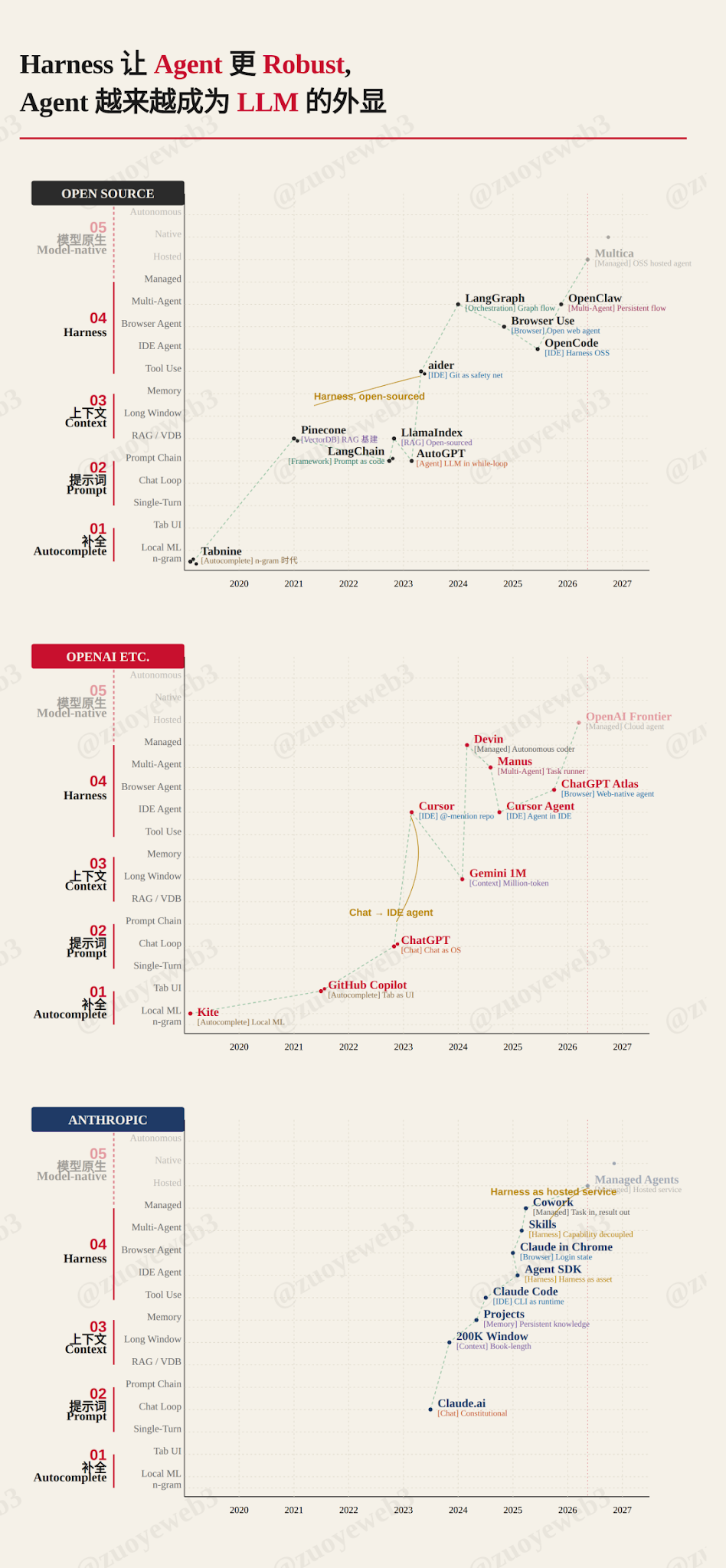
Image Description: Evolution of Agents
Image source: @zuoyeweb3
From the first time the Tab key was used to autocomplete code, it was only a matter of time before humans became the input layer of AI.
With the exponential reduction of the cost of trial and error, more interesting attempts can be made on human collaboration models:
- Software: SaaS, the source of human capabilities is no longer people, but emergent Agents
- Hardware: Computing cards + HBM, data centers serve AI needs directly for the first time
- Space: Harness, not a physical space for human collaboration, but a digital space for Agent interaction
- Interaction: Bean bag mobiles have perished; Google supports GUI Agents at the bottom layer of the Android system
AI’s capability of generating content holds little commercial value; the cost of generating text is low for humans. Yet what to "do" will cause Token consumption to surpass image and video generation, similar to how AWS sells not servers, but usage time.
AI sells not Tokens, but “work capabilities”; this is the root of the SaaS industry’s fear. Unfortunately, DeFi has become SaaS, rather than large models.
The SaaS Transformation of DeFi Protocols
DeFi is not outdated but overly premature.
AI is reimagining software engineering; it is not just SaaS being replaced, though SaaS is undoubtedly the most typical.
Even Bloomberg terminals' most crucial commercial value is not the advance of technology but the authority of information, which is built upon decades of industry connections, relationships, and other non-standard data.
Agents offer a choice to infer the future from data; even the next risky step, one can potentially outpace peers to earn little profits.
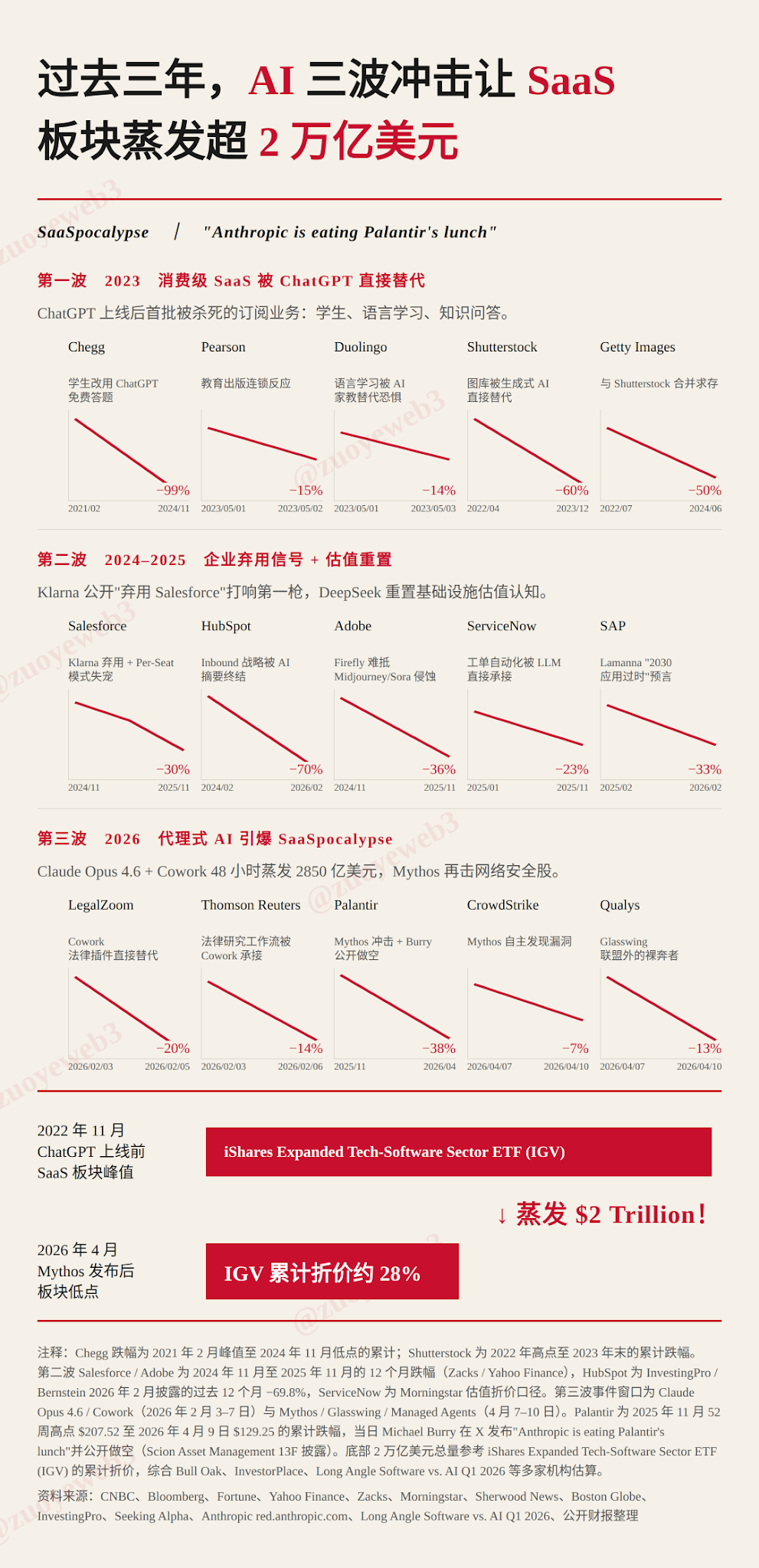
Image Description: SaaS in Collapse
Image source: @zuoyeweb3
You can interpret that Agents cleverly utilize the profit-seeking nature of capital; one can either wait for complete Bloomberg terminal information or use pieced-together, inaccurate data to bet for returns.
This is not a new concept; IBKR founder Thomas Peterffy was the first to "invent," or assemble physical trading terminals in the financial field, all starting from a idle P101.
If a method of leveraging data can earn more profits, then you can obtain more data, starting the flywheel.
SaaS monopolized the past; AI will dominate the future.
Unfortunately, we have to cut into DeFi from this point; remember the API paywalls of Dune/DeFiLlama? Holding onto premium data for survival, or the eventual shutdown of Arkham Exchange?
Data from the crypto industry has never been valuable.
However, the crypto industry is an openly accessible financial system; the data generated can be repeatedly learned from. Even before AI, the speed of fork projects had already dropped to monthly rates, while PumpFun’s imitational Memes have become compressible to a second.
There exists a contrarian inference: DeFi is the forerunner testing ground of the financial system; the AI + DeFi we attempt today may become the template for future financial evolution.
- For example, before the 2008 financial crisis, the unsecured trading LIBOR "triggered" the financial tsunami, subsequently replaced by the SOFR metric from US Treasury trading. However, the excess collateral mechanism guarantees the finality of DeFi's liquidation.
- For example, large model manufacturers don’t want to sell Tokens based on consumption; there must be tiered marketing, capability customization, and professional transformation, token economics have turned "use value" into a pretzel.
Crypto Tokens focus on use value, while AI Tokens focus on economic value.
From this perspective, the hacking incidents in DeFi are merely routine stress tests; open systems cannot self-repair external entropy that leads to Bugs.
Like the black humor of Catch-22, without external signal systems' stimulation, crypto defaults to the belief that the current environment is safe. Once a security crisis occurs, it collapses to a centralized processing system.
For instance, during the Drift incident, the target of public blame surprisingly turned out to be the sluggishly freezing Circle.
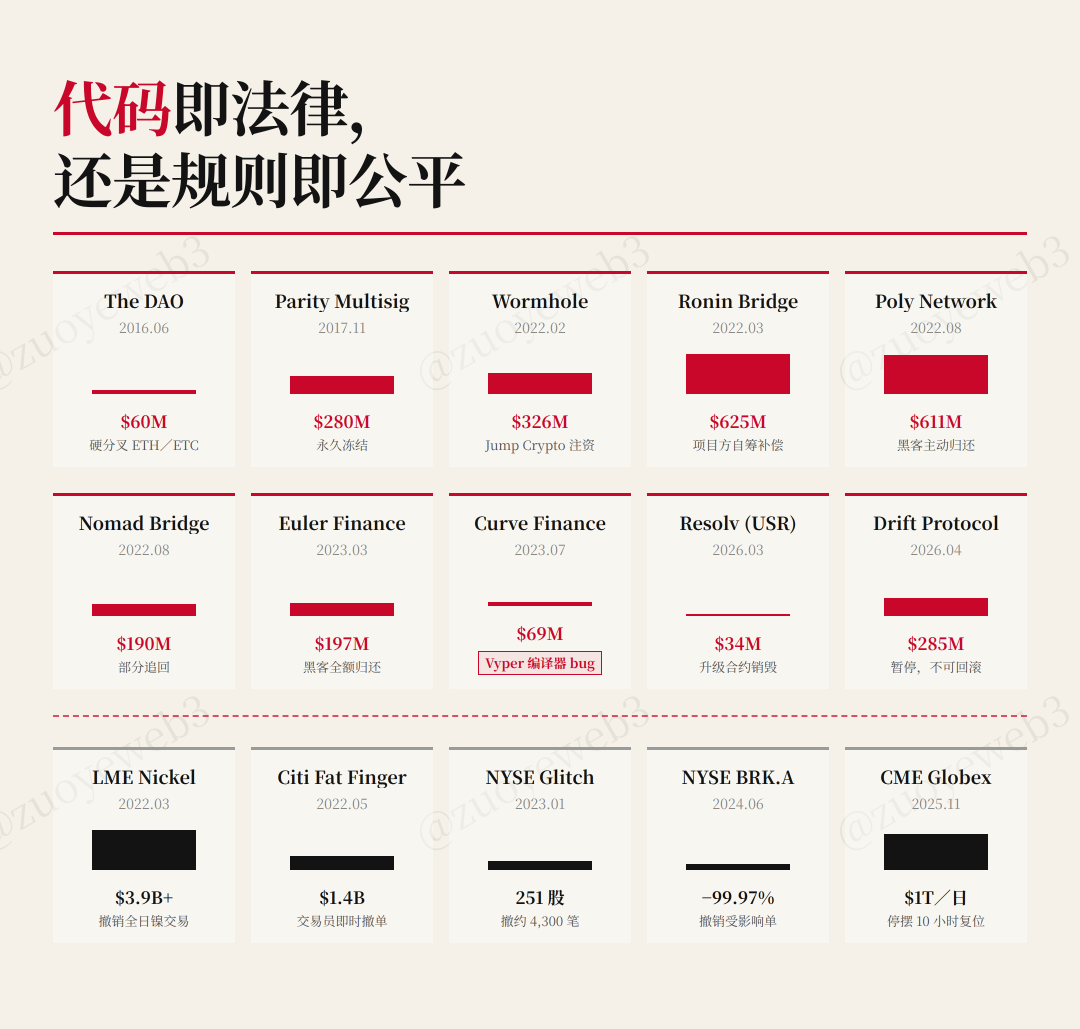
Image Description: Code Cannot Solve Security Problems
Image source: @zuoyeweb3
It can be said that, before the leap in AI capability, DeFi has already completed its SaaS transformation, only able to charge based on transaction frequency, unable to transplant “finance” directly onto the chain.
RWA on-chain lacks liquidity, and DeFi has no good solutions for this.
However, the evolution of Agent capabilities seems to bring a yet unclear glimmer to rewrite DeFi's rules.
- Token Economics: Spread consumption across channels, invest according to “capital efficiency”;
- Rule Setting: Mythos provides security finality; AI protects against zero-day crises;
- Human Organization: Great! DeFi has already been managed by just a few people handling billions.
The Revival of Engineering Narrative
Where does security come from? From the determinism of the Turing machine; where does danger come from? Infinite possibilities.
YC Garry Tan's concept of "Fat Skill, Thin Harness" resonates deeply with me; fundamentally, it means to set fundamental rules, a form of "freedom based on order."
The Turing machine can combine indefinitely; Von Neumann architecture has time delays in storage and computation, and large models cannot produce true random numbers.
In the future where data lacks value, only human behavior can create value from the flow of money.
Yet, human behavior still requires time to be thoroughly learned by AI and subsequently internalized into engineered and coded expressions.
Chasing the finite to catch the infinite is ultimately unattainable. LLMs cannot entirely eliminate hallucinations; they must approach the extent of “neither AI can reach, nor human power can achieve” for market mechanisms to price them effectively, allowing us to truly believe in smart contracts.
Currently, smart contracts can't claim success, as The DAO's fork, Curve’s programming language bug, even Drift's multi-signature evidence that "humans have final control over code" proves this.
Moral inquiries hold no economic value. The collaborative models in the DeFi field have collapsed from DAOs to foundations and "teams" ultimately due to real needs for contract upgrades and business cooperation.
Yet, humans simply cannot write code that is forever safe and can be dynamically upgraded. Please remember, it is forever impossible.
If never upgraded, then Curve's experience teaches us that the technology dependency stack will face problems too.
Now, past decisions will determine the future.
From the Simmons Medal Fund to Numerai running AI strategies, AI in finance is not rare; another contrarian case is that trading signals actually help AI evolve.
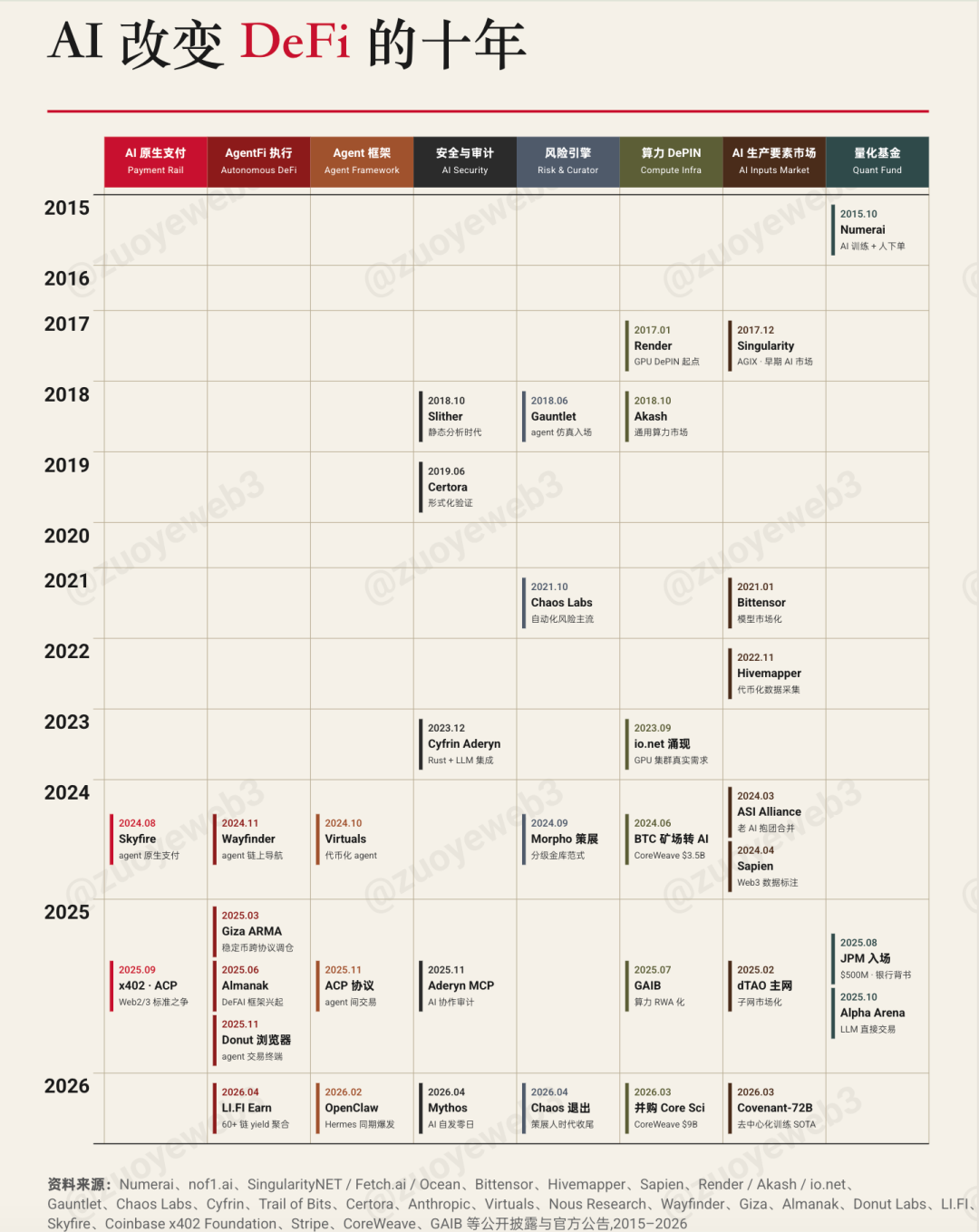
Image Description: AI and DeFi in 10 Years
Image source: @zuoyeweb3
AI models remain a computer paradigm, state machines that ingest signals; without external signals, they inherently lack the ability to simulate the outside world. Yang Lequn and Li Feifei bet on world models; that’s where their significance lies.
Yet, from the DeFi perspective, allowing AI to trade autonomously hinges on Agents learning behaviors through human intentions. This highlights the importance of humans to AI: even if Agents replace human labor, they still mimic and summarize human behaviors.
Indeed, humans cannot be intentionally random. Even slight intentionality exhibits statistical regularity, and human physiological characteristics possess random traits. For example, “I have a physiological preference for the market-making strategy of Ethena and disdain for strategy XX,” rather bears ambiguous preferences.
It is certain that making blockchain/DeFi the infrastructure for AI has faced dismal failures over the past decade; deAI/deAgent/deOpenclaw will encounter similar circumstances.
Directly using the latest large models to transform various structures of DeFi, for instance, contracts tested by Mythos defaulting to possess security, will detect any changes in real-time, thus raising the danger level.
In terms of human organization, the AI's choice is "no humans," only the "capabilities" of humans. DeFi is the most suitable industry for this, if not the only one. After the rule design, DeFi can only improve capital efficiency under secure conditions. Referring to autonomous driving levels L1/2/3/4, it will inevitably go through stages of information authorization –> limited fund usage rights –> full fund usage rights.
If Agents continuously learn the engineering capabilities of traders and management abilities of Curators, they are bound to surpass humans in trading and profitability. But unfortunately, the accumulated DeFi data has yet to be systematized for AI learning and training; the current crypto circle AI is still in the stage of raising funds.
However, I firmly believe that the practical usage of funds will be the main wave of AI transforming DeFi in the next stage, inevitable.
So, after security (contracts) and organization (humans) have been upgraded, what form will token economics take?
- In the PoW era, Tokens serve as certificates of computational consumption, consistent with current AI Tokens;
- In the PoS era, Tokens are certificates of expected profit discounts; AI Tokens are evolving towards this direction (providing capabilities that replace humans is the economic value expressed by AI);
- In the AI era, Crypto Tokens have surpassed our engineering scope, relying solely on theory for irresponsible predictions.
Referencing Sky controlling APY across various channels with token distribution, and Claude pricing model capabilities based on Token consumption, future Crypto Tokens will likely fall into a type of "capital return rate" certificate.
Here, it is important to differentiate. For PoS era Tokens, like $ETH, their expected returns are an economic hypothesis, a form of reasoning based on prior experience. However, the engineering design of AI will bring the parameters of DeFi infinitely closer to reality, making their return rates and risk rates highly credible and validated in real-time.
Furthermore, users can determine the current price of Tokens based on the large models and Agents used in DeFi protocols, as well as the scores of optimization metrics with Harness; to buy when optimistic and to sell when pessimistic.
Conclusion
Countless unspeakable troubles and humanity’s unpredictable future.
The future of DeFi splits into economic and technical aspects; token economics currently lacks good solutions, but safety shows a glimmer of hope. Claude Mythos can threaten the world; conversely, if so, it can also manage money properly.
AlphaGo fundamentally resolved the Go problem, and Claude fundamentally resolves programming issues; such scenarios will only multiply in the future. Contracts in DeFi, human organization, and even the units of economic valuation all have theoretical optimization space.
At least, one need not worry about being completely replaced. In an era when data is worthless, behavior holds its own significance. At least for now, the takeover of humans by Agents remains in details like “micro-tasks,” “micro-payments,” and so forth—details that continually repeat. We must create value from this repetitive, replicated behavior. AI causes the value of data and content to decrease indefinitely, approaching zero cost, while the unit economic value (cost) of AI Tokens and Crypto Tokens continues to decline, this is an unstoppable trend.
It can even be said that this is the first time money has truly opened its doors to individuals, whether used for AI work or Crypto for consumption.
免责声明:本文章仅代表作者个人观点,不代表本平台的立场和观点。本文章仅供信息分享,不构成对任何人的任何投资建议。用户与作者之间的任何争议,与本平台无关。如网页中刊载的文章或图片涉及侵权,请提供相关的权利证明和身份证明发送邮件到support@aicoin.com,本平台相关工作人员将会进行核查。


