Author: Zhou, ChainCatcher
Recently, the name Abraxas Capital has frequently appeared in the public eye.
On November 16, the perpetual DEX Lighter suspended withdrawals due to the leak of a trader's API key, and on-chain analysts quickly pointed to Abraxas as the victim's account.
According to on-chain analyst MLM's monitoring, Abraxas liquidated all its contract positions on Hyperliquid this week and withdrew the remaining funds, ending a 21-month trading period here with an approximate profit of 530 million USD.
Abraxas rarely makes public statements, and the outside world’s understanding of it mostly relies on labels assigned to its address by on-chain data platforms. What kind of institution is this, how does it make money, and where is its money kept?
1. Old London Fund, Largest Investor is Tether
According to official website information, Abraxas Capital Management was established in London in 2002, initially focusing on traditional markets, and entered the digital assets field in 2017. Co-founder Fabio Frontini serves as the fund manager of the flagship fund, while another co-founder, Luca Celati, serves as the Chief Risk Officer.
As disclosed by The Hedge Fund Journal, Abraxas currently manages approximately 4 billion USD in assets, making it the largest digital currency hedge fund manager that can be found in various databases. It is regulated in the UK, Malta, and Monaco, with over 300 investors.
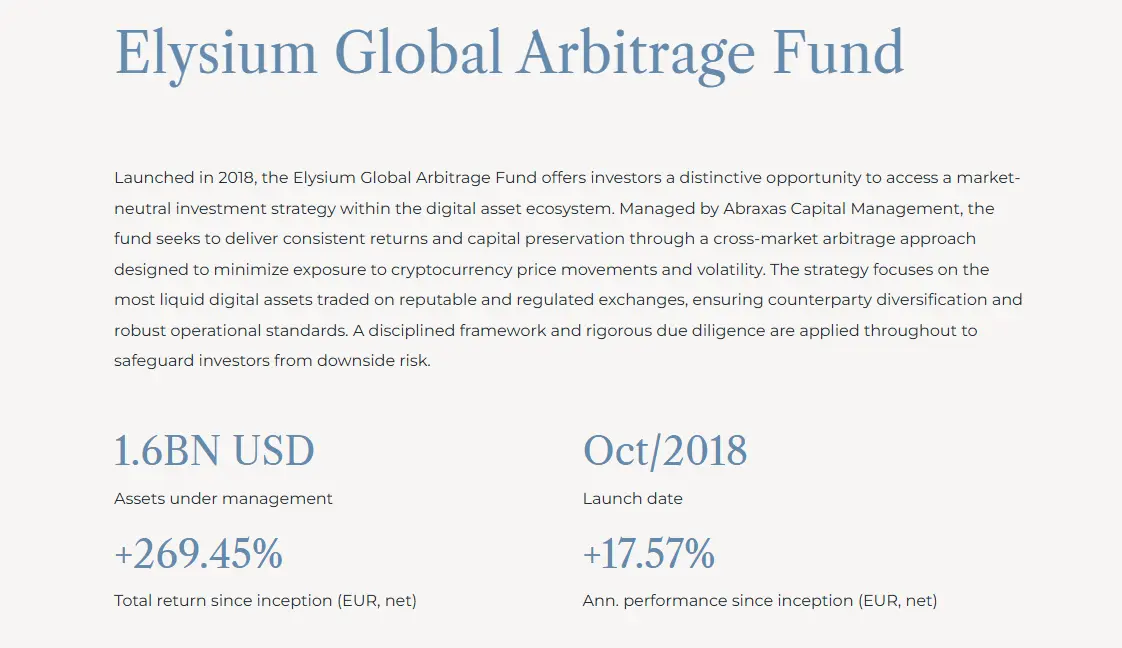
The flagship product Elysium Global Arbitrage Fund was launched in October 2018, legally structured under Heka Funds SICAV, with a management scale displayed on its official website of 1.6 billion USD. Abraxas also has products like Alpha Bitcoin, Alpha Ethereum, and Alpha Gold.
What truly makes this institution notable is its funding source. In July of this year, arbitration documents between Circle and Heka were released in the Boston federal court. The documents revealed that Tether contributed about 800 million USD to Elysium, accounting for approximately 75% of the fund's assets, and Tether also waived the fees for Heka to mint USDT.
2. How Arbitrage Machines Make Money
According to The Hedge Fund Journal, Elysium operates spot price differences, funding rates, and interest rate arbitrage between CeFi, DeFi, and TradFi, aiming for market neutrality where returns are unrelated to cryptocurrency price fluctuations.
The most illustrative example of this strategy is the USDC depeg in March 2023. Arbitration documents reveal that Heka bought discounted USDC on the secondary market, then redeemed it from Circle for 1 USD, with the redemption amount exceeding 587 million USD within two weeks.
Circle suspected that these trades were aiding competitor Tether in gaining market share, and in December of the same year, it ceased minting and redemption services for Heka. Heka subsequently filed for arbitration claiming about 49 million USD, which was ultimately dismissed. The arbitrator supported Circle’s decision, determining that Heka concealed Tether’s contribution and acted maliciously, but did not conclude that market manipulation occurred.
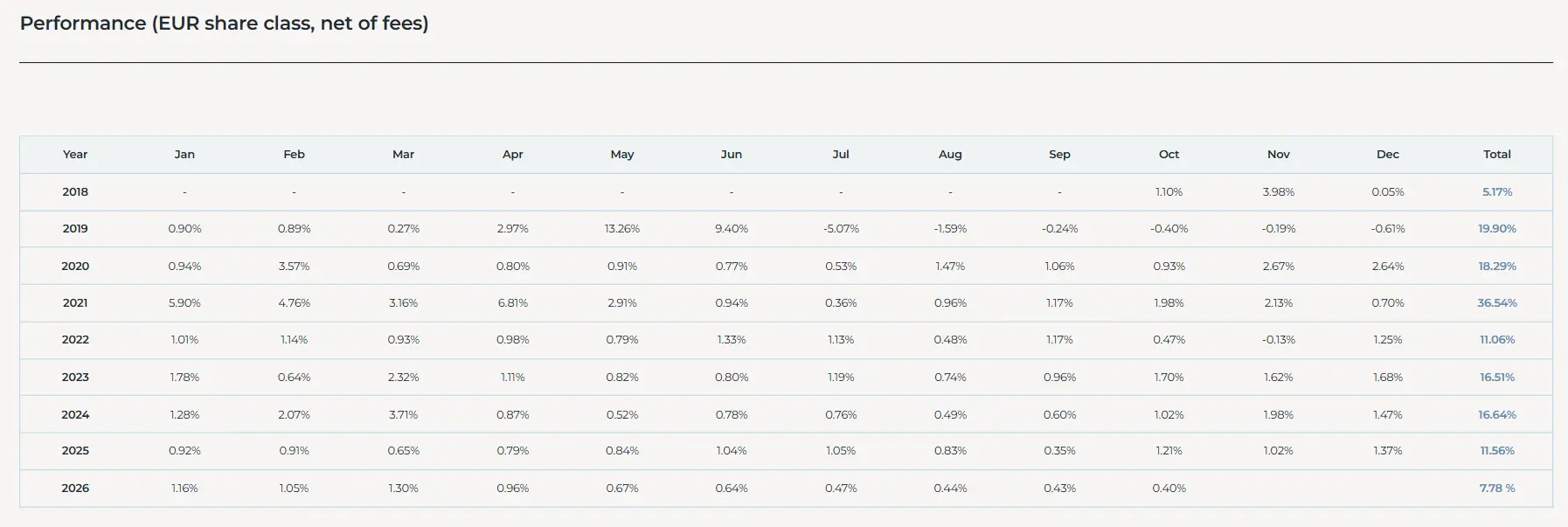
From a performance perspective, this strategy is quite stable. Data from the official website shows that Elysium's USD shares have not seen a single month of loss since its establishment in July 2020, with a net return of 12.41% for the entire year of 2025, and 8.96% as of October 2026.
In June of this year, Elysium also received multiple best performance awards in the market-neutral arbitrage category for funds over 1 billion USD from The Hedge Fund Journal.
3. On-chain Landscape
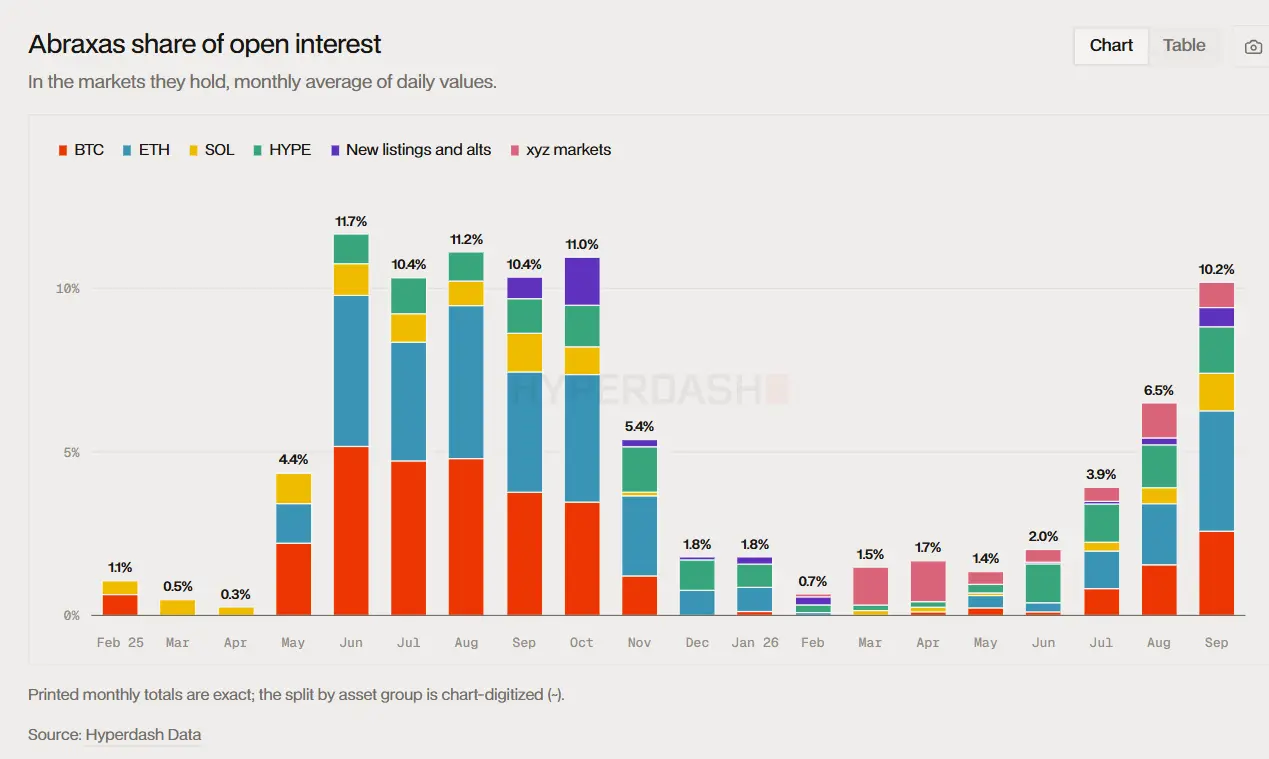
Hyperliquid is Abraxas' most prominent position. According to a Hyperdash research report, it completed its first transaction on Hyperliquid on February 20, 2025, initially only as a small-scale test. From August to October 2025, its positions accounted for about 10% of the total open interest on the platform, peaking at 1.57 billion USD in short positions on October 6.
These short positions are mostly hedging legs. MLM statistics indicate that Abraxas accumulated a paper profit of about 530 million USD on Hyperliquid, with at least 67 million USD coming from funding rates. It also noted that this is just one leg of Elysium's market-neutral strategy, and the positions on the other side would offset some of the profits.
Furthermore, this leg may not be the main source of profits for Elysium. According to the Hyperdash research report, from February to April 2026, Abraxas's funding rates on Hyperliquid turned into net expenditures, whereas Elysium’s net returns for the three months in that quarter were 1.27%, 1.16%, and 1.43%, making it one of the best-performing periods this year.
It does not only trade crypto assets on Hyperliquid. Hyperdash data show that it holds short positions in gold and silver on trade.xyz, while its short position in crude oil incurred about 5.26 million USD in funding rates.
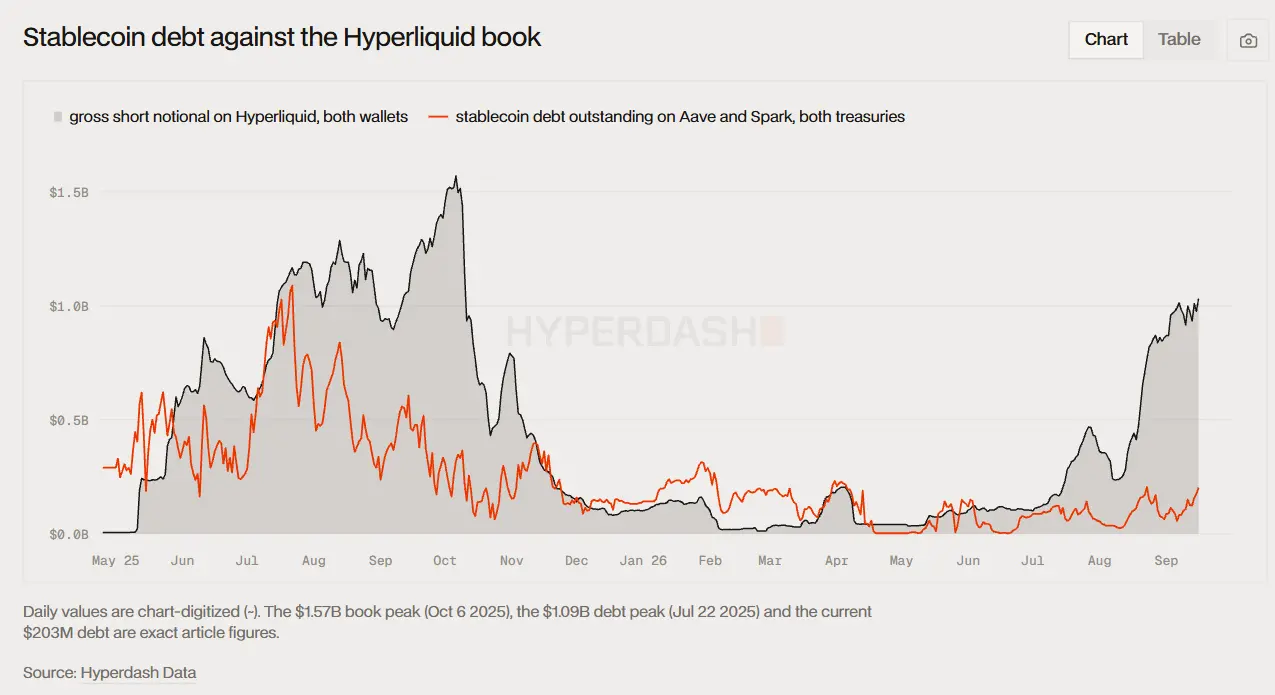
The other end of the hedge is in DeFi lending protocols. Abraxas locks ETH liquidity staking tokens in Aave and Spark as collateral to borrow stablecoins, which are then transferred to exchanges through Binance, and this cycle continues.
According to Hyperdash, since May 2025, it has borrowed and repaid approximately 35 billion USD in stablecoins, with the debt peaking at 1.09 billion USD on July 22, 2025.
The funding source is closely related to Tether. In late April this year, Tether issued about 3 billion USDT in one week, of which about 2.89 billion flowed from the Tether treasury to Abraxas. Moreover, Hyperdash's report indicates that the two wallets used by Abraxas on Hyperliquid alone received over 841 million USD in USDT directly from the Tether treasury.
4. After Leaving Hyperliquid
This is not Abraxas's first major contraction on Hyperliquid. According to the Hyperdash report, after the funding rates declined at the end of 2025, it gradually reduced positions in the following weeks, with total positions dropping from 104 million USD to 25 million USD by February of this year. With the rise in funding rates in September, it began to rebuild positions. According to Lookonchain monitoring, by October 26, its two hedge accounts' short positions exceeded 1.29 billion USD.
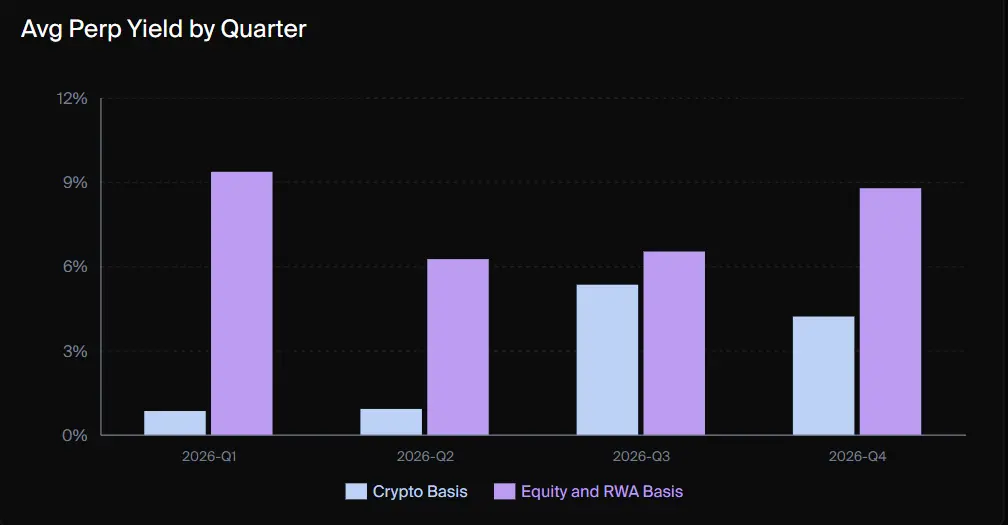
This time, however, the background is somewhat different. Official data from Ethena shows that the average yield of perpetual contracts for crypto assets in the fourth quarter is still around 4%, higher than the less than 1% level in the first and second quarters; funding rates have not disappeared.
The variable is due to the earlier mentioned theft at Lighter. According to Bitquery tracking, on November 16, the Lighter contract sent 10,393,057 USDC in one go to the attacker's address.
According to the incident report released by Lighter, the affected account did not use the official SDK; its self-written signature code reused a nonce, allowing the attacker to calculate the private key using only publicly available signature data. Then, the attacker created a public pool using this key in the name of the victim account, transferred funds into the pool, and then redeemed shares to withdraw the funds. The Lighter security committee subsequently refunded about 5 million USDC to the affected traders.
Lighter did not name the victim, nor did Abraxas respond publicly. On-chain analyst 0xTria pointed out that funds from one of the stolen accounts originated from Abraxas's Hyperliquid wallet.
Just a month before the incident, co-founder Frontini stated that the company's advantages lay in scale, institutional-level risk control, operational execution, and technology, and that it had the capability to deploy more funds within the same risk-adjusted framework.
More than a week later, Abraxas cleared its short positions on Hyperliquid. However, according to Lookonchain monitoring, its short positions had already dropped to 572 million USD before the incident.
Regarding the reason for the withdrawal, market opinions vary. Some users believe that after the leak of the credentials, it is a normal risk control action for the fund to pause activities on various platforms, check account permissions and signature software.
Former Ethena Labs growth head Seraphim stated that with Abraxas's scale, DeFi and most centralized exchanges are too small, and the exit from Hyperliquid was because it could no longer make money there.
After the withdrawal, Abraxas began to withdraw large amounts of assets from exchanges. According to Lookonchain monitoring, during the period when BTC fell below 60,000 USD, it withdrew 17,597 BTC from Binance and Kraken, at an average price of approximately 59,206 USD.
However, the Hyperdash report notes that some of Abraxas's spot hedges were already held on Binance, Kraken, or custodial institutions, making it difficult to discern whether the withdrawals were for building positions or transferring assets based on on-chain data.
A person from the funds allocation side stated that it is important to observe where this collateral flows next; if other large trading desks also begin to reduce collateral, one must pay attention to order book depth and the costs of large transactions.
At least for now, this situation has not emerged. According to Hyperdash data, as of November 27, addresses marked as Fasanara Capital and Wintermute are still actively trading on Hyperliquid, with nominal positions around 140 million USD.
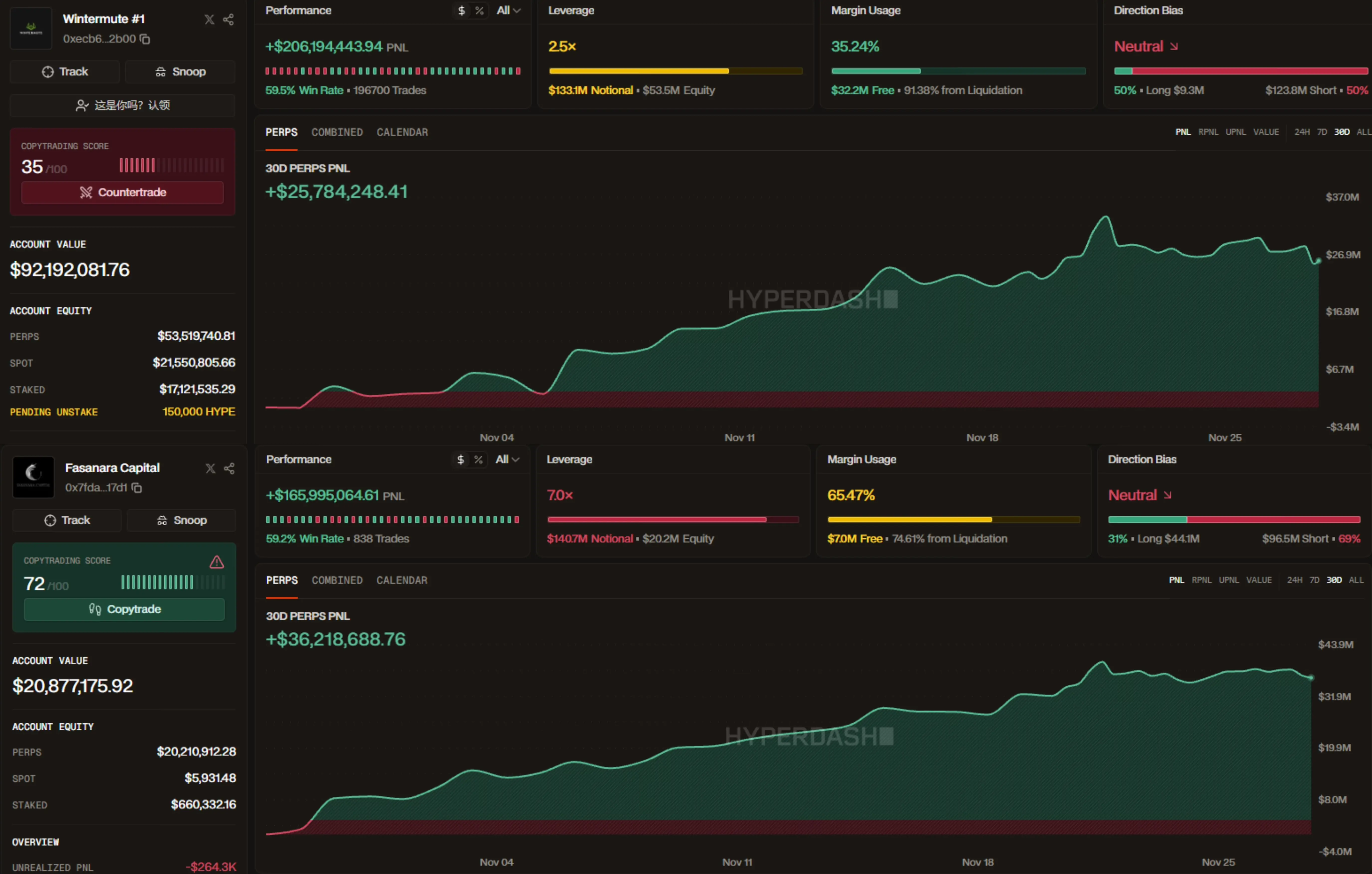
The key is that these two institutions are trading large amounts of American stock contracts for SK Hynix, Apple, Micron, Microsoft, etc. Ethena data similarly show that, each quarter this year, the average yield of stock and RWA perpetual contracts has exceeded that of crypto assets.
Abraxas is gone, but institutional arbitrage on Hyperliquid continues, just the focus is shifting from crypto assets to US stocks.
免责声明:本文章仅代表作者个人观点,不代表本平台的立场和观点。本文章仅供信息分享,不构成对任何人的任何投资建议。用户与作者之间的任何争议,与本平台无关。如网页中刊载的文章或图片涉及侵权,请提供相关的权利证明和身份证明发送邮件到[email protected],本平台相关工作人员将会进行核查。