Near Protocol News How SHIELD Blocked 99.7% of Bitget Hack Flows Today
NEAR's security layer, SHIELD, is in the spotlight. In its official post, NEAR says SHIELD blocked 99.7% of the laundering flows, worth over $50M, that were attempted through NEAR Intents after the Bitget hack.
This Near Protocol News update explains how SHIELD works and what is open to partners.
NEAR Price and Key Facts at a Glance
NEAR trades at $2.93, down 2.86% over the last 24 hours.
On the 24-hour chart, the price mostly drifted lower from around $3.05 to near $2.92, then bounced slightly at the end. Trading volume fell 50.87% to $226.52M.
Metric | Value |
Token | NEAR Protocol (NEAR) |
Price | $2.93 |
24h change | −2.86% |
Market cap | $3.86B |
Unlocked market cap | $3.74B |
24h trading volume | $226.52M (−50.87%) |
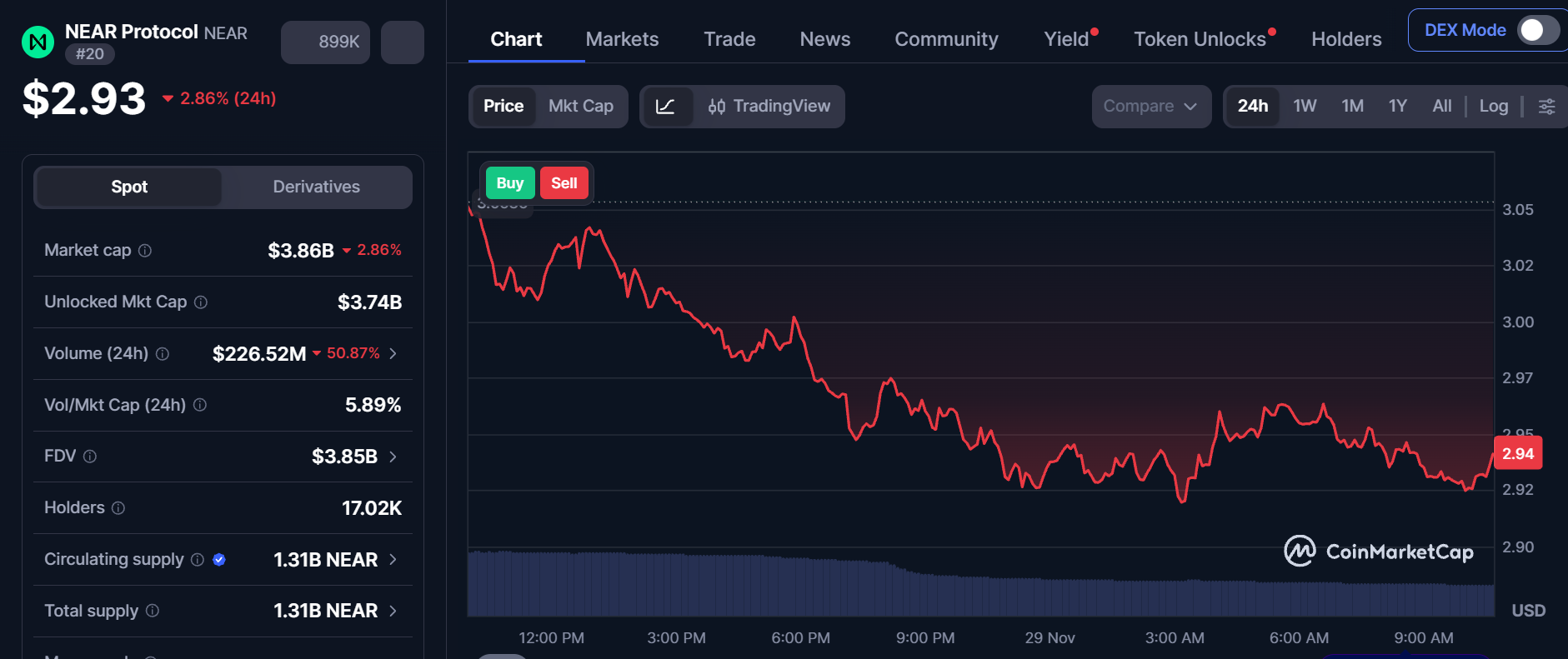
Note: Market data is as of 29 November 2026, around 10:30 AM. Crypto prices change every second, so please verify the latest figures on NEAR's official website and official channels before relying on them.
Source: CoinMarketCap Live Data
How SHIELD Blocked Laundering After the Bitget Hack
The blog, dated 19 November 2026, says Bitget was compromised for roughly $388 million in September and Binance for roughly $6 billion on 29 October.
Stablecoin issuers froze about half of the Binance flows within days, while the rest moved across chains to venues that did not stop it.
According to the same blog, SHIELD's results were:
Bitget hack: SHIELD detected and blocked 99.7% of attempted laundering flows, which it puts at over $50M.
Binance exploit: attackers moved roughly $194M of TRON across chains within two days, and only $171K went through NEAR Intents, based on independent onchain tracing cited in the blog.
Binance flows at NEAR Intents: as of 3 November, SHIELD had blocked approximately 96% of exploit-linked flows that reached it.
NEAR Intents is an application built on NEAR Protocol. It says the platform turns these flows away because an economy that settles stolen funds is one the wider world will not join.
How SHIELD Screens Funds Before They Move
It explains that SHIELD checks the public on-chain history of the funds in a request on the chain they came from.
It screens transactions, not identities, so no KYC is needed to use NEAR Intents. Checks run before funds reach the confidential layer, and a flagged request is not executed.
Signals come from an internal AML database, third-party intelligence providers and trusted industry partners.
The team also says SHIELD does not fully remove stolen funds, but it reduces exposure significantly.
One point matters for NEAR holders. SHIELD-applies to flows through NEAR Intents, not to balances on NEAR Protocol.
Anyone who holds NEAR and never uses NEAR Intents is never screened. Anyone can still hold assets, deploy contracts, or become a validator, and no single party can pause the chain.
The documentation says SHIELD works with three coarse security modes:
Mode | What It Does |
Normal | No added friction (default) |
Paranoid | Adds delay windows and more scrutiny while a situation is assessed |
Under Attack | Pauses affected functionality while responders contain the incident |
The docs also say its anomaly engine is rule-based and explainable, not model-driven, which means its scores can be traced to configured rules.
Latest Near Protocol News: SHIELD Opens to Partners
The most important part of this Near Protocol News story is that-SHIELD is built as shared security infrastructure.
It says it is open to wallets, bridges, exchanges, solvers, and protocols, and that major chains, exchanges, and security firms are joining as data sources.
Why this matters: stolen funds go to whichever venue does not screen them. When venues screen together, there are fewer places for attackers to escape through.
What partners get: a live status feed of incidents, scoped controls (such as pausing one chain), and an audit trail of their own actions.
What partners contribute: incident submissions through an authenticated API, observations flagged for review, and chain-specific knowledge.
How to join: the post links the SHIELD-docs and the Incident API reference, and invites teams to contact the NEAR Intents team to become a data submitter.
Producers do not inherit powers automatically. Each one gets an explicit permission set, and actions are auditable in both directions.
What Is Live Today and What Is Still Rolling Out
The official docs separate shipped features from plans, so readers should not treat everything as live.
Status | Features |
Live today | Incident submission and resolution, scoped permissions, security modes, and quote-time evaluation for integrated services; 1Click swaps checks, including scoped delay |
Rolling out | Wider use of SHIELD decisions across more request paths; bridge-touching flows |
Vision | Multi-surface posture control using richer chain-health and transaction signals; solver pool controls |
The docs also say scope enforcement is rolling out step by step, so behavior may vary by integration path.
Conclusion
SHIELD gives NEAR Intents a way to act on specific risky flows without pausing the whole system, and NEAR says it blocked 99.7% of laundering flows linked to the Bitget hack.
This Near Protocol News update shows a clear plan to share the tool with partners, while the docs make clear some parts are still rolling out. This article is for information only and is not financial advice.
Please verify all details through NEAR's official channels.
Disclaimer
This article is for educational and informational purposes only and is not financial or investment advice. Crypto assets are high risk, their prices can be very volatile, and you can lose some or all of your money. Always do your own research and consider speaking with a licensed financial advisor before making investment decisions.
免责声明:本文章仅代表作者个人观点,不代表本平台的立场和观点。本文章仅供信息分享,不构成对任何人的任何投资建议。用户与作者之间的任何争议,与本平台无关。如网页中刊载的文章或图片涉及侵权,请提供相关的权利证明和身份证明发送邮件到[email protected],本平台相关工作人员将会进行核查。