On November 25, 2026, the team of JPMorgan analyst Gokul Hariharan released a tracking report on Xiaomi Group (1810.HK) for the third quarter of 2026.
The report pointed out that driven by the improvement in the average selling price (ASP) of smartphones and gross margin, Xiaomi’s third-quarter profit slightly exceeded market expectations, but in the short term, there is still a lack of strong catalysts.
Third quarter slightly beats expectations, average smartphone price rises by 40% year-on-year
In the third quarter of 2026, Xiaomi achieved total revenue of 107.2 billion yuan, with an overall gross margin of 20.2%. The adjusted net profit for the quarter was 4.9 billion yuan, with adjusted earnings per share (EPS) recorded at 0.19 yuan, slightly above market consensus expectations.
In terms of core hardware, smartphone shipments in the third quarter were 30.7 million units, but the average selling price (ASP) surged by 40% year-on-year to 1,485 yuan, driving the smartphone business gross margin to 9.2%, slightly higher than JPMorgan's previous expectation of 9.0%.
Smart electric vehicles and innovative businesses are also steadily advancing, with quarterly revenue reaching 23.9 billion yuan and maintaining a gross margin of 19.2%.
Rising storage prices suppress short-term gross margin, smartphone gross margin holds in the 9% range
Although high-end models have pushed up the average unit price, rising prices of upstream components are eroding hardware profit margins.
Xiaomi’s management clearly stated in performance communication that DRAM memory prices continue to rise and are expected to remain high at least until the first half of 2028 (when larger scale new capacity will be released), while NAND flash prices are also expected to remain flat or slightly increase in the short term.
As a result, JPMorgan expects Xiaomi's smartphone gross margin in the fourth quarter to decline by 70 basis points sequentially to 8.5%, with an estimated full-year gross margin for 2026 at approximately 9.1%. Looking ahead to 2027 and beyond, even if the high-end product mix and price increases can alleviate some cost pressures, smartphone gross margins will still be limited to a narrow range of 9% to 10% in the long term. The company’s overall gross margin is expected to be 20.7% and 21.3% in 2027 and 2028, respectively.
Core business growth under pressure in 2027, annual growth rate only 5%
Entering 2027, Xiaomi's traditional core business will face severe external demand challenges.
Due to high memory costs suppressing replacement demand, the global smartphone market is likely to continue its downward trend. Accordingly, JPMorgan has adjusted its shipment expectations, forecasting that Xiaomi's smartphone shipments will decline slightly by about 1% year-on-year to 123.9 million units in 2027.
The IoT and consumer goods business also face a triple squeeze from weak domestic consumption momentum, the decline in trade-in subsidies, and rising storage costs. Although new retail stores and new product expansion abroad are driving positive momentum for overseas IoT, it is difficult to fully offset domestic weakness.
Overall, JPMorgan predicts that Xiaomi's core business (smartphones + IoT + Internet services) revenue will grow only 5% year-on-year to 344.5 billion yuan in 2027, while the increase in AI-related R&D investment will continue to exert some pressure on profits.
SkyNomad N90 hot sales drive volume growth, car entry into Europe becomes the next focus
In contrast to the flatness of traditional consumer electronics, smart electric vehicles are becoming Xiaomi's most core growth engine.
Relying on the strong performance of the SkyNomad N90 series, Xiaomi's vehicle deliveries in the fourth quarter are expected to surge to 165,000 units, driving total annual deliveries in 2026 to 451,000 units, and further climbing to 660,000 units in 2027. Reflected in production schedules, as of November 24, 2026, the delivery cycle for main models has been shortened to 4 to 7 weeks (with the SU7 Ultra being 20 to 24 weeks), and capacity ramp-up is smooth.
Market attention is turning to overseas expansion. Management revealed that preparations for Xiaomi's entry into the European market are progressing smoothly: a research and development center has been established in Germany, and memorandums of understanding (MOU) have been signed with eight leading German dealers, dealer recruitment is almost complete, and high-quality local store locations have been secured.
JPMorgan expects that Xiaomi will build its own distribution center in Germany and officially start European market deliveries in the second half of 2027, although the initial ramp-up pace will be relatively cautious, with limited financial contributions throughout 2027.
Valuation at historical low range, maintains neutral rating with a target price of 32 HKD
The report noted that in the past month, driven by risk-averse fund rotation and short covering triggered by the pullback in the AI infrastructure sector, Xiaomi's stock price has outperformed the Hang Seng Tech Index by 11%.
With a closing price of 26.50 HKD on November 24, 2026, Xiaomi's current stock price is operating in the historical valuation bottom range of 10 to 15 times the projected P/E ratio (corresponding to 24 to 27 HKD). JPMorgan believes that due to light institutional holdings and relative risk-averse attributes among Asian tech stocks, the downside potential for the stock price is limited, but it will continue to maintain a range-bound fluctuation in the short term due to the lack of major catalysts.
Analysts slightly raised the adjusted EPS forecasts for 2026 and 2027 by 1.5% and 3.2% (to 0.87 yuan and 1.06 yuan, respectively), based on the sum-of-the-parts valuation method (SOTP, core business assigned an 11 times future 12-month cash-excluded projected P/E ratio, and automotive and new business assigned 1.1 times projected P/S ratio), maintaining a "neutral" rating and a target price of 32.00 HKD for June 2027.
The report pointed out that breaking the fluctuation pattern in the future requires key observation of three signals: the progress of automotive entry into Europe in the second half of 2027, the overseas IoT business accelerating beyond expectations, and a rebound in China's consumer electronics demand leading to substantial improvement in smartphone and IoT gross margins.
Institution's ledger
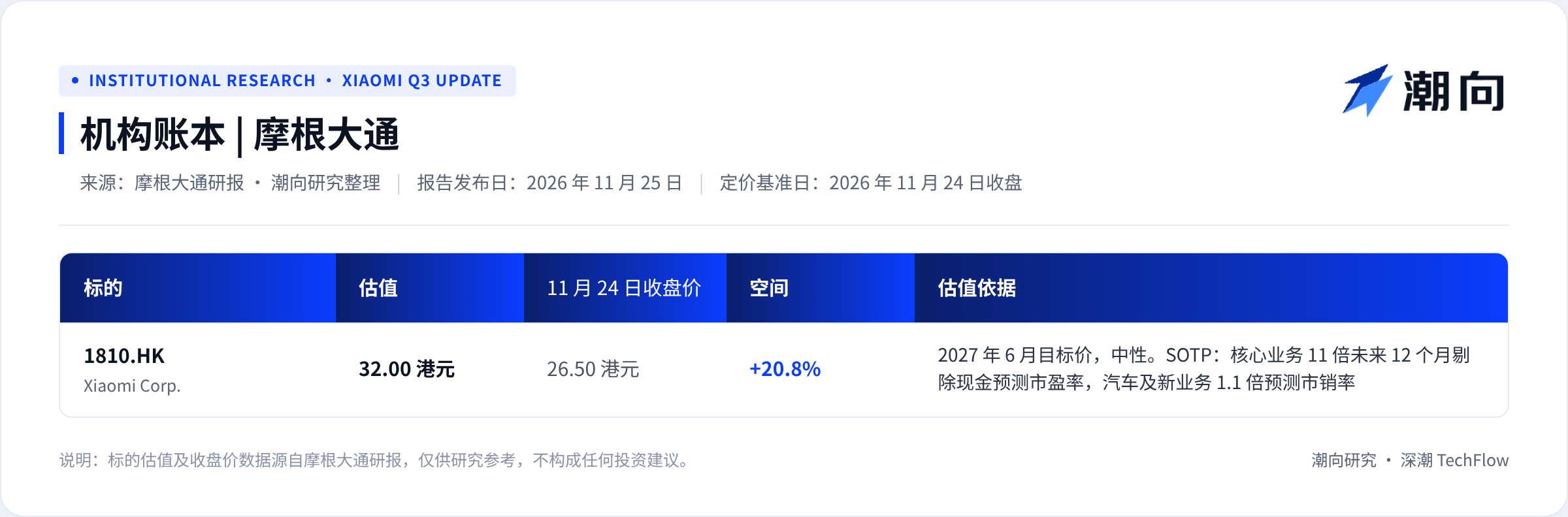
Note: Potential upside is calculated based on the target price of 32.00 HKD for June 2027 relative to the closing price of 26.50 HKD on November 24, 2026; the report's SOTP total equity value is approximately 721.739 billion yuan.
Fixed statement regarding the report content (brokerage views, not Tide Research views)
This article is a整理与解读 of third-party brokerage research reports by Tide Research. The ratings, target prices, profit forecasts, and related judgments quoted in the text are solely the views of the brokerage firm analysts and represent their respective institution's position, not the views of Tide Research, and do not constitute any investment advice.
The market has risks, decisions must be independent. This article should not be used as a basis for buying or selling any securities.
免责声明:本文章仅代表作者个人观点,不代表本平台的立场和观点。本文章仅供信息分享,不构成对任何人的任何投资建议。用户与作者之间的任何争议,与本平台无关。如网页中刊载的文章或图片涉及侵权,请提供相关的权利证明和身份证明发送邮件到[email protected],本平台相关工作人员将会进行核查。