Author: Moonshot, Geek Park
When AI can provide detailed answers in seconds, why do people still need to watch long videos?
The platform most in need of answering this question is Bilibili, but their latest financial report gave an unexpected answer.
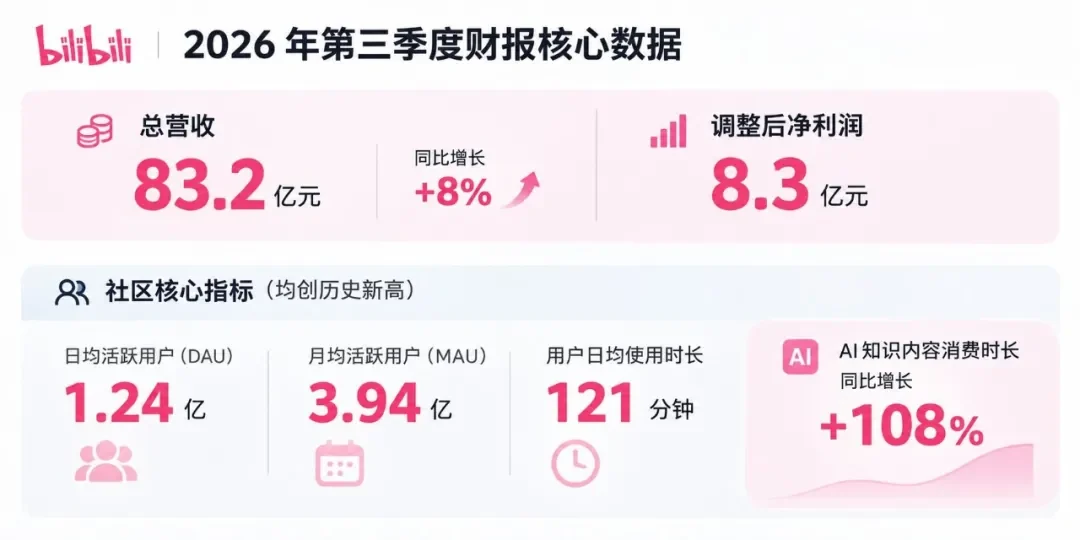
On November 24, Bilibili released its third-quarter financial report for 2026, with total revenue reaching 8.32 billion yuan, a year-on-year increase of 8%, and adjusted net profit reaching 830 million yuan.
All three core community indicators hit all-time highs: daily active users reached 124 million, monthly active users reached 394 million, and users' average daily usage time first broke two hours, reaching 121 minutes, especially in AI knowledge content, where consumption time increased by 108% year on year.
With growth in revenue, users, and content, it seems Bilibili is doing even better in the AI era.
By closely examining Bilibili's financial report and some new content and creators that have emerged this year, one can find that AI has brought opportunities to Bilibili that go far beyond just a trending topic in the tech area.
Bilibili, the best base for AI tutorials
AI itself has become a skill that the public needs to learn; this emerging "subject" is becoming a promising growth point in Bilibili's knowledge section.
Today, AI products are flourishing, and just figuring out what AI is available on the market and what they specialize in is enough for a video. Every few months, with updates to model capabilities, much content will also be updated accordingly.
Product reviews are Bilibili’s traditional advantage. From early mobile phones and computers to recent years’ new energy vehicles and smart hardware, Bilibili has cultivated a group of UP hosts skilled in reviews.
The explosion of AI products has brought a new category of content for these creators.
Bilibili has also caught this wave of creators. On September 16, Bilibili launched the "AI Infinite Arena" specifically for AI testing, gathering large model tests from UP hosts in different fields. They self-generate topics around coding, reasoning, professional applications, and various fun ideas, allowing mainstream large models from around the world to compete.
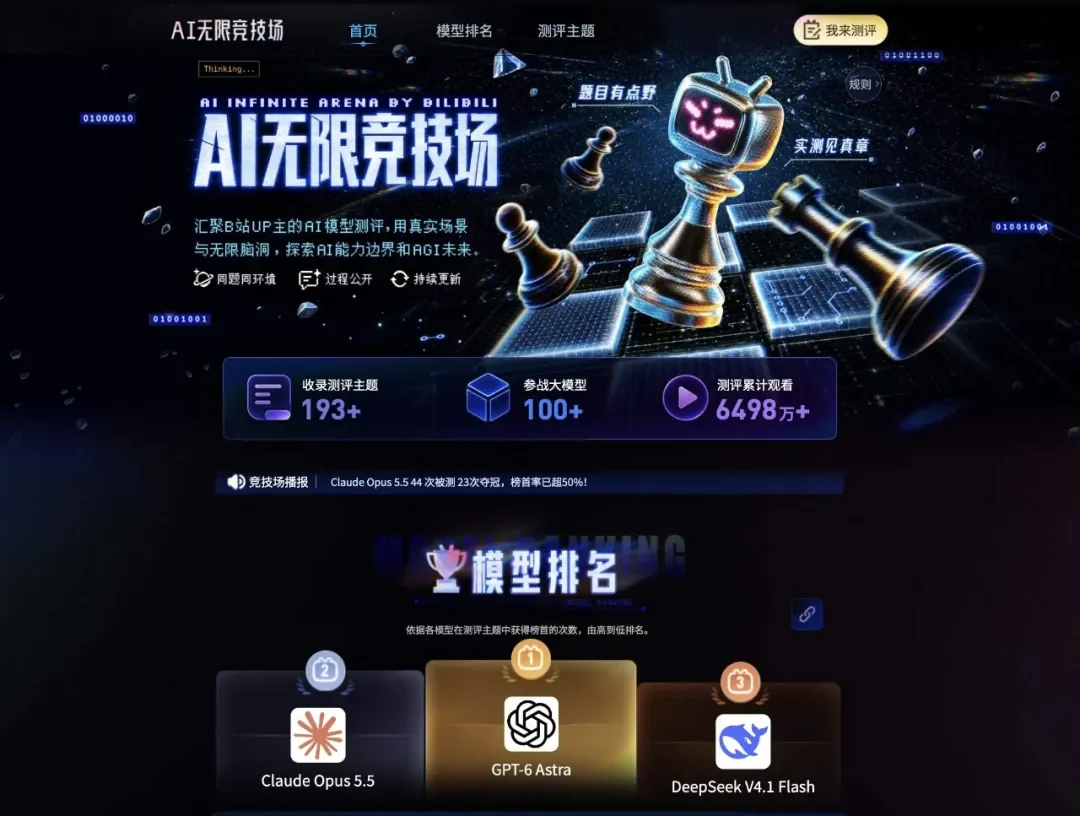
When large model manufacturers release new products, which company doesn’t conveniently showcase a few “top-ranking” performance reports? But on Bilibili, a UP host skilled in gaming can take the same game concept to test different large models. This type of cross-category, real-world scenario testing allows ordinary people to gain a more intuitive understanding of large model capabilities.
In the third quarter, there were more than 13,000 related submissions for real-world testing of large models on Bilibili, involving over 100 model versions. For an AI company, it’s probably difficult to design such a rich application scenario by themselves.

Moreover, learning AI is quite easy to get “hooked” on. From initially studying how to chat with AI to building one’s own AI workflow and creating individual works using AIGC… the process of learning AI is accompanied by continuous content consumption.
In this regard, Bilibili's depth and breadth of AI knowledge content are already quite considerable.
In August this year, DeepSeek open-sourced the developer tool DeepSeek Harness (hereinafter referred to as DSH). The first testing video by UP host "Programmer Yu Pi” received over 3.44 million views, while "Git Source Treasure," a detailed tutorial lasting 50 minutes, also surpassed 3 million views.

According to data provided by Bilibili, nearly half of the DSH plugin developers share and publish their plugins on Bilibili. When DSH was first open-sourced, the top-ranked works on GitHub in terms of Star count also came from Bilibili UP hosts.
Beyond tutorials, Bilibili's users are also creatively using AI.
For example, the same AI programming tool might be used by a gaming UP host to recreate childhood mini-games, while a film UP host might use it to build a personal movie database. Many uses are probably unexpected even by the AI manufacturers themselves. In terms of dissemination effectiveness, an interesting application case is more likely to inspire the public to explore new technologies than an official press conference.

Just right, the UP hosts in various sections of Bilibili have diverse interests, needs, and ideas; everyone can develop new uses for the same AI product, and these uses become materials for other users to learn AI.
And on Bilibili, content sometimes grows out of the community. A video's bullet comments and comment section may sprout new ideas. Some viewers are eager to try after watching a video, others offer suggestions to the UP host, and some even submit their own “homework.” This kind of interactive communication also motivates UP hosts to continue researching and updating the next video.
From learning to doing to sharing, Bilibili's AI content has already developed rich layers.
This also suggests that the 108% increase in AI knowledge content consumption time on Bilibili may just be the beginning. After all, as long as the AI industry continues to develop rapidly, there will be plenty of content to discuss in this field.
The next batch of UP hosts might be in the audience
Another significant impact of AI on Bilibili’s content ecosystem is that the composition of creators is changing.
Many creators on Bilibili have grown up from specific interest circles, with a gaming UP host possibly having over a decade of gaming experience, while a film UP host could simply be a massive film fanatic.
The accumulation of interest is far longer than the learning of skills. However, the advent of AI provides new creative opportunities for those who have long accumulated certain interests but lack professional production skills.
This summer, Bilibili held the "Build in Bilibili·AI Creation Open Competition," attracting 13,400 creators to participate. Among them, 64% of the participants had no professional development background, 88% of the participating UP hosts had fewer than 10,000 fans, and 56% of the entrants had a production cost of less than 500 yuan.
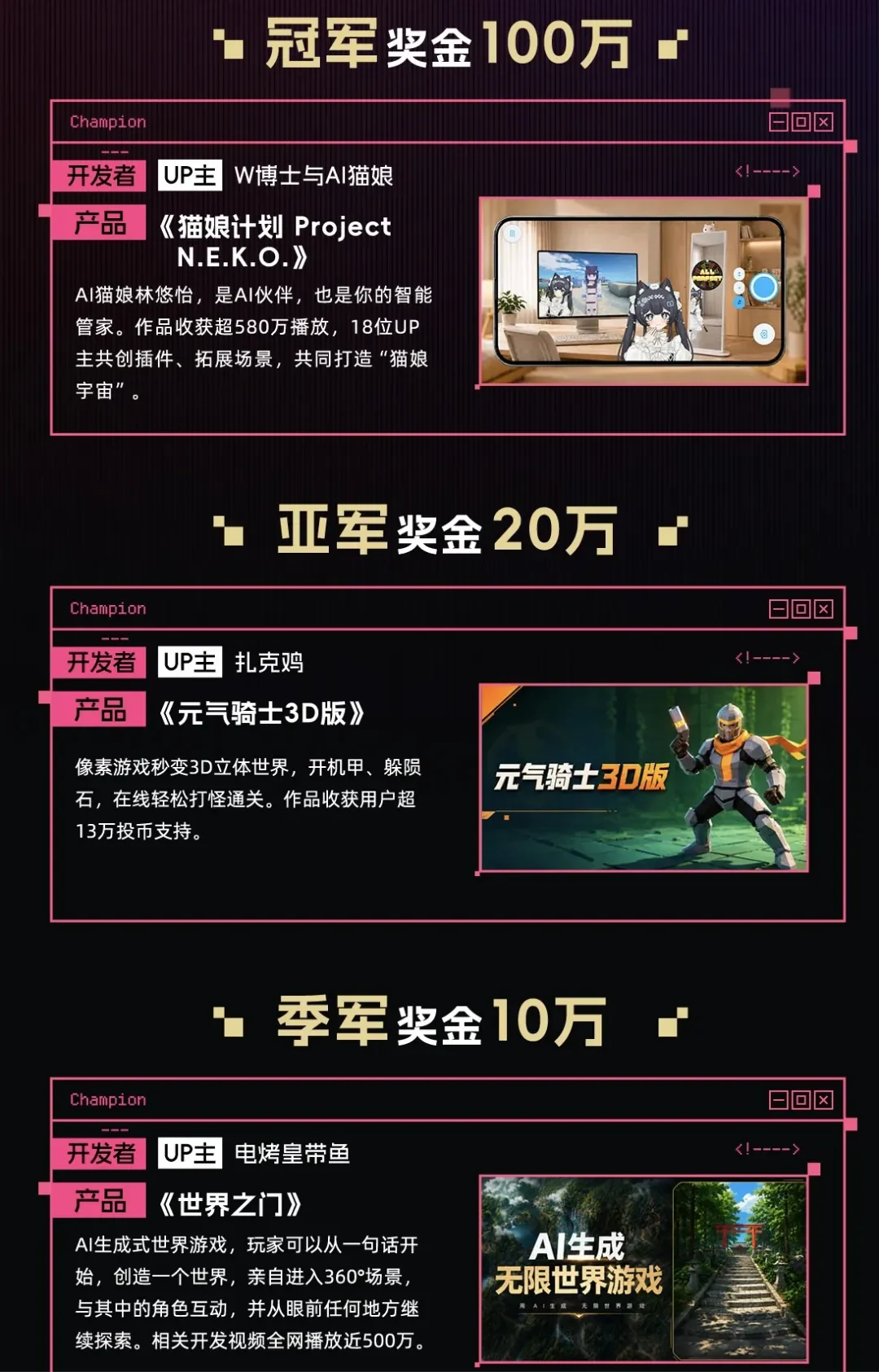
Even though most of them only submit works once or twice a year, this is still a significant content increase for a UGC platform of Bilibili’s size.
For existing UP hosts, AI has changed their topic selection logic and content production methods.
In the third quarter, Bilibili's video podcast consumption time increased by over 380% year on year. UP host “Cloud's Design Talk” made a video podcast in the style of “Round Table” with AI assistance, inviting the “guest” of Huangmei King from “Journey to the West” to discuss the workplace ecology. This episode gained over 2.6 million views on Bilibili and ranked second in the monthly “Bilibili Video Podcast Hot List” for the third issue.
In the past, producing such an episode would have been prohibitively expensive due to the costs of actors, makeup, and scenes, causing individual creators to abandon these topics.
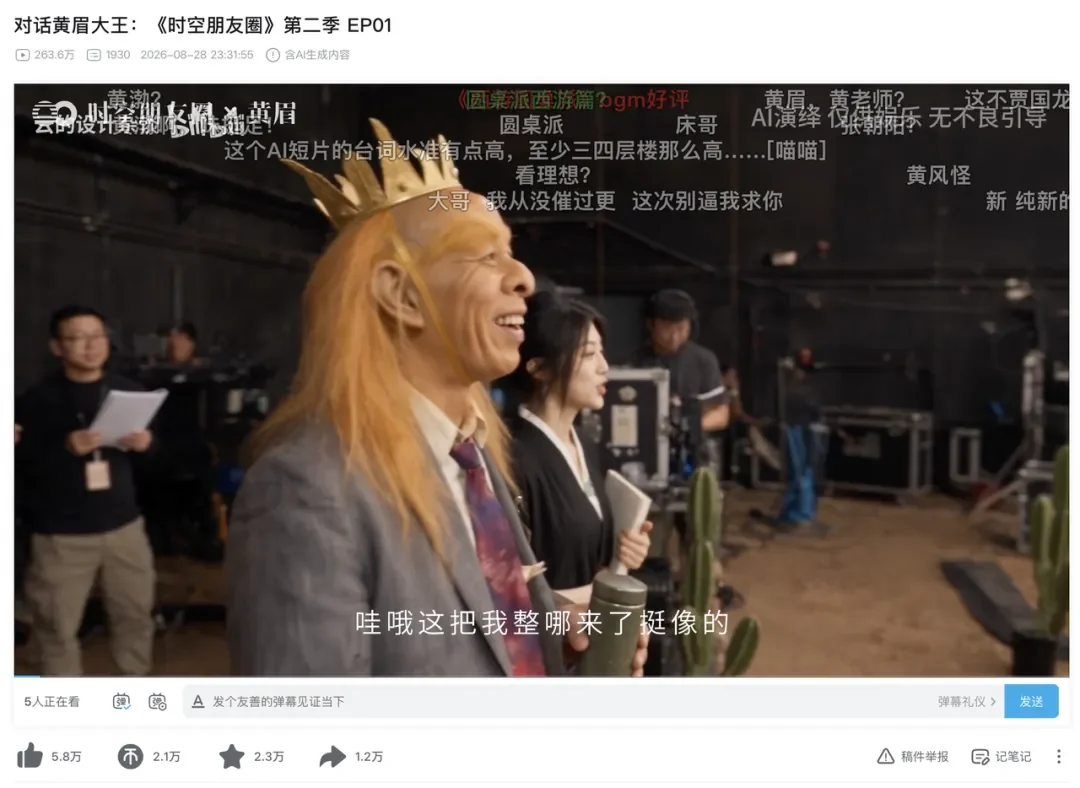
This is also the significance of AI to a community like Bilibili, which has a wealth of long-tail content. Many niche topics do have audiences; they just do not have a large enough audience to support the production costs. However, AI has significantly reduced production costs.
Such creative logic is particularly evident in Bilibili's remix culture.
Recently, BLG won the League of Legends World Championship for the first time. A Bilibili user rewrote the lyrics to “Sea Wide Sky” and used AI to create a Cantonese MV encouraging BLG, incorporating the team's past setbacks and regrets into the song.
For viewers familiar with BLG, the setbacks, resentment, and perseverance written in the lyrics are all memories they have experienced while watching. Perhaps the author may not possess professional music production skills, but in terms of understanding this team, a true fan may be more aware of how this song should be written than any professional musician.
This creative motivation has always existed on Bilibili. Early MAD, parody, and fan animations were mostly born out of young people's love for a specific work or character.
When creative desire is no longer bound by ability, in the third quarter, the number of submissions for pan-entertainment content on Bilibili increased by 46% year on year, and consumption time increased by 35%, emerging a batch of million-view works in animation, science fiction, suspense, and other genres created with the help of AI.
During the same period, Bilibili's daily average video submissions increased by 36% year on year, and the number of creators with more than 1,000 fans increased by over 25%, with more and more UP hosts accumulating their own audiences on Bilibili.
AI has lowered the threshold for becoming a UP host, adding a new set of creative tools for a community culture that has lasted over ten years.
The new business of AI also needs good content
This group of users with a strong learning demand for AI on Bilibili is also the consumers that AI manufacturers want to reach.
In the third quarter, Bilibili's advertising revenue reached 3.09 billion yuan, a year-on-year increase of 20%. Among this, advertising revenue from the AI industry increased nearly 95% year on year, far surpassing the overall growth rate of the advertising business.
From a commercial perspective, AI is an industry with an inherent demand for content marketing.
Often, consumers need to see a specific application case before they realize their own usage needs. The previously mentioned AI testing, tutorials, and creative works already bear some of the user education responsibility for manufacturers.
As AI begins to enter more consumer electronics products, commercial content is also extending into more interesting forms.
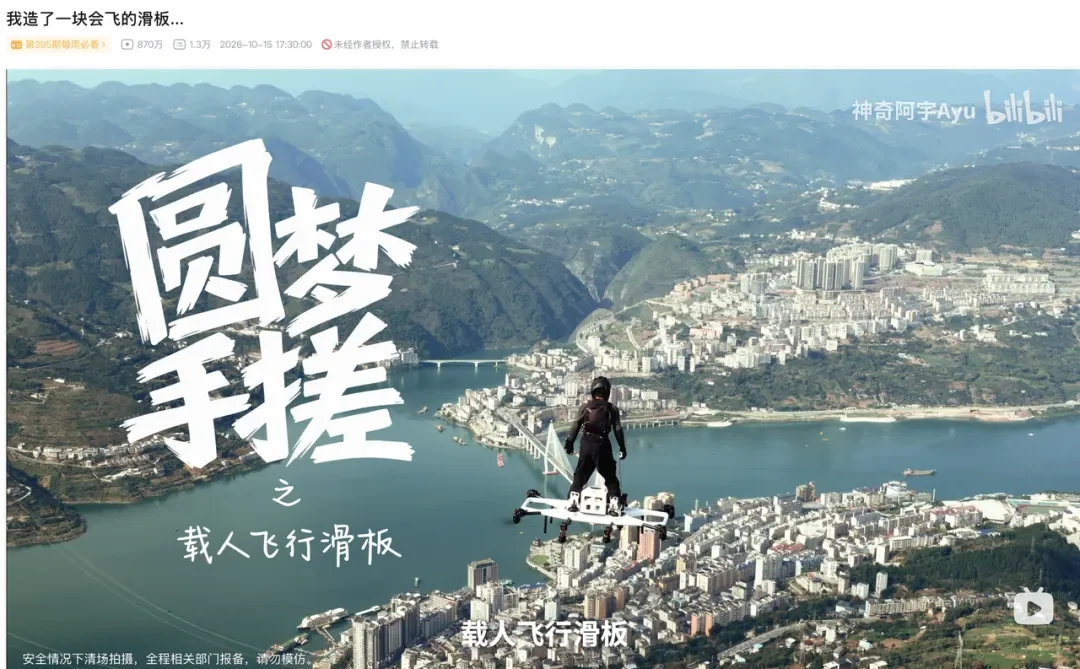
For example, in October, Bilibili UP host @Ayu released a video titled “I Built a Flying Hoverboard…”, achieving a real-life version of “Sword Flying.” So far, it has received 8.7 million views, 427,000 likes, and 157,000 favorites, and has been selected by Bilibili as a “must-watch of the week.”
This video is also a commercial collaboration with the AI intelligent device mobile phone STEPX Neo. In the development process of the flying hoverboard, Ayu used the AI intelligent device in the phone to analyze faults, monitor flying, and review training. A rather sci-fi concept has turned into a real scenario showcasing the capabilities of the AI mobile phone.
Creators have also gained more income in this process. In the third quarter, the average income per UP host on Bilibili increased by 25% year on year, with average charging revenue increasing by 31% year on year.
Charging revenue comes from users’ direct payment to creators. Users are willing to spend money to support their favorite UP hosts, allowing some content with relatively limited audience scope and longer production cycles to have an economic basis for sustained creation.
These “win-win” transactions occurring between users, UP hosts, and brands collectively form the commercial value of Bilibili’s content ecosystem.
In this earnings call, Bilibili CEO Chen Rui also admitted that Bilibili is one of the platforms that benefits most from the AI era, and the community is Bilibili’s strongest characteristic and barrier.
This indirectly answers the initial question: In the AI era, why do we still need UP hosts?
Because no matter how powerful AI is, it is just a tool that relies on human usage. And Bilibili is not just a content platform; it is also a user community. The productivity dividends brought by AI are something the entire content industry can enjoy, but how much of this productivity can be transformed into consumer-value content largely depends on what kind of people are gathered on the platform.
As of the third quarter, Bilibili's 12-month retention rate for official members is about 80%, with over 60% of new users being born after 2000. This means that Bilibili both has a group of long-term participants in community culture and is continuously absorbing the interests and creativity of a new generation of young people.
Over the past decade, the content, pop culture, and even aesthetics of young people on Bilibili have been changing, but the creation and communication within the community have never ceased.
Before the arrival of AI, Bilibili had already spent over ten years cultivating young people's creative and consumption habits. Now, AI has handed a set of creative tools to these young people that could only have been mastered by professionals in the past.
With people and content, this may be Bilibili's greatest opportunity in the AI era.
免责声明:本文章仅代表作者个人观点,不代表本平台的立场和观点。本文章仅供信息分享,不构成对任何人的任何投资建议。用户与作者之间的任何争议,与本平台无关。如网页中刊载的文章或图片涉及侵权,请提供相关的权利证明和身份证明发送邮件到[email protected],本平台相关工作人员将会进行核查。