Each method transfers the risk to the next person.
Written by: Nikos
Translated by: Chopper, Foresight News
A loan used to buy GPUs might take three years to pay off. Loans in private credit generally take several months to a few years to repay. When LPs deposit money into a fund that raises capital for such loans, they collectively bear the "long wait" period.
However, most people depositing stablecoins into DeFi do not intend to be locked in for three years. Borrowing positions, market-making positions, and most staking products can be exited quickly—provided there is enough liquidity in the market.
If LPs want to exit, it does not bring the maturity date of the underlying loans closer. Therefore, each protocol comes up with different ways to provide "earlier liquidity." Each method essentially transfers the risks of "waiting too long" and "possibly not being able to withdraw" to another person.
Mismatched Timeframes
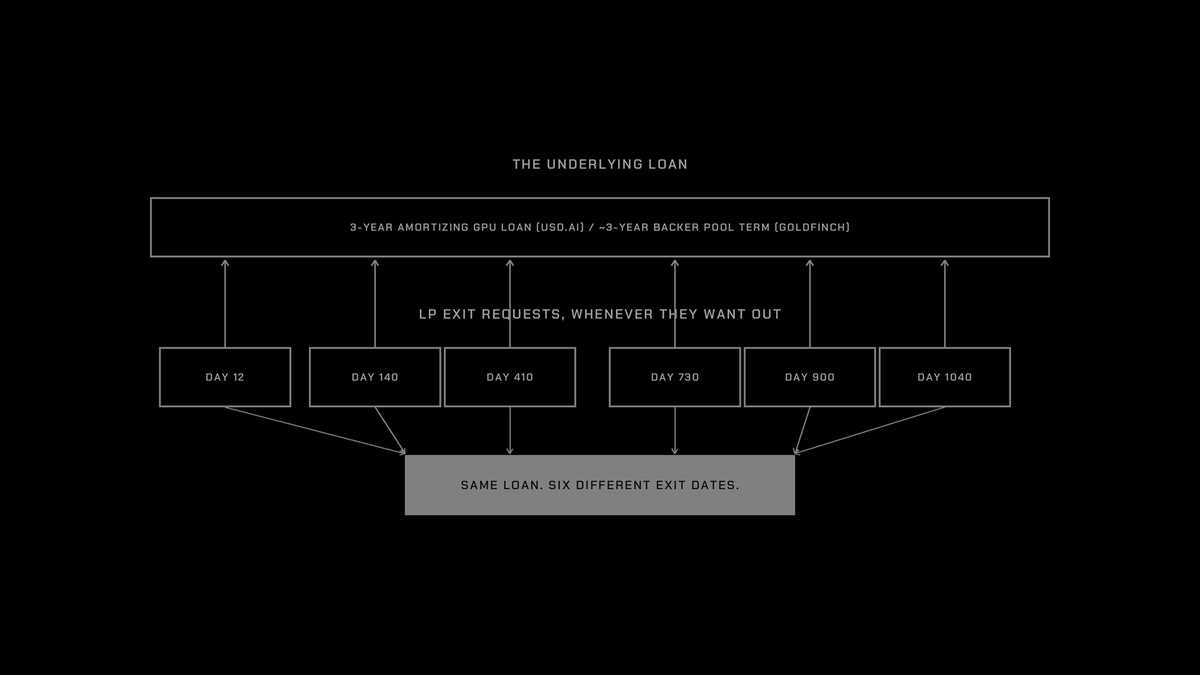
The GPU loans from USD.ai adopt a three-year repayment plan, with interest and principal paid every 30 days. Goldfinch's Backer Pool also had an average term of three years in the past.
In the real world, these conditions are quite normal: companies borrowing money to build GPU infrastructure or businesses borrowing against receivables inherently require longer-term funding.
On the other hand, LPs can deposit anytime and may want to withdraw anytime—whether due to market changes, liquidations elsewhere, or just wanting to change their positions.
Thus, the question becomes: if assets take a long time to recover, but depositors wish to withdraw at any moment, how can protocols reconcile these two ends?
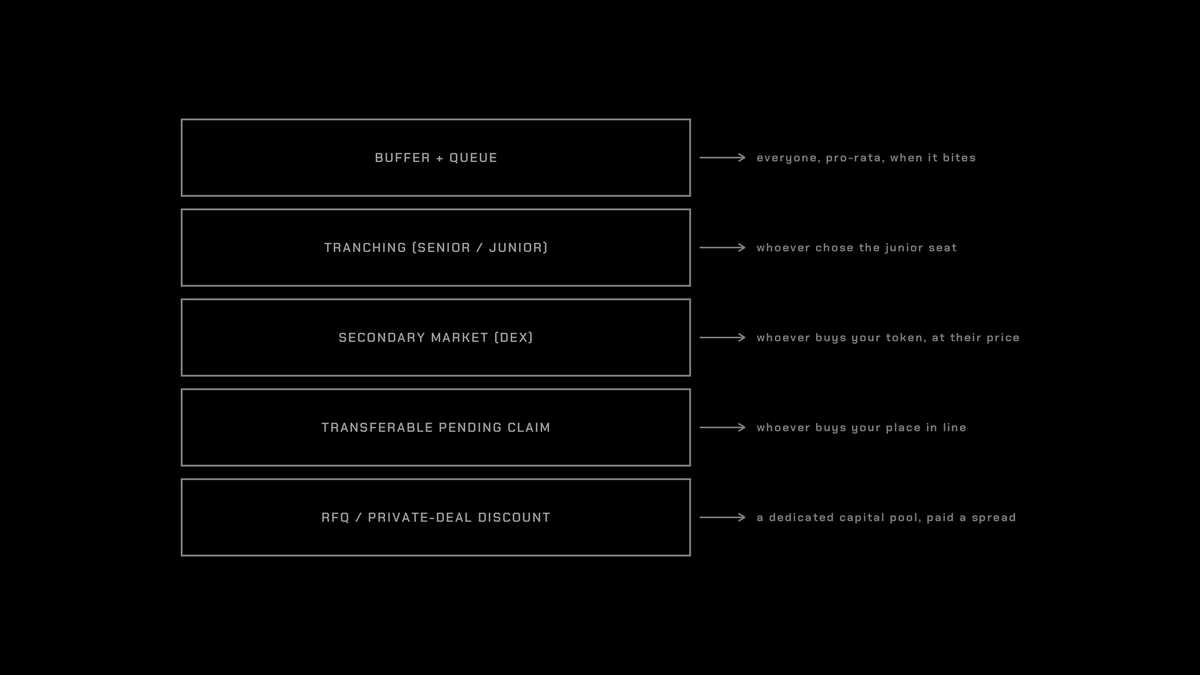
Five Methods to Provide "Early Access to Funds"
1) Keep Some Cash, Queue for the Rest
This is the most common approach. Keep a portion of deposits in cash or liquid assets, waiting for loan repayments to replenish that portion.
USD.ai stipulates that new loans can only account for up to 90% of the sUSDai funds, meaning at least 10% does not enter lending. Withdrawals are queued every 30 days, on a first-come, first-served basis. The protocol will not call back loans early just to allow people to withdraw.
The early version of Centrifuge's Tinlake pool followed the same idea: with a minimum 24-hour cycle, making withdrawals takes precedence over issuing new loans.
Goldfinch's Senior Pool processes withdrawals every two weeks. If there isn’t enough USDC on hand, it proportionally distributes the existing money to all queued individuals rather than a first-come, first-served basis.
This distinction is important: under a first-come, first-served rule, a large investor could take all the new money, leaving others in limbo.
This method relies on the premise that loans are repaid normally. Once the number of people wanting to withdraw exceeds the cash in the fund, the queue may grow longer.
2) Layering: Prioritize Some Investors
Layering divides investors into "senior" and "junior" tiers, altering the sequence of repayment and the risks assumed.
Senior tier investors withdraw their funds first; junior tier investors bear initial losses while typically receiving higher returns.
Goldfinch's Senior Pool (FIDU) essentially diversifies funds across multiple Backer Pools according to the initial design, enabling FIDU holders to withdraw as long as they hold surplus USDC, while Backer funds are locked according to their respective terms.
Centrifuge's Tinlake structure is similar: priority tokens (DROP) have first withdrawal rights, while junior tokens (TIN) come afterward.
However, layering does not resolve the conflict of "assets taking too long, while depositors want to exit anytime." It merely changes who bears the risks and who gets paid first. Senior tiers may enjoy better withdrawal conditions but still need real funds to withdraw.
3) Sell on the Secondary Market
LPs do not redeem from the issuer but instead list their vault tokens on the secondary market for sale.
Maple’s syrupUSDC and syrupUSDT can be sold directly on Uniswap, without waiting for the Maple queue. The trade-off is fees, slippage, and possibly selling below net asset value.
Goldfinch maintains a community-curated FIDU/USDC Curve pool, but the protocol itself is not responsible for this pool.
The main issue is: this liquidity is not guaranteed by the issuer, relying on how many people are willing to buy and at what price.
A token might have a market capitalization of $100 million, yet few may be willing to take it on. What matters is how much can actually be sold within an acceptable discount range.
4) Sell the "Queue Right"
Centrifuge's upcoming ERC-8161 standard presents another idea.
This allows "submitted deposit/withdrawal applications" to be transferable based on the existing "asynchronous vault" (ERC-7540). In other words, you don’t need to wait for your withdrawal application to settle; instead, you sell this "waiting right" to someone willing to wait, usually at a discount.
The buyer takes on your queued request, rather than buying the token and re-queuing.
This is particularly useful for private credit vaults with long withdrawal windows: some investors might need money before their applications settle.
5) Dedicated Vault to Buy Low and Wait
Symbiotic's Liquid Lane offers a fifth pathway that has already been implemented through some "managing vaults," like kpk's USDC RWA Liquidity vault.
Those wishing to exit submit a request for quote (RFQ). The manager sets a minimum discount and maximum purchase amount for each asset, enforcing this through on-chain rules.
The discount ranges published by kpk vary, from only 0.05% for Centrifuge’s JTRSY, JAAA, to some Midas and Pareto assets needing 0.80%–3.00%.
The vault only buys when both conditions are met:
- Buying this asset yields more than what could be earned from depositing this money in the vault's Morpho lending;
- The vault still has at least 50% of the funds available for immediate use.
The purchased assets go directly into a dedicated redemption account, with the vault holding the redemption rights until the issuer settles.
Settlement times vary by asset: some Centrifuge assets settle immediately; some Midas assets take 12–36 hours; while one wrapped Pareto asset takes 32–63 days.
Sellers take a discount and receive funds immediately; the vault earns a bit more for bearing the "settlement wait" risk.
However, there is no insurance backing. If the manager misprices the discount or if the issuer does not redeem at the anticipated net asset value, the losses will directly affect the price of each share in the vault.
What if Loans Cannot Be Repaid?
The five methods above address the issue of "when can funds be accessed," yet none eliminate the risk of "the borrower possibly not repaying the loan."
Goldfinch serves as an example. It once issued around $100 million in loans, with disclosures indicating recovery would take over two years, and actual losses were higher than displayed on its dashboard.
Queueing, layering, and secondary markets were all available at the time; these designs primarily addressed the time difference between "loans repaying normally, but LPs wanting to exit early."
But once loans truly default, the concern shifts from "when can I withdraw," to "how much can I recover?" Offering you an exit does not equate to transforming others' debts into cash.
What Should LPs Focus On?
These methods won't shorten the repayment terms of the underlying loans; they merely change who provides liquidity and who bears the corresponding risks:
- Cash buffer with queuing: If the buffer is exhausted, you can only wait for others' repayments.
- Layering: Senior tiers withdraw first, while junior tiers bear more risks regarding "repayment feasibility" and "waiting time."
- Secondary markets: Sold at market value, possibly below net value.
- Transferring withdrawal rights: Another person takes over your wait, usually at a discount.
- Dedicated vault acquisitions: They buy at a low price, waiting for settlement on your behalf while assuming risks.
If you want to invest in long-duration RWA vaults, I suggest not just looking at APY and disclosed withdrawal times, but also asking four questions: How much of the money can actually be accessed? Who provides it? Is there a commitment to ensure its availability? What happens if several large investors want to withdraw simultaneously? Most importantly, when underlying loans default, will these methods still be effective?
免责声明:本文章仅代表作者个人观点,不代表本平台的立场和观点。本文章仅供信息分享,不构成对任何人的任何投资建议。用户与作者之间的任何争议,与本平台无关。如网页中刊载的文章或图片涉及侵权,请提供相关的权利证明和身份证明发送邮件到[email protected],本平台相关工作人员将会进行核查。