Author:Principia Research
In June 2026, a somewhat awkward refund incident unexpectedly opened a crack in the global capital market infrastructure migration.
At that time, SpaceX, owned by Elon Musk, was landing on Nasdaq. To capture the enthusiastic demand from the crypto world for this century's tech stock, Binance Wallet, in collaboration with third-party tokenization platform xStocks, initiated an on-chain IPO subscription event called SPCXx. On-chain data recorded an astonishing scene: in just a few days, 27,689 independent wallet addresses rushed in, pouring a whopping $557 million in USDC.
However, the outcome was a cold shower. Due to the highly closed underwriting team of Wall Street's traditional primary market, upstream third-party asset vendors simply could not obtain a sufficient amount of underlying SpaceX shares. Binance ultimately had to announce the cancellation of the event, returning $557 million along the same route, and urgently resorted to airdropping $1 million from its own Abu Dhabi entity-issued SPCXB tokens to users as a reassurance.
Most observers viewed this as merely a typical operational episode; however, if you zoom out and piece together a series of capital, licensing, prospectus filing, and team recruitment actions taken by Binance from 2025 to the end of 2026 in the Abu Dhabi Global Market (ADGM), you will see a completely different picture:
The returned $557 million proved that on-chain funds were extremely thirsty for quality equity assets; meanwhile, the cut-off of third-party channels made Binance decisively determined that instead of serving as a traffic entry point for external small RWA packagers, it was better to build its own "on-chain securities exchange" in Abu Dhabi with a complete set of underwriting, clearing, custody, and trading licenses.
I. Why Abu Dhabi? The Dual Anchor Points of Personnel and Sovereign Capital
The crypto industry has never lacked the slogan of "bringing stocks on-chain." As early as 2021, Binance and FTX attempted early equity tokens, but they quickly faltered under the siege of regulatory agencies in Europe and America. Five years later, why can Binance successfully establish a complete set of securities infrastructure this time? The answer lies in Abu Dhabi's (ADGM) personnel genes and sovereign ledger.
The first pivot is the institutional imprint of its leader. Binance’s current Co-CEO Richard Teng (who will co-CEO with He Yi starting at the end of 2025) is not a grassroots crypto entrepreneur. Before joining Binance, he served as Chief Regulatory Officer at the Singapore Exchange (SGX) and later headed the ADGM Financial Services Regulatory Authority (FSRA) for six years from 2015 to 2021. The ADGM digital assets and ledger-based securities regulatory framework, hailed as a benchmark by global institutions today, was largely established by him during his tenure.
The second pivot is the interests bound to sovereign capital. In March 2025, the sovereign AI and technology investment agency MGX, chaired by Sheikh Tahnoon bin Zayed Al Nahyan, a core member of the Abu Dhabi royal family, invested $2 billion in Binance through stablecoins to acquire a minority stake. This was the first time since Binance's inception that external institutional shareholders were introduced.
This $2 billion deal rewritten Binance’s backdrop: it was no longer just a crypto company operating in offshore islands, but officially embedded within the UAE's national fintech and capital market landscape. Merely nine months later (approved in December 2025, officially effective January 5, 2026), Binance announced that it would end the global operational structure of Binance.com in the Cayman Islands, moving entirely under the ADGM regulatory umbrella.
II. Anatomy of Abu Dhabi's Compliance "Four-Piece Set"
If we browse through the public license register and prospectus disclosure documents of the ADGM Financial Services Regulatory Authority (FSRA), we will find that Binance's actions in Abu Dhabi are fundamentally not the routine "compliance of crypto exchanges" (just applying for a common VASP virtual asset service provider license); rather, they strictly followed the sectoral standards of traditional financial market infrastructure (FMI) in London or New York, setting up a closed-loop matrix consisting of "three licensed institutions + one issuing SPV + one on-chain service agent" fully owned by its Irish holding parent company Binance Holdings (IE) Limited:
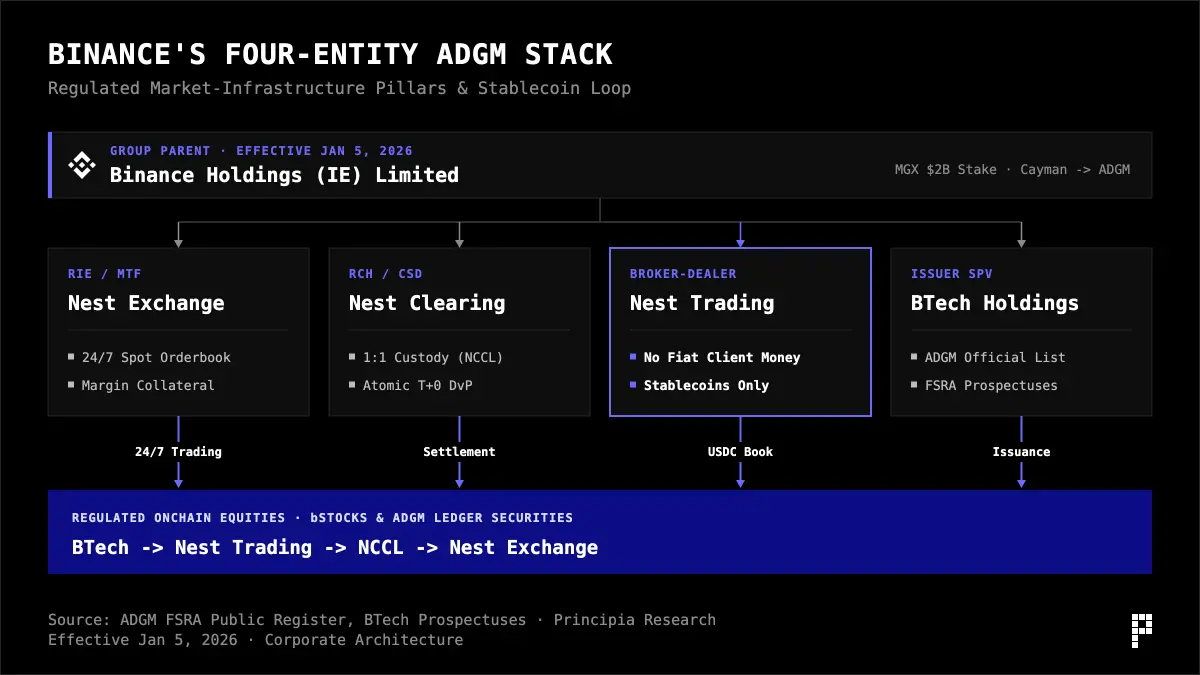
How intricate is this architecture? Comparing it to traditional Wall Street makes it clear:
▪ Nest Exchange Limited holds recognized investment exchange (RIE) and multilateral trading facility (MTF) licenses, acting as Nasdaq or the NYSE;
▪ Nest Clearing and Custody Limited (NCCL) has recognized clearing house (RCH) and central securities depository (CSD) licenses, acting as the US Depository Trust & Clearing Corporation (DTCC);
▪ Nest Trading Limited holds a broker-dealer license, approved to trade as a principal and as an agent for investment transactions. It acts as an underwriting and distribution seat for investment banks;
▪ BTech Holdings Limited (in collaboration with issuance and disclosure agent BTech Services Limited) is responsible for submitting the prospectus to the FSRA and applying to enter the official statutory listing directory of ADGM.
The "abnormal" details within the licenses expose the true intentions: on the FSRA public register, the license of Nest Trading Limited has two intriguing restrictions: first, it is strictly forbidden to hold or control traditional client fiat funds (Client Money); second, its fund service permissions are strictly limited to "recognized fiat-pegged tokens (such as USDC)." To traditional brokers, this is a crippling restraint; but from the on-chain capital market perspective, this is precisely a native design tailored for On-chain IPOs. It bypasses lengthy bank wire transfers and fiat custodial accounts directly from the legal foundation, locking in a pure on-chain closed loop of "compliant stablecoin subscription payment + central depository (NCCL) on-chain T+0 securities delivery (DvP) atomic settlement."
At the same time, the recruitment needs released by Binance in the UAE also confirm this judgment: Its official recruitment system has recently quietly launched positions for "0-to-1 Equity Capital Markets (Equity Capital Markets, meaning traditional investment bank IPO underwriting department)" BD and research analysts, with responsibilities plainly stating "to seek and engage potential listing issuers and investment banks, conduct issuer due diligence, build pricing models for transactions, and submit meeting memos to internal investment committees." If it were just about continuing to buy US stocks in the secondary market for mapping purposes, there would be no need to assemble a team that directly connects with potential listing companies.
III. From US Stock Handlers to Weekly Regulatory Production Lines
Before officially entering the primary market for new stock underwriting, Binance used its own tokenized securities product bStocks to achieve a closed-loop "regulatory and infrastructure stress test" in the second half of 2026.
On June 11, 2026, under the joint operation of international law firm Gibson Dunn and Middle Eastern law firm Al Tamimi & Co., the first batch of bStocks issued by BTech Holdings was officially approved for inclusion in the ADGM Official List and opened on Nest Exchange. This marked Abu Dhabi's first historical inclusion of tokenized digital securities operating on a public chain (BNB Smart Chain, BEP-20 / BEP-677 standard) into the official securities registry.
But this raised a core market question: with shares like Tesla and Nvidia locked within the US DTCC system, how can ADGM claim to manage them "1:1"?
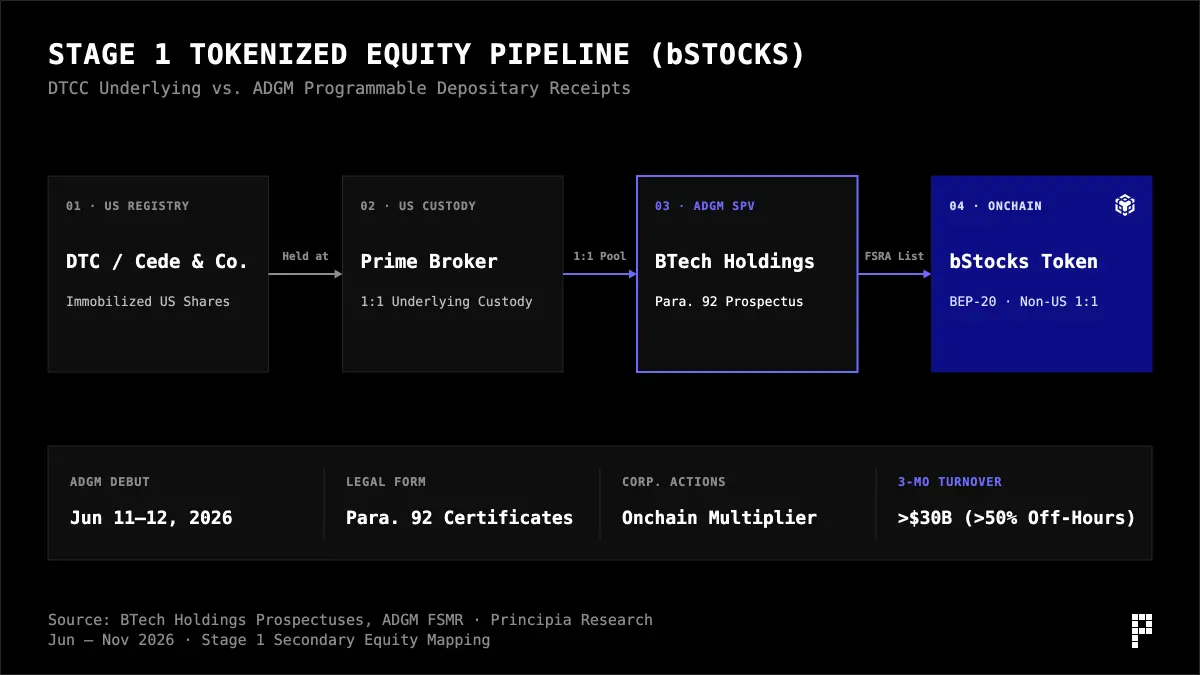
The answer lies in the honesty and transparency of legal qualifications: in the first phase (stock on-chain in the secondary market), true stocks have indeed never left the US DTCC system. The statutory identity of bStocks under ADGM's Financial Services and Markets Regulations (FSMR Schedule 1, Paragraph 92) is "certificates representing specific financial instruments," essentially a form of on-chain depositary receipt. The ADGM regulator does not "endorse" the existence of the assets for the issuer, but instead converts the obligations of 1:1 full segregation custody, periodic reconciliation, and reserves proof into legally enforceable information disclosure and contractual obligations through prospectus approval; on the technical layer, BTech Services has made the process of converting splits and net cash dividends into a seamless on-chain automated component through a multiplier adjustment mechanism built into the contract.
Even more noteworthy is the accelerated pace of approval in the following five months. Traditional securities markets typically take months to approve a prospectus, which can't keep up with the two-week window period for IPO roadshows; however, reviewing the ADGM official access notices from June to November 2026, BTech Holdings managed to transform this regulatory pathway into a "weekly production line":
▪ Early July: The Italian tech group Bending Spoons went public on Nasdaq on July 1 (ticker BSP, priced at $29); BTech quickly passed the independent prospectus approval to go live with BSPB, enabling cross/portfolio margin collateral functions, rehearsing the "rapid follow-up on IPO new shares + derivative collateralization";
▪ Late July to August: approved a three-fold leverage Nasdaq ETF (TQQQ) and highly volatile GameStop (GME), running complex leverage structures and high volatility risk control templates;
▪ September: On the 9th, Hims & Hers and Salesforce went public, followed by CEA Industries on the 14th, and Forward Industries on the 29th. The approval interval was shortened to 5-15 days and for the first time included small and medium market cap crypto treasury companies (DAT), proving that non-blue chip small stocks could also pass approval quickly;
▪ October to early November: approved Blackberry, MongoDB, Penguin Solutions, and volatility index ETF (UVXY) in a single batch on October 13-14, and re-approved Berkshire (BRKB) just six days later (October 20), followed by a rapid approval of a two-fold leveraged Intel ETF (INTW) supplemental prospectus on November 6.
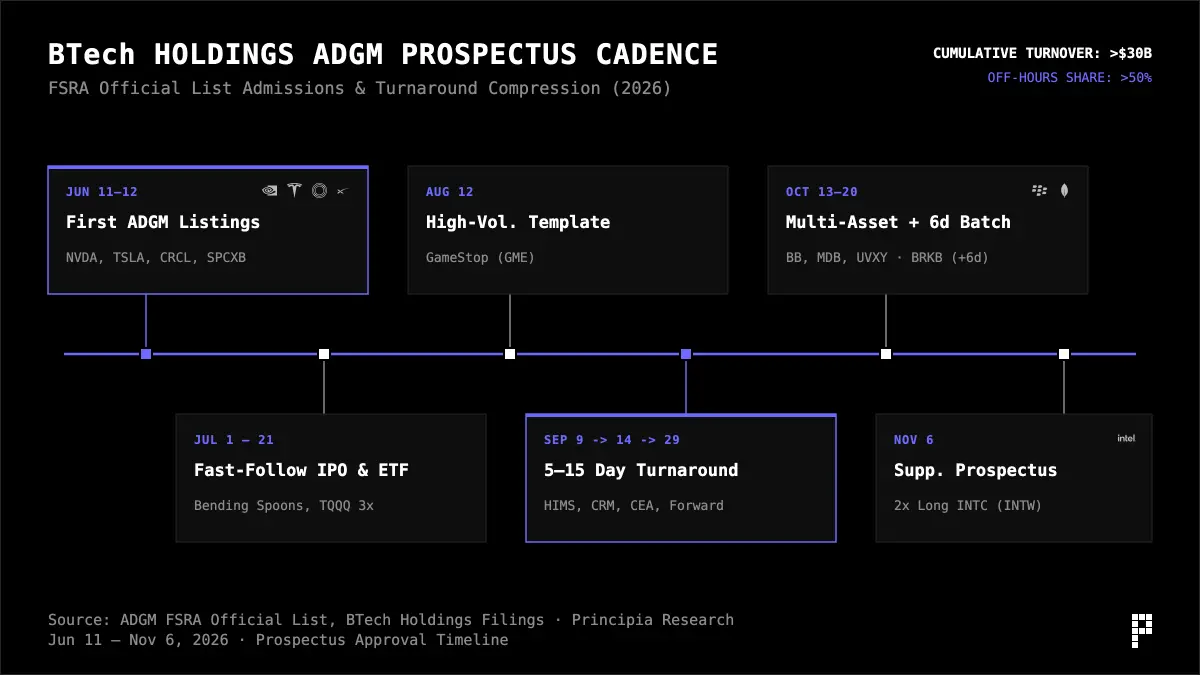
In just three months (by early September 2026), the cumulative trading volume of bStocks directly surpassed $30 billion, with over 50% of the trading volume occurring during US market off-hours (Asia-Pacific daytime, Middle Eastern hours, and weekends). The pipeline, liquidity, market makers, and regulatory coordination were all in place, and the only missing piece was the leap from "secondary market mapping certificates" to "primary market native on-chain IPOs."
IV. The IPO Dilemma and Global Exchange Liquidity Restructuring
Why are global retail investors and issuers seeking a "third channel"? According to full empirical data on Principia's data terminal, the distribution of traditional capital markets has become imbalanced, while the liquidity siphoning effect of crypto trading platforms is evident.
1. Structural Plunder of Traditional IPOs
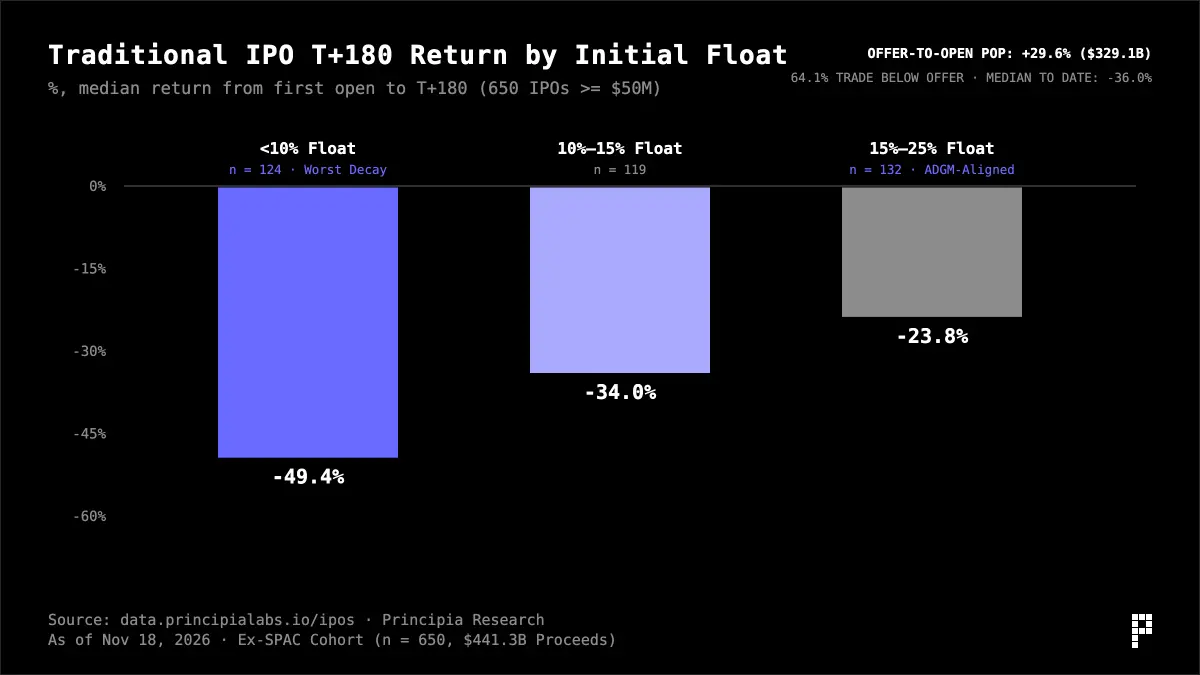
In the 650 traditional IPOs tracked by Principia (raising ≥ $50 million, excluding SPACs, with a total fundraising amount of $44.133 billion), two sets of striking data emerge:
▪ The disconnect between first-day soaring and retail investors being cut off: The average jump in traditional IPOs from the offering price to the first-day opening price is as high as +29.6%. By closing price on the first day, "desktop profits" amount to as high as $329.14 billion. This portion of lower-risk first-day premium is almost entirely allocated by Wall Street banks to institutional old clients. Once retail investors enter the public market after the first day opening, 64.1% of companies end up below the offering price, with the median return since opening day plunging to -36.0%.
▪ The "slow bleeding" pattern of low float: Tracking these 650 IPOs by their initial free float ratio reveals a surprisingly consistent pattern:
▪ 10% ultra-low float (124): The median withdrawal by day 180 reached -49.4% (now -44.4%);
▪ 10%-15% float (119): The median withdrawal by day 180 was -34.0%;
▪ 15%-25% float (132): The median withdrawal by day 180 contracted to -23.8%, halving the decline compared to the 10% group;
▪ Meanwhile, around the 180-day lock-up period (Lock-up Cliff, n=319), low float stocks (Float 15%) face the most severe -10.5% sell-off impact.
This set of empirical data not only explains why on-chain funds crazily rushed in $557 million to grab primary shares when SpaceX went public (because only by hitting the Offer Price could they avoid the structural take-up trap of -36.0% in the secondary market), but it also statistically confirms the scientificity of ADGM MKT Rule 2.3.10 which mandates a real public shareholding of 15%-20%.
2. Where does Binance's real scale stand?
Many traditional finance professionals instinctively believe that "the trading volume of crypto exchanges is far less than that of mainstream securities exchanges." The truth is far more shocking than stereotypes:
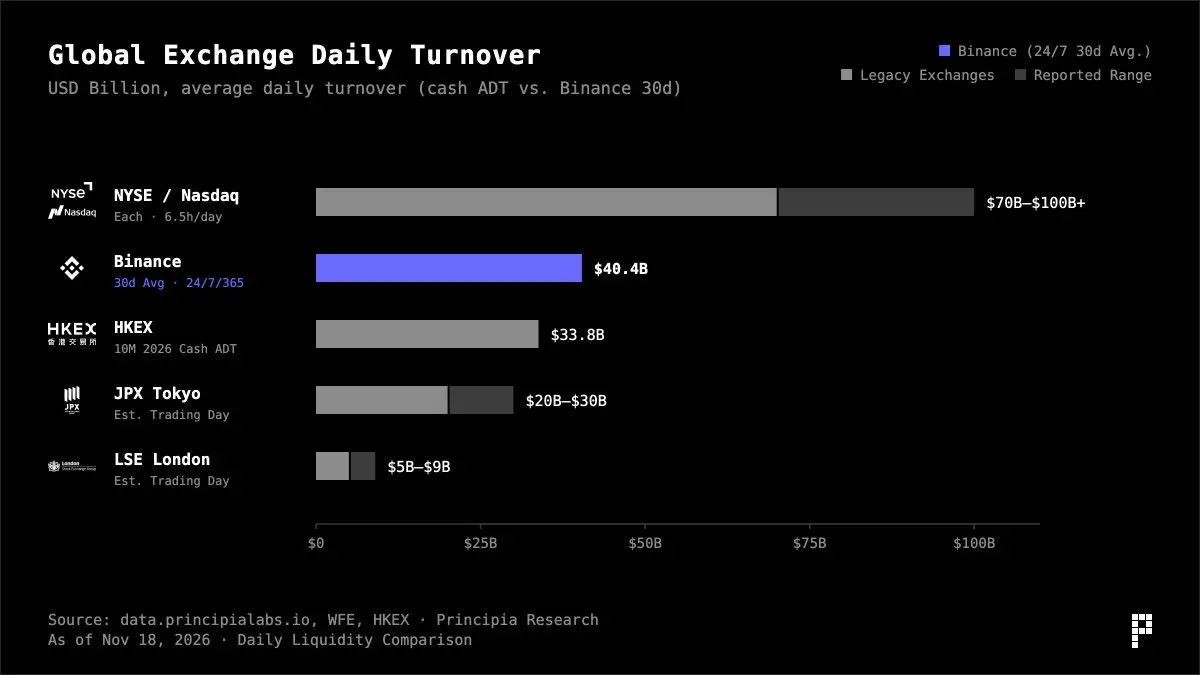
In 2025, Binance's trading volume exceeded $7.1 trillion (on par with Hong Kong Exchange's $7.88 trillion). Binance's 2025 spot volume has nearly matched that of Hong Kong Exchange, with total liquidity and 30-day average trading volume surpassing the daily average for Hong Kong Exchange spot trading.
What’s even more noteworthy is our statistics on the tokenized stocks/ETFs/commodities specialized track (as of November 18, 2026, the total tokenized market capitalization is $8.59 billion, with 804 active assets covering 187 trading venues worldwide):
▪ The entire track had a 24-hour spot trading volume of $1.79 billion and derivative trading volume of $50.52 billion (derivatives are 28.3 times the spot), with outstanding contracts of $11.22 billion;
▪ Among them, Binance alone accounted for 41% of the global trading share (24-hour RWA spot trading $470.6 million + derivatives $20.9 billion + outstanding contracts $3.47 billion, with a spot reserve reaching $112.71 billion), 4.3 times the size of the second-place OKX (9.5% share).
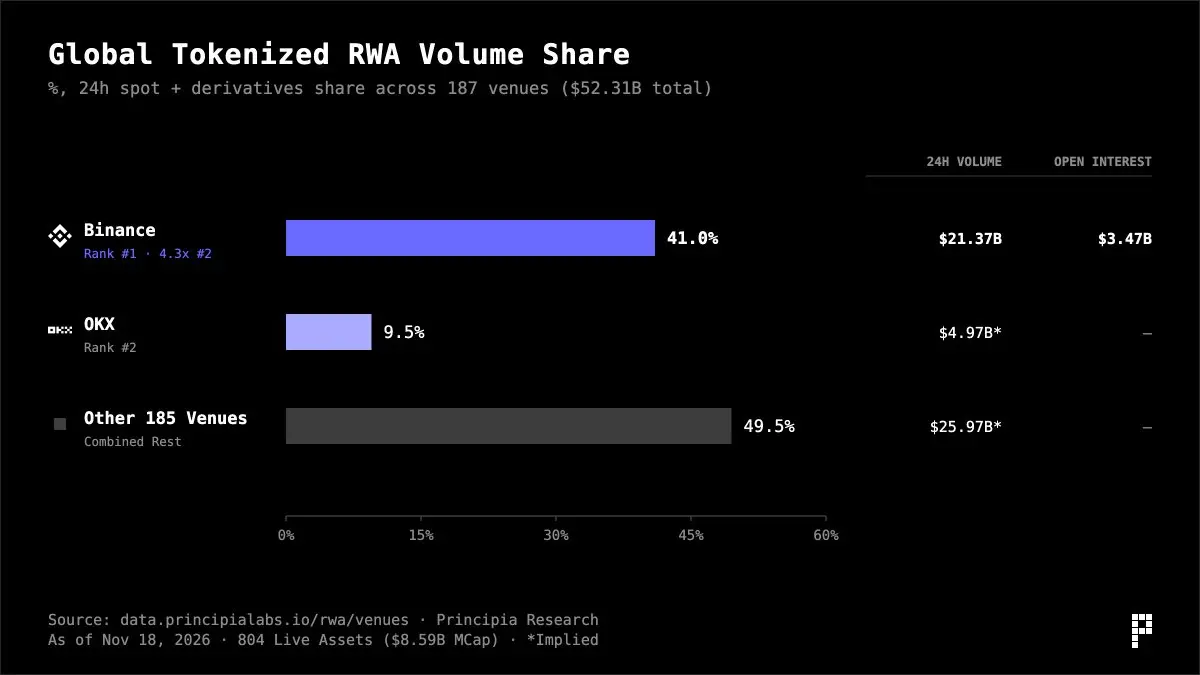
When a super exchange, operating 24/7 and achieving a 30-day average trading volume exceeding $40.4 billion, with 41% of global tokenized asset share, officially obtains legal securities exchange and brokerage full licenses in the ADGM, the dimensional impact on traditional regional exchanges is just beginning.
V. The Forgotten SMEs of Wall Street
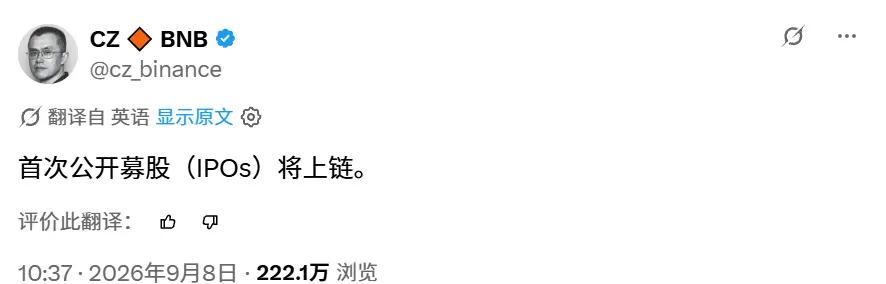
Binance Research has continuously released heavyweight reports such as "From IPO to Internet Capital Markets," pushing the global on-chain equity market into a confrontation along three routes:
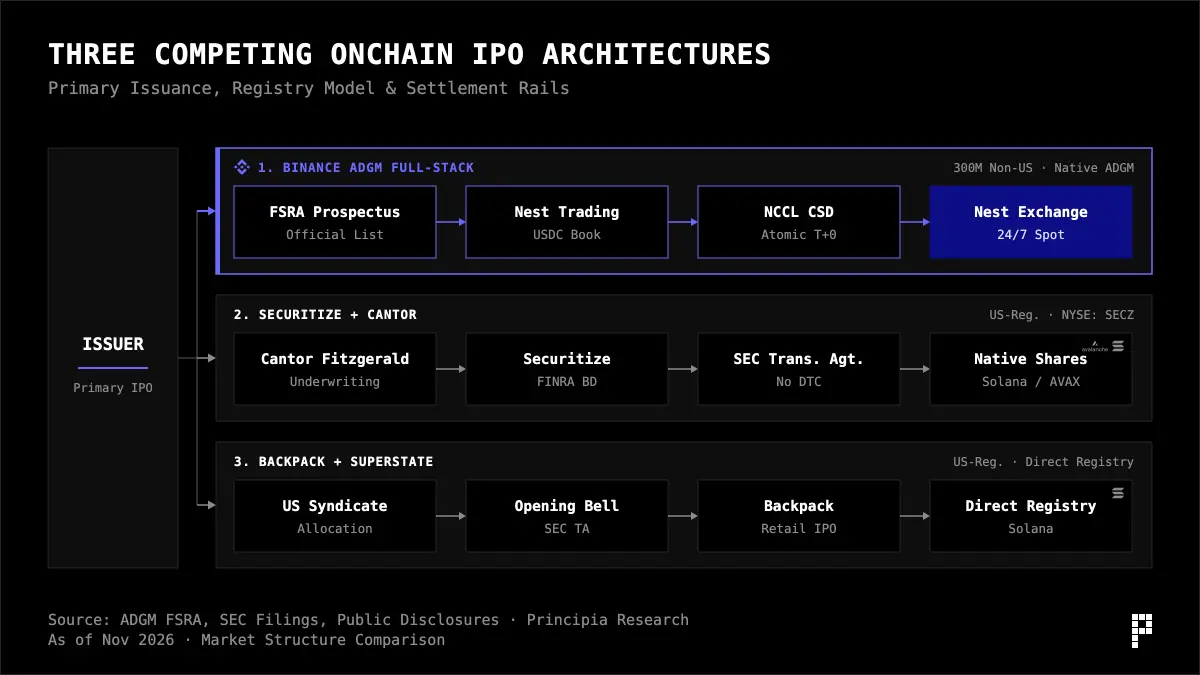
Comparing these three routes together, many people will fall into a misunderstanding: thinking that Binance would compete with Wall Street for the lead underwriting rights of SpaceX or Anthropic (ticker ANT), which is currently in a fundraising sprint of $74 billion.
On the contrary, the main battlefield that could truly make Binance's ADGM on-chain IPO platform explode is not among the multi-billion dollar giants but within the "mid-sized cash cow orphan band" with valuations below $3 billion.
A realistic calculation of the microstructure of the capital market makes it clear:
1. Structural "Abandoned Children" of Traditional Stock Markets vs. Institutional Dividends of ADGM
In today’s Nasdaq or HKEX, a high-quality company with an annual net profit of $3 million to $30 million, and a valuation between $100 million and $800 million (whether it be AI applications overseas, cross-border payment fintech, game publishers, or high cash flow crypto infrastructure), finds itself in a very awkward position:
▪ Going to the US market is too expensive and no one pays attention: Goldman Sachs and Morgan Stanley basically do not pick up IPOs below $1 billion; small second-tier investment banks require upfront costs of $2 million to $3 million just for lawyers, audit, and compliance, plus a 7% underwriting fee, and after listing, with no Wall Street research reports covering them, institutions don't buy in. Maintaining compliance every year would cost another $1.5 million;
▪ Going to the Hong Kong Stock Exchange/New Exchange results in becoming a "zombie stock": Although the average daily trading volume of HKEX is as high as $23.2 billion to $33.8 billion, most of the transactions are siphoned off by heavyweight stocks like Tencent and Alibaba, while the valuations of medium-sized tech stocks are often suppressed to single-digit P/E ratios, with average daily trading volumes sometimes dropping to a few tens of thousands of dollars, losing the functions of refinancing and shareholder exit entirely.
But if this company opts for a native primary listing at ADGM, the thresholds and costs would undergo a cliff-level reconstruction:
▪ Clear and gentle statutory admission: According to ADGM MKT Rule 2.3.15 (profit testing), as long as cumulative profits of $1 million are achieved over the past three years and consolidated profits of $500,000 over the last 12 months (even unprofitable tech companies can take the MKT 2.3.16 asset/market value test: a total market value of $10 million, tangible net assets of $3 million, and preparatory working capital of $1.5 million), they can legally cross the official listing directory threshold;
▪ Official regulatory fees are almost zero: The prospectus approval fee paid to the ADGM regulator ($20,000) plus the official listing entry fee ($3,000) totals only $23,000; even considering international law firms, audits, and market structure consulting, the total hard costs before ringing the bell would only come to a quarter to a third of that of US stock markets.
2. New Wealth Effect
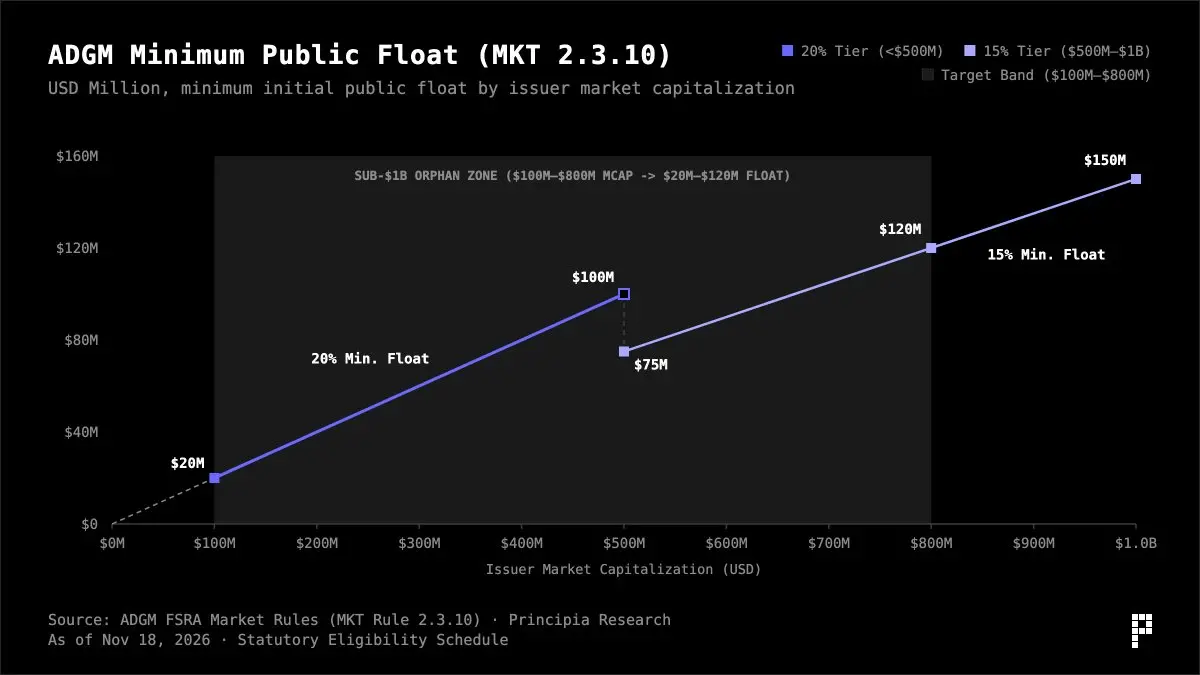
What’s even more sophisticated is the scale matching. According to the tiered public shareholding rules of ADGM MKT Rule 2.3.10:
▪ Issuers with a market capitalization below $500 million must maintain a public float of ≥ 20%;
▪ Issuers with a market capitalization between $500 million-1 billion must maintain a public float of ≥ 15%.
This means that a mid-sized company valued between $100 million to $800 million doing a native on-chain IPO at ADGM would see its public fundraising on the first day and free float market cap fall precisely between $20 million and $120 million USDC. For traditional stock markets, this is merely an overlooked micro-cap stock; but for Binance's ecosystem—which boasts 300 million registered users and a 30-day average total trading volume of $40.4 billion—initial float market capitalization of $20 million–120 million USDC presents a "golden sweet spot" that can easily attract multiple times oversubscription without draining liquidity or generating an extraordinarily high 24/7 turnover rate.
From "pseudo liquidity" to "real public shareholding" paradigm reshuffle: For practitioners accustomed to issuing tokens in Web3, On-chain IPOs will bring a complete rule reshaping. In past token issuances, project parties tended to stuff "tokens lent to market makers + team/ecosystem incentive pools + unallocated foundation shares" into initial circulating chips to make up numbers; however, under ADGM MKT Rule 2.3.10(3) of the securities regulations, holdings by directors and related parties, employee stock ownership plans (ESOP) trust pools, major shareholders owning more than 5%, and non-bought back market maker borrowed stocks are explicitly excluded from "public shareholding." Only shares subscribed by external unrelated investors with real money (or independently held shares not locked before listing) count, which completely ends the notorious "high FDV, fake liquidity, soft exit" problems that have plagued the crypto market.
VI. Will Binance Ever Get on the Table Itself?
Around Binance's series of major actions in Abu Dhabi, there has always been another layer of more imaginative speculation: besides serving as an on-chain IPO underwriting platform for others, could Binance itself (or its Abu Dhabi division) also conduct a native on-chain IPO in ADGM?
Objectively, Co-CEO Richard Teng has publicly stated several times between 2025 and 2026 that Binance has ample cash flow and no plans for a financing IPO in the short term. If we look through the underlying equity structure disclosed in BTech Holdings' prospectus, the Irish parent company Binance Holdings (IE) Limited is still controlled by founder Zhao Changpeng (CZ) as the ultimate beneficial owner (UBO). For the group as a whole to issue common stock publicly, the short-term obstacles remain significant, whether it be the sensitivity of global consolidated financial report disclosures or historical compliance burdens.
However, "the group as a whole not listing" does not preclude "licensed divisions spinning off for trial."
Don't forget two ongoing changes: first, the $2 billion sovereign shareholder MGX that entered in 2025 naturally has institutional demands for mid-to-long-term valuation benchmarks and capital exit; second, on the same day in July 2026 that US tokenization giant Securitize went public on the New York Stock Exchange (NYSE: SECZ), it simultaneously issued its own stock natively on the Solana and Avalanche public chains, proving the feasibility of on-chain public equity to the world.
In contrast, the four entities of Binance's ADGM (Nest trading and clearing system and bStocks business division) have operated independently under strict auditing by the FSRA since January 2026, shedding historical offshore burdens and holding true trading cash flows on an annual scale in the hundreds of billions. If one day in the future, Binance chooses to package a regulated financial business or joint venture in Abu Dhabi separately and initiate a dual listing of a native on-chain IPO on the Abu Dhabi Securities Exchange (ADX) and its own Nest Exchange, it will logically be a brilliant stroke of genius, both in terms of accountability to sovereign shareholders and establishing authority in its own on-chain capital market.
VII. The Birth of New Species Often Accompanies the Rise of New Ecosystems
Looking back over the past decade, the crypto capital market has swung violently like a pendulum: from the unregulated wild token public offerings of 2017 to the distorted "high-valuation VC coins" between 2021 and 2025, and finally returning in 2026 to the convergence point of "real business cash flow + legal securities prospectus + 24/7 stablecoin on-chain settlement."
The infrastructure of "exchange + central depository + stablecoin brokerage + modular prospectus" laid by Binance in ADGM essentially opens a third public capital formation channel (on-chain capital markets) for global growth enterprises, beyond Wall Street and HKEX.
And in this emerging industrial chain, opportunities are far from limited to the exchanges themselves. After all, when the bell of the securities exchange rings for the first time on a 24/7 blockchain ledger, all pricing languages, underwriting paradigms, and liquidity rules will be rewritten, and a new wealth effect may quietly arrive. Binance's next goal is to serve 3 billion people, which will be a bold attempt capable of changing existing human financial rules.
免责声明:本文章仅代表作者个人观点,不代表本平台的立场和观点。本文章仅供信息分享,不构成对任何人的任何投资建议。用户与作者之间的任何争议,与本平台无关。如网页中刊载的文章或图片涉及侵权,请提供相关的权利证明和身份证明发送邮件到[email protected],本平台相关工作人员将会进行核查。