There are no perfect tax avoidance shortcuts, only tax planning suitable for one's own funding cycle and risk tolerance.
Written by: Andrew Fenton
Translated by: Chopper, Foresight News
From establishing self-managed super funds (SMSFs) to registering a company, and even emigrating overseas, Australian Bitcoin holders can respond to the significant increase in capital gains tax (CGT) coming into effect in 2027 through these schemes.
The Australian government eliminated the 50% capital gains tax discount on all investment types in the May budget, a decision that has caused a significant impact on cryptocurrency holders. Under the new tax regime, the share of taxable gains has nearly doubled, retaining only a small part for inflation offset.
However, as long as preparations begin now, investors still have legal ways to reduce capital gains tax expenses. Some Australian crypto holders have taken aggressive measures: Finder founder and prominent figure in the crypto industry, Fred Schebesta, chose to move to Singapore, where there is a 0% capital gains tax, claiming the tax reform was a "fatal blow."
Of course, there are relatively moderate ways to reduce taxes, such as establishing a self-managed super fund (SMSF), setting up a company to trade cryptocurrency at the corporate tax rate, or simply hoping the opposition party will overturn these policies after the next election.
How will capital gains tax change starting July 1, 2027?
Since 1999, Australian asset holders have only been required to pay tax on half of their capital gains. Starting July 1, 2027, investors will need to pay tax at the full personal income tax rate: for gains between AUD 45,000 and AUD 135,000, the tax rate is 30%; for the portion between AUD 135,000 and AUD 190,000, the tax rate is 37%; for amounts exceeding AUD 190,000, the tax rate is 47%. All amounts in this article are in Australian dollars.
Even worse, low-income groups such as students and retirees who do not receive benefits will face a minimum capital gains tax rate of 30%, regardless of their gains.
The only remaining offset is an inflation indexation adjustment based on the cost base. For example: if you purchase property for AUD 1 million in 2027 and sell it for AUD 1.5 million ten years later, if inflation remains at 3%, about AUD 344,000 of the increase is due to inflation and is not taxable.
Swyftx CEO Andrea Yuen explains, "The challenge with cryptocurrencies is that this indexation offset is better suited for assets with slow growth rather than high-growth assets."
For example: if you buy Bitcoin for AUD 10,000 and sell it for AUD 100,000 ten years later, the inflation offset is only approximately AUD 3,439. Under the old policy, tax was only due on AUD 45,000 in gains; under the new policy, taxable gains become AUD 86,561.
Stockspot analyst Chris Bryki compared the tax burdens of the top ten asset classes under the new rules. He wrote in The Australian that "crypto assets rank last because nearly all of their gains come from capital appreciation. Speculative investments will see even further shrinkage in post-tax returns."
Here are several strategies that crypto investors can adopt to cope with the changes, varying in difficulty from simple observation to a complete restructuring of personal financial arrangements.
Strategy 1: Hope for a bull market before July 2027
Gains realized before July 1, 2027, will still apply to the old rules and enjoy a 50% tax discount. The ideal scenario is that before this date, a bull market pushes the value of holdings higher. You need to completely record the valuations of all crypto assets on that date, and any gains above this valuation will be taxed at the higher new tax rate.
Ben Simpson, founder of the crypto consultancy Collective Shift, indicates that the performance of Bitcoin since mid-year provides support for further rises before July amid a pressured macro environment. However, Simpson specifically notes that he is not a financial advisor, adding, "I wouldn't bet everything on a major bull market." "I think the Bitcoin halving in May 2028 will be the main phase for releasing returns. So this method may not be advantageous for investors."
Yuen also suggests that price movements are not controlled by human intervention: "If you are just holding out hope, that can't truly be called a strategy."
Strategy 2: Vote for parties promising to overturn the tax reform
The opposition coalition and the minor party One Nation have promised to repeal the tax reform if they come to power. Cryptocurrency voters who care deeply about this policy can use this as a basis for voting to push for a government change.
However, the ruling Labor Party holds 94 out of 150 seats in the House of Representatives, making it difficult to force them out of office. Even if a government change occurs, and the bill passes swiftly in the Senate, it may theoretically be possible to repeal the new policy before the tax season in July 2028. The more likely scenario is that relevant adjustments will occur after the tax reporting cycle. Adrian Forza, head of the Australian crypto tax agency Crypto Tax Australia, states this will complicate the reckoning of gains. "At that time, calculations will have to be done in three ways, which will be very troublesome, but in the long run, it will be more favorable for investors."
Strategy 3: Transfer crypto assets into a self-managed super fund (SMSF)
Australia's retirement system is referred to as superannuation, and investors can withdraw assets from their retirement accounts tax-free once they reach the age of 60, while assets can continue to appreciate.
Standard retail super accounts do not allow customers to invest in cryptocurrencies; to avoid taxes this way, one must establish a self-managed super fund (SMSF). About one-third of Simpson's high-net-worth clients configure crypto assets through SMSFs.
"Continuously buying and accumulating Bitcoin inside is a very sound strategy." However, he warns against heavily investing in altcoins, "Retirement funds are for ultra-long-term configurations; using it to bet on short-term altcoins is akin to risking your retirement life."
AMP, a large Australian super fund, has invested in Bitcoin, but does not offer this channel to ordinary customers.
This 27-year-old founder also points out the biggest shortcoming of SMSF: young crypto investors cannot access these funds for decades. "You won't touch a penny before retirement; you can only realize gains when you're very old."
This scheme is better suited for high-net-worth investors over 50 years old with shorter waiting periods.
The government has also raised the operational threshold for SMSFs, with a large amount of compliance paperwork, auditing requirements, and various fixed fees, making it difficult for smaller investors to bear the cost. Annual costs are typically between AUD 2,000 and AUD 4,000; if investing solely in Bitcoin or Ethereum ETFs and using services like Stake, annual fees can be reduced to about AUD 1,330.
Another limitation: to place crypto assets into an SMSF, one often needs to sell first, pay taxes, and then repurchase using fund capital; there are also annual contribution limits. However, Forza states that with proper planning, one can transfer nearly AUD 400,000 worth of assets to the account in a single transaction.
Strategy 4: Use Bitcoin for collateralized lending to avoid triggering a taxable event for capital gains tax
Many wealthy individuals are employing this tax reduction strategy: using assets as collateral for loans, where the repayment cost is often lower than the tax owed on selling the assets. Now Bitcoin holders have many lending platforms to choose from, BlockEarner, Vield, and Swyftx all support using BTC as collateral for loans.
Yuen jokingly states, "We want to bring this strategy, which used to belong only to the wealthy, to ordinary investors."
However, ordinary people do not have the same financial reserves as the wealthy, making this strategy quite risky: loan interest rates tend to be high, and loan terms are usually only 12 months; if market conditions reverse, there is a risk of liquidating the pledged Bitcoin, and one cannot borrow the full value of the asset, with Swyftx's collateral ratio being around 40%.
"Once the collateral value drops below the threshold, a margin call will be triggered." She says, "It's equivalent to betting on prices going up. You must determine that cryptocurrency will rise or at least not plummet to trigger liquidation; otherwise, crypto collateralized loans are not suitable for you."
Simpson does not actively recommend this strategy but acknowledges there can be profits if timing is right. For example, if borrowing costs 10% and Bitcoin maintains a historical annual rise of 33%, the final net profit would be better than simply selling and paying taxes. But he warns this is leveraged gambling and only suitable for sophisticated, experienced investors. "If your assets are heavily concentrated in cryptocurrency and you don't have additional backup funds, I wouldn't recommend trying; the risks are significant if you don't understand the rules."
In the past year, Bitcoin has dropped by 28%, and many investors who entered borrowing a year ago have already received margin call notifications and face liquidation while also bearing interest.

Using Bitcoin as collateral to secure a loan for a house down payment has become an increasingly popular practice.
Forza also reminds that in some scenarios, crypto lending itself may be deemed a taxable event, particularly evident in DeFi lending. For instance, depositing ETH into Aave automatically converts it to WETH, which triggers taxation; withdrawing will again trigger a taxable event.
Lending through centralized platforms like BlockEarner and Swyftx is currently in a regulatory gray area, with the Australian Taxation Office (ATO) not yet clearly defining whether it constitutes a taxable event.
"Borrowing AUD 10,000 is not a big issue. However, if you hold 3-5 Bitcoins, I wouldn't recommend taking the risk. Once the market turns against you, the tax still has to be paid."
"Currently, only Vield has received a private tax ruling confirming that its products will not trigger a taxable event, while other platforms have not." Swyftx stated it has not received such a ruling and recommends clients consult tax advisors individually; BlockEarner did not respond to related inquiries.
Strategy 5: Move overseas to a country with a 0% capital gains tax
The impending tax adjustments in Australia have prompted prominent figures in the crypto industry, including Finder founder, to relocate to Singapore, becoming a "tax exile" for tax avoidance.
Starting next July, the highest marginal tax rate on long-term capital gains from crypto assets will rise to 47% (with cost base adjustments according to inflation).
For single crypto investors with strong income growth potential, leaving Australia is becoming an increasingly attractive "ultimate option."
Popular crypto centers like Singapore, Portugal, Malta, the UAE, and Hong Kong offer 0% capital gains tax policies to attract high-net-worth investors for long-term crypto asset gains.
Ben Simpson, founder of the crypto consultancy Collective Shift, states that a number of clients have already put this into action. "Indeed, quite a few people are packing up and thinking: forget it, I'm moving to places like the Bahamas."
Swyftx CEO Andrea Yuen is well aware of the tax advantages of moving overseas.
"I lived in Singapore for 30 years and fondly remember its 0% capital gains tax policy." However, she did not move to Singapore initially for tax avoidance, and she also cautions that simply moving to pay less tax is a very radical choice.
"I would never advise anyone to simply plan their life around tax results. There are many good reasons for me to choose to settle back in Australia.
If your only reason to emigrate is to avoid taxes on crypto assets, you really need to reconsider."
Simpson himself spends half the year managing Collective Shift's business in the U.S. and has considered immigration, but after researching relevant regulations, he dismissed the idea.
"You almost have to cut off all associations with Australia. This strategy only works if you genuinely want to live abroad long-term, spend most of your time away from Australia, and forgo all related benefits like local healthcare."
"Bitcoin Jesus," Roger Ver, renounced his U.S. residency in 2014, and ten years later he was prosecuted for failing to report the value of his crypto assets and not paying exit taxes, ultimately paying nearly $50 million to settle the case.
Likewise, investors choosing to leave Australia will also face a hefty exit tax, sometimes having to sell off a large amount of their crypto holdings to settle taxes.
Adrian Forza, head of the Australian crypto tax agency Crypto Tax Australia, states, "Taxation is due when leaving. If you have accumulated significant unrealized gains, you will be taxed at exit. Even if future tax rates are higher, you still have to sell off assets to pay taxes now, which is hard to accept."
Forza adds that investors can choose to defer tax payments, but subsequent asset sales will be taxed on the entire gain. So, if you expect Bitcoin to rise further, paying exit taxes now would actually be more economical.
Strategy 6: Establish a company to access corporate tax rates
27-year-old Simpson does not want to lock his crypto assets for forty years. Thus, he chose to trade and hold cryptocurrency through a company, benefiting from a 25% corporate tax rate.
The difficulty of registering a sole director company is not as high as imagined, but only investors with larger capital reserves who trade frequently would find it worth the hassle. You need to register a company with the Australian Securities and Investments Commission (ASIC), pay annual fees, hire an accountant to prepare financial statements and file corporate taxes; if you also want to pay yourself a salary, you need to handle payroll systems and pay into superannuation. When you need money, you can withdraw funds through dividends.
"If you want to cap your capital gains tax at the corporate tax rate, the company structure would be very fitting." However, he also points out a key risk: when you withdraw funds from the company, you still need to make up the difference between the 25% corporate tax and your personal marginal tax rate.
"You will ultimately have to pay tax at your personal marginal tax rate, and if you apply the top bracket of 47%, the results will be the same as the previous capital gains tax rate."
Many people may wonder: since the final tax rate is the same, why spend money and energy to operate a company?
Simpson explains the core advantage: in the process of frequent trading and portfolio adjustment, each sale only requires 25% corporate tax. Compared to the 47% capital gains tax, each transaction can save up to 22% in taxes, which can lead to significant long-term compounding gains.
"The profits that originally needed to be taxed at 47% now only require a 25% tax under the corporate entity. After-tax funds can continue to be invested in the market, increasing your investable capital."
However, if trading frequency is very low, the applicable tax rate might rise to 30%.
Forza states that this structure shows more obvious benefits for high-income individuals: "If you are single and earning AUD 150,000 or even AUD 200,000 or more annually, setting up a company would be a very good choice, especially now that the capital gains tax discount policy has been abolished."
However, if you are only holding Bitcoin long-term and trading infrequently, this structure holds little significance and it will be hard to cover operational costs.
Strategy 7: Exit the crypto market to avoid high capital gains taxes
The former 50% capital gains tax discount will be replaced by an inflation-indexed discount, with the new mechanism incorporating inflation factors into the calculation of the original asset cost.
This means that investors who hold dividend-paying stocks or index funds long-term will receive stronger tax offsets. Should one sell off crypto assets and switch to buying ETFs to save on taxes?
In short: it isn't cost-effective. This new inflation-indexed "discount" is essentially just the real gains calculation after subtracting inflation and does not really qualify as a true benefit.
Simpson believes that although the tax reform significantly impacts the crypto industry, crypto assets still have excellent risk-reward ratios.
"In my view, Bitcoin's long-term growth potential far outweighs the impact of taxes. As long as the portfolio is reasonably constructed, its upside potential remains substantial."
Historical trends show that even amid significant volatility and prolonged bear markets, long-term gains from holding Bitcoin generally outperform ETFs after taxes are accounted for. However, altcoins carry much higher risks, with the potential for either doubling returns or dropping to zero.
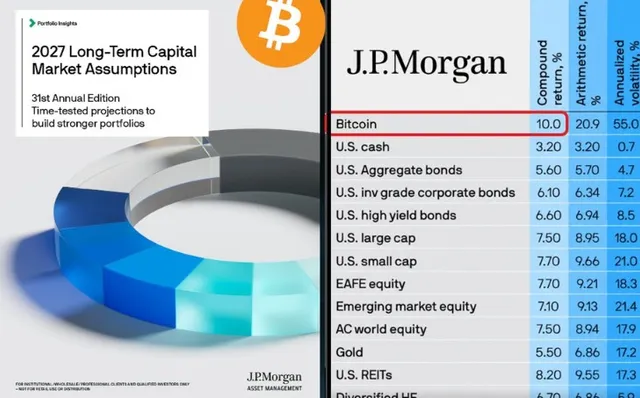
JPMorgan predicts that Bitcoin's future annual compound returns may reach 10%.
Simpson convinced his low-income sister, who works in basketball, to invest in Bitcoin two years ago instead of saving money in a savings account. "Her holdings have increased by 40% to 50%. She says that money will help her buy a house sooner, which is much better than just cash sitting in the bank being slowly eroded by inflation."
This underscores the significance of continually accumulating Bitcoin; for most ordinary individuals, tax burden is not the foremost concern.
Yuen also mentions that cryptocurrency is one of the few assets capable of yielding double-digit returns or even doubling principal within months. Even under the new rules, investors who take profits are still making money.
"My father often says that making a profit is a good thing, and paying some tax on it is only natural." Of course, no one willingly pays taxes, but after tax deductions, you still retain profits.
免责声明:本文章仅代表作者个人观点,不代表本平台的立场和观点。本文章仅供信息分享,不构成对任何人的任何投资建议。用户与作者之间的任何争议,与本平台无关。如网页中刊载的文章或图片涉及侵权,请提供相关的权利证明和身份证明发送邮件到[email protected],本平台相关工作人员将会进行核查。


