The existing cash flow in the crypto market contains a set of potential markets.
Written by: @thenarrator
Translated by: AididiaoJP, Foresight News
Almost every crypto transaction hides another transaction within it.
Some buy ETH exposure through perpetual contracts while also taking on the risk of funding rates. Some borrow against collateral while also accepting the risk of interest rate fluctuations. Some conduct business around trading activities, their income tied to fees generated by these activities.
The first type of exposure is usually the reason they entered the market. The second is incidental.
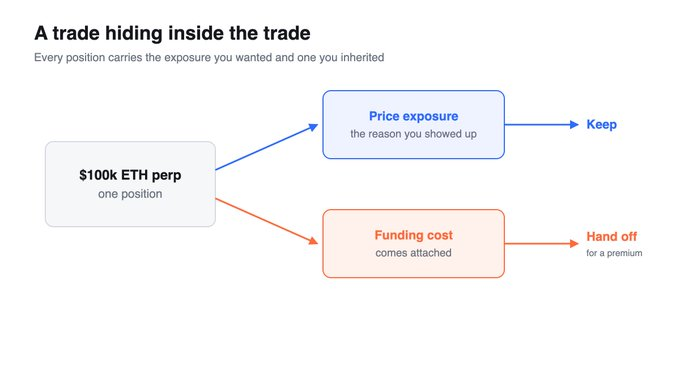
This distinction raises an interesting thought experiment: what happens when risks that people originally accepted as a cost of participation become something that can be traded independently?
Traders can be bullish on ETH but not want to shoulder an unpredictable funding fee bill. Borrowers might want funds but don’t want to bear the uncertainty of costs. In both cases, they have things they want to keep and things they are willing to pay to shed.
Being on the other side of such uncertainty could be one of the most undervalued assets in the crypto world.
Assume a trader holds a $100,000 ETH exposure, believing ETH will rise. The funding rate is another variable that affects the economics of this position. It could become very costly while their original judgment remains valid.
Closing out can resolve the funding fee issue but also eliminates the desired exposure. The same goes for reducing the position, but to a lesser extent. If there were an independent claim for funding costs, it would introduce a new possibility: retaining price exposure while offsetting part of the cost to maintain it.
At this point, a regular bill starts to resemble an asset in financial markets.
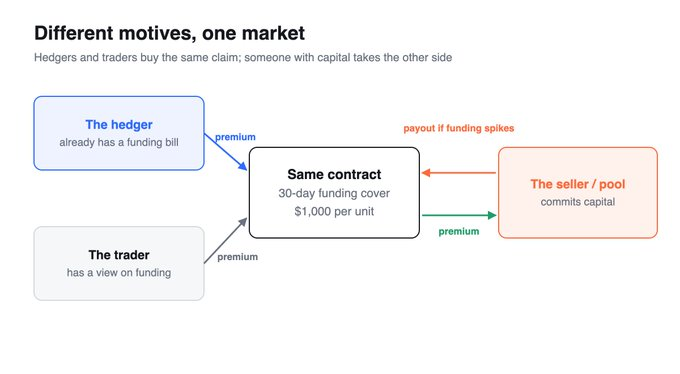
Imagine a contract covering a fixed 30-day window. Each unit corresponds to a $1,000 exposure. If accumulated funding fees exceed a pre-agreed threshold, excess costs would be compensated based on the reference amount, up to a cap.
A $10,000 position might use 10 units, while a $100,000 position would use 100 units. Everyone trades under the same rules, just with different quantities.
Mathematically, it’s not complicated. The interesting part of the structure is that the buyer doesn’t necessarily have a funding fee bill.
One person buys because a rising funding fee would hurt their existing position. Another person buys because they believe the contract undervalues the potential payout. The seller on the other side finds the premium reasonable relative to the obligation incurred.
Different motivations ultimately converge on the same claim.
This represents a useful connection between prediction markets and hedging. The market can express divergent views on the future while serving those who already have stakes in it. Hedgers come with existing exposure; traders come with price perspectives. To achieve the same payouts, orders can meet in the same market.
But once protection is involved, the nature of the payout becomes much more important.
A binary contract that pays $100 when the funding fee exceeds the threshold treats minor breaches and extreme spikes equally. This is entirely consistent as a contract. Whether it is useful for hedging depends on whether the $100 is close to the actual costs faced by the holder.
For variable costs, the probability of exceeding the threshold only tells part of the story. Severity determines how painful it is once the threshold is breached.
Payouts that increase with excess funding fees capture another part of the exposure. Caps limit the seller's obligations. A fixed observation window gives both sides a clear measurement period. These choices determine what risks are actually transferred.
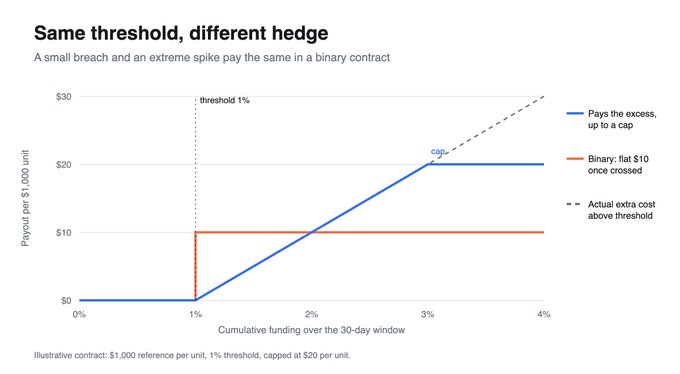
Calling a product "protection" does not establish this relationship. The payout structure must match that claim.
Standardized contracts encounter difficulties the moment they meet real positions.
Two traders may each hold $100,000 in ETH exposure, yet their costs may differ. One holds a fixed amount of ETH, the nominal USD value of which fluctuates with price. The other adjusts their position to keep the USD amount roughly constant. A third one exits mid-way.
Positions are changing while contracts proceed according to fixed rules established at issuance.
This mismatch leads to basis risk. Payouts could be less than losses, greater than losses, or not materialize when the holder incurs actual costs. Matching initial nominal amounts is helpful, but it won’t make exposures perfectly identical.
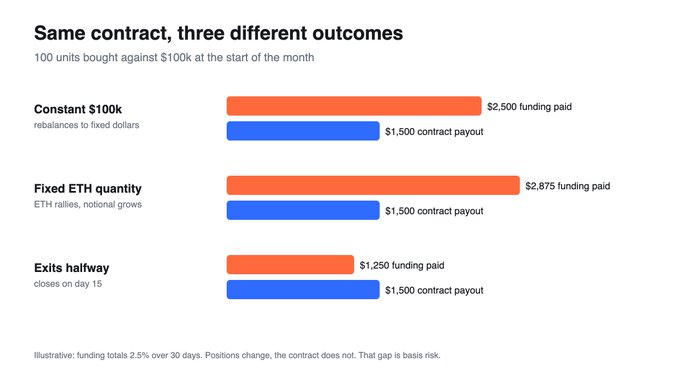
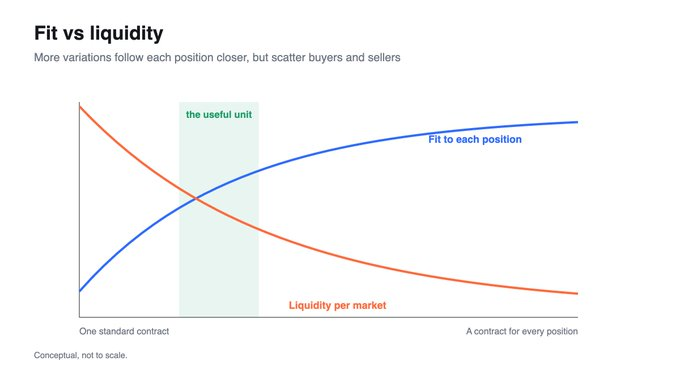
This creates a core tension in design: highly personalized contracts can better align with a single client but become harder to trade alongside others; standardized contracts provide participants with a common item to trade but leave individual differences outside.
More variations of contracts can improve matching but would scatter buyers and sellers into smaller markets.
Useful units exist in this trade-off: a risk is shared closely enough by enough people that, despite mismatches, a joint contract still has value.
Timing adds another dimension. Funding fee costs can erode available collateral throughout the month, while protection might only pay out at the end of the month. Even if it ultimately offsets costs, payouts might come too late to prevent earlier cash shortfalls.
The final amount and the timing of payout are two distinct attributes of hedging.
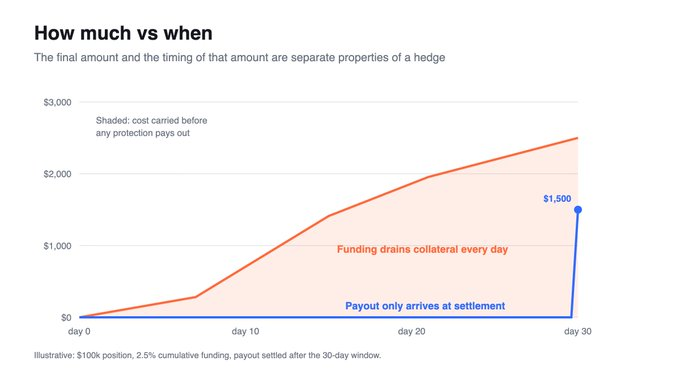
This distinction also explains why protection against funding fees does not automatically equate to protection against liquidation. The underlying positions still have price risks, collateral requirements, and their own cash flow arrangements. A claim held elsewhere may not help fulfill account obligations when they come due.
There’s a similar concrete problem on the other side of the contract: someone has to be able to pay.
It could be another participant or a pool of committed capital. In either case, the premium is compensation for assuming uncertain liabilities. Claims can lower returns. Multiple claims may arrive simultaneously. The capital set aside to meet unmet commitments cannot simultaneously be treated as freely withdrawable capital.
Returns come from successfully bearing this obligation over the long term.
Risk-bearing capacity becomes more precise here: it is the available capital under terms that allow protection to be useful, including in the event of adverse outcomes. Its value depends on the commitments attached to it, the concentrated risks within, and the price charged to provide such capacity.
Simply looking at a large capital pool does not clarify these attributes.
It also does not guarantee that existing contracts can be sold. Assets reserved for settlement respond to "can it pay out," while secondary liquidity answers "are there people willing to buy before that, and at what price." One market can solve one problem while leaving another unresolved.
This encompasses various familiar disciplines. Prediction markets provide a way to trade views on outcomes. Derivatives offer varied payout structures. Actuarial mathematics describes losses and the capital needed to absorb them. Market microstructure determines whether participants can enter and exit at useful prices.
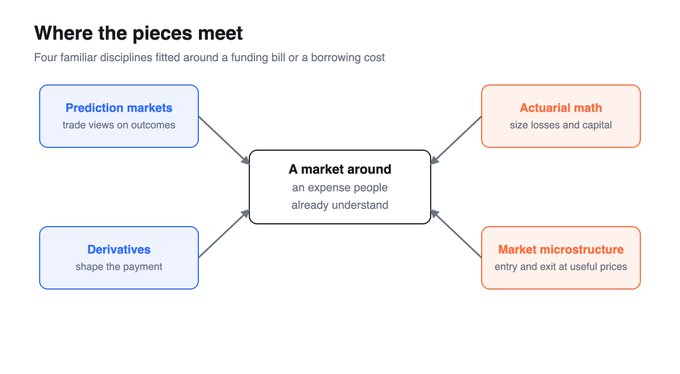
The opportunity lies in how these components fit together around a cost that people already understand.
Funding fee bills are concrete. Borrowing costs are too. Clients do not need to form a view on the new financial instrument ahead of time. They need to understand what may become costly, what the contract will pay, and what they are still responsible for.
Economic testing is equally concrete. When these answers can complement one another, the market can endure.
Seen this way, the existing cash flow in the crypto market contains a set of potential markets. Each position brings costs, dependencies, and uncertainties beyond screen prices. Some are too personalized to standardize. Others may be shared broadly enough to become standalone contracts.
The capacity to absorb these uncertainties has value because others have reasons to transfer them away.
Making this capacity measurable, financeable, and tradable is what presents an interesting opportunity.
免责声明:本文章仅代表作者个人观点,不代表本平台的立场和观点。本文章仅供信息分享,不构成对任何人的任何投资建议。用户与作者之间的任何争议,与本平台无关。如网页中刊载的文章或图片涉及侵权,请提供相关的权利证明和身份证明发送邮件到[email protected],本平台相关工作人员将会进行核查。


