Author: Kuri, Deep Tide TechFlow
The staking products of small and mid-cap public chains have finally squeezed into U.S. brokerage accounts, but the trading volume on the first day is nearly negligible.
On November 5, Canary Capital’s Canary Staked INJ ETF (code INJC) officially began trading on Nasdaq. This is the first listed staking ETF for Injective (INJ) in the United States.
According to Yahoo Finance data, the trading volume on the first day was only about 2,933 shares, opening at $25.15, reaching a high of $26.45, and closing at about $26.15. Canary’s official website showed a net asset of approximately $15 million at the same time, corresponding to the seed subscription previously promised by the Injective Foundation, holding about 1.91 million INJ, with a NAV of about $25, and a premium/discount close to 0.
During the same period, influenced by positive news, INJ itself rose by 9% within 4 hours.
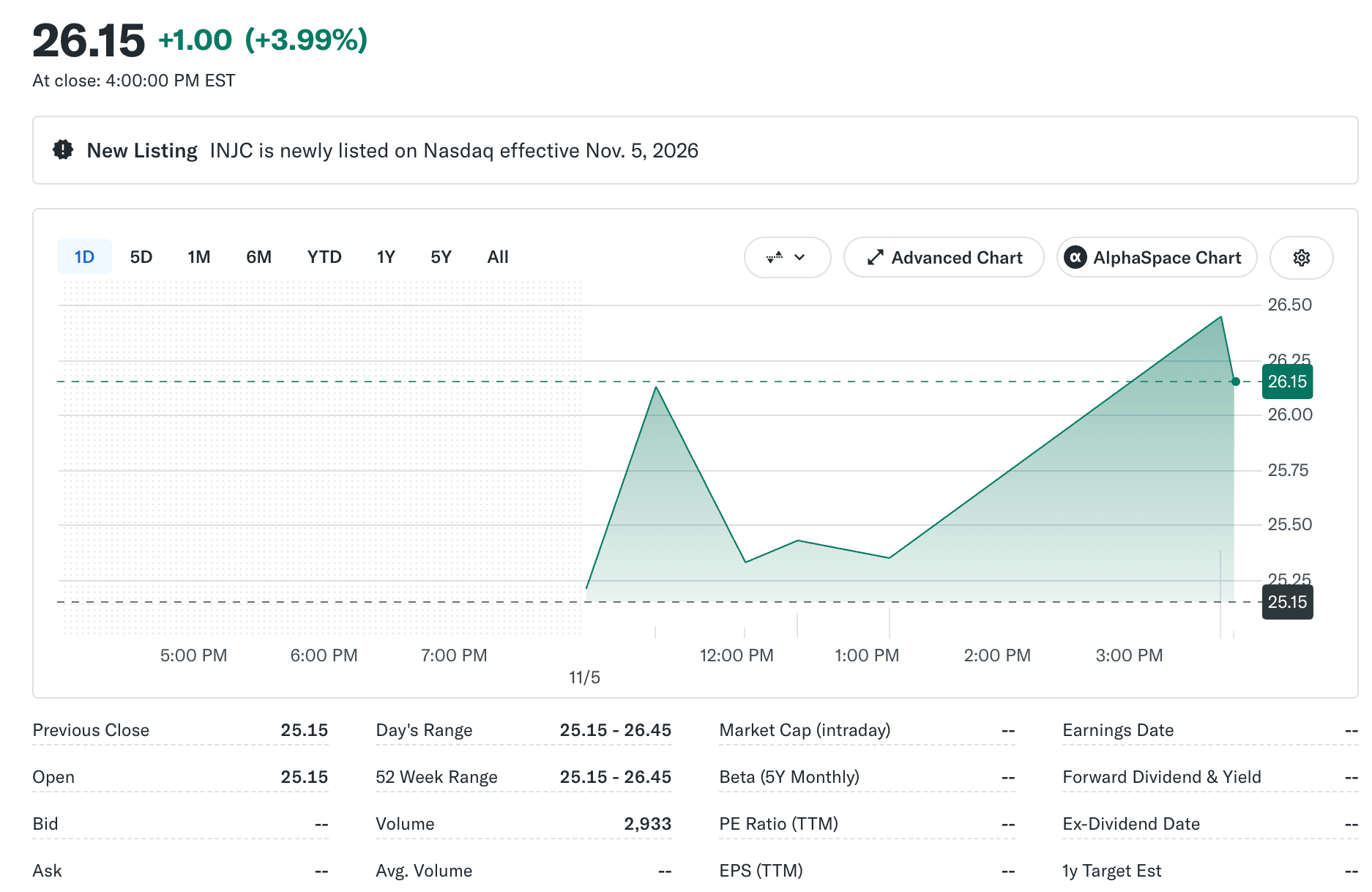
This number appears particularly thin compared to recent similar products.
Bitwise's Solana staking ETF saw a trading volume of about $56 million on its first day, while Canary’s own XRP ETF also had about $58 million on its first day. The trading volume of INJC, when calculated based on price per share, is only at the level of tens of thousands of dollars. The product structure of the "first U.S. staking INJ ETF" has landed, but authorized participants and external funds did not enter on a large scale on the listing day.
This fund is not complicated in design. It holds INJ, and under normal circumstances, aims to stake at least 90%, with the remaining portion kept for redemption liquidity. The Injective network has a 21-day unlock period, so the fund cannot lock all assets.
At the same time, rewards are not directly distributed in cash to investors, but rolled into the daily NAV, allowing the corresponding number of INJ per share to slowly increase. The fee side has a 1.10% annual management fee, plus about 30% of the staking rewards taken as fees.
Based on the current staking yield rates of the INJ network, the net returns investors ultimately receive will likely fall around 4% rather than the advertised nominal figure close to 7%. Europe has long had similar staking products like 21Shares' AINJ, while the U.S. is mainly filling in the gap for regular brokerage accounts and IRA accounts.
For INJ itself, this channel is currently more of a narrative aspect.
INJ has a market capitalization of about $800 million, with about half of its supply already staked. The 1.91 million INJ held by the fund is relatively small compared to the total circulating supply. Even if capital flows in later, the actual impact on spot supply and demand will take time to manifest.
More critically, whether authorized participants continue to purchase, whether AUM can move from the seed scale of $15 million upward, and whether trading volume and premiums/discounts can stabilize—these are the indicators for verifying demand. The almost unnoticed trading volume on the first day already indicates that this channel has not yet been widely utilized.
Looking at a longer period, the emergence of such products is not surprising.
U.S. crypto ETFs have already extended from BTC and ETH to Solana and XRP, and further down to smaller-cap public chains that offer staking yields. Canary had previously launched products like Staked TRX, following a similar logic: using familiar brokerage account structures to package on-chain yields into tradable shares.
The problem lies in that fees accumulate, the liquidity constraints brought by the unlock period, and the scale and liquidity of the underlying assets themselves will create a gap between actual experiences and expectations.
For users who are already accustomed to managing their own staking, this product addresses the demand of "not wanting to manage wallets and keys"; for institutions or more cautious funds, it provides a compliant channel.
Current data indicates that this channel has opened, but the funds have not followed in yet.
免责声明:本文章仅代表作者个人观点,不代表本平台的立场和观点。本文章仅供信息分享,不构成对任何人的任何投资建议。用户与作者之间的任何争议,与本平台无关。如网页中刊载的文章或图片涉及侵权,请提供相关的权利证明和身份证明发送邮件到[email protected],本平台相关工作人员将会进行核查。


