Author: Don’t Understand Classics
“The opportunity cost of going to college is too high. In today’s technological world, everything is developing too quickly. If you stay in school all day, opportunities will pass you by. ”
However, his perspective is not uncommon within a small circle. In Silicon Valley, the engine of global innovation, a disruptive “anti-college movement” is quietly gathering momentum among elites. It is no longer just scattered legendary stories of dropouts starting businesses, but is forming into a movement with theory, organization, and capital backing it.
The core argument of this movement is sharp and direct: the four-year university, once regarded as the golden ticket to the middle class and the American dream, is increasingly becoming an expensive, slow, and out-of-touch waste of time.
Is this just a few geniuses speaking without any pain, or is it the prelude to an educational revolution about to sweep the globe? A recent article by Business Insider explored this new current: the widespread aversion of the new generation of tech entrepreneurs in Silicon Valley towards higher education and the rise of the trend of “skipping college and starting a business directly” within the industry.
The article pointed out that more and more young men are choosing to abandon their college studies to work in tech companies or start their own businesses, encouraged by some Silicon Valley elites and companies.
Today, in conjunction with this article, let us further explore what those young people and tech giants at the forefront of this trend think and do, and what ordinary people can learn from them.
The Defector at the Stanford Crossroad
Sebastian Tan once walked firmly down a glittering broad avenue.
Growing up in Pittsburgh, like all ambitious peers, he regarded Stanford University as the Mecca for aspiring entrepreneurs. His idol is Peter Thiel, who founded PayPal, invested in Facebook, and is hailed as the "Godfather of Silicon Valley Spirit", a staunch Stanford graduate.
The script to success seemed already written: get into Stanford, bask in the California sun and aura of wisdom, and then create a world-changing company.
In April of this year, he got his wish and was about to fly to Palo Alto to attend a grand gathering for new students hosted by Stanford. Before leaving, he downloaded a book, Peter Thiel’s “Zero to One”. This book holds a status in Silicon Valley equivalent to the “Nine Yin Manual” in the martial arts world.
However, when he opened the pages, he found not only entrepreneurial philosophy but a disruptive worldview. In his own words: “This may be the best book I’ve ever read, although I’ve only read a few pages.”
Also, during this spring, a progressively louder voice echoed in his ear, a voice from teenage founders and tech giants wielding billions in capital: “The true future creators will choose to skip college.”
This idea pierced Tan's heart like a thorn. At Stanford's “New Student Weekend”, he met many peers who were just as excellent yet just as confused as he was. They were part of the top scorers in standardized tests across the U.S., the most perfect products of the traditional education system, but deep down, they harbored doubt about this very system.
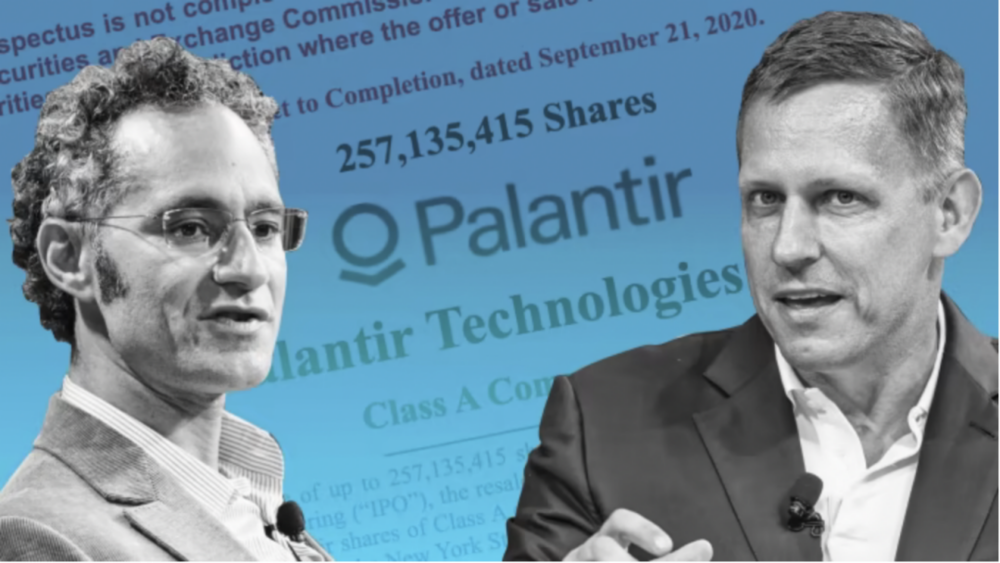
Karp and Thiel
This skepticism ultimately led them to a common destination—the internship application page of software and defense technology giant Palantir.
This company, co-founded by Peter Thiel, launched a very provocative project: the “Meritocracy Fellowship.” Its slogan boldly declares war on the world's top educational institutions:
“Skip the debt, skip the indoctrination, to earn a ‘Palantir Degree’.”
This program offers a paid internship for one semester, and outstanding performers can directly obtain full-time jobs. It acts like a huge magnet, attracting over 500 top high school graduates, including Tan.
In April, the dust settled. Tan made his first significant decision to defect in life: he accepted Palantir's offer and postponed his admission to Stanford until the distant year of 2026.
“In college, you don't learn the practical skills needed for entrepreneurship,” he explained, “You learn things like computer science theory. If you want to enter the workforce directly, these are not very useful.”
Tan's story is not an isolated case. He is merely a wave pushed to the forefront of this large current.
Silicon Valley’s “Heresy”: A Premeditated “Anti-Intellectual” Revolution
Silicon Valley's estrangement from universities is not new. From Bill Gates, Steve Jobs to Mark Zuckerberg, the dropout entrepreneurial “myth” has always been part of the spiritual totem of this land.
But today, the situation has undergone a qualitative change. This is no longer a flash of brilliance from a few geniuses but a systemic movement propelled by economics, technology, and ideology.
The flagbearer of this movement is undoubtedly Peter Thiel.
This unconventional billionaire initiated the “Thiel Fellowship” over a decade ago, funding 20 to 30 young people under 22 each year, giving each $100,000, with one condition: drop out for two years to pursue their own ventures.
Thiel's aversion to higher education is comprehensive. He believes universities not only charge absurdly high tuition fees, shackling young people with heavy debt but more importantly, they are “corrupting” the best among them mentally.
He once quoted an ancient Roman saying to criticize universities: “Corruptio optimi pessima,” the fall of the best is the worst. In his view, the institutions that should cultivate elites and inherit wisdom have devolved into the most rigid and worst educational entities.
According to analysis from “Education Next,” Thiel believes universities instill a narrow and biased worldview in students, stifling genuine innovation. This viewpoint has a large number of followers in Silicon Valley's elite circles.
If Thiel is the spiritual leader of this movement, then Palantir is the “military academy” that puts this theory into practice.
Palantir is a big data analytics company co-founded by Thiel. Many reports describe it as Silicon Valley's “new mafia” and “entrepreneurship school,” where many young people choose to work rather than pursue graduate studies since the company itself offers an extremely rigorous training system focused on holistic views and practical abilities. Today, this “school” has even lowered its admission standards directly to high school seniors.
Palantir’s CEO Alex Karp, an intellectual with a PhD in neoclassical social theory, used to be Thiel's roommate and candidly criticizes universities more than anyone else. He openly states: “Everything you learn in school and college about how the world works is intellectually wrong.”
This wave quickly exploded on social media. Adam Guild, who founded a company valued at $1 billion at the age of 25, posted on X (formerly Twitter), garnering thousands of likes: “Degrees are trivial. Learn from those who have built what you want instead of those who have never built anything.”
His point is incisive: university professors stay in their ivory towers while true knowledge lies in the hands of those who have “built” the world. He even compares universities to a “dropshipping” business:
“They (universities) put their logo on young people who are already exceptionally talented and intelligent, and then credit their success in society to themselves.”
This is a clever and biting metaphor that accurately strikes at the complex emotions many have regarding the halo of prestigious schools. Surya Mehta, co-founder of the AI hiring platform Mercor, offered a summary with even more declarative flair:
“The autodidact is the new alumnus.”
In their view, the internet and AI have made acquiring knowledge unprecedentedly convenient, rendering traditional, passive classroom learning inefficient and unnecessary. Degrees are no longer honors but a form of “procrastination.”
Who is Fueling the “Anti-College Movement”?
The rise of a trend is by no means coincidental. The anti-college movement in Silicon Valley is driven by the convergence of three major forces.
1. Economic Drive: Unbearable “Entry Fees”
The most pragmatic factor is money.
In the past few decades, university tuition in the United States has soared. By 2024, an undergraduate will average nearly $30,000 in federal student loans. Meanwhile, the total cost of four years at top private universities has exceeded $500,000. This huge amount is a heavy burden for any family.
At the same time, the rise of the tech industry, especially in AI, has made the myth of “getting rich young” more accessible. Paul Graham, founder of venture capital firm Y Combinator, and others have openly stated that it is “the best time for college students to start businesses in a decade.”
On one side are high sunk costs and uncertain future returns, while on the other are readily available entrepreneurial tools and a surge of capital. For the most ambitious and talented young people, the answer to this dilemma seems increasingly clear.
2. Technological Drive: AI Makes “Going Solo” Possible
Technological iteration is fundamentally dismantling the monopoly on knowledge held by universities.
In the past, becoming an excellent programmer or engineer required systematic, long-term professional training. But today, artificial intelligence and so-called “vibe coding”—a programming method relying on intuition and AI assistance rather than strict logic—have greatly lowered the technical threshold.
A creative young person can use AI tools to build a product prototype in weeks, something that may have taken a small team months of effort in the past. As those dropout entrepreneurs say, they would rather learn from an AI trained to be like Jobs than listen to a professor who has never written a line of commercial code lecture on theory.
The center of knowledge is shifting from institutional “teaching” to personal “exploration.” The world is changing so rapidly that the pace of university course updates can never keep up with technological advancements.
3. Cultural Drive: Reactions Against “Woke Culture” and Elitism
This is the deepest and most complex reason. Silicon Valley’s anti-college movement is closely linked to the current cultural wars in the United States.
On one hand, it is the ultimate rebellion against traditional elitism. Tech libertarians like Peter Thiel inherently distrust any large, old, centralized institution, whether governmental or educational. They advocate for individual ability and market competition, i.e., “meritocracy.”
They believe that university admission standards, especially at Ivy League schools, have become subjective, superficial, and opaque, rife with favoritism toward specific groups.
On the other hand, it also serves as a strong backlash against the prevalent “woke culture” and DEI (Diversity, Equity, Inclusion) policies within American universities.
22-year-old entrepreneur Sean Schneider's remarks are highly representative and controversial. He dropped out of a Christian high school to start an AI marketing company. He bluntly stated that dropping out of college is both an efficiency consideration and an ideological choice.
“It (college) represents DEI,” he said, “it represents a compromised institution of awakening. At least in my circles, the sentiment is that these institutions deserve to die.”
His viewpoint touches on a sensitive nerve in American society. In recent years, discussions about the increasing marginalization of males in the educational system have grown. According to the Pew Research Center, from 2011 to 2023, 1.2 million fewer students enrolled in American universities, of which 1 million were male.
Schneider believes the educational methods in schools are more suited for women and suppress male “masculinity.” He even voiced the shocking statement: “As a man, you cannot gain true satisfaction while receiving long-term education.”
This viewpoint blends a disdain for “political correctness” with a survival anxiety that carries significant “manosphere” undertones. It reveals a gender dimension that cannot be ignored in this anti-college movement, dominated largely by young men.
These three forces intertwine to create a perfect storm, pushing the ancient giant of universities towards unprecedented rocky waters.
The Return of Rationality: Is University Really “On Its Last Legs”?
As the anti-college rhetoric escalates, should we also listen to the other side’s voice?
David Deming, an economist at Harvard University, offers a calm perspective. He acts like a patient doctor, prescribing a “fever-reducing medication” for this ongoing heated debate.
First, Deming warns, “Very few people are truly self-taught.” He compares those who rely entirely on the internet and AI for learning to students who “copy classmates’ homework”—they may solve immediate problems but lack the foundational abilities to address unknown challenges.
Second, he points out that corporate in-house education, no matter how outstanding, is essentially “narrow and vocational.” Its aim is to cultivate cogs in the system that meet company needs, rather than developing well-rounded individuals with broad perspectives and adaptability. Universities, especially through their liberal arts education, provide students with “an openness to new things” and transferable skills.
Most importantly, there are the data. Deming notes that despite high tuition, the “college wage premium” has remained stable between 75% and 80% over the past decade. This means that, for the average person, the return on investment for a university education is still higher than for investments in the stock market, real estate, or entrepreneurship.
Even the “model project” of this movement—the scholarship program at Palantir—reveals an ironic twist. Despite its anti-elitist stance, reports indicate that many recipients have already been accepted to top schools such as Stanford, UPenn, and Columbia. Is this truly a subversion of elite education, or another form of “cream-skimming”?
Deming poses a thought-provoking question: “For those dropout founders, the question should be whether they would have accomplished more or less if they went to college.”
This question has no answer. But it reminds us that we cannot only see Zuckerberg's success while overlooking the countless dropout failures who remain nameless. What we see is always survivor bias.
The Final Chapter for Universities or the Growing Pains of a New Generation?
Looking around, we stand at a huge crossroads. One side features the ancient and solemn university halls, while the other presents the noisy, untamed growth of a new world.
However, the essence of this debate may not be as binary as “to go or not to go” to college. It resembles a symptom revealing the deeper crisis of our educational system in this era.
Born in the Middle Ages and standardized during the Industrial Era, the core model of modern universities—fixed four-year programs, lecture-centered knowledge transfer, standardized evaluation systems—has become increasingly clumsy and slow amidst the information explosion and the rise of AI today. It’s like a well-designed steam engine, asked to operate on high-speed magnetic levitation tracks.
Peter Thiel and his followers resemble a group of impatient passengers who choose to jump out of the train, trying to lay down a faster track themselves. Their statements may be extreme or even arrogant, but their actions act as a dose of strong medicine, forcing that drowsy giant to begin reconsidering its course.
What we are witnessing may not be the death of universities, but rather a violent painful birth of their next evolutionary form.
“The autodidact is the new alumnus,” means that the center of learning power is shifting. It is transitioning from an institution-centered model to an individual-centered approach, from passive “education” to proactive “learning.” The internet serves as its library, AI as its private tutor, and the real world becomes its ultimate examination ground.
Sebastian Tan, the young man standing at the crossroads of Stanford, has ultimately not burned all bridges to the past. He still plans to return to Stanford in the future. He acknowledges the value of practical experience while recognizing the significance of liberal education. Perhaps he simply wants to use the two years to add an “option” to his life.
He said, “My mom really hopes I go to college.” This casually revealed, most genuine and endearing reason allows us to glimpse a touch of humanity's warmth amid this grand narrative.
Regardless of how fierce the storm, the ancient halls will not easily collapse. Yet their windows and doors have been flung open, allowing the rain and sunshine from outside to pour in. Future learning will no longer be confined within those walls. It will become more blended, more personalized, and more lifelong.
The real challenge is no longer “whether to go to college” but rather: in a future world that updates faster than course schedules, how should we learn?
No one knows the answer to this question. But the process of searching for answers itself may be the most important lesson of all.
免责声明:本文章仅代表作者个人观点,不代表本平台的立场和观点。本文章仅供信息分享,不构成对任何人的任何投资建议。用户与作者之间的任何争议,与本平台无关。如网页中刊载的文章或图片涉及侵权,请提供相关的权利证明和身份证明发送邮件到support@aicoin.com,本平台相关工作人员将会进行核查。


