Author: Ada, Shenchao TechFlow
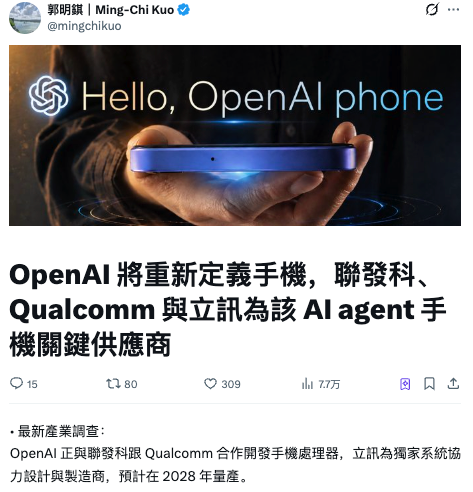
Guan Mingqi, an analyst at Tianfeng Securities, sent out a message stating that OpenAI is collaborating with MediaTek and Qualcomm to develop mobile processors, with Luxshare Precision as the exclusive manufacturing partner, expected to achieve mass production in 2028. This news has also been confirmed and reported by multiple media outlets.
As the news spread, supply chain stocks rose in reverence. Analysts began calculating MediaTek's incremental orders, Luxshare Precision's client structure optimization, and Qualcomm's licensing revenue from baseband solutions.
But the question is, why would a company that is expected to achieve profitability by 2030, with cumulative cash consumption potentially reaching around $115 billion, want to make phones?
Subscription Model Trap
OpenAI's revenue in 2025 reached $20 billion ARR, growing 3628 times since 2020. ChatGPT has a weekly active user base of 500 million, making it a top-tier consumer internet product globally.
However, according to a report from Deutsche Bank in October 2025, only about 5% of users are paying customers.
The remaining 95% are free users, with every conversation burning computing power, electricity, and GPU costs. Even Sam Altman has acknowledged that even the $200/month Pro subscription is operating at a loss. The cash consumption for the entire year of 2025 is around $9 billion, with 70% of the revenue directly evaporating on servers.
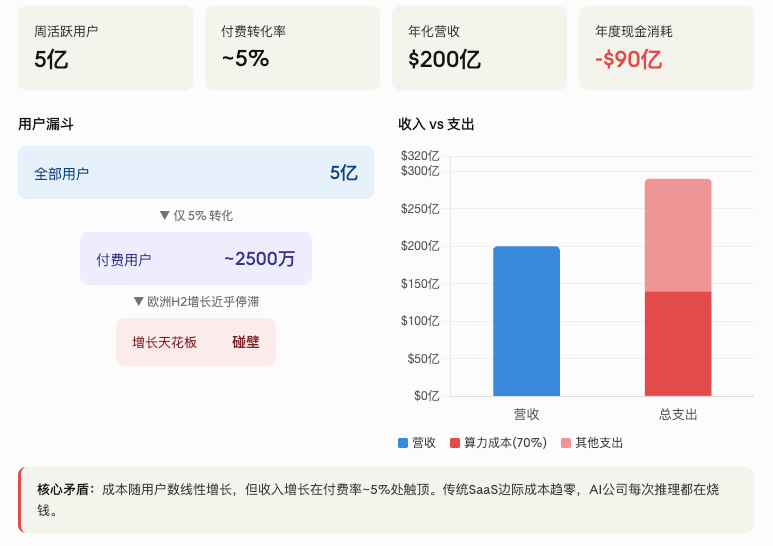
Moreover, according to the report by Deutsche Bank analyst Adrian Cox, the growth of paying users on the consumer side of ChatGPT in Europe almost stagnated in the second half of 2025. The ceiling for the paying rate may be much lower than anticipated, and the subscription-driven growth model is hitting a wall.
The problem with the subscription model is that while costs grow proportionally with user numbers, revenue growth stops at some point. This is a non-issue in traditional SaaS but is lethal for AI companies.
So what to do?
Advertising is one avenue. OpenAI has already started testing ads within ChatGPT, hiring Meta's monetization strategist Fidji Simo as the application CEO. However, doing ads means competing directly with Google, which has thousands of billions of cash flow from search ads alone every year, and with such a deep moat, OpenAI is unlikely to capture market share from its rival.
Enterprise services are another avenue. Currently, enterprise revenue accounts for over 40% of OpenAI's total revenue and is indeed growing rapidly. However, Anthropic's annual revenue from enterprise programming tools reached $30 billion as of March 2026, causing its secondary market trading price to temporarily surpass that of OpenAI. This path is also crowded with competitors.
Thus, there remains a third avenue: hardware.
Hardware is not a dream, but financial anxiety
OpenAI's CFO Sarah Friar stated in an interview with CNBC, "Hardware will become the next layer of value addition for ChatGPT and help drive user upgrades and subscription growth."
In other words, OpenAI needs a medium to convert free users into paying users. Selling a mobile phone bundled with a ChatGPT subscription would allow users to be billed automatically each month. There's no need to wait for users to open their browsers to upgrade to Pro. Hardware locks in the entry point, making the subscription the default option. It's similar to how iCloud storage is bundled with iPhones.
Therefore, the vision described by Guan Mingqi, of redefining the phone with AI agents, where users no longer open multiple apps but execute tasks directly through the phone, sounds appealing. However, the underlying motivation is more primitive: OpenAI needs a new monetization channel to fill that nearly billion-dollar annual gap.
The fundamental motive behind OpenAI's foray into mobile phones is also unrelated to innovation. It needs a way to transfer the cost of computing power off its balance sheet, and hardware serves as that transfer medium. When users purchase a mobile phone, they implicitly agree to pay for cloud inference.
OpenAI plans to IPO by the fourth quarter of 2026, targeting a valuation of $1 trillion. Before going public, it needs to present Wall Street with a growth story beyond just "our models keep getting better." Enterprise revenue is being pursued by Anthropic, advertising is just getting started, and AI agents are still in concept phase. The mobile phone is a good story. With billions of mobile phones sold annually, if it captures even a small slice, the revenue curve will impress.
Lessons from the Past
The distance between a good story and a good business has already been proven repeatedly in the AI hardware realm.
Humane AI Pin raised $230 million, priced at $699 with a $24 monthly subscription fee, but shipped fewer than 10,000 units. In February 2025, it was sold to HP for $116 million, and the product became non-functional as all users' devices ceased to operate.
Rabbit R1 was the spotlight of CES but sold 100,000 units before facing massive returns after users discovered many demo features were fundamentally non-functional. The device's 10 seconds of voice response delay rendered it unusable for real-time interaction. By early 2026, reports emerged that the company was struggling to pay employee salaries. Users discovered it was essentially just an Android app in a shell.
Both cases share a common cause of death: mistaking the freshness of technology for product-market fit. The demo was explosive, and the waiting list was long, leading the team to believe this was market endorsement. However, when users received the product, they found it more beneficial to simply install a ChatGPT app on their phones.
Jony Ive openly criticized Humane AI Pin and Rabbit R1 in an interview, calling them "very poor products," and stated that the entire industry "lacks products expressed through new thinking." He then sold his company, io, to OpenAI for $6.5 billion.
2028 Competitors are not Today's iPhone
The OpenAI phone is expected to achieve mass production in 2028. That is two years from now.
What will the smartphone market look like in two years?
Apple has already integrated Google Gemini and ChatGPT into the iPhone, with a major overhaul of Siri's AI expected to be rolled out in 2026. Samsung's Galaxy AI already covers flagship and mid-range product lines, Google Pixel is running Gemini natively, and Android XR glasses are on the way.
In other words, by 2028, every mainstream smartphone on the market will be an "AI phone." AI capabilities will become standard, just like cameras, GPS, and fingerprint recognition.
So what differentiates OpenAI?
Guan Mingqi's answer is that AI agents need to continuously understand users' contextual information, and only smartphones possess all of the user's real-time state information. Since OpenAI has the best model, the phone's user experience will be different.
This answer has an obvious flaw: model capabilities can be provided via APIs. OpenAI is already selling its models to Apple and Samsung through APIs. If models are the core advantage, selling them to all mobile manufacturers would be more profitable and carry less risk than making phones themselves.
Unless OpenAI believes that the revenue from merely selling model APIs is insufficient.
This circles back to the core question: Is the goal of making phones rooted in a technical ideal or in financial survival?
History is rife with cases of hardware failures, and successful examples of software companies venturing into hardware are rare. Google has worked on Pixel for ten years with a global share of less than 2%. Microsoft struggled to break even on Surface for many years after incurring significant losses. These companies have at least hundreds of billions in cash flow supporting their trial and error, but OpenAI does not.
$852 billion Bet
OpenAI's phone story is fundamentally a narrative demand associated with an $852 billion valuation.
Model capabilities are converging, and the lead window for new models may only be a few months, with Gemini, Claude, and Llama all in pursuit. When models become commodities, margins on model sales will only get thinner.
Subscription revenue may also be reaching a ceiling, with a conversion rate of 5% indicating the true market intent. The enterprise market is also being encroached upon by Anthropic. In the secondary market, Anthropic's trading price has already surpassed OpenAI's, as investors vote with their feet.
In this context, "making phones" offers investors a renewed realm of imagination. If OpenAI can sell 100 million AI phones, each bundled with a $20 monthly subscription, that translates to $24 billion in new annual revenue. Along with hardware revenue, total revenue would instantly double.
This mathematical problem is certainly solvable. However, Humane and Rabbit had similar solvable equations at the time, but while the numbers looked good, actual sales were dismal. Consumers are unwilling to pay for a phone that lacks an application ecosystem, without WeChat, Douyin, or a complete Google Play ecosystem. No matter how powerful the AI agent, it cannot fulfill everyday needs.
Guan Mingqi indicated that OpenAI may adopt a business model of bundling subscriptions with hardware sales. In other words, hardware may be sold at a loss, recouping costs through subscriptions. Another "lose first, profit later" story. OpenAI has been telling this story for the past three years, and investors have been listening for three years.
But by the time the phones reach mass production in 2028, how much longer can the story be told? By then, OpenAI will have consumed over $100 billion. If the phones struggle to sell, the flywheel will not only not turn but may reverse.
CFO Sarah Friar has already expressed doubts about OpenAI's IPO timeline, feeling the company is not ready to go public and has reservations about a $600 billion expenditure plan for the next five years. According to Bloomberg, a survey company found that after reaching out to hundreds of institutions, "no one is willing to buy OpenAI in the secondary market."
OpenAI's venture into mobile phones is most likely to end not by redefining the smartphone industry, but by adding a page to the IPO roadshow PPT. As for how much that page can ultimately be realized, it may ultimately hinge on conditions beyond OpenAI's control.
免责声明:本文章仅代表作者个人观点,不代表本平台的立场和观点。本文章仅供信息分享,不构成对任何人的任何投资建议。用户与作者之间的任何争议,与本平台无关。如网页中刊载的文章或图片涉及侵权,请提供相关的权利证明和身份证明发送邮件到support@aicoin.com,本平台相关工作人员将会进行核查。


