Epoch AI's latest data reveals that among the leading AI companies Anthropic, Minimax, and Z.ai, the expenditure on computing power accounts for a staggering 57% to 70% of total costs, overwhelmingly surpassing talent compensation. Among these, Anthropic is projected to have a total expenditure of $9.7 billion in 2025, with computing power alone consuming $6.8 billion. More alarmingly, the expenditure scale of the three companies is 2 to 3 times their revenue.
Written by: Zhao Ying
Source: Wall Street Insights
Compared to talent, computing power is becoming the heaviest financial burden for AI companies.
According to the latest data from Epoch AI, in the top three AI companies—Anthropic, Minimax, and Z.ai—expenditure on computing power occupies an absolute dominant position in total costs.
In the largest company, Anthropic, the total expenditure for the entire year of 2025 is estimated to reach $9.7 billion, with computing power alone amounting to $6.8 billion, covering both model training and inference stages. This figure far exceeds the overall expenditure scale of Minimax and Z.ai during the same period.
The rapid expansion of computing power expenditure reflects the highly capital-intensive nature of developing and deploying cutting-edge AI models. Epoch AI estimates that the current expenditure level of the three companies is approximately 2 to 3 times their revenue, and the industry as a whole is still in a stage of large-scale cash burning.
Computing Power Dominates Cost Structure, Talent Expenditure Takes a Backseat
According to Epoch AI data, in Anthropic, Minimax, and Z.ai, the combined expenditure on research and inference computing power accounts for 57% to 70% of their total expenditures, exceeding the sum of employee compensation and other operational costs in every case.
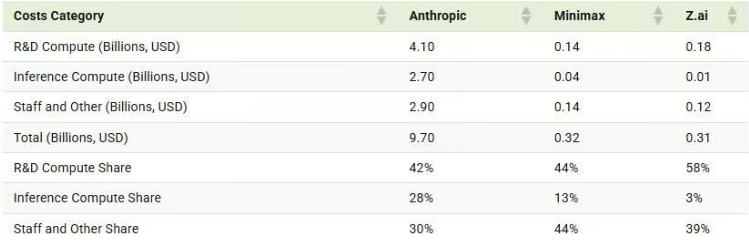
This ratio is particularly pronounced in Z.ai, where 58% of expenditures are directly related to the computing power required for model development and training, showcasing a distinctly research-driven cost structure.
Although top AI laboratories pay some of the highest salaries in the tech industry to engineers and researchers, talent costs have not exceeded half of total expenditure in any of the three companies. This indicates that, in the current context of the AI arms race, the strategic value of chips and computing infrastructure has surpassed that of human resources at the financial level.
Divergence in Paths of US and Chinese AI Companies, Open Source Strategy Lowers Cost Threshold
It is noteworthy that both Minimax and Z.ai have released a large number of models in open-source form, allowing anyone to download, modify, and run the model weights for free.
In terms of data sources, Anthropic's figures are based on reports from The Information and have a speculative nature; while the data from Minimax and Z.ai comes from IPO prospectuses released in January 2026, making them relatively more reliable. The statistical periods for the three companies also differ: Anthropic covers the entire year of 2025, Minimax includes the first to third quarters of 2025, and Z.ai covers the first half of 2025. Epoch AI states that its total expenses include operating expenses, the cost of goods and services, as well as non-cash items such as equity incentives.
Together, these data paint a clear picture: In the current environment where investment in AI infrastructure remains high and profit models have yet to be validated, the ability to acquire and allocate computing resources is becoming the key variable determining the competitive position of AI companies.
免责声明:本文章仅代表作者个人观点,不代表本平台的立场和观点。本文章仅供信息分享,不构成对任何人的任何投资建议。用户与作者之间的任何争议,与本平台无关。如网页中刊载的文章或图片涉及侵权,请提供相关的权利证明和身份证明发送邮件到support@aicoin.com,本平台相关工作人员将会进行核查。


