Author: David, Shenchao TechFlow
When Silicon Valley VCs finally let ordinary people at the table, it usually means one thing.
The game is about to end.
Yesterday, AngelList launched a fund product called USVC. AngelList is the largest venture capital infrastructure platform in Silicon Valley, with over $125 billion in assets under management, servicing more than 25,000 funds according to its official website.
It has effectively opened a door for all American investors, allowing investments starting at $500, without the need for accredited investor certification, enabling direct ownership of shares in seven AI companies including OpenAI, Anthropic, and xAI.
Standing behind this product is Naval, also a co-founder of AngelList. With a book titled "The Navalmanack," he has become one of the few individuals in Silicon Valley with both investment success and public influence.
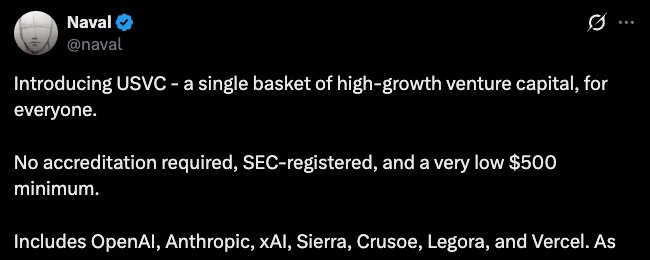
He posted a lengthy article on X promoting USVC, stating that early technology investment is the era's "venture capital," but ordinary people have always been kept outside. By the time impressive AI companies go public, the growth will have ended. USVC aims to open that door.
Within hours of the tweet being posted, someone in the comments raised an uncomfortable question:
These tech companies’ valuations have been pushed to the sky; all explosive growth occurred in the primary market. Now inviting retail investors, how is it different from finding exit liquidity?

USVC holds shares in seven companies, with the heaviest position in xAI. According to Decrypt, as of the end of March, approximately 44% of USVC's funds have already been invested in these seven companies.
However, these companies are not publicly listed; how are the shares acquired?
According to the prospectus, USVC has three ways to acquire targets: investing in emerging fund managers, participating in growth rounds of financing, and purchasing secondary shares through AngelList's network.
The first two are easy to understand; the third is the key point.
Secondary shares mean that the company has not issued new stock to sell to you; existing shareholders transfer their stakes to you. Who is transferring? Early angel investors, VC funds, early employees.
These individuals may have entered when the company's valuation was tens of millions of dollars; now the company is valued in the hundreds of billions, and they wish to convert paper gains into actual cash before the IPO. However, the primary market is unlike a stock exchange, with no ready buyers lining up to take over.
USVC just solves this problem. It raises funds from retail investors and then uses that money to purchase shares from insiders who want to exit.
AngelList indeed has a natural advantage in doing this. According to its website, there are over 4,500 active fund managers operating more than 25,000 funds, investing in over 13,000 startups.
This network flows with a large number of people wanting to sell and the shares available for sale, with AngelList sitting right in the middle. This is also what USVC repeatedly emphasizes as an "exclusive channel."
The channel is indeed exclusive, but the trade direction does not seem to favor retail investors.
In this transaction, the sellers entered when the company was valued at tens of millions, while the buyers are entering when the company is valued at hundreds of billions. The sellers have locked in returns of dozens or even hundreds of times, while the buyers are betting that these already fully-priced companies can still rise further.
Meanwhile, the terms that retail investors receive also indicate some issues.
According to USVC's prospectus, the fund is not listed on any exchange, does not anticipate a secondary trading market, may repurchase up to 5% of net value shares each quarter, fully at the discretion of the board, and provides no guarantees. Furthermore, the estimated annual total expense ratio is 3.61%, far exceeding the 1% management fee highlighted on promotional material, with the difference stemming from underlying fund aggregation fees.
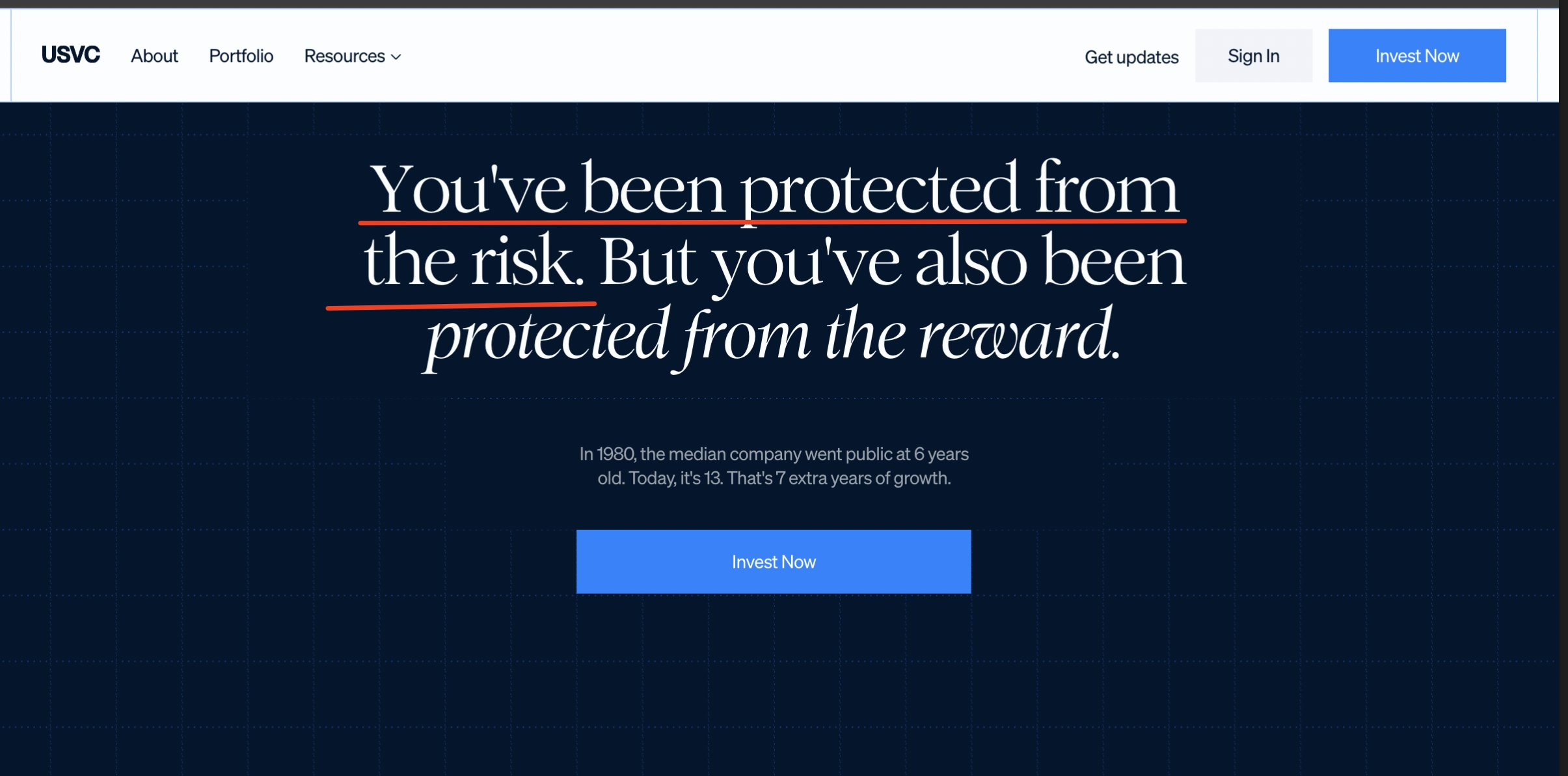
Being unable to sell and relying on queues for exit means that fees alone consume nearly 4% of the principal in a year. For a product starting at $500 aimed at ordinary people, this cost is not cheap.
Therefore, the complete picture might be like this.
On one side are insiders wanting to exit, having gained liquidity and locked in profits. On the other side are new retail investors who receive a non-tradable share that relies on queuing for exit, with an effective rate far exceeding the advertised rate. The flow of funds is consistently from latecomers to those who arrived earlier.
"Low Liquidity, High FDV" Version of Stocks
Looking at USVC’s model, insiders accumulate positions at low valuations, the asset price is pushed up, and then a channel is packaged for retail investors to participate, allowing the later funds to catch the exit of the earlier ones.
This logic was completely rehearsed in the cryptocurrency industry between 2021 and 2024.
In those years, VC-supported token projects had a common template. Seed round valuations started at a few million dollars, private rounds increased to tens of millions, and by the time the tokens were traded on exchanges, fully diluted valuations skyrocketed to tens or even hundreds of billions. Yet the circulation only released 2% to 5% of total supply, while the remaining was locked in with VCs and teams, unlocking in batches according to a schedule.
Low liquidity, high FDV.
What USVC is doing is essentially very similar to low liquidity and high FDV. Insiders enter when the company is valued at tens of millions; after the company value rises to hundreds of billions, they transfer shares through a product aimed at retail investors.
Naval's own trajectory is also intriguing. Last October, he tweeted on X, "Bitcoin is insurance for fiat currency; Zcash is insurance for Bitcoin." This tweet caused ZEC to rise over 100% within a week. Subsequently, the community uncovered that, according to public reports, Naval had invested $715,000 in the company behind Zcash back in 2015 and even served as a director for the Zcash Foundation.
The community's conclusion was straightforward: he was using his personal influence to promote his early investment. However, Naval did not respond to these doubts.
From Zcash to USVC, the model has not changed. Celebrities use credibility to open the demand side and channel that demand towards assets in which they hold positions.
Of course, USVC does not seem to have any illegal activities.
USVC is a registered fund, with comprehensive risk warnings in its prospectus, and the tweet about Zcash doesn’t constitute security advice.
However, there is often an ambiguous distance between legality and rationality. A platform managing a trillion-level venture capital network raises funds from retail investors with the narrative of "allowing ordinary people to invest in the future," and then uses that money to take over shares from insiders wanting to exit from within its own network...
All parts of this operation are compliant. But when all these elements are combined, they can easily trigger painful memories for merchants.
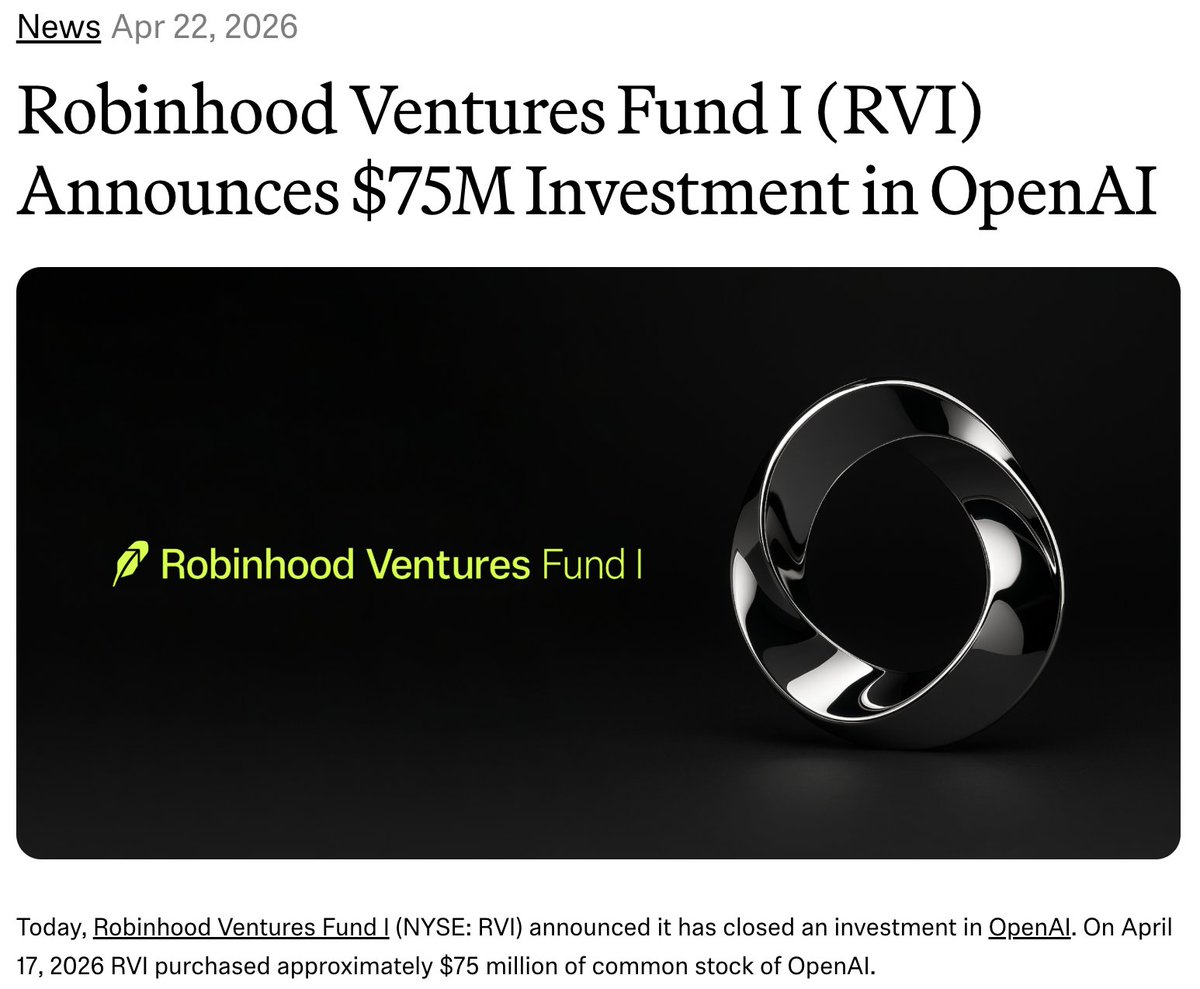
On the same day that USVC launched, Robinhood also announced that its fund had purchased $75 million worth of shares in OpenAI, also targeting ordinary investors. The two companies did the same thing in the same week, using their respective retail networks to provide an exit channel for insiders in the primary market.
Every time the financial industry suddenly begins to care about the investment rights of ordinary people, it is often not because the situation of ordinary people has improved but because exit channels for insiders have narrowed.
This was the case when the cryptocurrency industry opened its doors to retail investors in 2021, and it will likely be the case when Silicon Valley opens its doors in 2026. The timing of the door opening is never decided by those who wish to enter.
For ordinary people, there is a very simple method to judge whether an investment opportunity is prepared for you.
Look at whether those who entered before you are currently increasing their positions or selling. If they are selling while you are being invited to buy, you need to think clearly about one question: are you bringing funds or liquidity?
免责声明:本文章仅代表作者个人观点,不代表本平台的立场和观点。本文章仅供信息分享,不构成对任何人的任何投资建议。用户与作者之间的任何争议,与本平台无关。如网页中刊载的文章或图片涉及侵权,请提供相关的权利证明和身份证明发送邮件到support@aicoin.com,本平台相关工作人员将会进行核查。


