Author: Rishabh Gupta
Translation: Jiahua, ChainCatcher
As a novice founder, I poured years of effort into three ultimately failed infrastructure projects. In 2025, I began building a consumer-grade product that people truly want to use. Here, I share the insights I gained through painful lessons in user acquisition and funding.
I have been in this industry for about four years.
In 2023, when "account abstraction" was still the hottest topic in the circle, I started developing within the EVM ecosystem. At that time, everyone was developing SDKs (Software Development Kits) for account abstraction wallets. Rollup scaling solutions were also booming—Optimism, Arbitrum, and various RaaS (Rollup as a Service) dominated the landscape.
As a math enthusiast, I was deeply attracted to ZK (Zero-Knowledge Proofs), believing it would change the world (I firmly believe it will in the future).
I mistakenly thought: complexity == credibility.
When VCs asked about use cases, I confidently listed zkML (Zero-Knowledge Machine Learning), zk identity, zk voting—but to this day, no one is really using these areas. I mistook amazing technology for a useful product.
Over time, I began to believe that the more complex an idea is, the greater its chances of success.
VCs also told me that building infrastructure is the only way to succeed in the crypto space.
I spent nearly two years, experiencing over 500 rejections, before realizing this wasn't suitable for me.
Entering the Solana Ecosystem
For me, this was a completely new ecosystem—people here care about use cases. Even meme coins are acceptable because revenue is important.
Speed is crucial. Distribution is essential.
Having built consumer-grade applications on Solana for seven months, here are my insights:
1. Build for young users willing to try new things
Try to develop for young people who are naturally open to new products.
In the consumer crypto space, this often means those who can trade in the "trenches" or users aged 13-21.
A 2024 study by the Consumer Technology Association shows that 86% of Gen Z (ages 11-26) consider technology to be central to their lives—this percentage is higher than any older generation. They own more devices and are more willing to spend on tech products.
They are more inclined to try new apps, experiment with new features, and change their habits.
Users over 25 are generally less willing to adopt new processes unless there are strong incentives.
(Note: If you are in institutional business, this may not apply.)
Research indicates that social activity peaks around ages 20-21. This means products built for young people naturally have higher virality.

2. Equip the product with "viral attributes" to reduce marketing costs
If you don't have a huge marketing or advertising budget, the product itself must be a traffic channel.
In the crypto space, virality is especially important because:
KOL marketing is very expensive.
Trust levels are extremely low.
Everyone expects rewards or incentives.

If your product gives users a reason to spontaneously share with friends and communities, you've won publicity without burning cash. This is difficult, but it's worth optimizing from day one.
3. Launch requested features as quickly as possible
When users report a poor experience or bugs, fix them immediately, especially pain points that hinder usage.
I used to patch things up at the end of the day. As a result, I once had a user message me: "Since your app doesn't have this feature, I'm going to use product Y instead."
Once users go to a competitor and form a habit, it's hard to bring them back.
So, try to fix things immediately (ideally within 2-5 hours).
If multiple users request a feature and it's feasible:
Build it within 2-3 days.
Tell them it was launched based on their feedback.
You can even offer them some rewards.
This will build deep trust. Users will start to feel that this product "belongs to them," and this emotional ownership is incredibly powerful in early products.

4. The application name is very important
This may seem simple, but many people (including myself) have messed it up.
The application name should be highly recognizable and easy to share verbally.
My previous product was called "Encifher," which was extremely hard to remember, and even investors and partners would misspell it when creating groups.
So we later changed it to encrypt.trade. Simple, memorable, and appealing.
5. Communicating with users is difficult, but it must be done
Finding and talking to users is extremely challenging, especially when what you're building isn't part of the current "hype narrative."
When I started working on privacy, it wasn't popular. I reached out to nearly 1,000 people through cold DMs: out of 100 people, maybe 10 would respond. Among them, only 3-4 could provide substantial help.
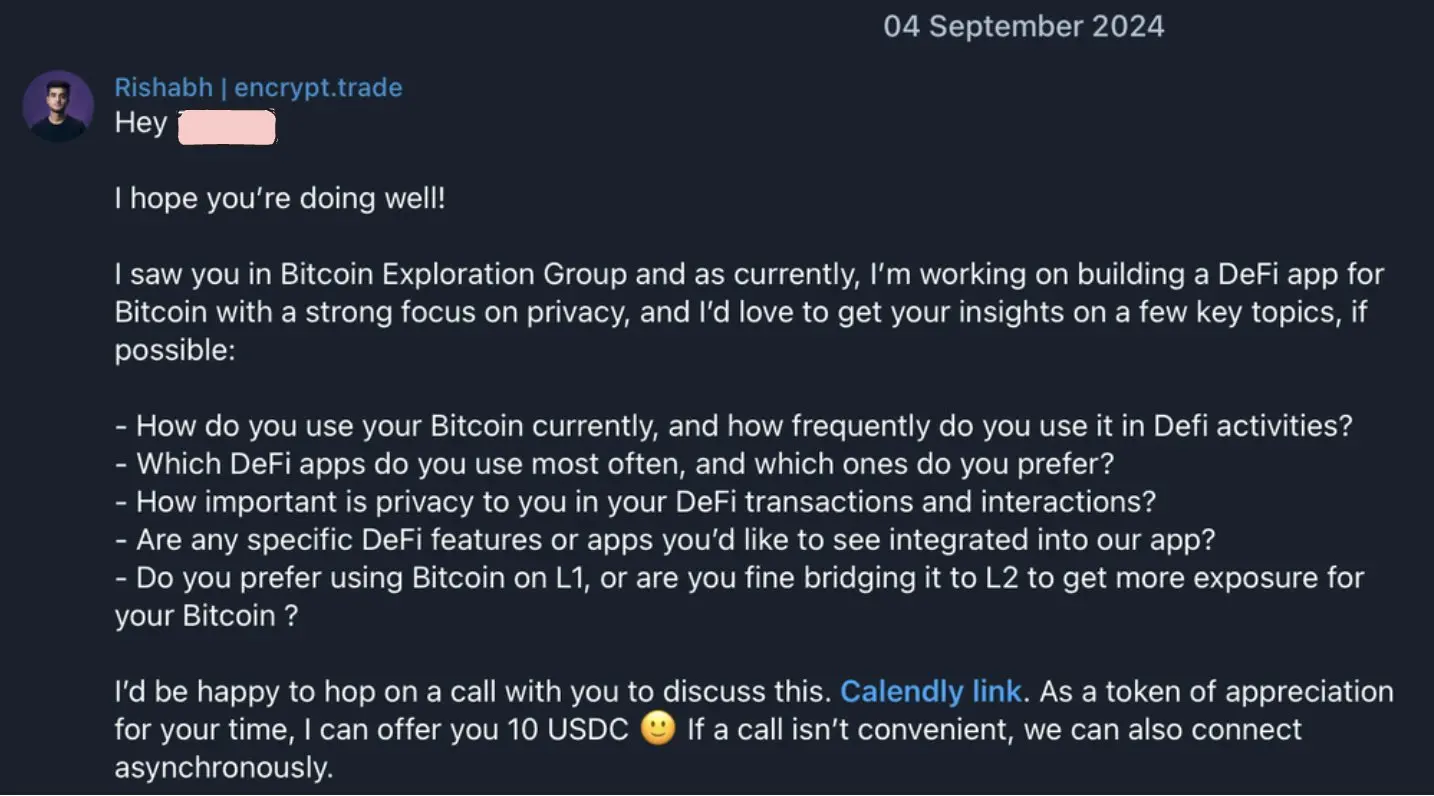
I talked to anyone who showed even slight interest.
I iterated the product with them.
The cold DM framework is also an iterative process, and here are some key points to note:
Start with an enthusiastic greeting.
Highlight the key points (funding status, transaction volume, etc.) at the beginning.
Explain where you found them.
Provide a friendly call to action.
Always remember to follow up.
There is no perfect cold DM; you must test against benchmarks to find effective methods for your target customers.
Here’s a good cold DM template to use: but be aware that this process is slow and exhausting.
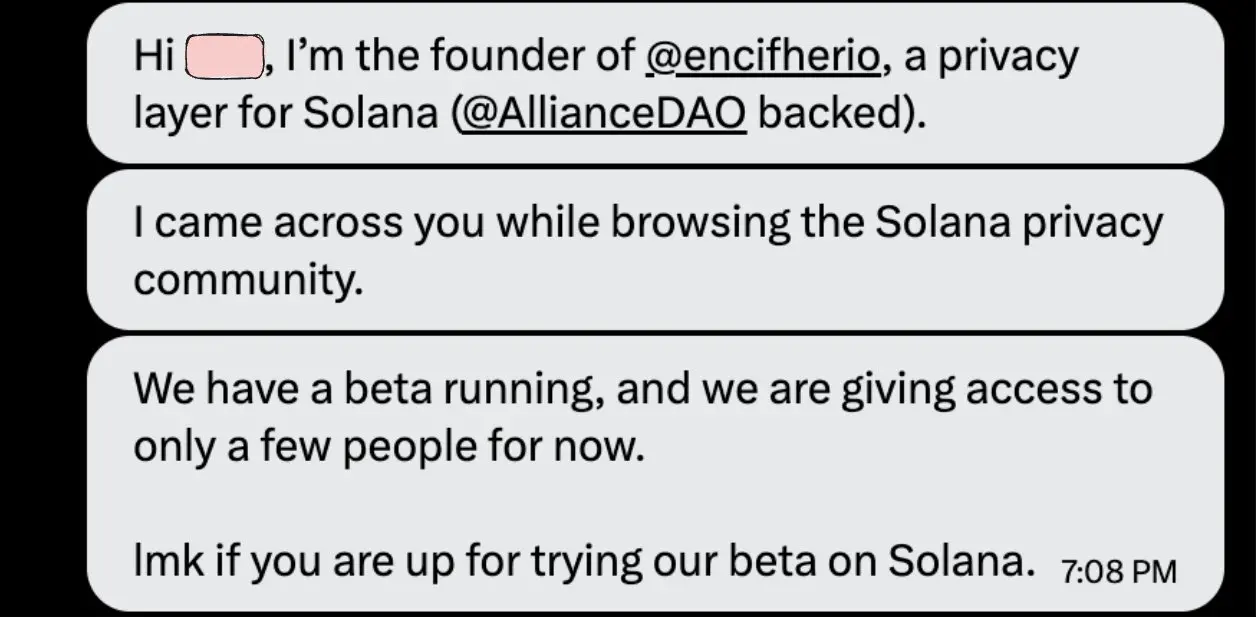
In the cryptocurrency space, very few people reply to DMs because scams are everywhere.
Low response rates are the norm (I know it can be frustrating).
Nevertheless, you must do it.
Your goal at this stage is not to acquire 1,000 users.
Your goal is to find 10-20 early users who care about the issues, are willing to try the product, and will provide honest feedback.
These early users will become your support system.
Early products often make mistakes, and these users will help you through that phase.
6. Rapid iteration
The crypto industry is fast-changing, and attention spans are extremely short.
You must study user behavior rather than just listening to their words:
What are they repeatedly doing?
What kind of workarounds are they using?
What are they already willing to pay for? (Many ideas sound good, but if users aren't willing to pay for them, they won't survive.)
7. Make your website simple to the point of "foolproof"
Never make assumptions about users' understanding.
As a developer, you've stared at the product for hundreds of hours and think it's obvious, but for first-time visitors, it's completely unfamiliar.
Don't introduce new terms or complex processes.
Minimize the number of clicks.
The core value should be presented within 5 seconds of entering the app.
Conclusion
Building consumer-grade crypto products is both fun and challenging. Iteration speed, user mindset, and marketing ability are more important than perfect technology. This is completely different from B2B.
免责声明:本文章仅代表作者个人观点,不代表本平台的立场和观点。本文章仅供信息分享,不构成对任何人的任何投资建议。用户与作者之间的任何争议,与本平台无关。如网页中刊载的文章或图片涉及侵权,请提供相关的权利证明和身份证明发送邮件到support@aicoin.com,本平台相关工作人员将会进行核查。


