Author: Spinach Spinach Talks RWA
February 6, 2026, a day worth remembering.
On this day, the People's Bank of China, in conjunction with eight major departments including the National Development and Reform Commission, the Ministry of Industry and Information Technology, the Ministry of Public Security, the State Administration for Market Regulation, the Financial Regulatory Bureau, the China Securities Regulatory Commission, and the State Administration of Foreign Exchange, issued the "Notice on Further Preventing and Dealing with Risks Related to Virtual Currencies" (Yin Fa [2026] No. 42). At the same time, a more practical attachment—the "Regulatory Guidelines for Issuing Asset-Backed Securities Tokens for Domestic Assets Overseas"—was also released.
This is not a simple "ban." If you are still stuck in the mindset of "China is going to ban crypto again," you may have completely misread this document.
Let me break down these two documents in plain language.
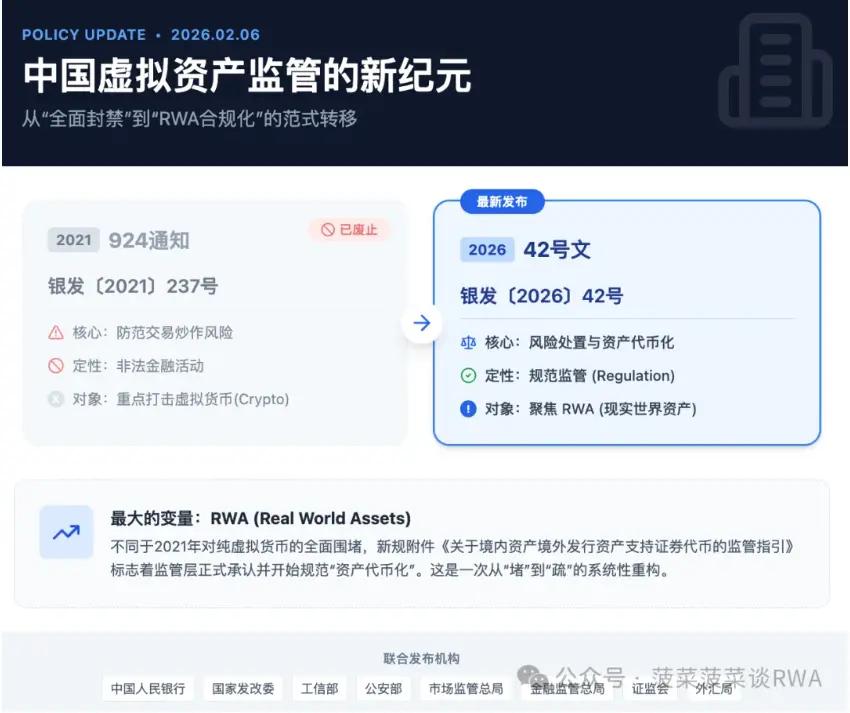
In 2021, the eight ministries issued a similar document—Yin Fa [2021] No. 237, commonly known in the industry as the "924 Notice." That document established the tone for China's "comprehensive blockade" of virtual currencies. Five years later, Document No. 42 explicitly states in its last article: "The Notice on Further Preventing and Dealing with Risks Related to Virtual Currency Trading Speculation (Yin Fa [2021] No. 237) issued by the People's Bank of China and ten other departments is hereby repealed."
The old is replaced by the new, indicating that this is not just a simple patch but a systematic reconstruction of rules. So, what is the biggest difference between the new document and the old one?
One word: RWA.
The 924 Notice in 2021 focused entirely on virtual currencies, and at that time, the concept of "RWA" hardly existed in the domestic regulatory context. However, Document No. 42 dedicates a significant amount of space to defining and regulating "Real World Asset Tokenization" (RWA), which itself is a huge signal—regulators have officially recognized RWA as a form of business and decided to set the rules for it, rather than outright denying it.
Key Point One: Attitude Towards Virtual Currencies Remains Unchanged, but Wording is More Precise
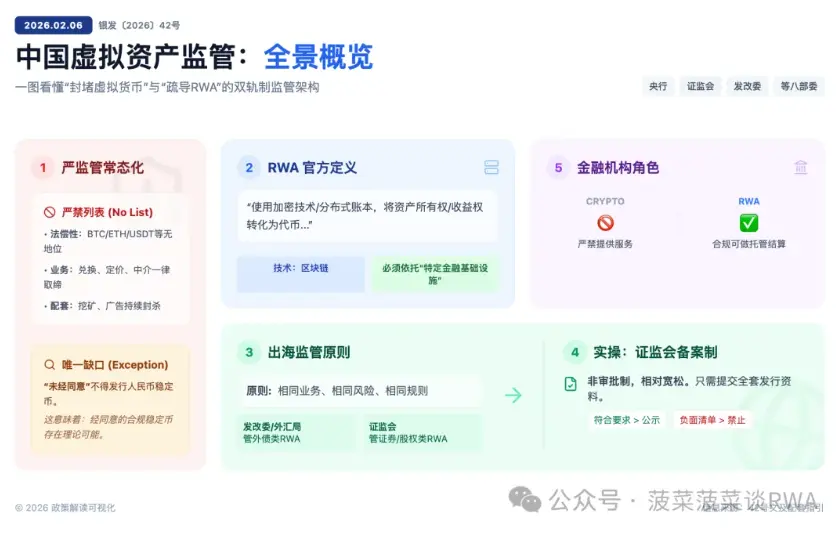
The first article of Document No. 42 states clearly: "Virtual currencies do not have the same legal status as legal tender." Bitcoin, Ethereum, USDT, and others are specifically named and characterized as "not having legal tender status and should not and cannot be circulated as currency in the market."
The subsequent wording is almost consistent with the 924 Notice: exchanges between legal currency and virtual currencies, exchanges between virtual currencies, providing trading intermediary and pricing services, and token issuance financing are "strictly prohibited and resolutely banned by law." Providing virtual currency services from overseas entities to domestic entities is also prohibited.
However, there is an important new statement: "Without the lawful consent of the relevant departments, no unit or individual, domestic or foreign, may issue stablecoins pegged to the Renminbi overseas." Note that the document uses "without consent," rather than "strictly prohibited." What does this mean? Theoretically, if "with the lawful consent of the relevant departments," there may be a compliant path for Renminbi stablecoins. This opening is very small, but it does exist.
For virtual currency investors, to be frank, there is nothing new in this area. What should be banned remains banned, and what should be cracked down on remains cracked down. Mining continues to be regulated, advertisements continue to be banned, and even company registration names and business scopes are not allowed to include terms like "virtual currency," "cryptocurrency," or "stablecoin."
Key Point Two: The Definition of RWA is Written into a Ministerial-Level Document for the First Time
This is the most noteworthy part of Document No. 42. The second paragraph of the first article provides a very clear official definition:
"Real World Asset Tokenization refers to the use of cryptographic technology and distributed ledger or similar technology to convert ownership, income rights, and other rights into tokens (certificates) or other rights and bond certificates with token (certificate) characteristics, and to engage in the activities of issuance and trading."
This definition has several layers of meaning worth unpacking. First, it locks the technical means of RWA as "cryptographic technology and distributed ledger or similar technology"—in other words, blockchain or blockchain-like technology is a necessary condition for RWA. Second, the objects of tokenization are "ownership, income rights, etc.," covering a wide range, theoretically including everything from real estate to accounts receivable, from bonds to fund shares. Finally, both "issuance and trading" are included in the regulatory scope.
However, the real key lies in the next sentence:
"Except for relevant business activities conducted with the lawful consent of the business competent authority, relying on specific financial infrastructure."
Translated into plain language: RWA is not completely prohibited domestically, but you must obtain approval, and it must be conducted on regulatory-approved financial infrastructure. The term "specific financial infrastructure" is very thought-provoking. What counts as "specific financial infrastructure"? The document does not explicitly list, but based on current practices in China, the Shanghai Data Exchange, Beijing International Big Data Exchange, Shenzhen Data Exchange, various local financial asset exchanges, and the digital Renminbi infrastructure led by the People's Bank of China could all be candidates.
In other words, the logic of Document No. 42 is not "prohibit RWA," but "RWA must be played in my arena."
Key Point Three: Tokenization of Domestic Assets Going Overseas Has a Formal Regulatory Framework
Chapter four of Document No. 42, "Strict Regulation on Domestic Entities Conducting Related Business Overseas," is the most groundbreaking part of the entire document. It is not saying "no going overseas," but rather "going overseas is allowed, but you must follow the rules."
Article 14 distinguishes several situations: if a domestic entity conducts RWA in the form of foreign debt overseas, it is under the jurisdiction of the National Development and Reform Commission and the State Administration of Foreign Exchange; if it conducts asset securitization or equity-based RWA overseas based on domestic rights, it is under the jurisdiction of the China Securities Regulatory Commission; other forms of RWA are also under the jurisdiction of the CSRC in conjunction with relevant departments. The core principle is "same business, same risk, same rules"—whether you are issuing in Hong Kong or Singapore, as long as the underlying assets are in China, Chinese regulation must follow.
What does this mean? The biggest obstacle for domestic assets to go overseas through RWA tokenization has never been technology or market, but the gray area of regulation. Many project parties want to do it, but no one dares to do it—because there are no clear rules, and doing it could be legal or illegal. Document No. 42 finally clarifies the rules: you can do it, but you must go through approval or filing.
The accompanying release of the "Regulatory Guidelines for Issuing Asset-Backed Securities Tokens for Domestic Assets Overseas" (hereinafter referred to as the "Guidelines") provides more specific instructions on "how to do it."
Key Point Four: CSRC Filing System—Asset Securitization Tokens Have a Specific Path
The "Guidelines" are the most practical document this time, specifically formulating filing rules for the scenario of "issuing asset-backed securities tokens overseas based on domestic assets."
The core process of the "Guidelines" can be summarized as follows: the domestic entity that actually controls the underlying assets files with the China Securities Regulatory Commission, submitting a filing report, a complete set of overseas issuance materials, and fully explaining the information of the domestic filing entity, underlying asset information, token issuance plan, etc. If the materials are complete and meet the requirements, the CSRC will carry out the filing procedure and make it public; if they do not meet the requirements, the filing will not be accepted.
Please note that the term used is "filing," not "approval." Although the CSRC can "seek opinions from relevant competent departments and industry regulatory agencies as appropriate," the overall system design is a filing system, which is much more lenient than an approval system. This indicates that the regulatory authorities are cautiously open to the idea of domestic assets going overseas to create asset securitization tokens—not giving you a green light, but also not welding the door shut.
The "Guidelines" also set a clear negative list: assets that are legally prohibited from financing are not allowed, those that endanger national security are not allowed, those with criminal records of controlling persons are not allowed, those under investigation are not allowed, those with significant ownership disputes are not allowed, and assets prohibited in the negative list of domestic asset securitization are also not allowed.
These restrictions are highly consistent with the existing regulatory logic of domestic asset securitization and overseas listings—regulatory authorities clearly see RWA tokenization as part of the existing securities regulatory framework, rather than starting anew.
Key Point Five: The Role of Financial Institutions is Strictly Defined
Article six of Document No. 42 clearly states the requirements for financial institutions: they must not provide account opening, fund transfer, clearing, and settlement services for virtual currency-related businesses; but for RWA businesses, the restriction is "without consent"—in other words, if it is a compliant RWA business that has gone through filing approval, financial institutions are allowed to provide custody, clearing, and settlement services.
This point is significant for the entire industry. For RWA projects to grow and strengthen, the participation of traditional financial institutions is essential—custodian banks, clearing institutions, payment channels, all of which are foundational infrastructure. Document No. 42 separates "compliant RWA" from the negative label of "virtual currency," clearing the policy obstacles for financial institutions to participate in RWA businesses.
Article 15 further stipulates that the overseas subsidiaries and branches of domestic financial institutions providing RWA services overseas must "act lawfully and prudently," requiring the establishment of professional personnel and systems, implementing KYC, suitability management, anti-money laundering, and other requirements, and being incorporated into the compliance risk management system of domestic financial institutions. This essentially tells the overseas branches of Chinese institutions: you can engage in this business, but it must be included in the unified management of the group, and do not engage in "regulatory arbitrage" overseas.
How to Understand the Overall Signal of These Two Documents?
When looking at Document No. 42 and the "Guidelines" together, you will find a very clear regulatory logic:
First, virtual currencies and RWA are clearly separated. Virtual currencies continue to be strictly cracked down on, a stance that has not wavered since 2017. However, RWA is no longer broadly categorized under "virtual currency-related businesses," but is treated as a financial business form that can exist within the regulatory framework.
Second, domestic RWA adopts a "licensed operation" model. To conduct RWA domestically, it must be done on regulatory-approved "specific financial infrastructure." Without a license or approval, it is considered illegal financial activity. This is consistent with China's longstanding regulatory approach to financial businesses—finance is a licensed operation industry.
Third, the tokenization of domestic assets going overseas adopts a filing system. This is the biggest incremental information. It provides a compliant path for high-quality domestic assets to enter the global capital market through RWA. The CSRC, as the main regulatory body, uses a filing rather than an approval process, with relatively reasonable thresholds.
Fourth, financial institutions are explicitly permitted to participate in compliant RWA businesses. This provides a systemic foundation for building the entire ecosystem. Without the participation of banks and clearing institutions, RWA is just a castle in the air.
From a more macro perspective, the issuance of Document No. 42 and the "Guidelines" marks the transition of China's regulation of crypto assets from "one-size-fits-all blockade" to "classified regulation." Virtual currencies that should be cracked down on will continue to be cracked down, but RWA—especially RWA businesses supported by real assets, with compliant structures and regulatory filings—are separated from the targets of crackdown and incorporated into the formal financial regulatory system.
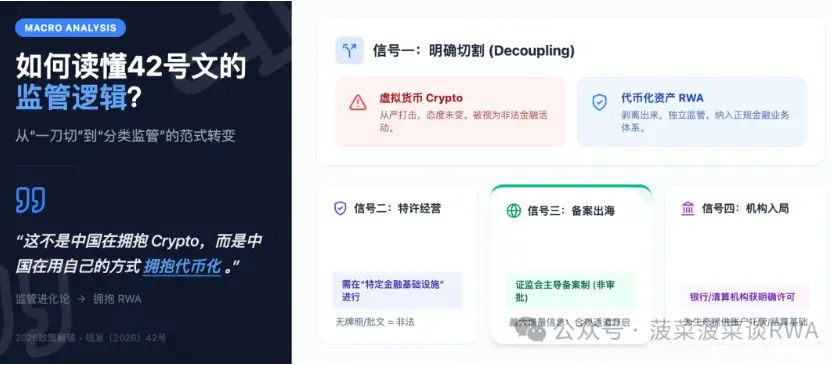
- This is not China embracing crypto, but China embracing tokenization in its own way.
For institutional investors and project parties that have been observing, the rules of the game are finally clear. There is a compliant path, a negative list, regulatory agencies, and a filing process. The remaining question is—are you ready?
免责声明:本文章仅代表作者个人观点,不代表本平台的立场和观点。本文章仅供信息分享,不构成对任何人的任何投资建议。用户与作者之间的任何争议,与本平台无关。如网页中刊载的文章或图片涉及侵权,请提供相关的权利证明和身份证明发送邮件到support@aicoin.com,本平台相关工作人员将会进行核查。


