Authors: Joyce, kaori
In the storage track, after FIL, it's AR's turn.
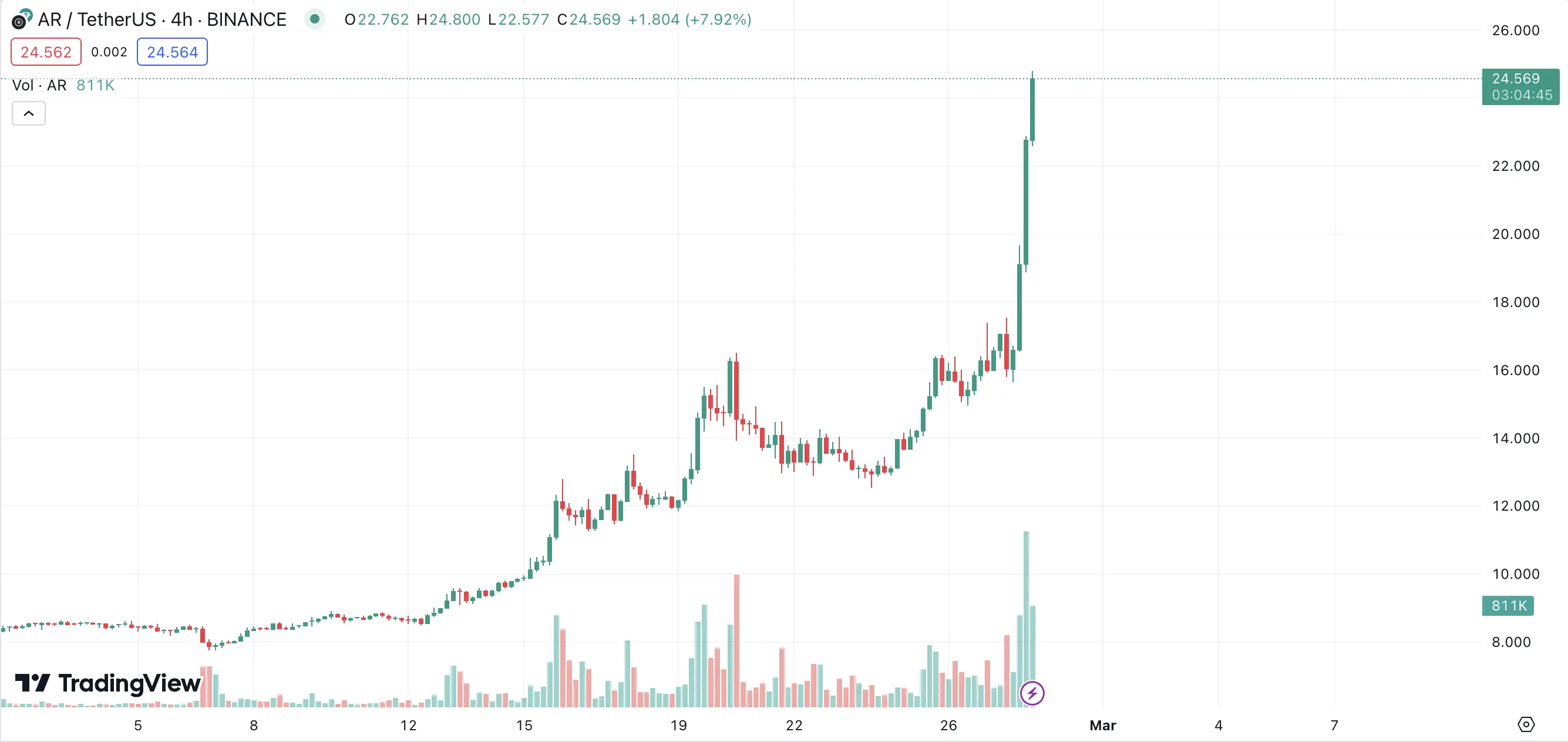
Yesterday, the blockchain storage protocol Arweave released the public testnet Arweave AO, designed for social media and AI computing layers. Subsequently, its native token AR's price surged successively, breaking through $24 at the time of writing, with a 51% increase in the past 24 hours.
Zhixiong Pan, the founder of ChainFeeds, posted on Twitter that "Arweave is the most hopeful encrypted protocol to make large-scale decentralized data storage a reality. We live a life that is completely different from our ancestors, solely because we inherit and utilize the knowledge and experience accumulated by humans over tens of thousands of years. Perhaps this new technology will place an ENIAC in the revived Library of Alexandria."
So, what mission does the testnet released by Arweave aim to accomplish? Arweave's founder, Williams, even stated that Arweave AO is confident in competing with Ethereum, self-proclaiming as an "Ethereum competitor." What exactly is Arweave AO?
Large-scale + Verifiable, Arweave AO's Vision of Supercomputer
Arweave's focus is on "permanent information storage," a decentralized data storage protocol based on blockweave technology. Its mainnet was launched in June 2018, utilizing the data structure of BlockWeave and the consensus mechanism of SPoRA to provide a new solution to the problem of permanent storage. Arweave's one-time payment and lifetime usage model also eliminates the cumbersome process of constant subscription for users. Arweave has also promised to provide users with at least 200 years of storage service.
The newly launched Arweave AO testnet is a new method to "infinitely" expand the blockchain to handle larger computing workloads. "AO is a super parallel computer, a distributed computing environment that allows you to run an arbitrary number of processes in parallel. Previous decentralized computing systems either supported large-scale computing or verifiable computing. AO can do both at the same time," said Arweave founder Williams in the announcement video.
This means that Arweave is venturing into the field of computing, similar to Ethereum's "supercomputer" claim. Arweave AO can even allow AI and Large Language Models (LLMs) to run directly in smart contracts.
In an interview, Williams stated that the difference between Arweave AO and other high-performance blockchains like Aptos and Sui is its ability to support storing large amounts of data, such as AI models. "This is largely because the core of the project is based on a data storage platform."
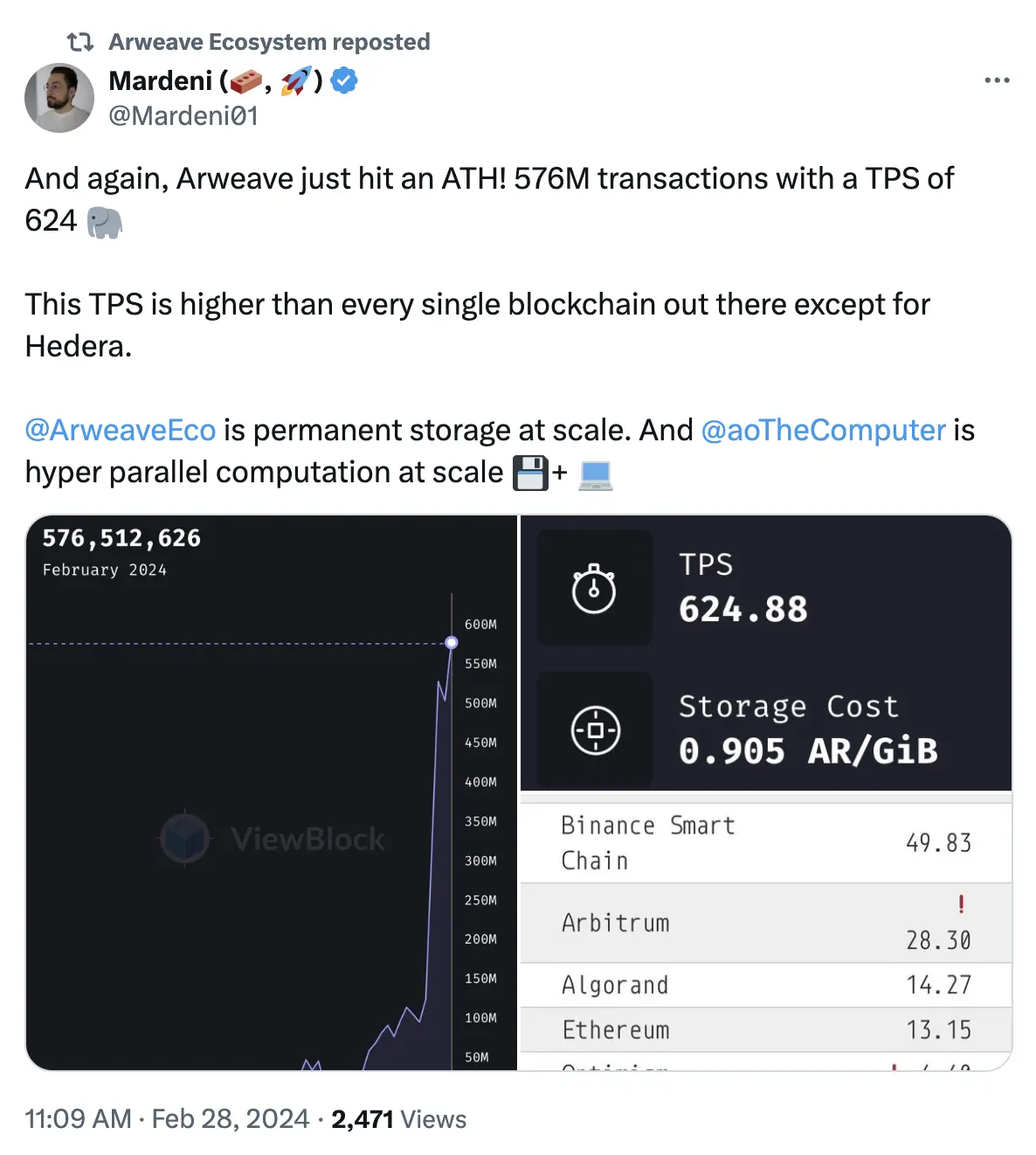
Mardeni, CEO of the decentralized database WeaveDB, wrote that Arweave's trading volume today has reached a historical high, with TPS far exceeding most blockchains. The future performance of Arweave AO remains to be seen.
However, before reaching this stage, Arweave went through a lot of exploration.
From Storage to Transformation, Arweave's Journey
Founded in 2017 as a blockchain-based file storage protocol, Arweave features one-time payment and permanent file storage, allowing miners to store data for a long time through a simple set of economic incentive rules. By 2021, there were over 200 applications based on the Arweave network, covering social networks, infrastructure, content distribution, verification tools, and other categories.
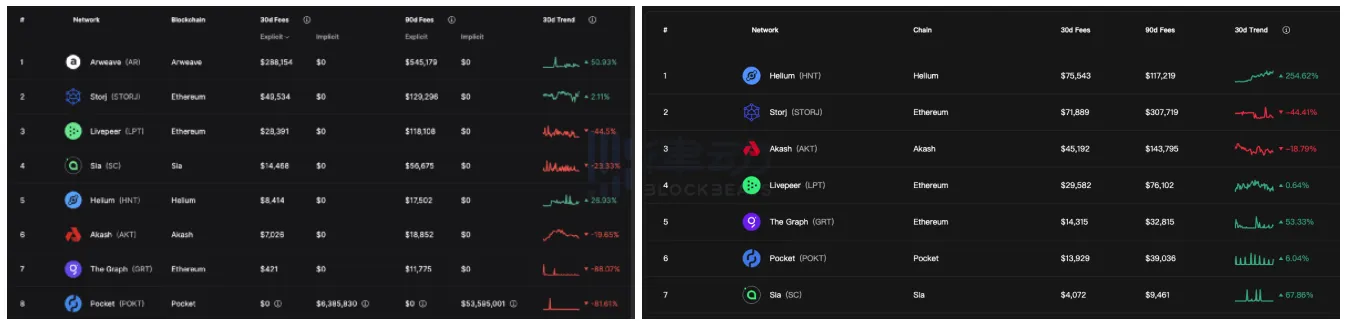
Over the next two years, influenced by the development of the NFT market and Web3 creator economy, Arweave's business data saw significant growth. By the end of 2022, Arweave's data storage volume was nearly three times that of the same period the previous year, with a year-on-year growth of 192%. At that time, Arweave's 30-day network income was close to $300,000, ranking first in the Web3 basic service protocol, far exceeding star storage projects like Storj, Helium, and DePin.
Related reading: "Reviewing the Past to Understand the Future | Arweave's Potential Lies in Reviving the Library of Alexandria, Not as a Filecoin Substitute"
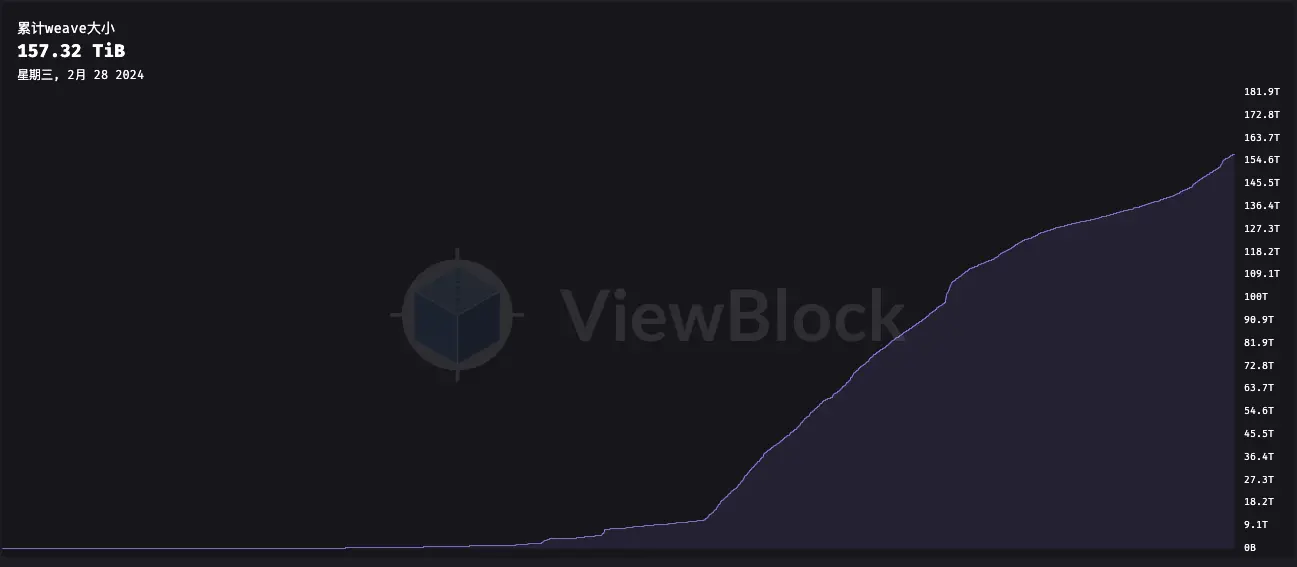
However, in 2023, the growth of Arweave's storage business slowed significantly. At the time of writing, Arweave's data storage capacity was 157TB, with an increase of only 30% in nearly a year, and the revenue from storage business was not as high as before.
According to a 2023 Arweave Ecosystem Report written by the PermaDAO community, Arweave's overall network storage volume in 2023 was lower than in 2022, totaling 32.96 TiB, a decrease of 55.78% year-on-year. Throughout 2023, the monthly network storage volume fluctuated between 2-4 TiB, with the lowest network storage volume in June at only 1.43 TiB.
At the same time, the Arweave network was exceptionally active in 2023, and the growth of contracts was also a key indicator. The growth of contracts in 2023 saw a huge increase compared to 2022, with a 1063% year-on-year growth.
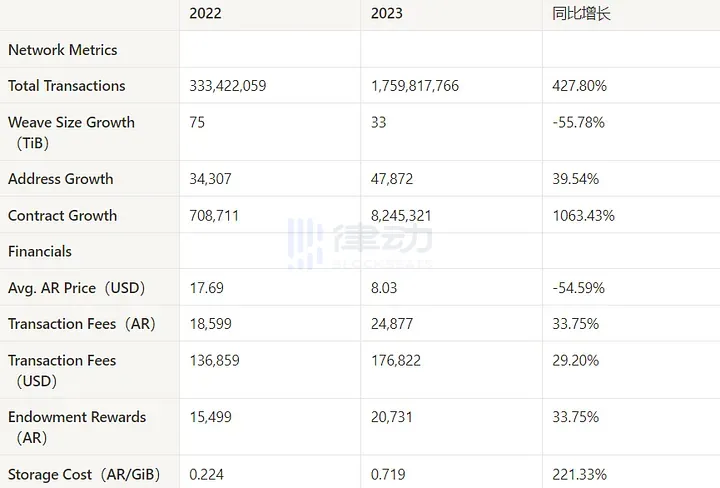
These data indicators reflect the challenges that Arweave faces: although there are many projects using Arweave's storage services, there are still relatively few projects developed solely based on Arweave. It is difficult for Arweave to form network effects solely through storage business. On the other hand, the rapidly growing new contracts also prove that Arweave still has considerable development prospects.
It is well known that low-cost on-chain storage is crucial for the success of blockchain and Web3. In a conversation with Philip Mataras, the founder of ArDrive, Arweave founder Sam Williams revealed a stunning cost comparison: storing a 13 GB file on Arweave costs only $87, while storing the same data on Bitcoin would cost about $35,620,000, and on Ethereum, it would require $780,000,000.
As a permanent storage project, Arweave itself is an openly visible, transparent, and permanent storage network, and the storage-based consensus paradigm SCP can already achieve off-chain expansion without sacrificing on-chain finality. As long as it complies with the expansion theory of SCP, it can be part of Arweave to achieve specific functions.
It can be said that Arweave naturally does not face the problem of expansion difficulty. Azriel, the author of PermaDAO, believes that "it's only a matter of time for Arweave to step into the spotlight." The public chain sector has long faced issues of computing and storage costs, and Arweave has already demonstrated its potential in promoting comprehensive decentralization of DApps. Arweave's positioning is not only a decentralized storage platform, but also a full-stack protocol supporting the comprehensive decentralization of DApps in Web3.0.
After the release of Arweave AO, Sam Williams, the founder of Arweave, stated in an interview, "We have built a super parallel computer, a computer that can run an arbitrary number of threads in parallel, and its scalability is incredible."
Not only the founder, but such a grand vision has always had believers in the Arweave community. Arweave is seen by the community and developers as a data availability layer directly meeting the development needs of DApps. In a space event in 2022, Xiong Wei, the founder of everFinance in the Arweave ecosystem, jokingly said, "Arweave's opening is Ethereum's endgame."
It is difficult to conclude how much impact the launch of Arweave AO will have on the current public chain landscape, but through nearly two years of planning, Arweave has completed the transition from storage business to a Web3 full-stack protocol. The 50% increase in the past 24 hours is enough to attract attention. It is foreseeable that Arweave's entry will make the competition in the public chain space even more exciting.
免责声明:本文章仅代表作者个人观点,不代表本平台的立场和观点。本文章仅供信息分享,不构成对任何人的任何投资建议。用户与作者之间的任何争议,与本平台无关。如网页中刊载的文章或图片涉及侵权,请提供相关的权利证明和身份证明发送邮件到support@aicoin.com,本平台相关工作人员将会进行核查。


