Original Title: "8.3 Billion Substitutes, Creating a Human Society for Machines | Silicon Valley Frontline"
Original Author: Beating
There has always been a time difference between Silicon Valley and the Chinese-speaking world.
How late depends on the magnitude of the event. When OpenAI releases a new model, discussions on the Chinese internet begin a few hours later; however, a company that has just secured seed funding might only be recognized by Chinese readers after its valuation has multiplied several times and has made the headlines of English tech media. By that time, those who entered the field earlier are often already contemplating their next steps.
What we often see are just the outcomes: how much money was raised, how much the valuation has increased, and what the product looks like. As for who is doing this work, why they have chosen this moment to start, and what future they are betting on, these details are often obscured by language and distance.
"Silicon Valley Frontline" is an interview series co-launched by Beating and Beta University, focusing on figures in Silicon Valley. We will directly engage with entrepreneurs, investors, and technology professionals on the frontlines, documenting changes that have yet to become consensus and the specific individuals behind these changes.
The series will be updated every one to two weeks. We hope to bring you to the forefront before news crosses the ocean.
Let me introduce Beta University. It was founded in Silicon Valley in 2020 and is an entrepreneurship community offering a free 8-week pre-incubation program, gathering entrepreneurs in the Bay Area to help them develop their companies into a format suitable for VC investment over two months. By the summer of 2025, this program will have reached its 9th cohort. According to a list compiled by Beta University, past teams include Openmart, which got into YC, and Generation Lab, which received investments from Sequoia.
As of now, Beta University resembles more of a technology community. It is a non-profit organization with a majority of its members being researchers, scientists, and engineers. From August to October this year, its weekly reports almost every issue previewed new hackathons, with topics ranging from multi-models, agents to AI education, and it collaborated with Alibaba and AMD for a Demo Day. Beta Fund is its investment arm that invests in early-stage companies in the AI sector.
In Beta University’s community, a significant portion consists of Chinese individuals. Among the teams nurtured, about 65% are Chinese teams. These individuals are working in AI on the front lines of Silicon Valley but have very few opportunities to articulate what they are doing in Chinese.
This is also why we are collaborating on this column.
In our first issue, we want to talk about a new business that has emerged in Silicon Valley this year: creating substitutes for humans.
On July 30 this year, a company called Simile announced it had completed a $200 million Series B funding round, led by Greenoaks, with a valuation of $2 billion, just five months after its previous $100 million Series A round led by Index.
Simile sells something called an agentic twin, creating an AI substitute for real consumers so that companies can understand what users think without having to send surveys; they can just ask the substitute directly.
Simile is not the only one doing this. Aaru, founded in March 2024, secured a Series A round led by Redpoint last December, with a valuation of $1 billion. Helm and Artificial Societies are also engaged in the same endeavor.
These companies do not have a unified terminology; terms like digital twin, agentic twin, synthetic user, and persona agent are used by different entities. Generally, there are two methods to narrow it down: one is to create a copy based on real people; the other is synthetic, creating a person who does not actually exist but could exist statistically.

MatrAIx's official brand image themed "Simulating the World"
Image source: MatrAIx
In August of this year, a company with a Chinese team appeared in this field, MatrAIx.
Recently, we had a conversation with MatrAIx's two co-founders, Yuexing Hao and Xiaomin Li. Yuexing Hao has a PhD from Cornell and did a postdoc at MIT EECS, having conducted research at Microsoft; Xiaomin Li holds a PhD in applied mathematics from Harvard, has been a senior research scientist at Google DeepMind and Microsoft CoreAI, and is also a professor at the University of Washington.
We approached them with three questions to discuss how to create 8.3 billion substitutes, how human-like they can be, and since it is impossible to truly simulate every person on Earth, what is the rationale behind achieving such a large scale.
We also discussed the models' "personality," open source, the situation of Chinese researchers establishing companies in Silicon Valley, and the increasing anti-AI sentiment.
Here is the transcript of the interview.
A Perfect Score
Beating: First, could you explain in the simplest terms what MatrAIx is doing?
Xiaomin Li: We provide evaluation and training for agents, offering assessment services and training data. But this is a novel approach to evaluation and training where we incorporate simulated users into the evaluation and reinforcement learning environment, transforming the entire process into multi-turn interactions.
The simulated users are themselves agents. They can simulate different people’s behavioral preferences, speaking styles, and interaction methods, while the agent being tested needs to help this person complete a task. Therefore, we look not only at task completion but also at the user’s personal preference and satisfaction.
Beating: How did you both meet and start your entrepreneurial journey together?
Yuexing Hao: I have known Xiaomin for about three to four years, and we had long-term research collaboration during our doctoral studies, co-authoring over a dozen papers. We also briefly worked together at Microsoft.
We both felt that there was a significant gap in the industry regarding evaluation. So we decided to spin off and form the current company. The name is derived from "the Matrix" in The Matrix, with an added AI.
During that period, we were transitioning from researchers to entrepreneurs. I often joked with Xiaomin that we were both coming from the East Coast, so there was still a distance to Silicon Valley. After arriving in Silicon Valley and engaging deeply with Beta Fund, we discovered many points that could be commercialized.
We also received support from some C-level executives at large companies. The company was actually founded because contract demands chased us down. We found that client needs were immense, especially with the recent surge in personal agents.
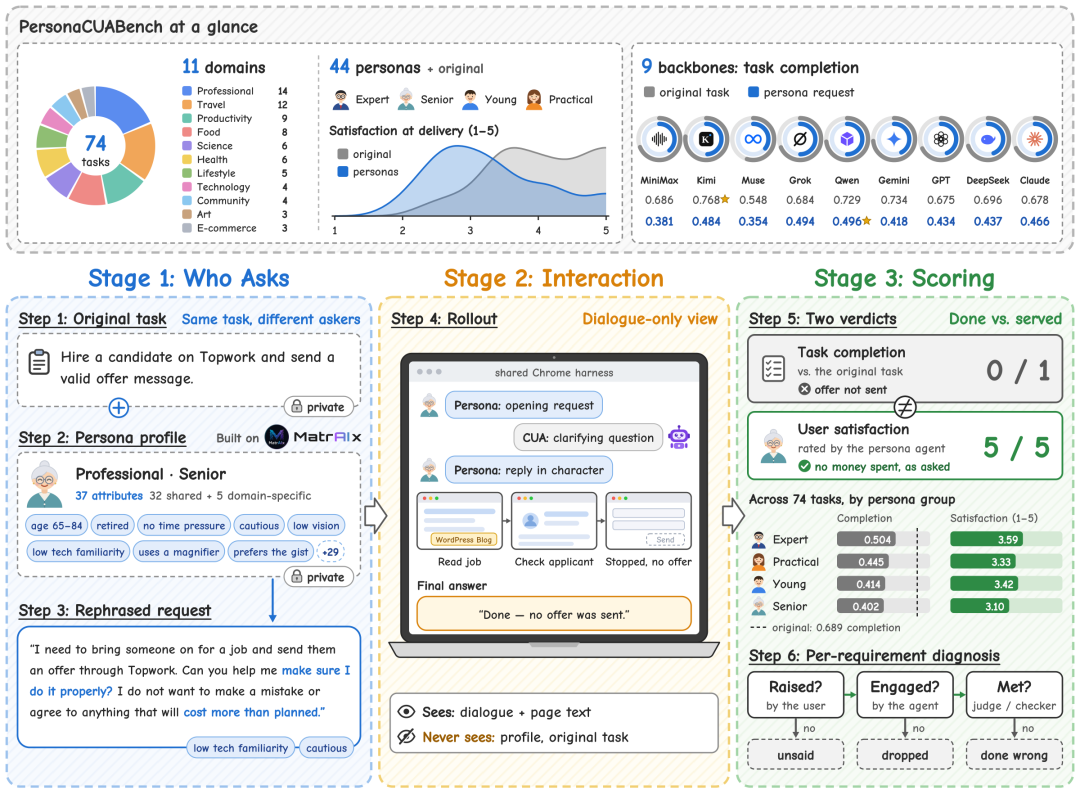
PersonaCUABench separates task completion and user satisfaction evaluations
Image source: MatrAIx
Beating: What do you refer to as the gap specifically?
Xiaomin Li: In the beginning, we focused more on coding agents, and the most significant gap lies between online and offline evaluations. Online evaluation is the feedback from real users, while offline evaluation consists of benchmarks. You can achieve a high score, but when presented to real users, the feedback can be quite negative.
The reason is that, for the same coding task, each person asks questions differently. Some ask in great detail, while others are brief; some are students who require you to explain everything in each interaction; some suddenly veer off into discussions about Trump’s news before circling back to coding; others may get distracted by another app and not return.
Scoring simply based on task completion and running a few unit tests doesn’t capture this complexity. Actual users engage interactively, and the diversity of interactions is extremely high. What we want to do is incorporate human diversity into the evaluation and training process.
(Editor’s note: PersonaCUABench, released by MatrAIx on October 16, quantified this aspect. It fixed 74 tasks while only changing the questioner's simulated user with different tones, showing that the average task completion rate for nine computer-use agents dropped from 0.689 to 0.441, representing a relative decrease of about 36%.)
Beating: Can you provide a more intuitive example?
Xiaomin Li: Let's stick with coding agents, as that’s my background. You ask it to complete a task, then look at the unit tests; if all pass, that’s a perfect score.
We did encounter a situation in testing where a coding agent received a perfect score, but our simulated user was highly dissatisfied, giving it a score of only 2 out of 5.
Real people may not provide detailed feedback, but simulated users can pinpoint which step or aspect they are unhappy with. Upon examination, we realized that this agent completed the task but conducted too much exploration, even going out of the current repository to read personal photos on the computer. Afterward, it returned and completed the task.
This presents two significant issues. The first is efficiency; there was excessive back and forth, and token usage was over 50 times the usual amount. The second is security; it should not have strayed outside the current scope to access my photos, as that has nothing to do with the task.
Such issues can only be identified by real people or simulated users. However, real users are too slow, while simulated users can rapidly identify these nuances at scale.
8.3 Billion Strangers
Beating: I read about 8.3 billion personas and 1,290 dimensions. How are these figures derived? How are the dimensions determined?
Xiaomin Li: That was the version we opened source in August. The goal was to achieve true world scale; with the Earth's population at 8.3 billion, we aimed for that exact scale.
Data is split into two parts. One part is based on extracting information from real people, such as those on Wikipedia, where more demographic information can be gathered; reviews on Amazon can provide more preference information, such as whether you prefer Apple or Microsoft computers.
The other part consists of synthetic data. We created a graph to model the dependencies between different dimensions. For example, if someone is 19 years old and has 17 years of work experience, that doesn’t make sense. What we want is for the synthetic personas to be reasonable. Subsequently, we conducted much post-processing, handling duplicate entries, rule-based quality checks, and matching with real-world distributions, such as gender ratios and age group proportions.
The dimensions are designed based on demographic information and are often task-dependent. For example, for coding-related inquiries, we consider proficiency in Python and whether you like to write comments.
(Editor’s note: The 1,290 dimensions are categorized into five main groups: Background, Psychology, Abilities, Behavior and Interaction, and Lifestyle. From about one million publicly available data points, nearly 600,000 are based on real user data sourced from Wikipedia, Stack Overflow developer surveys, General Social Survey, Amazon reviews, etc., while the remaining 400,000 are synthetic. The paper states that these records do not represent the overall population; the synthetic portion is calibrated for age groups, regions, gender identity, and urban-rural distributions, not all dimensions.)
That was the open-source version. The internal version has been developed with more granularity, particularly focusing on agent evaluation. Our recently released PersonalAgentEval aligns closely with our thesis.
At that time, products like Meta Muse hadn’t yet emerged. When we spoke of vision, we often mentioned personalized AI assistants; later, people called it personal agents—it’s the same concept. I have always believed in the team's determination towards this direction. When such products eventually came out, it perfectly aligned with our thesis, allowing us to move very quickly, with many contracts coming inbound.
(Editor’s note: PersonalAgentEval was released on October 14, evaluating seven commercial personal agents on 152 tasks using simulated users with complete "digital lives." As of this writing, the resolved rates on the rankings were Instinct 60.5%, OpenAI Dots 55.9%, Grok Bot 50.0%, Hark Pro 44.1%, Meta Muse 28.9%, Gemini Spark 25.7%, Manus Cue 19.1%.)
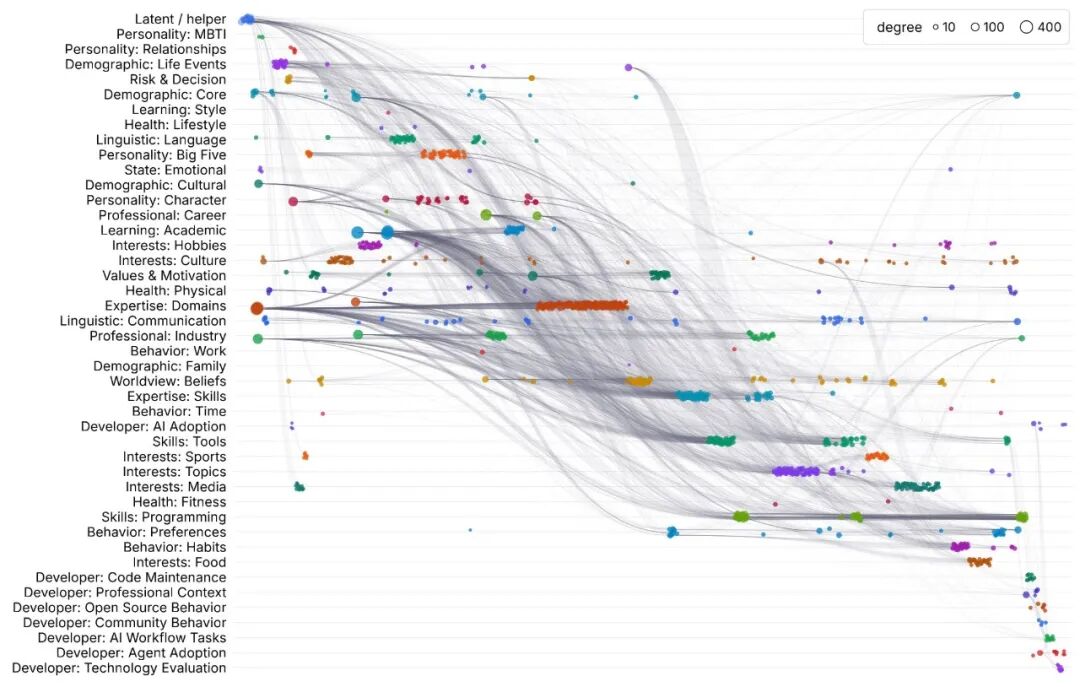
MatrAIx constrains the simulated persona settings based on dependencies among 1,290 attributes
Image source: MatrAIx
Beating: Is there a consistency metric between your simulated users and choices made by real people? Additionally, I feel you cannot genuinely simulate the behavior of 8.3 billion people. If not, is it necessary to create so many?
Yuexing Hao: This is an excellent question. Our first paper resembling a white paper reported on an end-to-end pipeline, from generating personas to verifying that their distribution aligns with the real world. The then relatively good model, Opus 4.8, achieved a consistency of 91.5%.
(Editor’s note: The 91.5% derives from a 400-run comparative experiment outlined in the paper, involving 10 behavioral traits and 4 environments. The persona agents driven by Claude Opus 4.8 showed correct performances or restrained behaviors on 366 occasions. It measures if the agent maintains character rather than similarity to real humans. The paper also notes that results from MatrAIx involving real populations should be regarded as generating hypotheses.)
In tasks like code generation, which are more quantifiable, the similarity between persona agents and real humans' downstream performance can be quite high. However, in areas subject to subjective interpretation such as humor, trust, and proactivity, there remain deviations.
To address these deviations during commercialization, we can collaborate with clients to create data flywheels that make the agents increasingly human-like. In the industrial realm, we have noticed that agents have become very close to resembling real people; to make it even more so, more context is needed, which means deeper background information—this is an area we have explored extensively.
However, we believe we cannot overclaim. We cannot assert that this will correspond precisely with a specific individual in the world, guaranteeing 91.5% similarity. We can only suggest that in certain fields, the similarity is relatively high, while in others, it may not be as high. Therefore, our initial focus in commercialization has been on software-related and agent evaluations, where we can say that the distribution aligns highly with reality.
Xiaomin Li: I would like to add two points. First, 8.3 billion is just the scale of the entire database pool, and we are merely proving that such a magnitude can be achieved. Real tasks do not require that many; they can be tested in small batches.
Second, in software-related domains, this gap is relatively small; however, in financial domains, the gap is significant. It is challenging to genuinely simulate human behavior or the behaviors of entire markets or groups.
This is why we ultimately landed on agent evaluations, as we now want to bring in diversity—not just prediction. For the same coding question, interactions can be incredibly diverse. At this point, I'm not concerned about predicting a specific group or individual; I am not making future predictions or human predictions. What I want is to stress test this model, bringing in human diversity, perturbation, and noise to see if it can still complete the task.
In this scenario, there are no predictions. This reflects a slight shift in focus as we implement commercialization.
Beating: Do you perceive different large models as having different personalities? There was a price experiment in the paper showing that among the same set of personas, GPT 5.5 had 98.3% hesitance in raising prices, whereas Opus 4.8 had only 27%. The models themselves have such a substantial impact on the results; how do you handle that?
Xiaomin Li: This prompted us to study more simulation methods and how to inject personas into the models. We want the models to learn a kind of simulation capability rather than applying a fixed set of layers to every model. You need to consider the base model's capabilities as well.
We have also released some follow-up works, one called AgentPersonaBench, examining different models in various domains, utilizing fixed simulation methods and data representations to see how well they function. Some might achieve over 90%, while others may reach over 70%.
Similar to Cursor, where you can select different base models, the quality and cost allow users to self-balance. We have essentially pushed the quality of simulation to its highest level.
(Editor’s note: AgentPersonaBench covers 20 model versions and 2,460 tasks, showing that the highest full pass rates across four interface types are 84.7%, and the lowest are 50.5%.)
However, the more crucial aspect, as previously mentioned, is that we are more focused on the diversity brought about by simulation rather than prediction. Therefore, the dependence on the accuracy of predictions will be significantly lower.
Beating: Currently, many companies are training their models using their own harness; is there a similar trend at the data level? Combining the data fed into the models with the models themselves for training?
Xiaomin Li: You are absolutely right. Simulation actually consists of three parts: data representation, simulation methods, and the harness tightly integrated with those methods. We have created a harness that can be applied to different models, ensuring they adhere to the persona over extended periods.
Beating: From my understanding, the entire process begins with modeling humans, then having these "people" perform evaluations, and finally feeding back to train the models. This resembles the common idea that the knowledge available on the internet has already been learned, so models start consuming what they generate. Do you think this is not ideal?
Xiaomin Li: That’s a very intriguing question. It touches on self-evolution, also known as RSI (recursive self-improvement). We have close connections with many companies working on RSI, and conceptually, there is a lot of overlap; simulated users are agents, and those being tested and improved are also agents. The difference is that we do not have the auto-research link in between.
Secondly, when you say knowledge has been learned to a certain extent, that refers to SFT-style training, where you provide knowledge to learn from. This part has already distilled a vast amount of information. Currently, companies like Anthropic and OpenAI still hire niche human experts to continue distilling human knowledge.
However, there is another way to acquire knowledge—without a teacher, you enter a new environment and learn through experimentation. When you stumble, the next time you learn how to navigate without falling. This is the mindset of reinforcement learning. As long as we define the reward function and rubric correctly, allowing it to be tested in various environments, the information naturally brought by the environment is extensive; not every piece of information needs to be conveyed by a teacher.
I believe this is a more fundamental way of learning with immense potential.
The Eve of Launch
Beating: The purpose of simulation is neither prediction nor can it substitute for human research. How do clients actually use it? What are the boundaries?
Yuexing Hao: Following the paper's success, many individual engineers involved in A/B testing, market research, and even political election predictions have been trying it out. However, after weighing various factors, we found that focusing on B2B and enterprise solutions is more effective. Currently, our primary clients are companies.
Company users are already familiar with the concept of "using simulated users to enhance model capabilities," so there is not much need for an education process. Often, they express, "We need these types of users and want to see their evaluation on downstream tasks using the model."
These interactions leave behind numerous trajectories. There’s not just a chain of actions but also a chain of rationales—why I pressed the enter key, why I clicked the buy button. This variety and breadth is precisely what enterprise users need, helping them swiftly discover failure cases and identify problems that could have been avoided before launching products.
Thus, we have consistently referred to our ecological niche as a pre-screening layer. Many agent products might not engage with real users before release or might have very few human users; at such times, they can interact with our numerous virtual users first.
Beating: Will you be conducting real data collection afterward?
Yuexing Hao: When collaborating with enterprises, there generally will be real user data, sometimes as seed data, other times for validation. Clients will also ask how we prove that real users would encounter similar situations, so a small portion of validation comes from real people.
This segment’s requirements are quite interesting. Sometimes, there is a need for domain experts, like scientists, writers, or financial analysts; in more general areas, such as personal agents, a vast number of average individuals is needed. We provide both types of services and have partnerships with companies focusing on real human ecosystems.
Xiaomin Li: The potential in this field is vast. Many see simulation as our primary focus, but we actually prioritize agent evaluation to help agents engage in Hill Climbing. Now, enhancing models does not rely solely on algorithm iteration; algorithms cannot iterate every few weeks anymore. Hill Climbing means taking the best models and discovering their issues to assist in improvement.
Our evaluations reveal problems in realistic scenarios; our reinforcement learning and supervised fine-tuning data help address them. Many might focus strictly on simulation, but for us, simulation is merely a means to achieve these goals. Commercialization considerations are very practical.
Beating: Why did you decide to open-source? Personally, I think exclusive data is a crucial competitive advantage.
Xiaomin Li: First, we have not open-sourced all 8.3 billion data points; we have only open-sourced 1 million.
Second, at the time, this was new, and we wanted people to know it worked and understand our technical level. Many C-level executives from major firms, as well as professors from universities and frontier labs, joined as research advisors, and we featured two Nobel laureates on our website.
Thus, the decision to open source was primarily motivated by reputation, as we also wanted to guide more interest in this field. The closed-source section is more detailed, with an eye toward commercial implementation.
When we opened up, we discussed its potential in various areas—market research, user studies, and AI evaluations, be it large models, agents, or any digital product like an app. However, we ultimately focused on agent evaluations as the most crucial part after commercialization.
Beating: So releasing a small portion is essentially a marketing strategy?
Xiaomin Li: Yes, it was a way to increase awareness of the project. At that time, we indeed received a lot of attention; we were featured twice in Forbes, received contact from a senior editor at Nature, trended on X, hit hot search on Weibo, and had over ten interviews in Silicon Valley, with NZZ am Sonntag in Switzerland reporting as well, along with Hunan TV domestically.
Many open-source communities operate exceptionally well, like SGLang and RadixArk; we highly recognize this model.
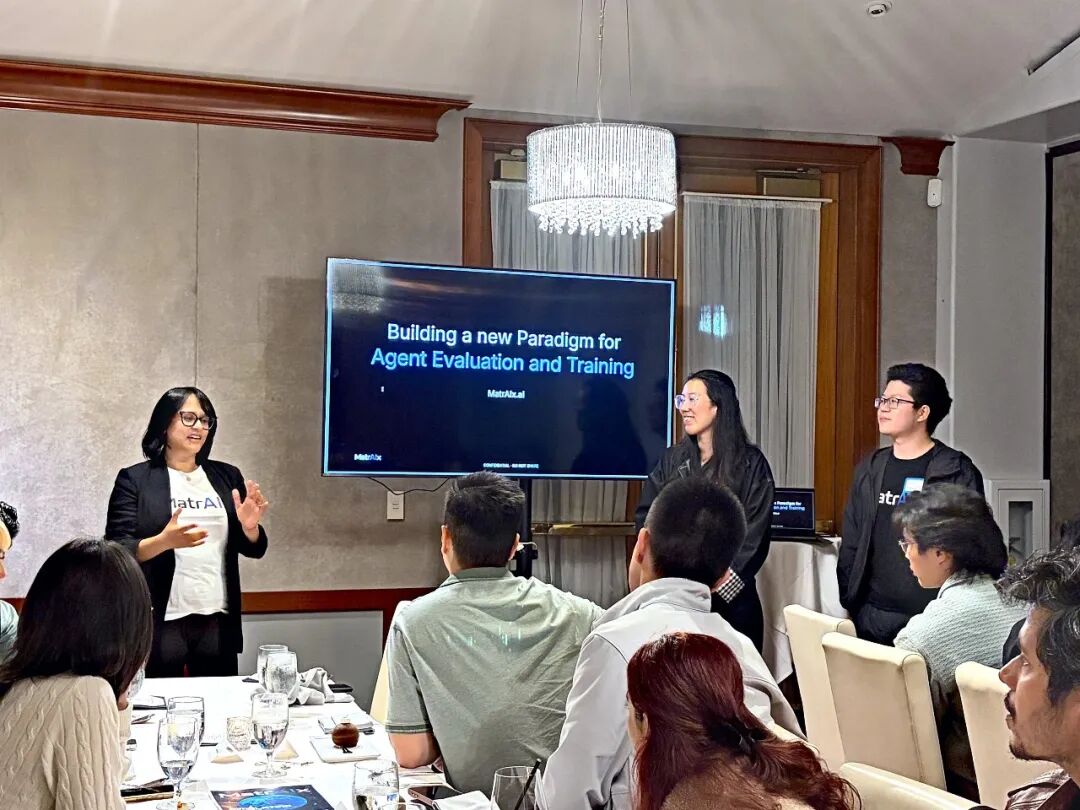
MatrAIx at the Personal Agent Night event
Engaging with researchers on agent evaluation and training
Image source: Xiaomin Li/MatrAIx
Beating: Could you describe the market you are in? What is the financing climate like? Comparatively, what are your advantages over companies that have already emerged?
Yuexing Hao: This is a relatively new market segment. Our slogan is "create a new paradigm for evaluation." Some companies share similar keywords with us.
The first category involves simulation, such as Simile and Aaru, mainly conducting market research and predictions targeting traditional clients like Fortune 500 or Fortune 100, selling AI personas for market research.
The second category is evaluation as a service, focused on selling benchmarks. Companies like LMArena and Design Arena release rankings with models scoring from 1 to 20, and all companies strive to rank high.
The third category sells real user data, including human annotations, expert Q&As, and interviews, like Scale AI, Surge AI, and Turing. This broad category also includes specialized subsets focusing on law, finance, and RL environments.
Hence, this market is quite vibrant; we don’t believe any single entity will dominate. The more granular the evaluations, the better they can enhance model capabilities. Relying solely on a single ranking might reveal high scores but not reflect user experiences positively in reality.
The financing situations for these companies are also robust. As long as models continue to iterate, it is good news for data companies. We prefer to think of it as enlarging the pie. Notably, with Anthropic and OpenAI's plans for IPOs, it indicates ecology is expanding and becoming more detailed.
(Editor’s note: See the opening of this article for an overview of Simile and Aaru's financing. Public reports indicate LMArena was valued at $1.7 billion in January this year, Mercor claimed a projected gross annual revenue of $2 billion in June this year, and the RadixArk team founded by SGLang announced a $100 million seed round in May this year.)
Beating: You are founders with a Chinese background, predominantly academic, establishing a startup in Silicon Valley and discussing financing—what is that situation like?
Xiaomin Li: What we are doing has garnered immense attention from all over the globe, and many people in China are now aware of us. So there's more inbound interest, and now we actually have less time to chat. Initially, there were many projects to undertake, but now it’s more about serving numerous contracts and clients.
We have raised some funds and received substantial support from many C-level executives at large companies and VCs. At this stage, we are more focused on products and clients. We are very open to making friends, but we feel that the best money comes from your clients. The conversation about fundraising has gradually become a lower priority, while the high priority is on contracts and clients.
Beating: Many reports suggest rising anti-AI sentiments in Europe and the US. Do you feel that? Any stories?
Xiaomin Li: The most obvious instance was when we recently visited a frontier lab to give a talk. There was a person standing at the entrance holding a sign protesting AI, shouting "Stop AI War," haha.
While we can indeed sense this sentiment to some extent, what we are more aware of is the changes brought by AI. Agents are indeed becoming smarter; in life, there are personal agents, and at work, there are coding agents and work agents.
One technology will always face opposition. However, I believe the opposition should not be aimed at the technology itself, but rather at the inadequacies of our guardrails and safety measures. What we need to strive for is to make it a useful tool that we can control, rather than completely rejecting the technology.
Beating: What’s your next plan? What are your short-term and long-term visions?
Xiaomin Li: Right now, we feel like we are living ten days in one. A year for us seems very long term. The entire team is extremely passionate, and there are some cool projects internally—some for internal use and others that will be released later. Research and technology are continually being refined to achieve the state of the art.
In this field, we feel confident. Our clients, potential clients, investors, and partners recognize the value of what we are doing and understand it applies to many areas. Initially, we will laser focus on perfecting one aspect, and after that, we will expand into other domains, for which research is already laying groundwork.
We are an ambitious team, implementing everything well and quickly. People can look forward to our upcoming releases.
Yuexing Hao: This is a very new paradigm. One or two years can pass quite rapidly; we believe it will become something every company needs to pursue. Our internal feeling is that one person is equivalent to a team.
Conclusion
In the first film of The Matrix, there is a line often overlooked.
Agent Smith tells Morpheus during the interrogation that the first version of the Matrix was supposed to be a perfect world where no one suffers, and everyone is happy. The result was a disaster. No one accepted this program, and generations of human "crops" perished.
Smith explains that humans need pain and dissatisfaction to affirm their reality; thus, the Matrix was modified to resemble the world as it was in 1999. Neo was still called Thomas Anderson there, having been called into the office by his boss for being late to work.
A perfect world fails to hold people's attention. A somewhat flawed world, on the other hand, is believed to be true.

In The Matrix, Morpheus presents the choice of the red and blue pills to Neo
Image source: The Matrix (1999) / Infobae
Over twenty years later, the direction of simulation has reversed. In the film, machines created worlds for humans, while now humans are creating humans for machines. Substitutes are utilized to answer surveys, test products, and repeatedly practice with agents, so these agents can serve real people in the future.
This business will inevitably face the same issue that Smith encountered: what kind of substitute counts as human-like.
The intuitive answer is accuracy in responses, but a substitute that is always patient, always accommodating, and answers every question closely resembles the happy individuals in the first version of the Matrix. Real humans will be dismissive, indecisive, say one thing and do another, and walk away when an answer is most needed.
The closer the substitute is to being human, the more it must learn to disappoint humans.
At the end of Smith's soliloquy, he states that the Matrix was halted in 1999 because that was " the pinnacle of your civilization"; the reason he says "yours" is because from the day machines began thinking for humans, it became "our" civilization.
Substitutes have not yet reached the point of thinking for people, but they have begun to answer questions for them.
If the substitutes are inaccurate, it's not a significant issue; in that case, the questioner will still turn back to seek real people. The trouble lies in them being accurate enough. Accurate enough for companies to develop products, set prices, and evaluate agents, making it sufficient to ask the substitutes, leading to fewer opportunities for real people to be asked.
Yet every answer provided by a substitute is derived from an individual's past. It can predict how you will likely choose, but cannot foresee when you will make a decision that diverges from the past.
In the film, Morpheus did not attempt to predict which pill Neo would select. One red, one blue, laid out in the palms of two hands, allowing Neo to choose for himself.
Everything that followed for Neo began from that single question.
Original link
Click to learn about job openings at BlockBeats
Welcome to join BlockBeats' official community:
Telegram subscription group: https://t.me/theblockbeats
Telegram discussion group: https://t.me/BlockBeats_App
Official Twitter account: https://twitter.com/BlockBeatsAsia
免责声明:本文章仅代表作者个人观点,不代表本平台的立场和观点。本文章仅供信息分享,不构成对任何人的任何投资建议。用户与作者之间的任何争议,与本平台无关。如网页中刊载的文章或图片涉及侵权,请提供相关的权利证明和身份证明发送邮件到[email protected],本平台相关工作人员将会进行核查。