The Traveler aims to develop a Chinese version of the "Starship" - the Traveler Ship.

Author: Zhan Zhu
Handmade Quantity丨100%
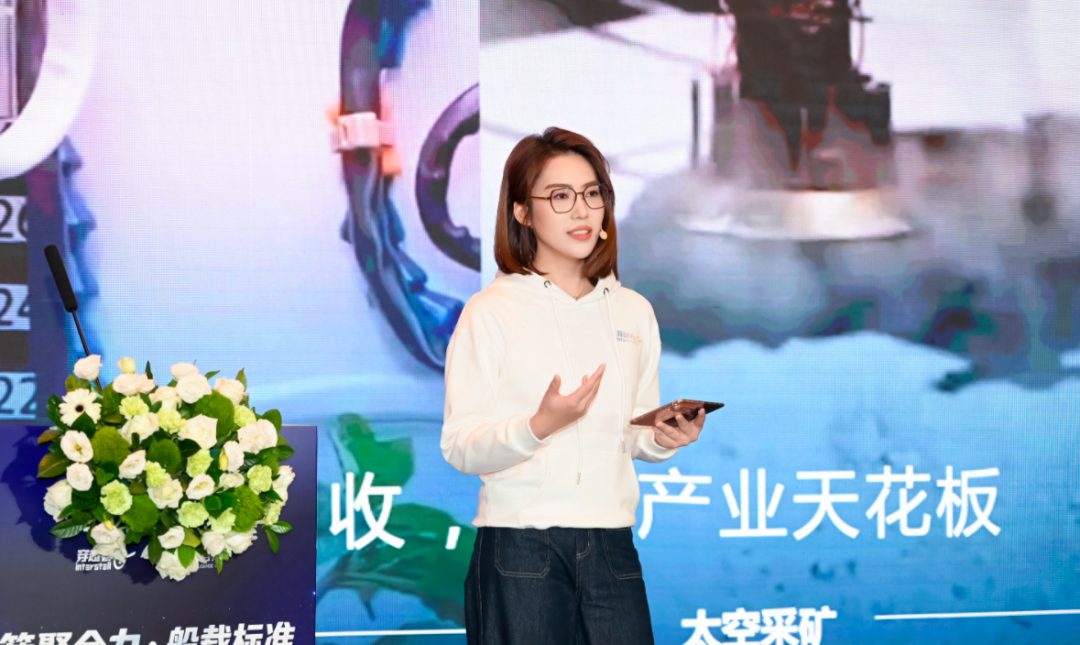
In 2021, Lei Shiqing wrote an application letter for space tourism to a well-known overseas commercial space company, but received no response for a long time. Five years later, she became the issuer of the space tickets herself. A suborbital ticket from the Traveler is priced at 3 million yuan, attracting various big shots from fields such as academia, well-known actors, and entrepreneurs to reserve tickets. Before the tickets can be fully realized, Lei Shiqing needs to simultaneously advance two things: the self-developed spacecraft and the supporting rocket.
This presents a stark contrast in reality: the spacecraft has not yet completed its manned maiden flight, yet ticket pre-sales have already begun; instead of developing its own rocket, focusing on manned spacecraft development, the company has announced a procurement framework for 30 rocket launch services with a scale of 150 million yuan. According to the procurement standards unveiled for private commercial space launches, this scale is relatively rare. The industry's thirst for market-oriented orders was also vividly reflected at the recent launch and rocket technology matchmaking conference hosted by the Traveler: over 50 rocket and upstream and downstream enterprises, along with nearly 80 investment institutions, crowded the venue.
This reflects the current structural reality of commercial space: domestic hardware development capabilities are ample, but sustainable market-oriented terminal orders remain scarce. In this context, the investment community faces three major cognitive traps regarding commercial manned spaceflight: believing in the shortcut of "cargo first, manned later," confusing the technical boundaries between first-stage recovery and orbital second-stage return, and asserting that high-difficulty space engineering can only be led by seasoned technical experts. In fact, commercial manned spaceflight is a compound proposition of technology + operations, where seasoned experts maintain the technical safety baseline while strategic operational leaders must oversee the big picture.
As a post-90s, non-technical ENTJ founder, Lei Shiqing is a rare female hard technology space entrepreneur in China, daring to enter the highly challenging field of commercial manned spaceflight. She is skilled at breaking free from inherent path dependencies within the industry, as suggested by the breakthrough connotations of the name "Traveler"; having established the company just three years ago, it has already become a new force in the industry that cannot be ignored, garnering widespread attention from industry and capital.
Her core advantage lies not in personally developing hardware, but in strategic definition, talent aggregation, user perspective, and a commercial closed loop. She has inspired a group of industry veterans from the national manned space program, many of whom have more experience than her, yet they choose to start a business alongside her. The company insists on positive research and development of manned baseline projects, refusing to convert cargo transport into manned missions, and employs a three-tiered commercial monetization ladder to hedge against the prolonged development cycle.
Below is a dialogue between Zhongzhong Network and Traveler's founder and CEO Lei Shiqing, edited and arranged.
Personal Experience and Entrepreneurial Choice
Why build a spacecraft in 2023?
Q: Let's start with your personal experience. Which experiences have had the greatest impact on your subsequent choices?
Lei Shiqing: I am a girl from Hunan, deeply ingrained with a spirit of "enduring hardship, being assertive, and tolerant of annoyance."
In 2018, I participated in the production of the documentary "Chasing Dreams in Space" for CCTV; this was my first deep dive into the commercial space sector, where I interviewed the first batch of private entrepreneurs in China who built rockets and launched satellites. I was particularly shocked, realizing that ordinary people could start from scratch in space - how cool!
However, what truly compelled me was in 2021 when Virgin Galactic and Blue Origin began carrying out space tourism flights. As a regular consumer, I carefully wrote a long application letter to overseas space tourism companies hoping to secure a flight opportunity, but it fell on deaf ears. At that moment, I thought, One day, I will fly into space on a Chinese spacecraft!
Later, I began systematically learning about manned spaceflight. While pursuing a master’s degree in Applied Psychology at Renmin University, I focused on human factors engineering and human-computer interaction and was fortunate to receive personal guidance from senior experts in the Chinese manned space sector, gradually getting a grip on the engineering system, technical context, and talent landscape of Chinese manned spaceflight. The accumulation of knowledge over the past two years has solidified my commitment to this direction.
Q: Wanting to fly into space is one thing, deciding to start a company is another. Why in 2023?
Lei Shiqing: To be honest, this initiative was initially a non-consensus for investors - they couldn't understand it, thought it was too sci-fi, and it was already good enough that they didn't view me as a fraud. Moreover, there was great policy uncertainty, and there was no mature comparable company in the country. However, at that time, I had four judgments:
First, what I have, others do not. Paid space tourism has already emerged overseas, and there are commercial companies providing personnel and cargo transport services to the International Space Station. I was concerned about when someone in China would do it.
Second, China’s manned space program has been 100% successful for over 30 years, and the technology is mature. In terms of the industry, there are already many commercial rocket companies. My judgment in 2023 was that reusable rockets would meet maiden flight conditions in the next three to four years. If we enter the field now, we could conduct joint tests with rockets around 2028, thus quickly opening a new era of average citizens going to space in China. We cannot wait on the rocket or let the opportunity slip; entering the market in 2023 is just right.
Third, the spacecraft is the only industry direction in the commercial space sector that directly targets consumers. Beyond tickets, space training, health support, research learning, and cultural and creative products also offer ordinary consumers opportunities to participate. This ToC consumption potential and IP extensibility are in the trillions.
Fourth, this sector direction is highly certain, has a sufficiently high ceiling, and aligns perfectly with my ability model. The talent pool for manned spaceflight is extremely narrow, the technical threshold is extremely high, and resource integration is very difficult - which is precisely the best moat. Building a spacecraft requires more than just engineers—it necessitates a dual-driven approach of "hardcore technology + top-tier operation." The spacecraft must be built, tickets sold, and the ecosystem established. I understand users better than engineers, and I know how to turn hard technology into consumer products. Early in my entrepreneurial journey, I visited NASA's Kennedy Space Center to see how they convert real space missions into various priced consumer experiences and how to build NASA as a global IP.
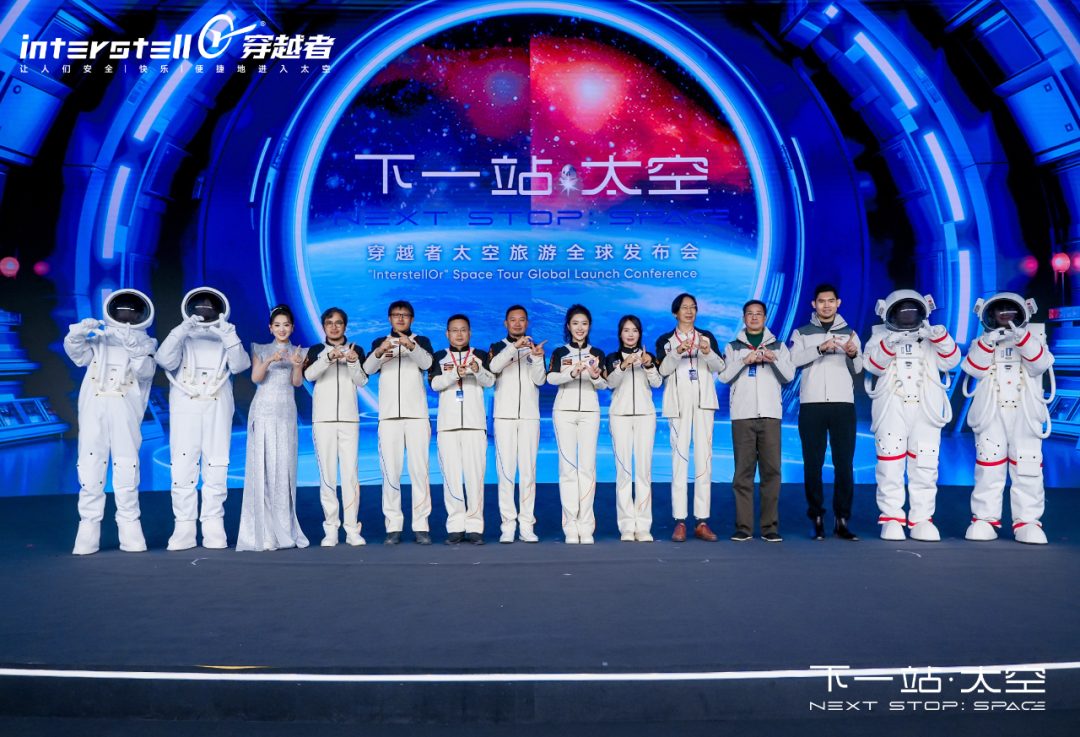
In January 2026, at the Traveler "Next Stop: Space" global space tourism launch event, Lei Shiqing takes a photo with the first batch of registered space tourists. This conference received billions of reads online and trended on multiple platforms, introducing specialized terminology such as suborbital flight and the Kármán line into public discourse, breaking the notion that "space flights only belong to professional astronauts," and pushing China's commercial manned spaceflight into mainstream visibility.
The Turning Point of the Space Economy
Opening the Era of Full Reusability with Secondary Recovery of the Spacecraft
Q: The Chinese commercial space sector has developed for over ten years. From the current standpoint, what do you think will be the most crucial change in the next ten years?
Lei Shiqing: If the past decade was the enlightenment phase of the Chinese commercial space industry, with a focus on technological breakthroughs and engineering validation, that's essentially wrapping up phase 1. The next decade will see the industry enter phase 2.0, gradually shifting its focus toward scaled operations and the realization of commercial value.
Since the policy opened up in 2015, we kicked off the 1.0 era, where market-oriented capital and private entities formally entered the field, completing the foundational construction of the industry from 0 to 1. The core mission during this stage was to resolve issues of low-cost orbital access and habitual space operations. Capital layout and valuation competition revolved around rocket development, orbital capacity, primary recovery, and satellite support. The market also experienced a complete cycle of capital appreciation and depreciation: from 2018 to 2020, the first surge occurred, and by 2023 to 2024, it returned to rationality, with investment criteria shifting from conceptual PPTs to technological implementation, bulk deliveries, and capacity realization; by 2025, supporting policies will continue to improve, constellation networking will accelerate, and the private entry environment will continue to be optimized, steadily increasing the industry's prosperity.
In 2026, SpaceX completed its second-stage orbital recovery of the Starship, marking a significant event in the global paradigm shift in commercial spaceflight, officially ushering in the 2.0 era. Regarding global rhythms, we can see that the Falcon 9 achieved first-stage recovery in 2015, marking the beginning of 1.0 with low-cost upward capacity; while the successful operation of second-stage orbital recovery truly opens the space economy 2.0 characterized by earth-space round trips and closed-loop operations. From a domestic perspective, low-cost upwards and first-stage recovery have already made breakthroughs, but the orbital second-stage return, safety for manned round trips, and low-cost high-load downwards recovery still face challenges. There naturally exists a time difference, a technical gap, and a valuation disparity, which are core breakthroughs for the next generation of industry upgrades.
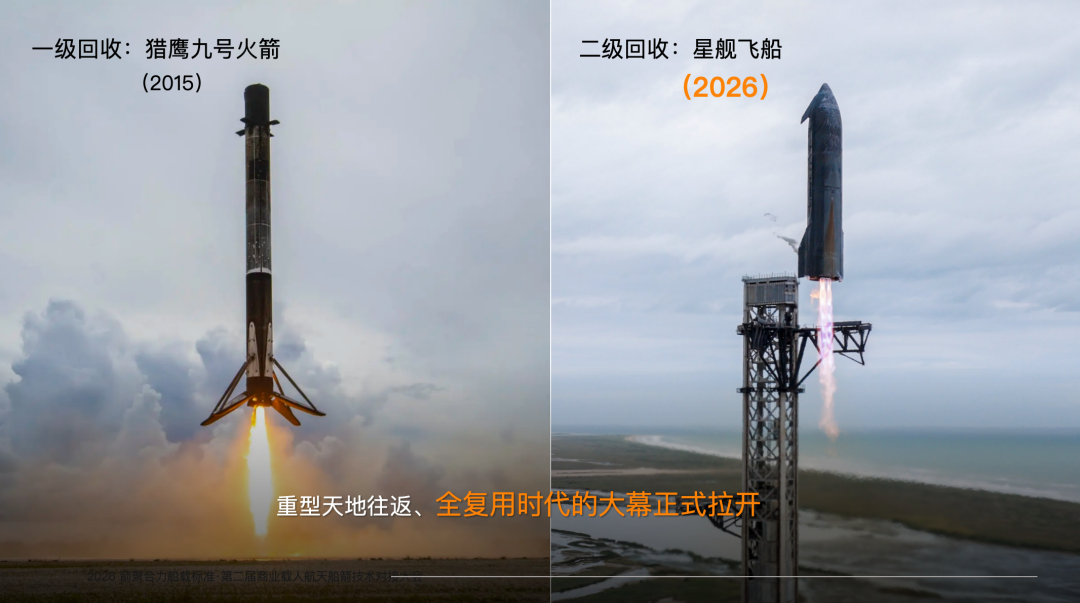
From the Falcon 9's first-stage recovery in 2015 to the Starship's second-stage recovery in 2026, commercial spaceflight is transitioning from the one-way 1.0 stage to the "earth-space round-trip and full reusability" 2.0 era.
It can be said that second-stage orbital recovery is the foundation for all next-generation space economic scenarios: First, it supports the large-scale deployment of space computational power. For space computational power to commercialize, it requires extremely low launch costs, iteratable, and maintainable on-orbit platforms. Secondary recovery will continuously reduce costs, potentially lowering launch expenses to $200 per kilogram, eliminating the cost barriers for mass networking and continuous operations of space computational power; Second, it runs through high-end industrial closed-loop in space. On-orbit new materials, space biological experiments, and space manufacturing will genuinely derive value from successful transformation after sample landing. Stable and low-cost downlink return capabilities will allow experimental payloads and space-manufactured products to be consistently recovered, creating conditions for mass manufacturing, thereby evolving space research activities from experimental projects into commercially viable businesses that can sustain themselves. Third, it supports the industrialization of commercial manned flights. The barrier to commercial manned spaceflight is not just about launching to space but also concerning safety, control, and reusability in round-trip capabilities. Second-stage recovery for manned flights is fundamental for normalizing and scaling manned travel.
Thus, 2026 will be a turning point for the shift in industry focus. In the 1.0 era, capital was focused on foundational transportation capabilities and networking; in the 2.0 era, the industry's focus must shift to technologies for orbital round trips, space applications, and space computational power, which are high-value segments. Compared to established, well-priced stock sectors, the 2.0 sector is still in its infancy; the industry landscape is not yet solidified, and the potential for valuation increases is enormous.
In my view, over the next three years, quality opportunities will concentrate in three directions: First, orbital manned second-stage returns and fully reusable spacecraft systems. This is the foundational infrastructure of the space economy and the core for defining industry standards and controlling ecological discourse. Especially platforms capable of overall spacecraft design and primary chain capabilities have much higher ceilings than single component suppliers - this is precisely the route the Traveler has chosen, not only aiming to master single-point technologies but also to build a complete ecosystem capable of operating through the entire chain. Second, space computational power and on-board intelligent payloads, are expected to succeed traditional satellite networking, becoming the largest incremental sector in the space economy. Third, in-orbit services, space manufacturing, and round-trip commercial payload business scenarios are less reliant on policy orders, thus more likely to form independent and sustainable commercial closed loops.
In summation: first-stage recovery has solidified the foundation of commercial space, while second-stage round-trips define the long-term growth boundaries of the space economy. Chinese commercial space has already bid farewell to the basic construction phase of one-way launches, entering a new stage of earth-space dual circulation and self-sustaining ecological growth, with a new wave of industrial dividends being released.
Q: What will be the path for aerospace to transition from a national heavyweight to the general public? What is Traveler's path?
Lei Shiqing: For a long time, aerospace, as a heavy tool for great nations, has primarily been planned by the state, with research institutions and the national team undertaking the development and task execution, while private enterprises have concentrated more on the supporting components, resulting in very limited channels for the public to directly engage and perceive. As commercial space policies continue to ease, social capital and market-driven innovation entities have begun to deeply enter the field, and commercial companies are starting to undertake core functions such as the development of complete satellites and rocket assembly and launch, cost reduction in launching, and technological iteration. The satellite internet sector has already been the vanguard of this trend. Commercial manned spaceflight is also advancing along this evolutionary path: driven by social capital, we are conducting independent research and development aligned with international advanced technological pathways, continuously reducing the cost barriers for earth-space round trips.
However, we must also objectively recognize that even if commercial manned flight ticket costs are reduced to several hundred thousand yuan in the medium to long term, only a small number of people will be able to afford direct access to space. This is very similar to the history of civil aviation: early aircraft were similarly exclusive to a small group of adventurers and the wealthy. After prolonged technological iteration, industrial support, and large-scale operations, taking a flight gradually became an accessible travel option for ordinary people. The popularization of space will inevitably be a long-term process characterized by layered penetration and gradual advancement, rather than an overnight achievement of "everyone goes to space."
In my view, the core of popularizing space is not to get everyone on a spaceship right away, but to allow every ordinary person to find their own step to connect with the space economy. Satellite internet and space computational power trends toward B-end infrastructure, which is difficult for the public to perceive intuitively; however, commercial manned spaceflight inherently possesses strong experiential, widespread communicability, and high recognizability IP attributes, making it one of the few sectors that can directly reach C-end markets, which is its unique value.
Thus, the Traveler's business model extends far beyond just "selling tickets." We have established a three-tier mutually supportive, self-contained ladder system aimed at different consumer levels of space enthusiasts, paving the way for everyone towards space:
At the bottom layer, first transform our IP into an entry point for public consumption. While the 3 million yuan ticket may seem far out of reach, no worries - for 300 yuan, you can buy space-themed cultural and creative products just like the ones Huang Jingyu uses. This isn't a joke; young people are willing to invest in the word "space," but what they lack is someone to present the products in front of them. Aerospace cultural tourism, research learning, simulated astronaut training, wellness, and cultural and creative activities are all low-threshold, widely applicable businesses, establishing the first touchpoints that connect ordinary people with space. This is not a mere auxiliary business - we aim to create a space fan economy, which constitutes the first layer of cash flow at the consumer end of commercial manned space IP and is also conducive to nurturing the public's yearning for space, accumulating a foundation for industrial development. Today's young people and children who can't yet afford tickets will become supporters and participants in the entire space sector in ten years.
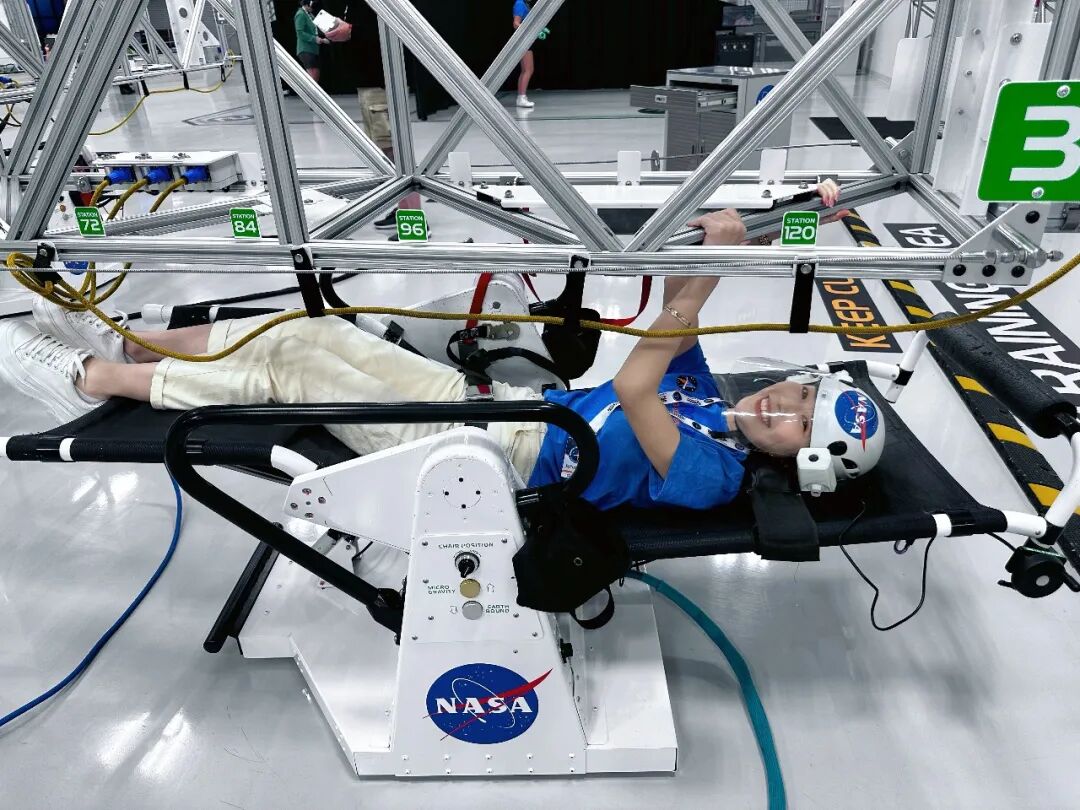
Lei Shiqing at NASA's Kennedy Space Center, experiencing professional astronaut training facilities and researching overseas commercial space experience projects.
The middle layer involves leveraging the spacecraft's capacity to provide lightweight, flexible space-derived services, enriching our revenue structure and amplifying our IP value. For instance, our plan to launch everything into space, on-orbit experiments, space manufacturing, brand space collaborations, and space advertising, etc. These business types have lower barriers, more flexible orders, and can be initiated ahead of the normalization of manned operations, continuously monetizing our spacecraft's capacity and space IP. Flexible orders can continually bring upfront cash flow to projects, amplify IP influence, and keep industry enthusiasm simmering, fueling our higher-level manned business. The credibility from collaborations and partnerships stems from our proprietary manned spacecraft platform; in return, the revenues generated from these businesses can also flow back into spacecraft development investments.
At the top layer is our core business: the Traveler series reusable manned spacecraft, focusing specifically on the round trips themselves. We aim to align with the underlying logic of fully reusable Starships, but also remain grounded in domestic engineering realities, avoiding reckless pursuit of exceptionally large capabilities all at once. We strategically plan: first to achieve the capacity of 20 tons upward, 10 tons downward, accommodating at least 10 people for orbital round trips, constructing a fully functional, controllable tempo of a fully reusable earth-space round-trip platform; the suborbital model CYZ1 is on track for its maiden flight, aiming for China’s independent commercial manned flight. The manned round trip is the central foundation of this entire system, serving as the anchor point for all ecological layouts.
In summary, The Traveler's development logic centers on the core business of commercial manned round trips, building technical barriers and industry IP; relying on space launches, in-orbit services, space manufacturing, and other intermediate businesses to obtain upfront cash flow, easing the funding pressure of long cycles; then extending the reach of the space IP's influence outward through aerospace culture, research learning, and cultural and creative consumer ecosystems.
Product Definition
The Traveler aims to develop a Chinese version of the "Starship" - the Traveler Ship
Q: What are the most critical choices you have to make while achieving the goal of developing the "Traveler Ship"?
Lei Shiqing: This is a core issue touching upon the fundamental aspects of corporate strategy and technical pathways. The essence of research and development in commercial aerospace is about continuous trade-offs, where there are always priorities and sacrifices. For the Traveler, all choices regarding technical pathways, product pacing, and resource input ultimately serve our core mission: to realize normalized and scalable earth-space round trips, allowing humanity to enter space more safely, joyfully, and conveniently.
In summary, I believe there are three significant trade-offs, which fundamentally differentiate us from many players in the industry.
First major trade-off: insisting on the highest safety standards for manned missions as the baseline for original design, and being compatible with cargo missions, rather than "converting cargo to manned." There's a critical engineering misconception here that there is no shortcut of "flying cargo ten times to get to the eleventh person." How occupants can escape, how to maintain a survivable environment inside the cabin, and how much overload a person can bear must all be considered independently. We choose to invest more time and resources upfront, hoping these engineering accumulations can be applied to subsequent models.
Second major trade-off: in terms of the research and development path, we voluntarily gave up the radical approach of "directly developing a heavy manned spacecraft to fully parallel Starship." The first version of the "Traveler Ship" could be described as a "MINI" version of the Starship, fully functional but calibrated to domestic development foundations and feasibility, focusing on rigorous innovation. Our design goal is not to immediately achieve 100 tons and 100 people, but to realize a round-trip capability of 20 tons upward and 10 tons downward, accommodating at least 10 people for orbital round trips. Additionally, compared to the Starship, we preserved the spacecraft's independent escape capability throughout the process, prioritizing safety. Moreover, to realize it, we have divided our efforts into three major research and development stages: the suborbital spacecraft CYZ1 first, crossing the 100km Kármán line to validate aerodynamic, re-entry, thermal protection, and escape technologies. Meanwhile, we build on services, exploring space tourism’s commercial demands to accumulate engineering and operational data for CYZ2; the second stage will introduce the orbital cargo version of the Traveler Ship CYZ2.1 to validate high-load round trips; and the third stage will bring the orbital manned version CYZ2.2 to fruition, with the engineering accumulations from CYZ2 serving CYZ3 and extending into deep space missions. This three-step strategy allows technological progression upwards and downward compatibility, where every level of R&D accumulation paves the way for the next, allowing business closed loops along the way.
Third major trade-off: not developing first-stage launch rockets, but focusing on creating the most professional manned spacecraft platform in China. This has been a point of contention for many outsiders, why we do not make rockets. First of all, from the perspective of the Traveler itself, we need to stay focused and amplify our scarce advantages, building solid core barriers. Many commercial space teams tend to pursue self-development along the entire chain, working on rockets, spacecraft, and engines all on their own. While it may seem controllable, it actually disperses R&D resources extremely and prolongs iteration cycles, significantly increasing trial and error costs. The technical threshold for manned spacecraft is exceedingly high and comprises an entirely different technical system from launch rockets. Our greatest confidence, somewhat rare in the market, is that we have a team of top technical talent with the capacity for positive development of manned spacecraft. We aim to leverage the best talent effectively, amplifying this core advantage, concentrating all key resources, R&D capabilities, and product focus on our essential barriers - that is, the positive development of manned spacecraft, overall design, orbital-level returns, comprehensive safety systems, human factors engineering, multi-task platform iteration, and earth-space operation systems. Making inroads into the manned sector means establishing standard interfaces for rockets and advancing into real terminal markets. So, we do not disperse efforts by self-developing rockets, avoiding the old path of full industry chain heavy assets.
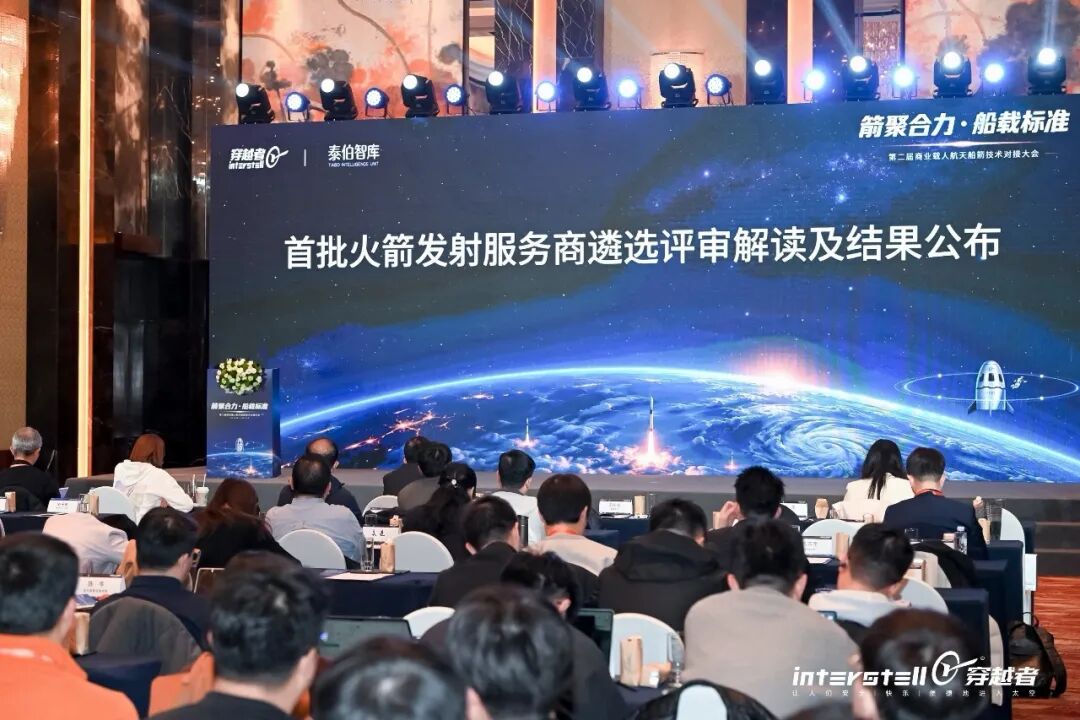
At the second Commercial Manned Space Flight Launch and Rocket Technology Matchmaking Conference, the Traveler announced the results of its initial selection of rocket launch service providers.
Furthermore, from the industry's perspective, we must confront structural issues head-on and utilize real orders to drive industry iteration. This year has been a banner year for rockets in China's commercial space sector, with many emerging rocket companies causing a surge in industry enthusiasm. But behind the excitement lies a long-standing structural challenge in the industry: domestic rocket manufacturers do not lack development capabilities but rather sustainable, self-cycling real market orders. Many launch missions depend on the direction of national strategic projects, which are directed tasks and do not create sufficient diverse, market-oriented terminal demands. Many rocket teams remain stuck in a state of "unprofitable yet engrossed," burning money continuously with business models struggling to complete closed loops. As a rare entity of genuine market demand, we are willing to invest real money, placing orders for 30 rocket launch services totaling 150 million yuan; based on our analysis of real market demand, 30 launches are far from enough. Therefore, at this technology matchmaking conference, we concurrently initiated another round of tenders for 30 rocket launches and the bidding process for first-stage heavy rockets. Relying on China's mature private rocket industrial ecosystem, we aim to drive continuous iterations and upgrades of domestic rocket models through stable, long-term, and scalable market demands while actively filling in gaps in the classification of commercial manned rockets, motivating companies to invest in manned-level technologies with reliability premiums, serving as the breaking point for the Traveler.
Additionally, looking globally, against strong competitors like SpaceX, if we attempt to cross the peaks of heavy rockets and manned spacecraft solely by ourselves, the challenges are immense, not to mention stretching our focus too thin. Each party must leverage their strengths while collaborating through specialization, forming synergy to catch up more quickly with international advancements. This is, after all, the optimal strategy of the path unique to China. Therefore, on the rocket front, we insist on strong cooperation with leading rocket enterprises, complementing each other's advantages, working together to establish low-cost, high-reliability, earth-space dual round-trip operations that are self-sufficient.
Q: What costs have you incurred in striving for the highest human standards?
Lei Shiqing: From the very beginning, establishing the highest standards for manned missions as our design baseline has been a proactive strategic choice, but it also means we must pay more in terms of time, funds, and communication costs.
First, it results in a longer R&D cycle, making it impossible to launch as quickly and yield flying results as readily as purely cargo or purely freight vehicles. Many rival cargo models can start from scaled-down prototypes, quickly proceeding to flight testing and obtaining quick flight exposure within a short time. This evokes early choices in the private rocket sector: Solid rockets can deploy more swiftly and achieve flight sooner; whereas choosing the liquid rocket route necessitates a far longer development cycle and validation chain. Our path mirrors this in abandoning quick flight tests and fast exposure of flight results, strictly adhering to the development norms of the manned space engineering system, advancing through design verification, detailed design, initial ground testing, and official flight testing step by step, without skipping steps or compressing the validation profile, which naturally results in a slower pace. This can create an extended "quiet period," lacking high-frequency flight events to signal externally.
Second, it incurs higher R&D and validation costs. Anchoring to manned standards necessitates a complete suite of escape, life support, overload control, redundancy, and human factors safety systems, all of which must undergo numerous boundary condition and extreme condition validations; the result is a greater number of experiments and more sub-sample trials, leading to significantly higher inputs of manpower, testing, and equipment compared to cargo models, yielding a larger financial expenditure scale, with longer cycles. Furthermore, we are the first truly commercial manned space enterprise in China, tasked with building the country’s first commercial manned spacecraft while also reconstructing the supply chain. Existing rocket and satellite supply chains are mature and operational, whereas our development is forward-looking without existing support. We adopt a strategy of "controlling one end while opening up the other": adhere to aerospace-grade standards for safety-critical components, while allowing non-critical components to introduce industrial-grade suppliers. Every single component, from a small electromagnetic valve, requires thorough groundwork and testing validation, establishing a qualified provider system belonging to commercial manned space bit by bit, thereby nurturing a new aerospace support ecosystem, which also consumes considerable time and validation resources.
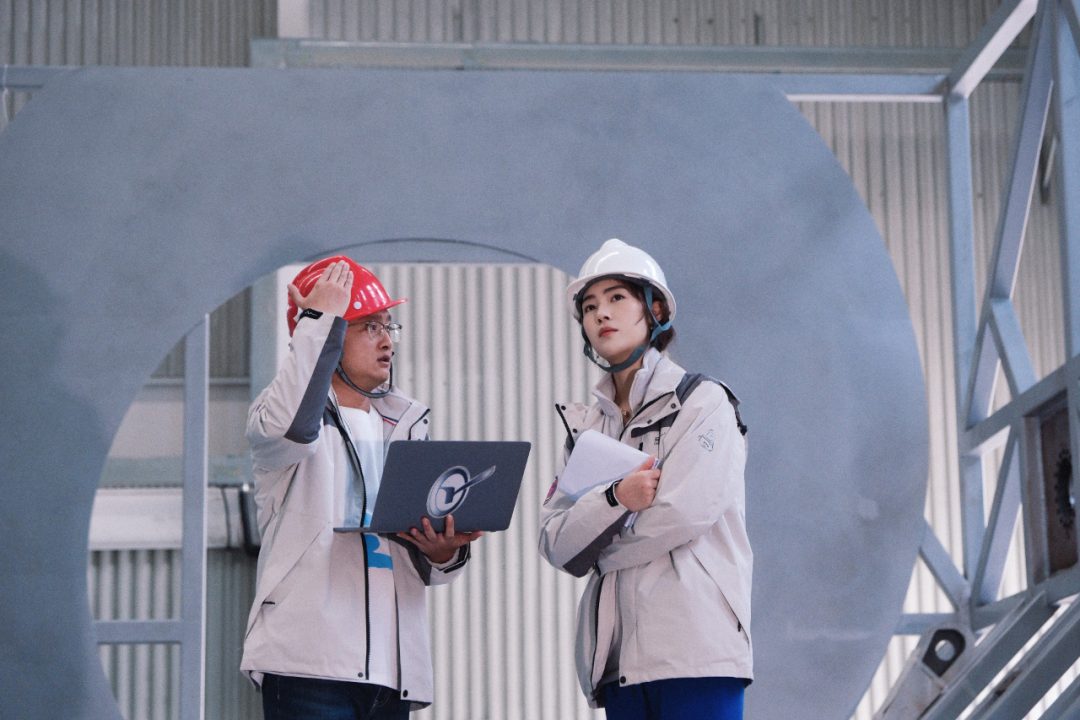
At the spacecraft testing site, Lei Shiqing interacts with the technical team to discuss engineering details.
Thirdly, the pressure from cognitive discrepancies due to weak milestone perceptions means that, in financing and market communications, we continually need to explain the value of our pathways. Compared to swiftly completed flight tests that consistently release trial milestones, the milestones associated with our pathway often remain buried in ground experiments and subsystem validations, lacking the demonstrativeness and impact of a single launch. External industry members, including investors, often find it difficult to understand the value of these critical ground tests, which can lead to doubts about project scheduling, thus bringing ongoing pressures to our expectation management and capital communications, requiring us to repeatedly clarify the validation logic under manned standards.
However, a silence does not equate to stagnation; the ground validation phase is precisely our high-density research and development period. From 2023 to 2024, we will complete the phase verification of the project, and from 2025 to 2026, we will enter detailed design and key technology ground validation, with the core objective of thoroughly assessing performance boundaries and reliability indicators of all subsystems on the ground, ensuring there are no doubts before flying. As things stand, core experiments such as active thermal protection, smart flight control computer joint tests, comprehensive land buffer validation, escape thrusting system performance tests, escape pod modal experiments, and static tests have been completed in succession; the first full-sized life support experiment cabin and escape test pod have successively come offline. Following this, we will successively conduct tests like cabin separation, recovery system air drop, GNC semi-physical simulation, and life support, all of which will be the first in the realm of domestic commercial space. According to plan, we will officially transition into the system flight testing phase by 2027, advancing steadily along the progressive path of "from low to high, from unmanned to manned," continuously iterating system reliability with real flight data.
We know this pathway is harder and tests patience. However, there are no compromises in manned standards; every investment today in ground testing, supply chain construction, and validation work lays the foundation for future scalable earth-space round-trip operations. Short-term pressures come in cycles, costs, and communications, but in the long run, this platform, fully validated to manned standards, will have the confidence to sustainably iterate and support the scaled operation of commercial manned endeavors.
Q: What do you think is the hardest part of this endeavor?
Lei Shiqing: I believe the core lies in three thresholds, and undoubtedly, these three thresholds filter out the players who can reach the endgame.
First challenge: the extreme scarcity of core talent and high technical barriers serve as the entry threshold for the sector. The limited number of models means fewer opportunities for engineering iteration and a scarcity of training platforms to cultivate talent. Professionals with real hands-on experience on the Shenzhou, Dream Chaser spacecraft, and space station, mastering the core technology across the whole chain, are a rare resource in this sector; even with ample funds, it’s difficult to assemble a complete team in a short time. However, our core advantage precisely lies here: before the company was formally established, I spent over a year mapping out a complete talent ecosystem, understanding the professional directions and core talent distributions needed throughout the manned spacecraft chain. Now our core technical team mainly originates from the national manned space program development system and has deeply engaged in the development work on the Shenzhou spacecraft, the space station, Dream Chaser spacecraft, etc., possessing cross-scenario system engineering capabilities from low Earth orbit missions to deep space projects.
Second challenge: the manned commercial airworthiness guidelines have not yet been established, leading to uncertainty in cycles, which is also the risk most concerning to investors. We are conducting tests per manned requirements, anchoring safety boundaries through authentic engineering tests and flight data, ensuring each step accumulates comprehensive and compliant engineering data, thus providing solid technical support for airworthiness reviews. Meanwhile, we are forming commercial closed loops via scientific payloads and IP-derived businesses during the wait for the guidelines to be released and testing validations to commence.
Third challenge: commercial manned spaceflight requires a dual-driven approach of technology and operations: not only must we develop spacecraft, but we must also deliver services, explore global markets, and establish a brand. We need to shift public perception from viewing "space tourism as science fiction" to believing that "space travel is a real consumable scene." Moreover, following our launch event at the beginning of the year, our backend saw over 200 new applications, with some overseas clients also reaching out to inquire. We hope to collaborate with travel platforms to provide more channels for interested individuals to learn and reserve.
Q: What do you think the biggest misunderstanding from outside, including investors, is about this sector?
Lei Shiqing: In the ongoing conversations with investors and industry partners, I have found that there are generally two misunderstandings about commercial manned spaceflight. These misconceptions directly affect judgments about pathway choices and technological barriers, and I seized this opportunity to share our understandings.
First misunderstanding: many investors default to the route of first developing cargo spacecraft and then manned spacecraft. The underlying thought process is quite straightforward—manned missions involve high risks and difficulties, so one should first conduct rapid trials with cargo vehicles to gather data, later upgrading them into manned spacecraft, which seems safer. However, there's a key engineering cognitive discrepancy I previously mentioned: crewed and cargo designs are two distinct baselines; manned spacecraft must adhere to manned standards from day one in their design and engineering validation. Once this capability is formed, cargo operations become one of its functions; conversely, the baseline for a cargo spacecraft is built upon catering to cargo needs, eschewing considerations for escape systems, environmental control for life support, human factors engineering, landing buffers, and fault scenario validations—none of which require designing system-level redundancies for "what to do in case of a fault." Its technologies cannot be transferred to manned models, and the engineering resources invested ultimately won't accrue to pathways towards manned endeavors. A common misconception is that "if you fly 10 cargo missions, you'll be ready for the 11th to be manned." This premise doesn't hold in engineering logic; flight-testing a cargo vehicle a hundred times does not lead to acquiring the complete safety redundancies needed for manned flights or the capabilities for escape and life control that are requisite. Just like solid rockets achieving ten successful launches doesn't mean the eleventh will successfully operate a liquid rocket.
SpaceX has never had a purely cargo variant, as its Dragon spacecraft and Starship embody the design philosophy of "the same platform, different configurations": starting with the manned baseline version defines the core capabilities, and with shared basic hardware and structure, this could easily switch to cargo operations by stripping out seats, manual controls, life support systems, and abort systems. In other words, its baseline has always been manned; they first conducted drone test flights before carrying cargo, as opposed to independently developing a cargo spacecraft before migrating to manned versions. The Traveler follows the same logic: establishing the highest safety standards for manned missions while also accommodating cargo capabilities—so that a spacecraft possesses both the safety redundancies required for manned missions and cargo task capabilities, ensuring its sustainable commercial value. Meanwhile, some enterprises are framing their narratives around the "cargo-first" argument by aligning with a plan for 10kg-level cargo satellites, yet these products do not present technological continuity in aerodynamic design, thermal protection systems, or structural scales when compared to multi-ton cargo spacecraft; the vast differences in technical thresholds easily confuse concepts.
Of course, many teams retreat to pursuing cargo shipments for very straightforward reasons: they cannot surpass the thresholds posed by the system for manned crafts. Numerous teams have backgrounds in satellite development, but satellite and manned spacecraft represent completely different engineering languages, with capabilities not translatable. Satellites, in essence, are precise orbital payload platforms that rely on rockets to ascend into space and do not need a return capability; the entire set of required technologies for manned spacecraft, such as escape systems, environmental controls, landing buffers, re-entry thermal protective systems, and complete system redundancy, is thoroughly unattached to satellites. The country moved from satellite engineering to manned missions thanks to billions in investments and extended development cycles, ensuring the operational integrity of this entire system. Now, pouring investors' funds to bridge this enormous engineering gap between cargo and manned operations equates to retracing fallen footsteps, all while incurring disarray in time and resources.
The Traveler team is ingrained with manned aerospace themes; even though I do not engage in frontline technical development, we have a seasoned team for developing manned models. There is a clear divergence between manned aerospace and satellite development, as even the top engineers in satellite domains cannot directly transpose their experiences into manned spacecraft development. As mentioned, if we have the capabilities to develop intelligent machines, we should have no reason to regress and build a "brick phone" that can only make calls. If investors are still accustomed to judging "brick phones" from a non-first-primal principle perspective, it may indicate a discrepancy in how both parties appraise the future of the sector. Yet I firmly believe that investors who truly understand the conclusive future of commercial manned enterprises will acknowledge the value of "intrinsic manned capabilities." With this rarity of expertise in manned engineering, if we cannot effectively run through this fully reusable round-trip platform, other domestic teams will undoubtedly face even greater hurdles in achieving the same.
Furthermore, cargo spacecraft without return capability inherently compete with rocket upper stages. The rocket upper stage can provide on-orbit carrying and experimental services through adaptive modification at a cost advantage, outperforming the independent development of a cargo spacecraft. The Xinhua Energy has adapted the Vesta Stage One for serving as the Celestial Hub’s orbiting platform, while the China Aerospace Science and Technology has also extended the capability of the LCAR-1 rocket to provide in-orbit services. This indicates that the footprint of independent cargo spacecraft is being pressured from both ends: the top is squeezed by national low-cost cargo projects like Light Boat and Haolong, compressing unit prices; the bottom is being eroded by the marginal cost advantage of rocket upper stages, limiting demand. Platforms without return capabilities are fundamentally still experimental satellite systems, incapable of supporting high-value research samples or on-orbit manufacturing products' downlink demands, which would hinder the formation of commercial closed loops.
We also need to clarify one point: manned spaceflight is not a fresh endeavor that starts from zero; global manned spaceflight has traversed 60 years, while China's manned spaceflight has maintained a 100% success rate for over 30 years, establishing a proven mature systematic engineering methodology. Our core team has deeply engaged in the development of Shenzhou, Dream Chaser spacecraft, and the space station and has complete engineering know-how on the safety systems for manned spacecraft, reentry, and escape life. Our first phase aims to introduce suborbital manned capabilities, leading progressively towards the orbital Traveler Ship; for us, undertaking suborbital manned missions represents a lower-tier application of the entire manned technology system, not an outright hard leap into a very challenging level. Instead, we have added tasks around user experience and reusable economy as commercial objectives. Years of operational experience with overseas suborbital manned vehicles have validated the feasibility of this route.
The second misunderstanding is that many people simplify the second-stage recovery of Starship as merely a rocket recovery technology, promoting the misconception that first-stage recovery and second-stage recovery must be understood on the same dimension. In reality, the first stage caters to heavy rockets, while the second stage handles the Starship, with second-stage recovery belonging to the orbital-level return category, whose core technologies arise from the technology spectrum of manned spacecraft. Specifically, first-stage recovery involves a power-assisted return at suborbital speeds, whereas second-stage recovery entails controlled re-entry at first cosmic speed without propulsion. The extensive challenges it needs to navigate include high kinetic energy, extreme heat fluxes, narrow re-entry corridors, blackout communications, as well as precise landings. The core competencies required for aerodynamic deceleration, thermal protection, re-entry guidance, and safe landing have long been refined within manned spacecraft systems, and cannot simply be extensions of traditional rocket engine capabilities. This distinguishes why we regard manned spacecraft and the second-stage round trip as our core sector, rather than merely focusing on rocket development.
In conclusion, these two misunderstandings stem from previous frameworks used to view traditional aerospace or rocket investing, failing to capture the completely new domain of commercial manned spaceflight. It is not an upgraded version of cargo rockets, nor solely a competition in rocket recovery, and it certainly cannot just be accomplished by relying on experienced professionals. Instead, it is an entirely new industry centered on human safety design baselines, grounded in round trips, balancing both technologies and commercial operations.
Team and Management
How are people gathered, and how is time spent?
Q: What is the current size of the team? How has this manned spacecraft team come together?
Lei Shiqing: Currently, the team comprises nearly a hundred members, with 70% being R&D personnel; core members primarily hail from the national manned space program development system, and 30% consist of commercial operations and functional personnel.
For me, the organization itself is the most important product; no matter how great the product, it is still created by a group of remarkable individuals. Thus, I also see myself as the top human resource officer of the company. During my postgraduate studies, I was fortunate to receive guidance from veterans in the manned space sector, systematically learning about the engineering structure of manned space missions. Meanwhile, I dedicated substantial energy to clarify the logical flow of manned model development and talent structure, deeply appreciating the rarity of individuals possessing practical experience in overall design within the industry. With the flourishing of China's commercial space sector, the industry ecosystem is beginning to absorb some of the excess aerospace talents, which also provided me the opportunity to build a team. I spent about a year and a half laying out a high-level talent allocation plan focusing on seasoned professionals with experience in developing manned models who have stepped outside their previous systems. Everyone came together with a shared passion for manned spaceflight and the vision of "building China's own commercial manned spacecraft." Currently, this rare cohort of experienced talent is gradually converging into our team, thus shaping the talent structure progressively along the initial plan.
When scouting for a chief engineer, I studied two classic case studies: Blue Origin's use of a younger chief engineer early on, and Elon Musk's partnership with Tom Mueller—where Musk defined the vision, commercial strategy, and set breakthroughs, while Mueller, as a top technical chief, maintained the foundational logic of engineering and turned bold ideas into actionable plans. This combination of "strategic helmsman + hardcore technical chief" has been a strong inspiration for me. Hence, I have a clear image in mind for our chief engineer: they must inherit over thirty years of reliable engineering experience from the national team, maintain safety standards, possess an international perspective, dare to innovate, and understand commercial demands, resonating with our core goals. Ultimately, I found Zhang Bo, a young technical prodigy who developed algorithms for 8,000 km spacecraft recovery during his doctorate, shining brightly in the manned spacecraft design team. After several discussions, he joined us as a co-technical lead and has become a key figure in our spacecraft development.
In the early stages, with limited funds, we avoided blindly expanding, forming teams as needed per engineering milestones. Many seasoned experts didn’t start out in full-time roles; usually, they began as supportive team members, engaging deeply while observing. As we steadily delivered results, proving our commitment and tangible progress, they bore witness to our iterations, gradually trusting us and eventually choosing to formally join full-time.
We aim for a structure combining new and experienced talent: seasoned experts serve as stabilizers, experienced in the Shenzhou spacecraft, space station, and Dream Chaser development, familiar with all risk boundaries in manned missions, ensuring reliability; young technical talents act as our innovation engine, embracing new technologies and daring to diverge from traditional paths. The experienced "old hands" provide support while the young innovators pave the way; this unique combination grants us an advantage. With this solid foundational framework, we maintain rigorous innovation: clearly identifying what red lines are absolutely non-negotiable, and in which directions we can boldly break new ground.
Q: Where do you primarily invest your time? What new insights do you have regarding management?
Lei Shiqing: At Traveler, I serve not only as the top human resource officer but also as the chief strategy officer and chief product officer.
In management, I hold a somewhat "ambitious" goal: to build Traveler into the "largest aerospace manufacturer in the East." This isn't about simply pooling together a lot of people for scale, but rather establishing a self-driven, capable, and vibrant system that achieves the professionalism and confidence of a major manufacturer, leveraging methods from new generation tech companies to tackle the most intricate problems in manned aerospace.
This year, I engaged top international human resource service providers to comprehensively refine the company’s organizational structure, hierarchy system, and compensation framework. My intent is to make the rules transparent: what does the growth path look like, what level of achievement corresponds to which returns, and who makes the key decisions—all of this is straightforward.
I promote a "double high culture": hire high-paid experts who can bear heavy responsibilities. We do not employ a numbers strategy, nor do we discriminate against seniority; meritocrats rise, while the incompetent fall, with values and returns in equilibrium to ensure those who work hard aren't at a disadvantage. Everyone on our team is an elite—there’s no need to waste energy on internal conflict and processes; we want to work efficiently.
Initiating early on, we've committed to building an AI-first organization; in its inception phase, I established a chief digital strategy director role, leading the team to promote AI across all levels. All "tedious" tasks and processes are delegated to AI, so the team can apply their minds to areas requiring judgment and problem-solving, avoiding getting lost in trivial matters. Tools manage low-level tasks while humans tackle real issues; this is the ideal profile for a tech company.
This past year, my greatest revelation has been: an effective organization possesses self-healing capabilities. Rather than needing to engage personally in everything, it is more essential to clarify regulations, responsibilities, growth paths, and return systems, providing strong players with ample opportunities to shine.
Sometimes I perceive entrepreneurship as an immersive, real-life, world-class game. Various challenging problems and complex individuals and situations are NPC levels along the path. They are not there to frustrate me but to sharpen me. I revel in this, unwilling to go offline daily, wanting to boost this group of talented partners as we level up and continue our journey into space.
Q: What kind of company do you envision Traveler becoming in the future?
Lei Shiqing: In my heart, Traveler is never just a simple hard technology company focused on building spacecraft. We aspire to be constructors of the entrance to the popular space age, defining China’s era of commercial manned spaceflight. Our ultimate goal is not merely the success of a single spacecraft but a complete closed loop integrating technology, transport capabilities, ecosystem, and brand, evolving into what we envision as "the largest aerospace manufacturer in the East."
The first layer reflects our role as pioneers, builders, and leaders in the field of commercial manned aerospace technology in the country. Looking forward, we aim not only to produce vehicles but also to construct a new infrastructure for China's space travel: a standardized, reusable, open manned round-trip transport system providing the base capacity for the entire aerospace ecosystem, and offering interfaces for spacecraft rocket integration, operational standards, and manned service capabilities, thereby truly amplifying the overall sector’s value.
The second layer positions us as operators of platform-based round trips for space. We will not rely on the one-time sale of spacecraft to fulfill value; CYZ1 has locked in suborbital access, CYZ2 secured rights for manned and cargo round trips in near-Earth orbit, and CYZ3 will secure lunar space entry rights. Accumulating these three access rights equals a complete spectrum of entry for Chinese commercial manned space voyages beyond Earth. When transport capabilities evolve into a flight-scheduled model, the gateway to the entire space economy will genuinely open up.
The third layer represents us as a space entry enterprise building a multi-tiered value ladder. We cater not only to a few high-net-worth individuals willing to spend millions on tickets but also to all ordinary people gazing at the stars: not everyone can instantly fly into space, but everyone can find ways to get closer to it. From content interactions, daily space-themed consumer goods, collections, and aerospace educational experiences, to the ultimate goal of space travel, we are establishing a comprehensive value ladder casting from hundreds to millions of yuan; allowing various individuals to discover their unique means of connecting with space.
Ultimately, our original intention is to open the door to the public space age. Traveler's mission is to construct not only spacecraft for accessing space for ordinary people but also to establish all pathways that facilitate their approach to the cosmos. This journey is bound to be long and replete with challenges, but this endeavor, while difficult, is the right course; it is essential for someone to take the first step. As pioneers, we must establish solid technologies, integrate cohesive ecosystems, and deeply ingrained brands in the public’s conscience, making Traveler synonymous with commercial manned spaceflight in China. This is the answer from our group to this era.
Conclusion
According to our plan, the Traveler will transition into the system flight testing phase in 2027, following a sequential order of "from low to high, from unmanned to manned," continuously iterating system reliability with authentic flight data. For Lei Shiqing, this endeavor is driven by a simple wish: when she penned that letter in 2021, she wished for a day to fly into space on a Chinese spacecraft.
免责声明:本文章仅代表作者个人观点,不代表本平台的立场和观点。本文章仅供信息分享,不构成对任何人的任何投资建议。用户与作者之间的任何争议,与本平台无关。如网页中刊载的文章或图片涉及侵权,请提供相关的权利证明和身份证明发送邮件到[email protected],本平台相关工作人员将会进行核查。