“Sleep more, experience sleep paralysis at midnight, and easily trip during the day.”
Hangzhou Seventh People's Hospital is a top-tier psychiatric specialty hospital. The chief physician and deputy director, Mao Hongjing, spoke about a 24-year-old patient who has been troubled by these issues for six years. He had consulted various grassroots medical institutions multiple times but had never received a clear answer.
Finally, this patient was diagnosed with narcolepsy, typically characterized by “sleeping anywhere at any time.” This was identified through a conversation of a few minutes with an AI developed by Mao Hongjing’s team, which guided the patient to a diagnosis after directing him to seek medical attention.
Reflecting on this matter, Mao Hongjing had one thought: if the experience of experts in top-tier hospitals could be shared and implemented in grassroots settings, how many similar patients could avoid unnecessary detours?
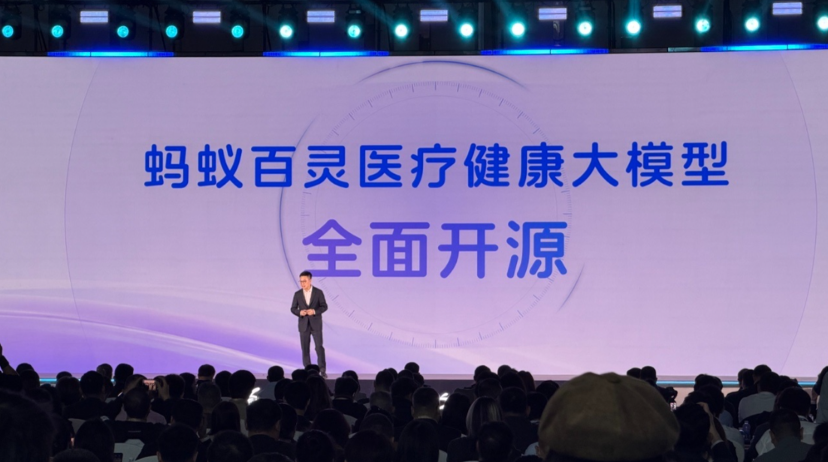
On November 23, Ant Group released the big model family of BaiLing Medical Health including medical professional reasoning, multimodal understanding, disease risk prediction, safety protection, and real-time intelligent agents, among other directions, and open-sourced two core models.
Previously, the external perception of Ant Group in the field of medical health AI was mainly “Ant Afu,” which is a specialized health AI application that has attracted over 150 million users since its launch, providing more than 2,000 health consultations per day.
This time, Ant Group chose to further open-source the foundational model capabilities behind Afu to the industry, allowing more hospitals and research institutions to develop their own medical AI applications based on the BaiLing Medical Health model foundation, combining in-hospital experience to enhance daily work and diagnostic efficiency.
Why does general AI not work in real medical scenarios?
Dr. Chi Chenfei, an attending physician in the Urology Department at Shanghai Renji Hospital, once tested a general model with a common clinical question: “PSA levels are elevated, what should I do?”
The answer from the general model was a lengthy introduction about prostate-specific antigen, but in outpatient clinics, doctors are more concerned with whether the report shows an increase in total PSA or free PSA, the ratio of both, as well as whether the patient has any difficulty urinating or a relevant family history.
Doctors refer to this as differential diagnosis; the same anomalous indicator could point to vastly different conditions. All useful information in the questions faced by the general model is already written in the stem, but in real outpatient situations, this information is actually completed by the doctor.
Professor Mao has also encountered similar problems. He mentioned that general models often give vague responses to ambiguous conditions like “I am not sleeping well,” such as recommending general sleep advice. A truly qualified psychiatrist should probe further—asking about difficulty falling asleep or early awakening, whether there is low mood, or any somatic diseases.
Mao Hongjing believes that the most critical gap between general big models and specialized medical large models lies in the “depth of domain knowledge” and the “rigor of clinical reasoning.”
Professional models must understand the precise meaning of medical terminology, be able to distinguish when to ask specific follow-up questions, and, more importantly, know where its capability boundaries are as an AI—when medical attention is necessary, it should direct the patient to see a doctor.
Chi Chenfei calls this capability “a sense of proportion,” which is a judgment ability that general models cannot provide.
For hospitals, chatbots find it difficult to truly integrate into clinical practice; what doctors need is an “informed assistant” rather than a generalist who knows a little about everything.
This is where Ant Group’s approach in the healthcare sector differs significantly from pure model companies: while the latter mainly focuses on model parameter scale, Ant Group tends to let models learn to “think like a doctor.”
Zhou Jun, the head of the BaiLing big model, explained that even during pre-training, the medical team and the foundational model team decide together which specialized materials to use and their respective weightings.
Each training problem involves at least three people in annotation; if there are three possible clinical options, doctors can hold differing opinions but must write down the rationale for their choice and what evidence supports it. When it comes to the subsequent reinforcement learning phase, the team must also verify whether the evidence cited by the model can indeed lead to the conclusions it provides.
The BaiLing model has also received feedback from frontline doctors during the training process. For instance, during the development of the Renji Urology AI (RJUA), Ant's tech team worked with urologists at Shanghai Renji to define tasks:
What constitutes “answering correctly” and what constitutes “missing,” would be defined first by clinical practice; once defined, doctors would write questions based on real outpatient scenarios, provide answers, and document reasoning as well. How to read a report is also decided clinically first, and then technically realized.
In this process, it is actually the doctors using their clinical experience to teach the model to adopt a doctor’s thought process.
The models released this time include the deep reasoning model LingSante-3.1-flash, which can read long medical records and review literature, and the multimodal model LingSante-3.1-air-VL, which can analyze anomalies by combining imaging and lab reports. Additionally, there are models for predicting disease risk, called Pulse, and for identifying medical safety risks, called MedGuard. During video consultations, Afu can ask questions in real-time while reviewing, using the real-time multimodal agent LingSante Live.
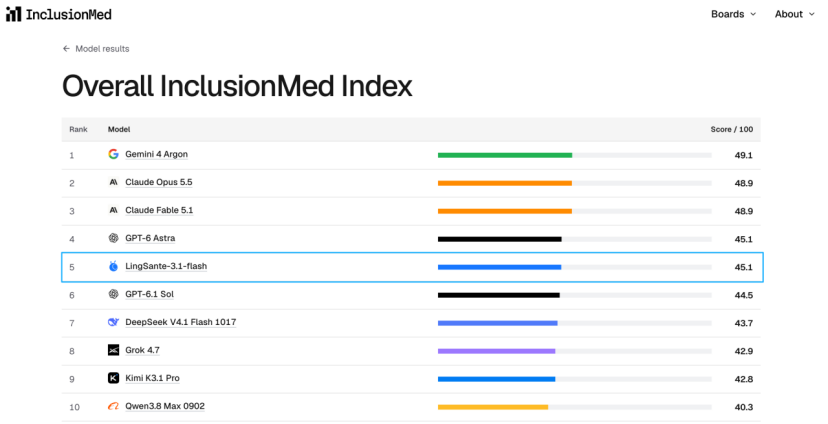
According to the evaluation disclosed at the launch, Flash ranks first among open-source models on the global medical AI evaluation platform InclusionMed. Air-VL received the highest scores among eight competing models in three tests: chest X-ray report generation, skin disease identification, and medical report interpretation.
The same BaiLing enters different hospitals
The team led by Chen Xiuyuan, deputy director of the Thoracic Surgery Department at Peking University People's Hospital, participated in the design of a lung cancer evaluation, GAPS (the world's first evaluation framework for evidence-based ability of large models for specific diseases), which included a question regarding lung nodules for patients in mid-pregnancy, where existing guidelines do not provide direct recommendations.
When guidelines do not offer ready answers, what relevant research can the model find? Does the research involve pregnant women, and what conclusions can be applied to her case? In clinical practice, evidence-based medicine requires doctors to combine the best available evidence with their clinical experience.
Chen Xiuyuan has a method for judging model capabilities: give it two very similar treatment options and see whether it can distinguish the clinical studies supporting each. “If this model uses the same evidence for both, I am unlikely to use it.”
The BaiLing team believes that if training uses information from the internet, it often contains inaccurate details, whereas training with the most standard textbook content in the medical field ensures that each diagnostic result and judgment has a clear source, which achieves evidence-based effectiveness.
Based on the BaiLing Medical Health big model, Hangzhou Seventh Hospital continued to pre-train with psychiatric specialty materials and refined it using supervised fine-tuning with samples that had demonstrative answers, creating its specialized model. According to Mao Hongjing, the team conducted comparatives of this model with overseas models and found that the specialized model had an advantage of “over 10 percentage points” in the tasks measured.
“Ant Group’s accumulated foundational capabilities make the training efficiency of specialized models far exceed our expectations,” Mao Hongjing said.
Patients encounter “Doctor Mao Hongjing” within Afu, which is also a sleep pre-consultation intelligent agent based on BaiLing training that inquires about how long the symptoms have persisted, what discomforts accompany them, and keeps an eye on anxiety and depression. Currently, it has served over 7.4 million individuals. Beyond pre-consultations, Mao Hongjing's team has also led the development of a software for assisting in the treatment of sleep disorders, which has received registration certification for digital therapeutic medical devices.
When patients arrive at Chi Chenfei’s urology outpatient clinic, they often bring along the reports. A patient might come in with a PSA test report, a prostate MRI report, a B ultrasound report, and sometimes an additional biopsy pathology report. Each report contains conclusions, but the patient most wants to understand what these several documents together indicate.
In September 2024, Renji Hospital and Ant Group launched the urology specialty intelligent agent RJUA. It is based on the BaiLing Medical model and can provide preliminary risk assessments in relation to test values and the descriptions in imaging reports. Before seeing the doctor, patients can complete the International Prostate Symptom Score with its assistance.
When patients enter the consultation room, doctors already have a symptom record ready for verification. According to Renji Hospital, as of August 2026, the intelligent agent had cumulatively served over 800,000 individuals, with 65% of consultations coming from third-tier cities and below. Many patients from out of town are able to leverage the interpretation experience of Renji doctors even before entering a consultation room in Shanghai.
These two specialized assistants have already outlined an ecosystem of medical AI intelligent agents based on BaiLing. Doctors from Renji teach it how to read through a stack of reports, while doctors from Hangzhou Seventh Hospital instruct it to understand the phrase “I am not sleeping well” in the middle of the night. The same methodology could be transferred to other fields, such as lung nodule screening in thoracic surgery, fracture imaging interpretation in orthopedics, and even chronic disease management in internal medicine.
Chi Chenfei believes that the foundational capabilities offered by the Ant BaiLing Medical model combined with the clinical knowledge of specialized doctors can construct an ecosystem of intelligent agents covering multiple diseases.
The Road to Open Source for Medical Models in China
Overseas tech giants have generally entered the medical field, with OpenAI and Anthropic integrating specialized capabilities into their medical products, allowing hospitals to utilize models through corresponding services and make configurations and integrations within allowed ranges, but they remain mainly closed-source, with tech companies leading model development.
However, the uniqueness of the medical industry lies in its extreme requirements for data privacy and localized deployment. For instance, in psychiatry, patients often discuss very private matters. Mao Hongjing stated, “We cannot put all the data in the cloud.” Ant assists hospitals in integrating models into their internal systems, with training and daily use conducted locally.
Therefore, by open-sourcing the models, Ant Group directly provides the model's capabilities to hospitals, allowing more doctors and research teams to participate in deciding how healthcare AI should be utilized.
Gu Jinjie, CTO of Ant Health Group, stated that model open-sourcing is also Ant Group's commitment to the community and partners, with continuous future investments in the healthcare AI big model field to enable more institutions to build their specialized AI applications on the foundational model, thereby promoting ecosystem development.
In Ant Group's development philosophy, model parameters should not necessarily be larger for better performance; especially in real medical scenarios, using models with appropriate parameter scales to solve suitable problems in relevant contexts is more crucial.
For hospitals, smaller models and open-source models imply genuinely reduced costs and barriers.
For example, among the Ant BaiLing Medical Health big model family, the deep reasoning model Flash for hospitals has 560 billion parameters, and in complex medical reasoning tasks, its capabilities are comparable to top-tier closed-source models with trillions of parameters. Meanwhile, the multimodal model Air-VL, which focuses on reading images and interpreting reports, is lighter with a total of 124 billion parameters and can be deployed locally on a laptop.
At the launch event, the Ant team demonstrated running Air-VL on a laptop. For doctors with suitable equipment configurations, they can see if it can read their department's reports without waiting for the entire hospital to upgrade its computational power.
The BaiLing team refers to this as the “intelligence-efficiency ratio.” According to the research and development goals set by BaiLing big model leader Zhou Jun, the next generation should use only half the parameters of the previous generation but exceed its capabilities.
In the Urology Department of Renji, even the questions for testing models have been opened up.
The dataset RJUA-QA, jointly constructed by this hospital and Ant Group, is the first Chinese medical specialty report interpretation question-and-answer dataset, which has been open-sourced on OpenKG, an open knowledge graph.
This means that researchers and developers nationwide can use this dataset for scientific research, model training, and algorithm validation. This is not merely a simple “data sharing,” but rather a “capability spillover”—opening up the clinical knowledge and diagnostic logic of nephrology at a top-tier hospital to society in a structured manner.
Other hospitals receiving BaiLing can try it out with Renji’s report interpretation Q&A set, incorporating the challenging problems they frequently encounter in their own outpatient clinics.
Chi Chenfei believes, “Open-source means that researchers and medical institutions across the country can innovate on the same high-quality foundation; our nephrology experience can benefit more grassroots hospitals through the open-source model.”
“I wholeheartedly support model open-sourcing,” Mao Hongjing thought of the general practitioners in grassroots clinics, where there might not be dedicated psychiatric specialists. “If there is a professionally trained healthcare large model that can be open-sourced, grassroots doctors can use it for preliminary screenings and supplementary judgments, effectively bringing the experience of top-tier hospital experts to the grassroots level.”
The open-sourcing of high-performance medical health big models will itself accelerate innovation in healthcare AI applications. The situation of different institutions developing independently might transform into a flourishing landscape in the future.
From this perspective, open-sourcing is not just a technical choice but a value choice concerning medical equity.
免责声明:本文章仅代表作者个人观点,不代表本平台的立场和观点。本文章仅供信息分享,不构成对任何人的任何投资建议。用户与作者之间的任何争议,与本平台无关。如网页中刊载的文章或图片涉及侵权,请提供相关的权利证明和身份证明发送邮件到[email protected],本平台相关工作人员将会进行核查。