Author|Dong Daoli
GLM-5.4 is officially released. Its biggest highlight is the adoption of the Loop Transformer architecture, allowing the 28-layer network in the GLM-5 base model to perform two rounds of cyclic calculations. This is equivalent to letting the model "think once more" before answering. According to Zhipu, this operation enables a model with 750B parameters to achieve intelligence levels comparable to 2T-3T class super-large models.
Illustration of GLM-5.4
Of course, making the model "think one more round" is not simply running the code twice. To avoid computing power and memory explosion, according to Zhipu's official disclosure, there are three core technical improvements behind this:
Gated Incremental Update: Avoids data distortion caused by repeated calculations, allowing the model to learn a division of labor where "the first round comprehensively understands the overall situation, and the second round fine-tunes"; the harder a word is to understand, the more attention will be allocated in the first round.
KV Cache global sharing + sliding window independence: Performing an extra round while occupying almost no extra memory - the second round directly reuses the "global memory" of the first round, only reserving a small amount of new memory for the current partial content being processed. Even when dealing with long texts of millions of words, deployment costs remain controllable.
Reuse of Sparse Attention Index: The second round of calculations directly uses the "important index" established in the first round, eliminating the need to re-scan the entire text while saving almost no loss of effect, thus skipping the doubling of retrieval costs.
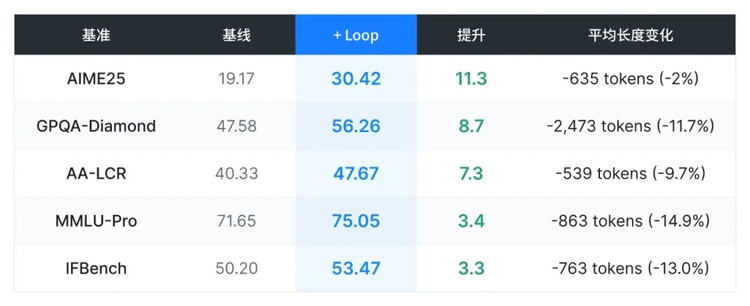
Currently, Zhipu has not released a ranking list for GLM-5.4, but based on the small model test of 30B, significant improvements were observed in the benchmarks assessing mathematics competition (AIME25), doctoral-level scientific Q&A (GPQA-Diamond), long text reasoning, and instruction following, with the Loop version showing clear improvement relative to the baseline. If the score improvement can be proportionally transferred to GLM-5.4, it would indeed be quite impressive.
1
Does GLM-5.4 Loop Transformer's advantage manifest?
GLM-5.4 VS Kimi K3.1
First, let's test GLM-5.4 against the truly large parameter model 2.8T Kimi K3.1. The task is to replicate the previously tested HTML page "The Gate of the Tide: The Giant Ring Sea City After the Tide Recedes" and the Blender animation "The Giant Ship Maintenance Dock in Jupiter's Orbit".
Test 1: 3D Web Animation "The Gate of the Tide: The Giant Ring Sea City After the Tide Recedes"
We submitted the original prompt given to Kimi K3.1 Pro for "The Gate of the Tide" to GLM-5.4 as is. The screen recording started from a panoramic view of the bay, cutting to the square, adjusting the tide level up and down, and then switching between blues and navigation perspectives. The Kimi original artifact on the right can be opened offline, changing with the operations.
GLM-5.4 ended its first run in 704.5 seconds, with 5 retries, and did not output HTML. When rerunning according to the original prompt, the first HTML stopped at the parsing stage due to duplicate declaration of JavaScript variables. It later rewrote the page, but the second HTML still encountered an undefined y0 when initializing the 3D scene. The left side shows the actual screen recording of GLM-5.4, the control panel appeared, but the sea city was not rendered.
Even after the second round of fixes, it wasn't smooth sailing; further shader compilation errors were discovered, and after fixing the rendering, overexposure occurred, leading the model to adjust the sun's position, fog color direction, and bloom algorithm.
Although the generation process had its ups and downs, the water surface and the detailing of buildings in GLM-5.4 felt slightly better than Kimi K3.1.
Test 2 | Blender Scene "The Giant Ship Maintenance Dock in Jupiter's Orbit"
This task required the model to model in Blender using the same prompts. GLM-5.4 took 325.0 seconds for the first run, with service retrying 15 times, and did not generate the project. The second request retried 10 times within 48.5 seconds. The third time, the submission was changed to only include Blender Python code, outputting 75,059 tokens, with a syntax error at line 780 and a missing generation entry at the end. The fourth run followed the original prompt but exited with API throttling at 429.
In any case, let's look at the final model that was produced.
As with the previous task, the effect generated by GLM-5.4 is indeed not inferior to Kimi K3.1, and from the main perspective's layout, GLM-5.4's scene is more reasonable, featuring a dedicated platform for astronauts to pass through, and the massive ring-shaped building's lights are turned on, creating a very reasonable appearance.
GLM-5.4 VS GLM-5.3
In the previous round, we tested whether GLM-5.4 can match it against truly large parameter models, discovering in some areas that it indeed has merit. Next, we will directly compare GLM-5.4 and GLM-5.3, using the same base model to see if the new architecture and technology bring qualitative changes.
First, it should be noted that during the test, ZCode encountered server throttling (429) or overload (529) multiple times, so ZCode may have remembered previous failed cases, subtly influencing the results.
Test 3 | Modify Code and Add a Gate to "The Gate of the Tide"
Let's first test the model's code modification ability. We handed the completed 3D sea city webpage "The Gate of the Tide" created by Kimi K3.1 to both GLM-5.3 and GLM-5.4. Both models received the same code and prompts, adding a gate between the inner harbor and the outer sea. When the gate is closed, players can drag the slider to make the outer sea tide rise while keeping the inner harbor's water level unchanged.
Functionally, both models locked the water level of the inner harbor, and the vessels also stopped waiting. But at the gate, the differences emerged. The four sections of the GLM-5.4 gate panels unfolded from above and landed on the water surface, retracting upwards when opened. In contrast, GLM-5.3's panels also displayed "Waiting," but the panels were not visible on the water surface. Upon rechecking the 3D coordinates, it was discovered that its panels were hidden below the water surface in both open and closed states.
In terms of prompts, GLM-5.4 performed better, clearly indicating to players why the ship hadn’t moved yet. GLM-5.3 only displayed a small line showing the navigation status, while GLM-5.4 used more evident prompts, with red indicating "Waiting" and green indicating "Navigable."
Test 4 | Modify Blender Animation and Add Disassembly Animation
We handed the completed "The Giant Ship Maintenance Dock in Jupiter's Orbit" by Kimi K3.1 to GLM-5.3 and GLM-5.4. Both models received the same Blender project and prompts, requiring a 15-second disassembly animation to be added to the giant ship. First, the rear hatch of the ship was opened, and the engine was lifted onto the maintenance frame outside; wait until the frame is steady before releasing the hook.
In this test, we can also see that GLM-5.4 significantly outperformed GLM-5.3; although both had corresponding animations, GLM-5.4 was obviously more complete and superior in terms of aesthetics and logic compared to GLM-5.3. However, it is important to note that GLM-5.4 had been interrupted for various reasons and submitted four times, making it difficult to say whether it could affect the results.
Test 5 | The Aerial Cargo Station Has Only One Battery, How to Deliver Cargo to the Airship?
For the last task, we started a small game from scratch, no longer letting the model take over tasks midway; this should theoretically minimize the advantages brought by the loop architecture.
The cargo station has only one battery. In the short task, the cargo box is already on the high platform; once the battery is plugged in and the bridge to the airship is connected, the cargo can be dispatched. In the long task, the cargo box is still in the warehouse, and players must push it onto the lift platform, power it, secure the counterweights, elevate the cargo platform, then connect the bridge and secure the airship at the dock.
In terms of gameplay, both versions are balanced, but GLM-5.4 provided clearer prompts for players. At the beginning of the long task, we didn't prepare anything and clicked "Dispatch." GLM-5.3 reminded, "Load first, then raise." In contrast, GLM-5.4 stated four issues at once: the cargo box is not on the high platform, the bridge is not connected, the airship is not secured, and the cargo station has no electricity.
From a gaming aesthetic perspective, it is felt that GLM-5.4 is far better than GLM-5.3; the materials are clearly segmented and the colors are diverse.
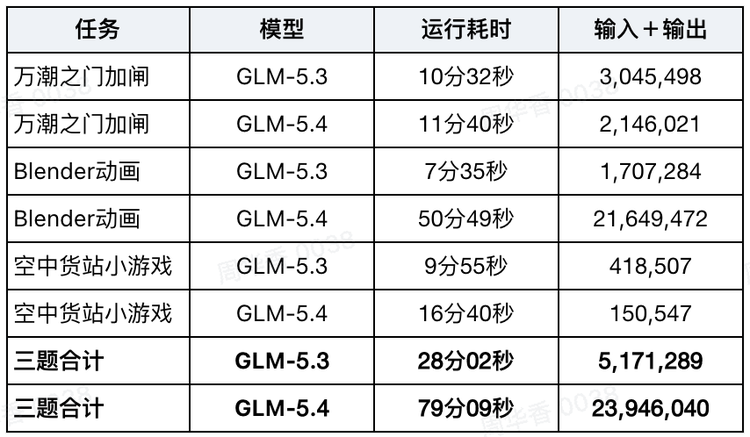
Finally, let’s compare the time and token costs of both models while completing this set of tasks. The statistical standards only calculate the final successful delivery for each question, with the time thoroughly including both tool execution and waiting time. In total, GLM-5.3 took 28 minutes and 02 seconds, while GLM-5.4 took 1 hour, 19 minutes, and 09 seconds.
The "culprit" behind the extended total time difference focused on the Blender animation task—just this one test, GLM-5.4 ran 43 minutes and 14 seconds longer than 5.3. A meticulous review of the execution logs shows that GLM-5.4, after saving the animation files in two sizes, did not directly finish but actively went back to repeatedly adjust the maintenance frame’s position and recheck the hatch gap. In this round, GLM-5.4 generated 107 model requests with a return on usage, while GLM-5.3 only had 28 requests. Due to multiple rounds of tool calls continuously rolling historical code and inspection results into context, back-and-forth modifications not only made input tokens snowball but also increased output consumption for the newly generated debug code.
However, as long as this "persistence in details" Blender task is stripped away, it becomes evident that in remaining tasks, although GLM-5.4 takes slightly longer, the extent is not exaggerated, and the output tokens are even more economical. Cyclic structures inherently introduce computational delays, whereas the gating mechanism introduced by Zhipu allows the model to learn to "think quickly on simple tasks and deeply on complex tasks," which is intuitively validated in the measured durations and usage distribution.
Through several rounds of high-intensity testing, the Loop Transformer introduced by GLM-5.4 has indeed brought substantial value, matching Kimi K3.1 Pro in terms of final delivery quality. In contrast with the same base model GLM-5.3, the improvements are more visually prominent; whether in visual aesthetics or the implicit user prompts and rationalization of project structures, GLM-5.4 is clearly superior.
However, "thinking one more round" is also a double-edged sword. In some complex scenarios, repeated iterations may lead to the model falling into the trap of "overthinking" by self-modification, such as in the first 3D web test, where the model introduced a blocking bug during repeated adjustments. Meanwhile, when encountering complex engineering challenges, repeated cycles compounded with contextual snowballing can exponentially amplify time and token consumption, echoing the humorously critiqued "thunderous thinking" in Zhipu's official article. Fortunately, in the vast majority of routine tasks, it only requires a bit of extra waiting time to ensure a higher delivery quality and more refined token consumption.
Overall, the new architecture has the potential to provide significantly improved performance, which raises expectations for its application in larger sizes.

Give a“Heart” and leave
免责声明:本文章仅代表作者个人观点,不代表本平台的立场和观点。本文章仅供信息分享,不构成对任何人的任何投资建议。用户与作者之间的任何争议,与本平台无关。如网页中刊载的文章或图片涉及侵权,请提供相关的权利证明和身份证明发送邮件到[email protected],本平台相关工作人员将会进行核查。