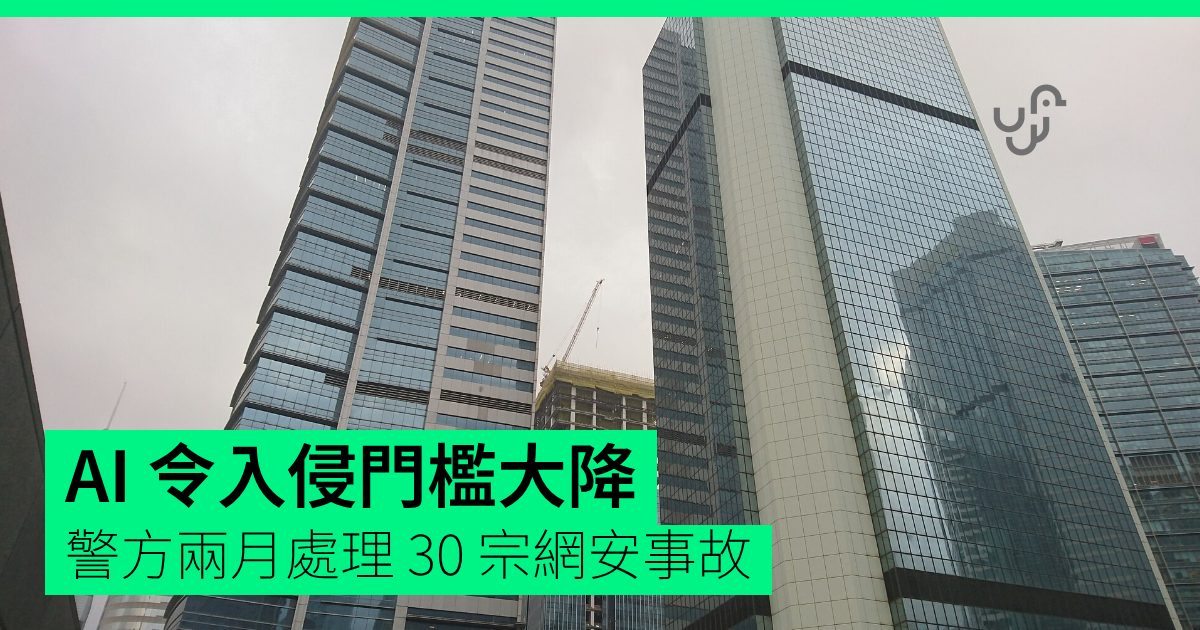

The Hong Kong police recently explained at a press conference that in the past two months, they have handled 30 cybersecurity incidents and indicated that criminals have used AI to accelerate scanning for system vulnerabilities. The Office of the Privacy Commissioner for Personal Data also announced at the same event that it received 330 reports of data breaches this year, reflecting an annual increase of nearly 50%. According to reports, the Hong Kong Cybersecurity Incident Coordination Centre (HKCERT) also participated in the press conference.
30 Cyber Incidents 11 Involving API Vulnerabilities
After consecutive attacks and data breaches on institutions in Hong Kong, the police disclosed that among the 30 cybersecurity incidents handled since October, 14 involved ransomware, 16 involved hacker intrusions, and 11 involved API vulnerabilities. According to the Hong Kong Wen Wei Po, the affected institutions are from various industries, with retail being the most represented.
API, or Application Programming Interface, is used for data exchange between applications and systems. The police pointed out that some of the involved institutions left API keys in the source code of mobile applications or websites, leading to a risk of key leakage, which hackers could exploit to gain unauthorized access to customer data.
Police Indicate AI Accelerates Vulnerability Scanning
The Hong Kong police pointed out that criminals have utilized automated tools and autonomous agent-based AI to scan for system vulnerabilities, accelerating their attack speed. The police mentioned that recently, the website and mobile application of a chain retail store were breached, with hackers obtaining over 1 million pieces of data in a short time; the case is still under investigation.
Privacy Office Received 330 Reports Nearly Half Involving Hackers
As of November 25 this year, the Privacy Office received 330 reports of data breach incidents, of which 156 involved hacker intrusions, accounting for 47% of the total, more than double the 75 incidents at the same time last year. Among all the reports, 113 were received in October or later.
The Privacy Office pointed out that insufficient authentication and authorization, as well as weak access controls, can exacerbate the impact of data breaches. Once an institution discovers a data breach, it should immediately gather important information, contain the situation, and notify affected individuals and the Privacy Office as soon as possible.
Institutions Must Verify Access Rights Citizens Beware of Fake Refunds
The Hong Kong police have handled 30 cybersecurity incidents in the past two months, and the number of data breach reports received by the Privacy Office has also increased annually. The police remind that even if IT services are outsourced, institutions still have the responsibility to protect customer data and should adopt a "zero trust" principle, verifying identity and access rights each time access requests are received.
Leaked order data can be used for "precision fraud." Fraudsters can use legitimate orders to gain citizens' trust, then solicit banking information, verification codes, or request transfers under the pretext of refunds or compensation. Even if the other party can provide order details, it does not mean they are customer service representatives, and individuals should verify through official channels themselves.
This article is reproduced from unwire.hk, with copyright belonging to the original author and media.
免责声明:本文章仅代表作者个人观点,不代表本平台的立场和观点。本文章仅供信息分享,不构成对任何人的任何投资建议。用户与作者之间的任何争议,与本平台无关。如网页中刊载的文章或图片涉及侵权,请提供相关的权利证明和身份证明发送邮件到[email protected],本平台相关工作人员将会进行核查。