Your counterpart is always the same one? Variational combines Robinhood and Citadel into a single protocol.
Written by: Four Pillars
Translated by: AididiaoJP, Foresight News
Notes: Variational is an on-chain derivatives trading protocol, with its core product being Omni. Its core is not "just another on-chain exchange," but rather a vertically integrated derivatives platform of "self-built market maker + direct customer relationships": its selling points are zero fees, best execution, and the ability to list hundreds of traditional financial markets, with the cost being that all positions are ultimately concentrated on the same OLP market-making desk. In the words of co-founder Lucas Schuermann, this is equivalent to "stacking Robinhood and Citadel together." It does not seek to be a price discovery venue but rather strives for the best execution; its revenue is not based on trading fees but on spreads. Settlements occur on Arbitrum, and each user has an independently deployed smart contract settlement pool.
Most traders never question who their counterpart is. Asking this question on the order book is almost meaningless—counterparties are simply someone who has placed an order at that moment, and it cannot be traced afterward. However, on Variational's Omni, the answer is always the same: Omni Liquidity Provider (OLP). This is a market-making system built and continuously operated by the team, with every trade's counterparty being it. The OLP first takes the position and then hedges against other user traffic in milliseconds, or directly hedges to external venues.
Co-founder and CEO Lucas Schuermann describes Omni as a "broker-style business." In an interview with Bankless, he stated more bluntly that this is equivalent to "stacking Robinhood and Citadel together." Traditionally, these two companies are separate, connected by payment for order flow (PFOF); Variational has decided to do both simultaneously and has grown significantly. As of November 1, 2026, the total trading volume reached $451.7 billion, with $78.1 billion in October alone, covering 581 markets, and the team consists of only about 25 people.
It is this vertical integration that allows the platform to offer zero fees and list products that exchanges cannot offer directly. The trade-off is that all positions ultimately rest on the same market-making desk.
Liquidity aggregator of self-made market making
Schuermann breaks down trading into three components: exchanges are responsible for matching, market makers provide quotes and take positions, and brokers bring in retail users.
Robinhood does not do market making itself but sells user orders to market makers like Citadel. Market makers earn money from spreads and then pay Robinhood a fee based on order volume, known as payment for order flow (PFOF). For users, it superficially seems "zero commission," but the actual cost is hidden in the spread, which is shared by market makers and brokers. Variational chooses not to outsource, acting as both a market maker and having direct customer control.
He further ranks financial businesses: banks at the top, followed by market makers, then brokers, with exchanges further behind; at the very bottom are those CFD brokers that bet against customers. In his view, what Variational aims to do is "market maker + direct customer relationships," rather than merely being an exchange or a broker.
They explicitly do not aim to become a price discovery venue but instead strive for the best execution. Exchanges sell price discovery and profit through fees; best execution relies on the price itself, with money earned in the spread. Variational chose the latter.
The mechanism is roughly as follows: after a user requests a quote, they receive a real-time full price quote (streaming RFQ), the OLP checks risk limits, applies user slippage limits, and the order either fully executes or does not execute. Afterwards, the OLP holds the opposite position and hedges as quickly as possible—unless another reverse user flow appears first. Margins and profits and losses are settled on Arbitrum, with each user having a separately deployed smart contract.
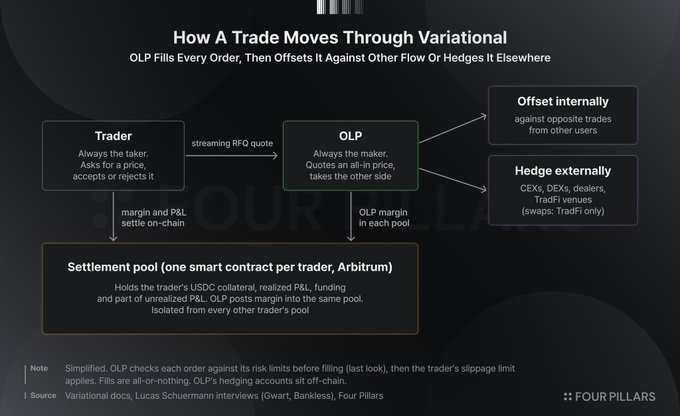
Why not allow smart routers to split orders across multiple exchanges? Co-founder Edward Yu explained: Derivative positions are not like spot positions; they cannot simply be moved to other venues. Splitting into five parts means holding five positions, each with its own margin and funding rates. Someone needs to take on the positions and pool liquidity, and that role in Variational is the OLP.
At first glance, it looks like a traditional CFD broker, but Schuermann emphasizes the essential difference. A CFD broker makes money only if it keeps positions (B-booking) and the customers lose; the OLP is closer to trading strategies like those of Jane Street or Wintermute—profiting from the spread while offsetting risks. The biggest difference lies in custody: each customer’s collateral is placed in a chain-visible contract.
When comparing with Hyperliquid and Lighter, the differences become clearer. In those platforms, counterparties are third parties placing orders, and while there are vaults like HLP and LLP, the vaults support exchanges; the OLP is the counterparty itself. Schuermann views exchanges as infrastructure layers, placing Hyperliquid similar to CME and AWS, while Variational aims to be "Apple." In fact, there is overlap—Hyperliquid is one of the hedge venues for OLP, and some of the traffic on Variational will ultimately also reflect on Hyperliquid.
Zero fees, all income from the spread
Variational has no trading fees. Schuermann’s logic is that traders bear two costs—fees and spreads, but spreads are unavoidable. In the Robinhood model, wholesalers take the spread, then share part of it with brokers as PFOF; Variational retains everything, avoiding "leaking to external market makers," and allows more competitive pricing.
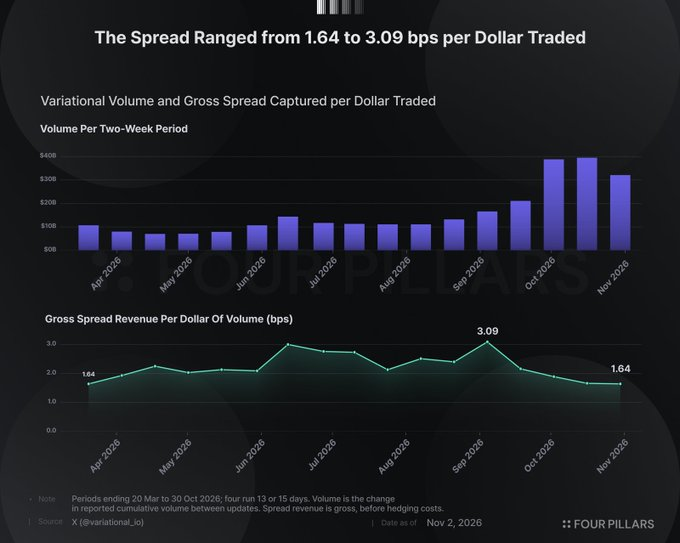
Biweekly reports show that gross spread revenue per dollar traded fluctuates between 1.64 to 3.09 basis points. At the end of March, it was 1.64 basis points, rising to 3.09 basis points in early September, and back to 1.64 basis points at the end of October, while the biweekly trading volume rose from $10.75 billion to $32 billion. Part of the reason is the product structure—swaps contributed most of the growth in October, and quotes are usually tighter than perpetuals; the rest is due to scale effects.
Schuermann explained why market makers can reduce costs as they scale, with three reasons.
- First, as trading volume increases, they can obtain better rates, rebates, and financing conditions from external hedging venues, making hedging itself cheaper.
- Second, with more flow, many orders can be hedged internally. The OLP buys from user A and sells to user B, earning the spread on both sides without needing to spend externally to hedge.
- The third point is less intuitive: assume the OLP has just taken on $100 million of BTC from some seller, acquiring a large inventory. At this point, it is more willing to offer the next buyer a better price than the market to sell off inventory quickly. As long as this price is still above its cost line, it can make a profit. A better price will attract more orders, increasing flow, and the cycle begins.
This is also why, in traditional finance, only a few companies ever consume most of the market-making volume.
Currently, these scale advantages primarily benefit traders, rather than being consumed by the platform itself.
From March to October, there were 18 biweekly reports. The OLP earned a total of $59.7 million in gross spread revenue, with a net profit of $24.7 million after deducting market-making costs and user rewards, with every period in the positive. The cost-to-gross revenue ratio fluctuated between 43% and 78%, not continuously expanding with scale. This means the OLP did not increase its profit margins as its business grew.
Schuermann described this as "not built to extract."
Swap: Direct Connection to Existing TradFi Liquidity
From the user's perspective, Variational's Swap is very similar to perpetuals: it offers leverage, allows for both long and short positions, and is collateralized by USDC. However, at its core, it is a bilateral contract between the user and the OLP, fundamentally not compatible with being listed on an order book or cleared by an exchange; it must have a market maker on the other side.
The funding rates also differ. The perpetual rates follow the deviation of the contract price from the index; the Swap directly transmits the financing rates between Variational and TradFi counterparties, with US stock indices referring to SOFR plus some points, precious metals referencing rental rates, and other commodities referencing the holding costs on the futures curve. Dividends are paid to holders, with hedging going solely through TradFi markets.
The core argument here is that an order book must rebuild liquidity market by market, especially on-chain—each new asset requires market makers to invest capital. This approach is feasible for a few deep markets but becomes a massive project for hundreds of markets. Variational skips the rebuilding and connects the OLP directly to existing liquid venues and traders. Schuermann mentioned that connecting to TradFi took "two quarters or even longer," from co-located servers in the Equinix NY4 data center to FIX connections and commercial agreements. The slow and tedious work creates a counterparty network that is part of its competitive edge. Capacity has already exceeded $1 billion and is released in batches.
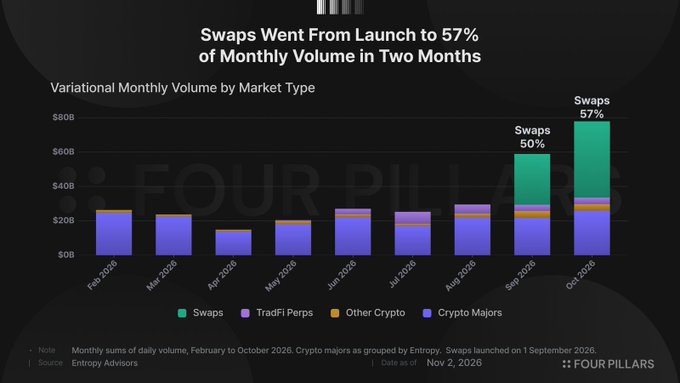
The result is that the share of TradFi markets rose from 4.3% in May (when the first RWA perpetuals were launched) to 62.0% in October. Swaps launched on September 1, with October trading volume of $44.6 billion, accounting for 57% of the total trading that month, and 92% of TradFi trades. The workday percentage was even higher—during the 24 hours ending November 4, swaps accounted for 66% of $26.5 billion in trading.
The most direct comparison is looking at swaps and perpetuals side by side for the same asset. For gold, silver, oil, and the S&P 500, Variational has listed both products simultaneously.
At 2:46 AM UTC on November 2, the swap quotes were tighter for three out of four assets. For a $1 million gold transaction, the complete bid-ask spread for the swap was 2.74 basis points, while the perpetual was 6.63 basis points.
The difference in funding costs is even more pronounced. Just after the weekend, the annualized funding rate for gold perpetuals reached 29.2%, while silver soared to 70.4%; the corresponding swap long-term holding costs were only 5.5% and 5.7%. The perpetual rate for the S&P 500 was 4.4%, slightly lower than the swap rate of 4.9%.
Swaps are not always cheaper. What they offer are rates anchored to traditional financial benchmarks—that will not spike suddenly due to trading congestion on the platform.
In the U.S., regulated competitors have already emerged. On October 29, ICE, the parent company of the New York Stock Exchange, announced a partnership with trade.xyz to build a regulated perpetual market on Hyperliquid’s infrastructure; on November 3, the first single-stock perpetual futures passed CFTC review.
Schuermann believes this is a good thing for the entire industry and has a neutral impact on the swaps themselves.
His judgment is that for assets like cryptocurrencies and Pre-IPO that lack deep secondary and derivatives markets, perpetuals are a more appropriate structure; whereas for stocks, indices, and commodities, deep liquidity and leverage already exist in traditional finance, making it unnecessary to rebuild them on-chain.
He still believes that if retail users can choose between futures, perpetuals, swaps, and spot, swaps are the better option. The CFTC changes mainly allow more ordinary traders to access leveraged derivatives, expanding the market for all who create such products.
Born for Scale and Breadth
Schuermann candidly discusses his model’s shortcomings.
In a September interview, he acknowledged that for small retail orders of $1,000 or $10,000, the order books for a few mainstream markets may look quite similar to Variational's. However, once orders grow larger, or involve hundreds of inactive stocks from Nasdaq or global markets, expanding the order book becomes very challenging—each market must separately seek out market makers to invest capital. For Variational, it is simply a matter of bringing in existing liquidity, akin to "just plug and play."
Data also supports this assessment.
During the US trading hours on November 11, the author captured quotes simultaneously at 10 AM, noon, and 2 PM New York time, calculating the back-and-forth costs for a $1 million one-time buy and sell, then comparing it with the same asset's trade on Hyperliquid’s trade.xyz perpetuals.
Even excluding Hyperliquid’s fees, Variational’s swaps are cheaper for the S&P 500, Nasdaq 100, gold, and oil. Including fees, the back-and-forth cost for Nasdaq 100 is 0.9 basis points for Variational compared to 4.0 basis points for Hyperliquid. Silver is the only case where Hyperliquid outperforms Variational on a traditional financial product.
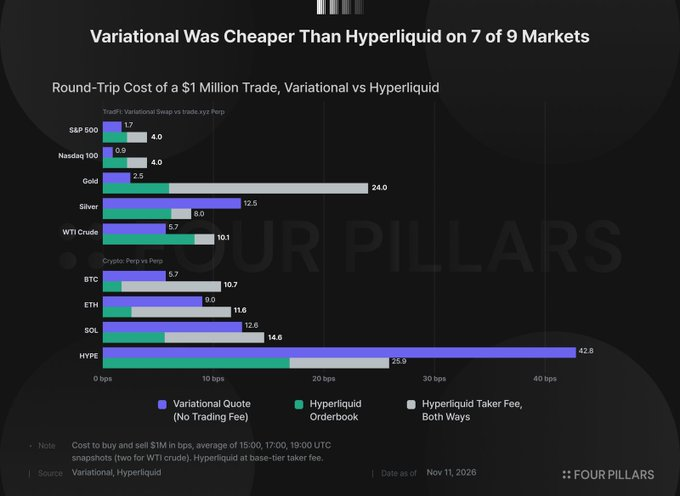
In contrast, the situation is reversed for cryptocurrencies.
Hyperliquid’s order book offers tighter quotes than Variational’s for four major tokens. For a $1 million back-and-forth trade of BTC, Hyperliquid’s spread is 1.7 basis points compared to Variational’s 5.7 basis points. However, when adding Hyperliquid’s base-level trading fee (4.5 basis points each way), Variational becomes cheaper for $1 million transactions in BTC, ETH, and SOL, and for $100,000 trades of the four major tokens.
HYPE is an exception. At the $1 million level, Variational is at 42.8 basis points, whereas Hyperliquid is only 25.9 basis points even when including fees. The mode of quoting plus hedging minimizes advantages in the venue with the deepest liquidity—where Hyperliquid is already deep in HYPE. Hyperliquid will also lower fees for the largest traders, further narrowing the gap.
In reality, very few people place $1 million orders for SOL or HYPE all at once; large orders are typically executed gradually using algorithms or TWAP. More importantly, the platform's current focus is: swaps have already captured most of the trading volume, and the next emphasis will be on traditional finance, where Variational can be significantly cheaper than other on-chain venues while listing hundreds of markets that others do not have. There is still room for improvement in crypto execution, with the current goal simply to maintain competitiveness.
The weekend situation is different.
Swaps close after Friday’s market close and reopen on Sunday night (UTC). This approach is aimed at avoiding extreme fluctuations and forced liquidations in markets with thin liquidity when trading occurs around the clock. The perpetuals for the same asset continue trading, but they reference a smoothed index.
From September 7 to November 1, weekends accounted for only 3.3% of Variational's traditional finance trading volume; whereas from June to August (when only perpetuals could be traded in traditional finance), weekends made up 18.5%.
Therefore, swaps are Variational’s strongest scenario for large trades in indices and commodities; while mainstream cryptocurrencies tend to be cheaper for routine volumes, even after accounting for fees. Large orders in HYPE and silver are still best placed on Hyperliquid; while currently, traditional finance exposure trading can only be done through perpetuals during the weekend.
OLP is built on the Genesis market-making system
From 2019 to 2021, Schuermann and Yu built an electronic market-making system and a single dealer platform together at Genesis Trading. Schuermann was responsible for engineering, and Yu for quantitative research. Omni is essentially their second single dealer platform but this time the dealer is themselves.
The two met at Columbia University. Around 2017, they operated a systematic forex and crypto fund called Qu Capital, which was later sold to Digital Currency Group (Genesis’s parent company). By the end of 2021, they left Genesis, more than a year before the bankruptcy of Genesis's lending department. They then ran Variational in a proprietary and OTC trading format until 2024, being active in places like dYdX, Drift, Zeta, Lyra, and at one point were one of the early large depositors in the Hyperliquid vault.
The FTX incident changed their direction.
In 2022, Schuermann saw many OTC counterparties being wiped out in the market. The problem lay in the infrastructure: at the time, OTC trading was conducted via Telegram or phone agreements, then formalized through email and DocuSign, settling through wire transfers days later. If a counterparty went bust before funds were received, the trade simply vanished.
Their solution was to move the inquiry (RFQ) and settlement on-chain: collateral was placed in smart contracts, and would automatically liquidate if a counterparty encountered issues. This idea later became Pro, which is why each Omni user transacts from their own independent settlement pool—positions and funds do not mix.
Going public means giving up a covert proprietary company that lacks a marketing team and public image. The two discussed this for a long time and ultimately decided that a category-defining business was worth pursuing. The protocol is set to go live on the mainnet in January 2025, with Bain Capital Crypto and Peak XV co-leading a $10.3 million seed round, and Dragonfly leading a $50 million Series A round in May 2026.
The experience is reflected in the OLP rules directly written into the protocol: every order undergoes a risk check, limiting the OLP's risk value, total nominal amount, net nominal amount, positions in each market, and exposure relative to the underlying asset size. A limit per user adds another layer of protection, allowing administrators to suspend trading when necessary. These mechanisms permit the OLP to reject orders that exceed risk limits. Currently, orders must either fully execute or not at all; partial fills of limit orders are being planned.
You are truly underwriting the OLP
The settlement pool is the first layer of the single counterparty model answer. Each user’s collateral is placed in an Arbitrum smart contract deployed solely for them, with the OLP also depositing its own margin into the same pool. Realized profits and losses, funding rates, and some unrealized profits and losses transfer nearly in real-time between the user pool and the OLP. As of November 2, there were 40,747 pools classified as active by Entropy.
If the OLP encounters problems or even goes bust, the original collateral in these smart contracts is completely isolated. If the OLP’s collateral in your pool is exhausted, liquidations affect the OLP, and your position closes at the settlement price plus a 0.5% bonus. From launch to October 10, there were a total of 167 such automated deleveraging trades, amounting to $273,000, while the trading volume in that period was about $400 billion.
The second layer is how the OLP trades. Schuermann describes the book running "very, very, very smoothly," with risks "in many cases held for only milliseconds" before being hedged or offset, supported by biweekly reports. In 17 out of 18 periods, the OLP's own profit and loss were positive. The only loss occurred in the two weeks ending May 1, amounting to $36,821, which corresponded to $7 billion in trading volume. Extreme markets are challenging for any market maker, but this loss magnitude on such a large book is what "smooth" looks like.
Then there was the Binance hack incident. On October 29, approximately $6.3 billion was stolen; Binance suspended withdrawals and stated it would cover the losses. On that day, Variational users withdrew a net of $16.5 million from the pool, setting a record for the largest outflow in a single day, but the withdrawals were completed smoothly because collateral had never left the on-chain contract. For the two weeks that included this incident, the OLP earned $1.06 million; Schuermann stated they were also profitable during the crash on October 10. Yu later noted that at that time, less than 25% of the OLP's capital was with Binance, and any losses would be borne by the capital providers rather than the users.
When pressed about the worst-case scenario—if the OLP lost all its funds, Yu replied that users could still withdraw existing funds from the pool, but "any future unrealized/realized profits after the point of OLP bankruptcy might not be payable." Collateral and settled profits are protected, but the earnings owed at the moment of bankruptcy are not.
Thus, the focus shifts to the OLP's capital, most of which is not visible. The OLP hedges with capital from CEX, DEX, and TradFi traders; the hedging capital is off-chain, outside of the reported TVL; the on-chain OLP vault fluctuated between $16.2 million to $54.8 million in October, merely representing operational balance. The total amount is undisclosed. The largest capital provider is Variational itself, funded through venture rounds, retained profits, and years of proprietary trading, while external parties supplement through LP agreements. The CEO states the company is sufficiently capitalized. The community OLP vault is on the public roadmap, but not imminent.
Build Citadel first, then Robinhood
Robinhood starts with customers and rents market makers; Variational constructs the Citadel part first and tested the market-making desk with real orders during the private testing phase of Omni. In September, Omni did not have a trading API, and product head Justin Bram stated that all trading volumes at that time came from users manually trading in the app.
Yu referred to the competitive edge as "having end users." The retail customers that Variational wants are already trading at the competitors Schuermann has named: from Robinhood, Interactive Brokers to Indonesia's Pluang, India's Groww, and Korea's Toss when regulations allow (Variational already has one of the largest user bases). The selling point is that the execution on swaps is good enough that you no longer look at the order book, just like you wouldn't check the order book when buying stocks through a broker's app.
Under the invitation-only system, new accounts declined from 42,700 in Q1 2026 to 17,500 in Q3. Monthly active users rose from 35,088 in February to 39,123 in October, with monthly trading volume per active account increasing from $760,000 to $2 million. On November 2, the top 100 settlement pools held 43.6% of the user pool amounting to $227 million.
Schuermann attributes the slowdown to the market and tracks the quantity of large accounts actively trading swaps and RWA perpetuals, which is increasing. Many are running strategies that do not rely on incentives, such as basis trading between perpetuals and swaps. "Traders like things that make them money," the CEO stated.
On November 12, the Omni mainnet opened and lifted the requirement for referral codes. The trading API will introduce systematic traders, whose flow is harder to price than manual clicks. This is exactly where the second scale cycle becomes critical: more flow allows the OLP to have more internal cross orders and better information to price incoming trades.
The Pro plan is set to launch in 2027 and is a multi-dealer model; Yu stated it can support markets where the OLP does not participate since Variational does not provide liquidity on Pro. Omni can only list markets that the OLP is willing to quote and hold, while Pro intends to remove that restriction.
The goal of Pro is to capture the OTC flow currently streaming through brokers like Goldman Sachs and JPMorgan. Schuermann believes that if you want to get OTC derivatives from banks today, you're still calling desks, with wire transfers settled two days later. By his estimates, this market is larger than all retail trades combined. He describes Pro as "the stablecoin moment for OTC trading." Everyone saw that the dollar peg was weak back in 2017, but it took institutional players and regulators years to get in. The rationale for something like Pro is easy to articulate; the key lies in who has the connections to build it—Variational has established these connections while running swaps.
免责声明:本文章仅代表作者个人观点,不代表本平台的立场和观点。本文章仅供信息分享,不构成对任何人的任何投资建议。用户与作者之间的任何争议,与本平台无关。如网页中刊载的文章或图片涉及侵权,请提供相关的权利证明和身份证明发送邮件到[email protected],本平台相关工作人员将会进行核查。