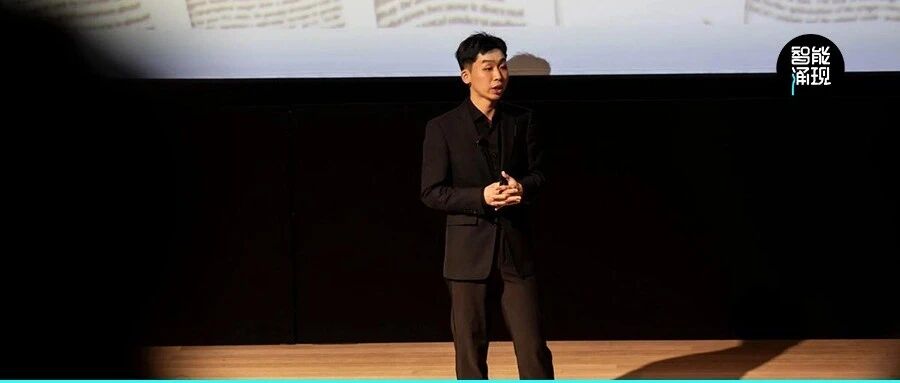
About a few weeks ago, my friend Teacher Dato (BW Research, public account "Yangge Zhifou") and I recorded a podcast together
introducing what research should look like in our eyes during the era of AI. Perhaps both of us are a bit idealistic, so most of the time we are discussing themes that lean towards grand narratives, and we are not sure if it can truly help everyone. However, at that time, we briefly introduced part of the AI投研 workflow that I built with Teacher Dato, and the recent market conditions may also have well-validated the value of this system and framework.
In the past two weeks, precious metals and base metals have unexpectedly dropped significantly, attracting high attention from the public. In fact, the trading decision daily report that Teacher Dato updates after the close of trading has already stood on the short side two months ago—silver dropped 33% after turning short on September 28, and Shanghai tin dropped 22% after turning short on September 11, while crude oil rose 55% after turning long on August 17. Many conclusions in my own public account actually rely heavily on the judgments made by various AI dashboards and data, whether it's macro marginal changes or the fundamentals of commodities, so we believe a more valuable thing is to hold an online meeting every two weeks in the future, to discuss the market while sharing our wheel-making ideas, dismantling these tools and how to use them, and how to make better trading decisions based on everyone's specific needs, creating real value. The first session is tentatively scheduled for this Sunday at 10 AM. We believe this will be a gradual process where, at first, everyone will mainly listen to our discussions about the market, and as time goes by, people will trust our tool judgments more.

We have not set any registration barriers, nor have we filtered participants. If you miss the meeting or don't have time, we will share our conclusions on the public account afterwards.
Returning to the main topic, since both of us come from a background in metal trading, we have reached a consensus on two points after such a long discussion.
1. AI is an extremely powerful information search and analysis tool that can greatly liberate productivity, providing individuals with an unprecedented leverage to amplify their own abilities.
2. At this moment, humans can still provide unique or even decisive decision-making value in research.
As time goes by, the second part may gradually decrease, eventually condensing into aspects concerning values and long-term vision. Most people will have their own super research assistants, and information asymmetry will no longer be a source of Alpha in investments; cognitive differences will become the core driving force behind differences in investment returns. We believe that there are two things we can do in this process.
The first is that we can distill a lot of our experiences into skills and then promote them to more people, smoothing out much of the information gap. This may not yield much in terms of returns, but it is a very worthwhile thing to do.
The second is that we can, in the process of this promotion, establish a deeper understanding and cooperation with more like-minded friends, sharing our visions and values in the short, medium, and long term. We believe these are two very valuable things, so our future calls will also be dynamic; on one hand, our understanding of AI is deepening, and what we do with AI in a few months may be entirely different from what we do today. On the other hand, at the beginning, there may be a lot of subjective exchanges among participants discussing market views, etc., but as time goes by, we may gradually reduce the subjective aspects.
We do not mind friends drawing on our ideas and then developing their own tools. As mentioned earlier, in this process, establishing deeper exchanges, understanding, and cooperation with more like-minded friends may be the more meaningful thing to do, but doing good deeds and leaving the rest to time. If you find it troublesome and wish to save your time and energy better, it’s perfectly fine to use our tools directly. Frankly speaking, we haven't fully decided how to price an AI research tool yet, because products in the age of AI iterate very quickly. On the other hand, if we open up the usage rights of the AI to users, it will also generate variable costs. So, for the first month, we plan to improve these tools while allowing everyone to use them for free. By around the Spring Festival next year, I believe these products will be more refined, and pricing ideas will also be clearer. I think in the next 2-3 years, we will gradually realize that in some areas, machines are indeed better than humans, and many parts of research can and should be left to machines.
Of course, if you insist on human judgment and do not wish to use any AI tools, you can always get our views on the metal market for free on our public account.
Specifically, our first discussion meeting will share several parts of content:
1. Top-down macro views
2. Bottom-up micro structure
3. Comprehensive view of the market
The third part is unrelated to AI and is purely our exchanges. The first part is mainly what I have done; the second part is mainly what Teacher Dato has done. The macro part mainly includes several segments.
First, the analysis of macro scenarios.
This part mainly consists of two sections: a part is a more traditional macro analysis, focusing on what scenario we are currently in. I have mainly done two aspects of work: the first is based on asset prices.
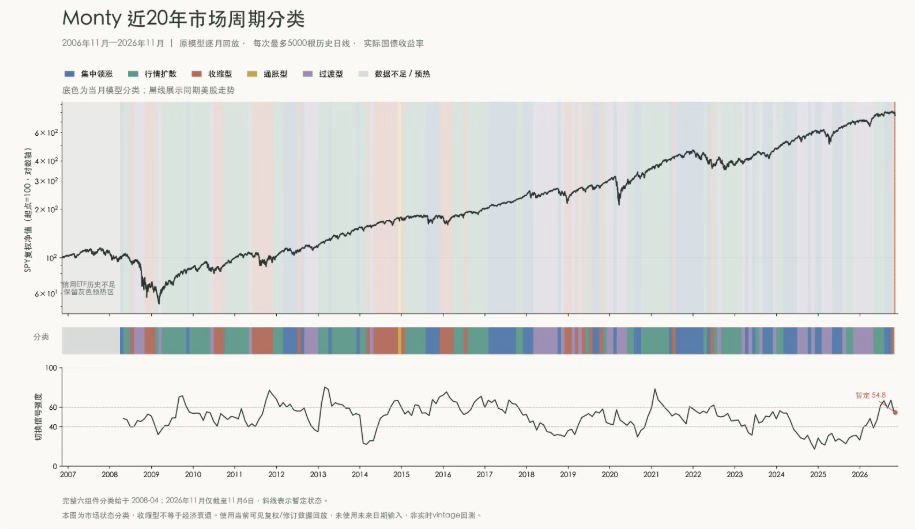
The second part is a relatively simple growth/inflation four-quadrant, but it actually requires quite a bit of personal involvement, which I think is a part of macro analysis that is relatively hard to replace, at least for now.
Macro scenario assumptions have fixed methods, as mentioned above, but there are also unfixed methods that follow the market trends. For example, at the end of 2023, I believe the outlook for 2024 will focus more on whether the US will cut interest rates and whether China will promote stimulus—these create a four-quadrant scenario. By the end of 2025, the scenario assumptions for 2026 will involve AI versus traditional industries in a four-quadrant scenario. At this moment, I believe a significant scenario assumption is the three trends after interest rate hikes:
- Nothing happens after the rate hike, and everything is peaceful.
- The world is not at peace, and the problem lies in the US.
- The world is not at peace, and the problem lies in emerging markets.
Of course, we will also analyze the trends in the interest rate market to discuss whether our macro assumptions are reasonable.

The second part of the macro overview is the overview of commodities, which also includes several sections:
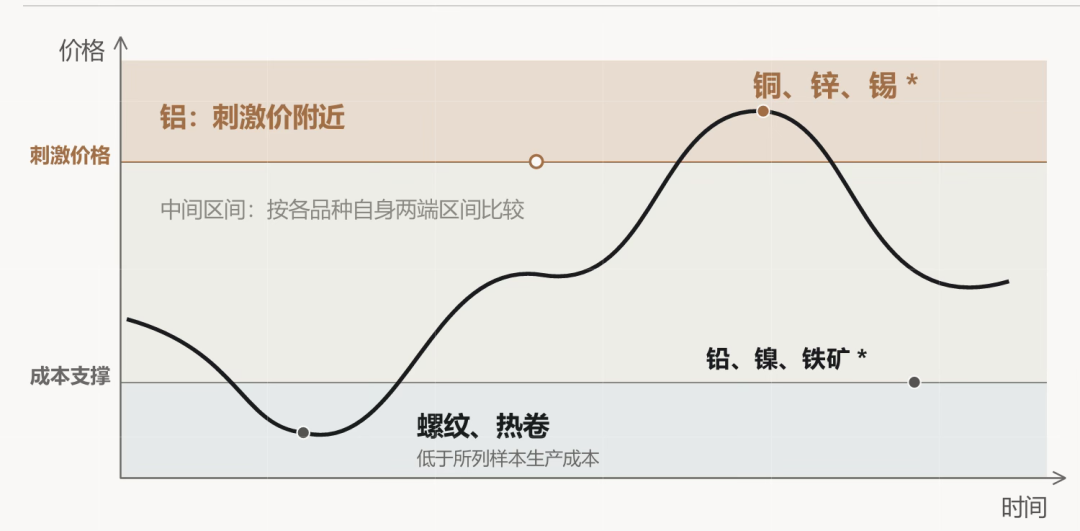
The judgment of commodity positions based on cost support and price stimulation, simply put, whether this item is expensive or cheap.
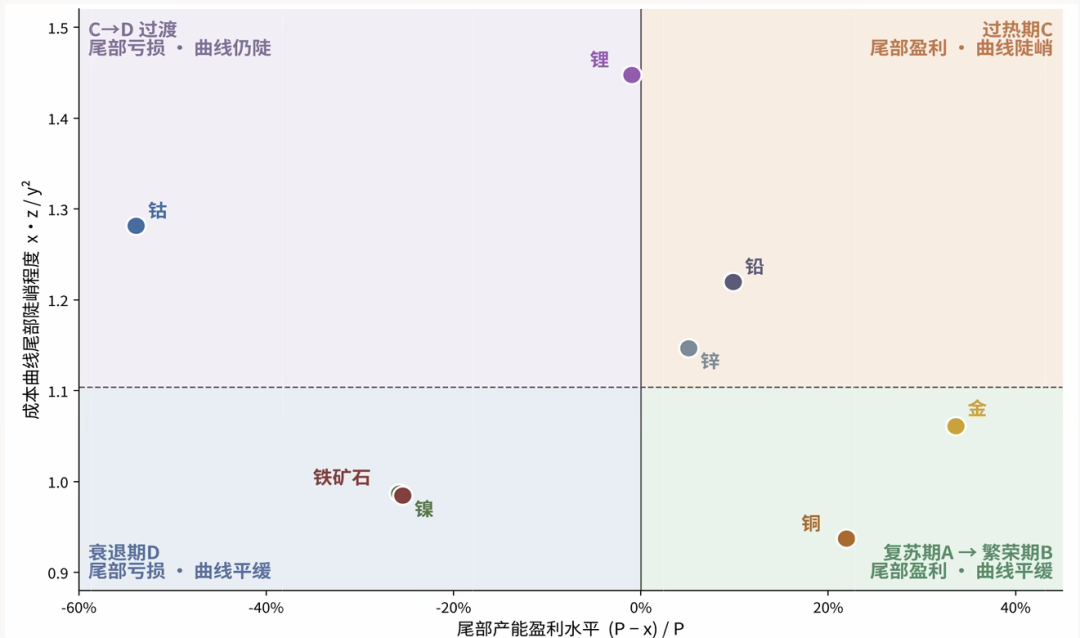
The judgment of commodity positions based on the industrial cycle; this is thanks to the ideas provided by a friend, judging based on the steepness of the curve and the profit situation of tail-end mines.
The third one is judging the prices of commodities traded on the market from the perspective of inventory basis profits, determining whether they are in a high range or a low range.
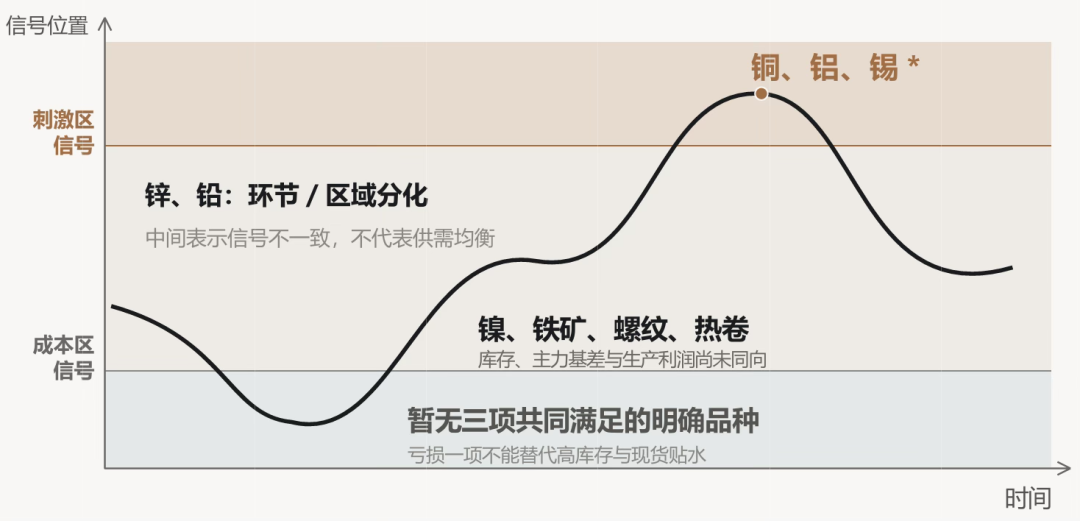
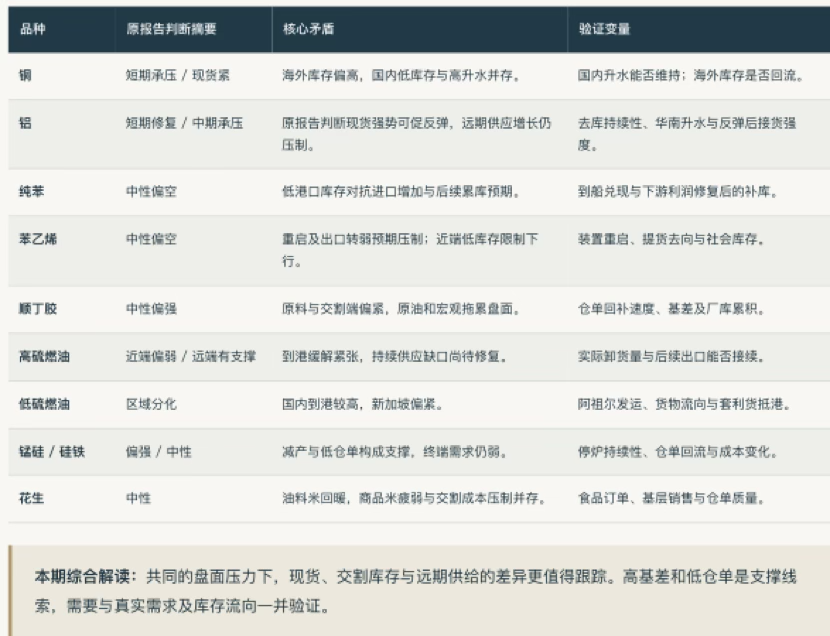
Many of these charts were created last month, and I was on a business trip last week and haven't updated them, so they are only meant to showcase ideas; everyone should not seek to fit them rigidly. Of course, we will also collect research reports from home and abroad to share the market consensus expectations for these commodities.
Now, it is Teacher Dato's part. His website bwresearch.club publishes three daily reports after market close every trading day, answering three questions. He will focus on these three angles to explore short to medium-term market flows. The first report: CTA trends—what are the trend strengths and weaknesses for each sector and commodity, and what are the marginal changes?
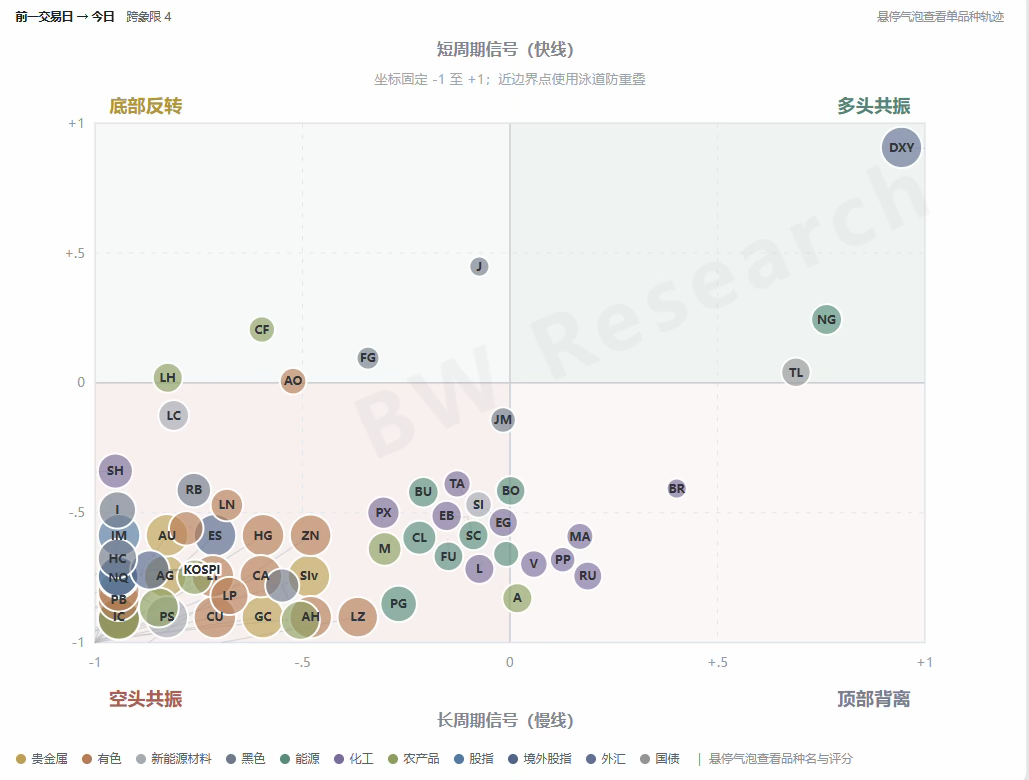
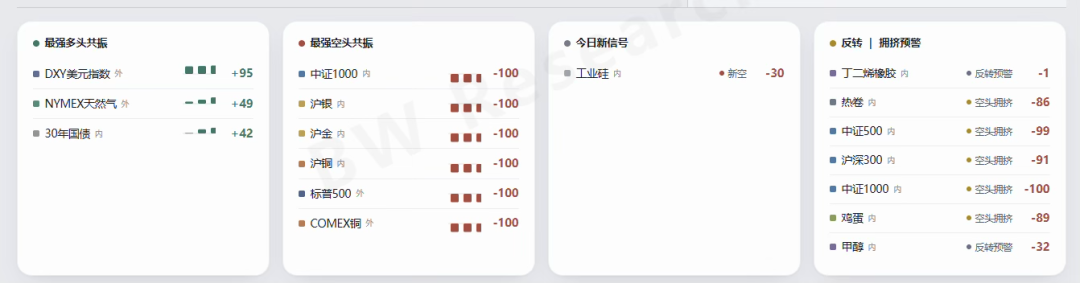
More than 60 internal and external commodity varieties will be scored each day with a ±100 trend score, with the day the direction changes marked as "New Long / New Short." The CTA positions are more suited for commodities where prices are significantly above stimulation prices or significantly below cost support. Its changes are sensitive, both a good thing and a challenge; the good thing is it can tell you where changes are occurring. For example, the CTA for non-ferrous metals has been bearish since September 11 when tin first turned short, until the recent collapse of metals; the challenge is that certain commodities will fluctuate repeatedly, such as copper, which was hit back and forth twice when downstream tightness occurred. I think this is why the integration of macro and micro perspectives can create a lot of Alpha: the direction is given by the trends, and whether it should be trusted is confirmed by the next two reports.
The second report: Position holdings—where does smart money stand in terms of each specific commodity?
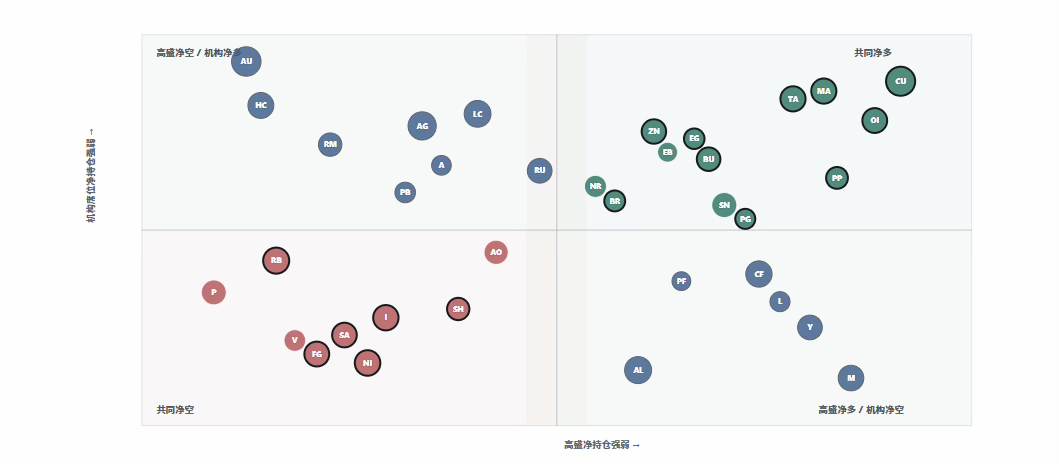
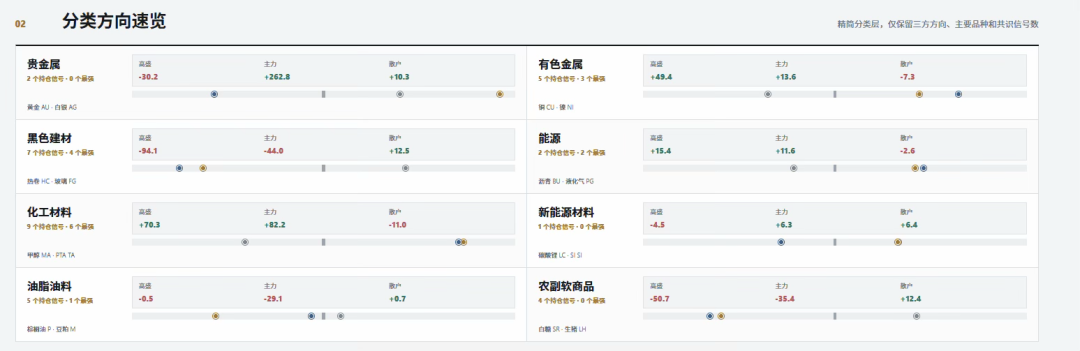
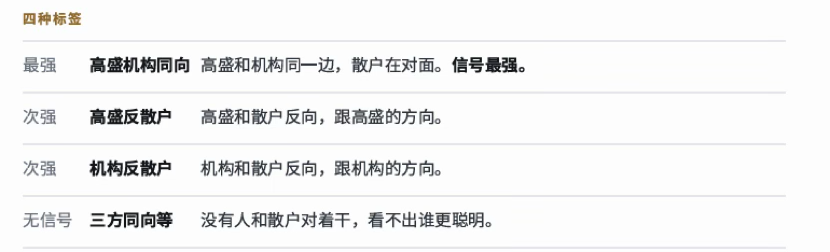
The domestic exchanges publish the positions of major members daily, and the report divides positions into three parties: Goldman Sachs, main institutions, and retail investors, analyzing just one thing: who is standing opposite the retail investors. Historically, buying contrary to Chinese retail investors has created plenty of opportunities, which is undeniable; I check daily with whom I am standing.
Although institutional investors generally have an information advantage over retail investors and are right in the vast majority of cases, this is also why we need to look at the consensus expectations, trends, and commodity prices of institutions together. For example, Goldman Sachs has maintained a bullish stance on copper, while retail investors are net short, and the position report daily indicates "strongly bullish"; however, the CTA became bearish starting October 30. By combining this with macro insights, we can look at the CFTC fund's long positions (Managed money).
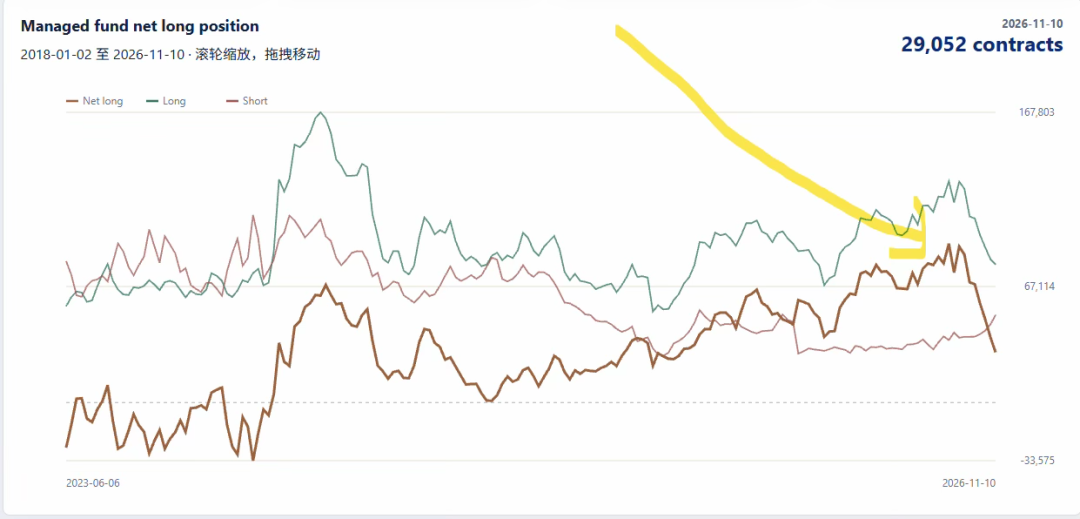
Goldman Sachs is generally right, but the funds on the long side have quickly withdrawn from high positions (the yellow mark in the figure). When there is a clash among institutions, funds, and trends, whether to continue long alongside Goldman Sachs is another question. According to the report's rules, this kind of situation is to hold off first; the cost is lower profits rather than losing money.
The third report: Capital tides—does the price change have confirmation from actual funds and holdings?
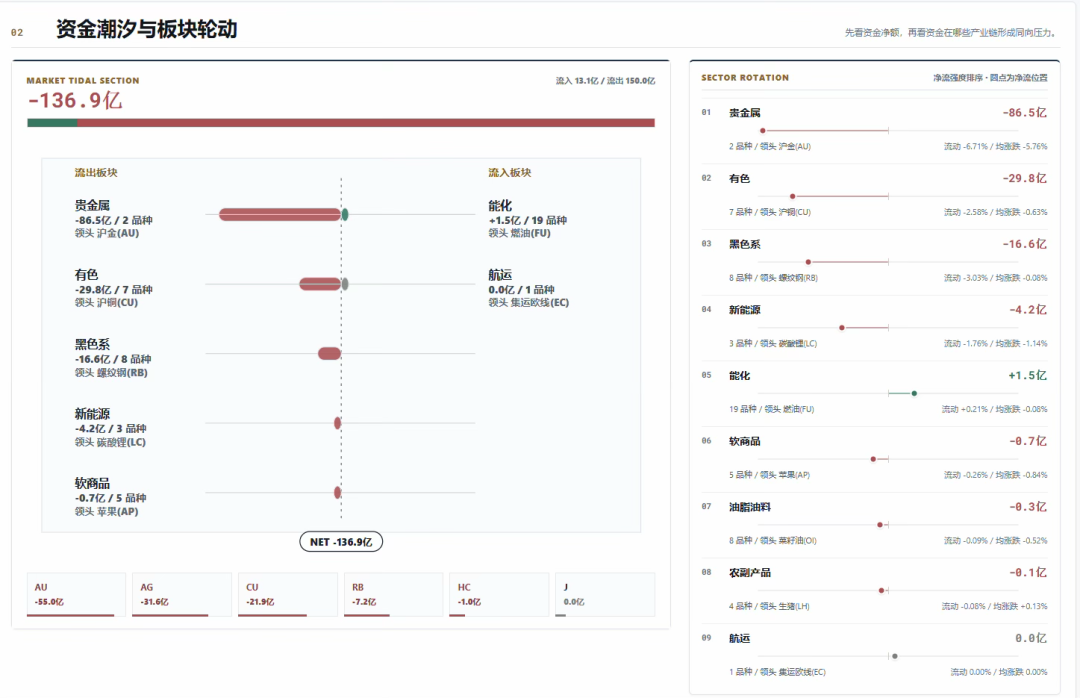
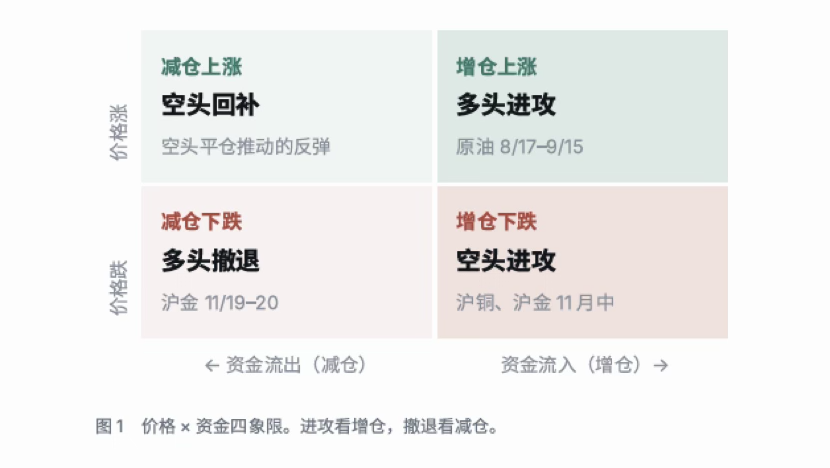
The report calculates whether the margin deposited in each commodity has increased or decreased today. It is important to note that inflow does not equal price increase; both long and short positions need to deposit margin when opening positions, so capital and prices should be looked at together: increased positions with price declines imply that shorts are attacking, for example, Shanghai copper and Shanghai gold in mid-November; decreased positions with price declines indicate long positions are retreating, such as the Shanghai gold change from November 19 to 20. I like to combine this part with volatility; the changes in capital and holdings are leading indicators of volatility, which often become leading indicators of price in this era, for example, the increase in volatility for copper two weeks ago and the rise of volatility for silver at the beginning of this year.
Each of the three reports casts a vote, focusing on the consensus and observing conflicts. How to read them, what has been right or wrong historically, Teacher Dato has written an introductory guide on his website (overview plus four articles, bwresearch.club/guide), and we will also decode it live at Sunday’s online meeting. I believe that through this data, we can greatly reduce the chances of making wrong judgments and provide ourselves with more signals and information before every decision. As you can see, this is a prototype of a product; our combination of top-down and bottom-up approaches is still quite unfamiliar, and we hope to refine and improve this product step by step through everyone's feedback and reminders in the next few months. If many years ago, Alibaba's slogan “Make it easy to do business anywhere” inspired many, I hope the work of Teacher Dato and me can “make it easy to invest anywhere.”
Of course, the above content is for educational and research reference only and does not constitute investment advice. Thank you very much.
免责声明:本文章仅代表作者个人观点,不代表本平台的立场和观点。本文章仅供信息分享,不构成对任何人的任何投资建议。用户与作者之间的任何争议,与本平台无关。如网页中刊载的文章或图片涉及侵权,请提供相关的权利证明和身份证明发送邮件到[email protected],本平台相关工作人员将会进行核查。