On the weekend, HIMS was pumped up to $132, only to be brought back down to reality on Monday—how should the pricing of tokenized stocks be adjusted?
Written by: Krix, blocmates
Translated by: AididiaoJP, Foresight News
At the end of August, someone attempted to squeeze HIMS's tokenized stock, resulting in nothing but a farce.
A group of traders created a trading pair between a certain memecoin and HIMS's tokenized stock, buying in large quantities with the intent of hoarding HIMS on-chain, thereby driving up the price. Since this took place over the weekend, HIMS on-chain briefly surged to $132.64, while the closing price on Nasdaq last Friday was only $28.84.
They overlooked a key issue: the HIMS circulating on-chain only accounted for a tiny fraction of the actual total circulation. After the market opened on Monday, the issuer directly increased the number of new tokens, arbitraging the price difference between on-chain and off-chain, and HIMS's price instantly returned to a normal level.
What is truly noteworthy is not that someone wanted to short-squeeze Nasdaq stocks, but that most tokenized stocks still operate separately from traditional DeFi's AMM. Prices are entirely determined by the ratio of the two tokens in the pool, and only when arbitrageurs step in will the price be pulled back to reality.
The result is that the price of real assets and the price of on-chain tokens are completely decoupled, with tokenized stocks existing in a different parallel universe.
If HIMS had been placed in Metric's active pool, such an event would never have occurred.
What is Metric Doing?
Metric is a decentralized exchange, centered around "active pools." It separates pricing and liquidity into two independent components, specifically addressing the issue in traditional pools where "prices only change with trading activity."
Many people might ask: Isn't there an oracle? Why is such a design still needed? The answer is that oracles are only theoretically effective.
The quotes of traditional Uniswap pools are entirely determined by the pool itself. V2 looks at the ratio of the two tokens in the pool, while V3 and V4 consider the current price range and the liquidity within that range. In either case, the price does not automatically follow the true external price—when the external price changes, the pool remains at its original quote, and someone must notice the price difference to arbitrage, causing the pool's state to change and the quote to be adjusted.
Metric's active pools, however, transfer the pricing authority to external sources. They can directly read oracle prices or generate quotes using other custom logic, providing prices for tokenized stocks, foreign exchange, gold, and mainstream crypto assets that are close to the actual market price. As long as the external reference price is updated, the pool's price will change accordingly, without needing arbitrageurs to act first.
How Active Pools Work
The biggest difference between active pools and traditional AMMs is that "pricing" and "how much money is in the pool" are completely separated. The price in traditional pools is calculated by the inventory itself, while the price in active pools is independently determined by external factors. This separation allows prices to remain accurate at all times, which is the core breakthrough of active pools.
Price Provider
In active pools, the asset price is not calculated by the pool itself, but provided by an on-chain contract called Price Provider. This contract always offers three prices: the buy price, sell price, and an intermediate reference price.
Its price sources are very flexible. The most common is directly reading from oracles like Chainlink or Pyth, which track the off-chain real market prices in real-time; it can also incorporate more complex logic, such as the midpoint price from another exchange or time-weighted average price (TWAP), exchange rates from staking or vaults, and even custom models designed for options, prediction markets, synthetic assets, as well as strategies for grid trading, limit orders, over-the-counter trades, and volatility adjustments.
In simple terms, the Price Provider is responsible for "telling the pool what price to quote now," meaning the pool itself no longer sets its own prices.
No matter how complex the logic, the pool itself does not form its price viewpoint; the pricing responsibility is completely outsourced to the Price Provider.
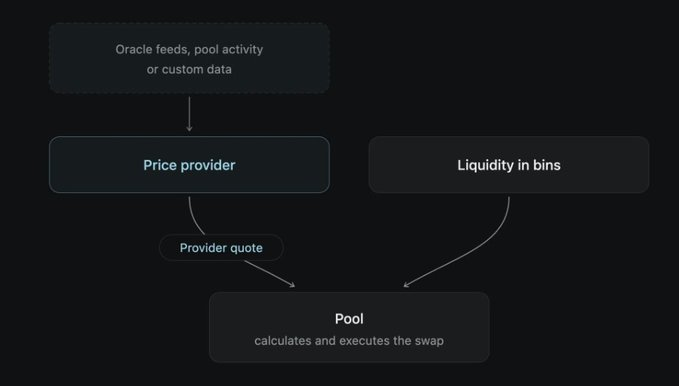
Having an accurate price is not enough; there also needs to be a willingness for someone to place funds in. This is where liquidity bins come into play.
How Liquidity Follows Price
In Metric, the funds provided by market makers are not fixed within an absolute price range, but rather distributed around the reference price provided by the Price Provider, segmented into various "bins" divided by percentage. Each bin represents "how much higher" or "how much lower" than the reference price.
For example: Suppose the current reference price for ETH is $2000; you set your willingness to sell 2% above the reference price and buy 2% below it. At this time, your sell price is $2040, and your buy price is $1960.
If overnight ETH rises to $3000, in a traditional concentrated liquidity pool, your original bin would likely become completely detached and ineffective. However, in Metric, the bin will automatically move with the reference price, and the rules remain unchanged—still 2% above and below. So the new sell price becomes $3060 and the buy price becomes $2940.
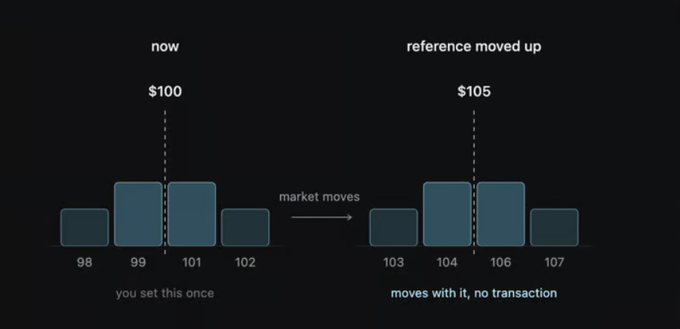
In other words, as long as the reference price changes, all bins will shift in sync without requiring someone to execute trades in the pool; liquidity will also not become ineffective due to significant price fluctuations.
Actual Effects
Again, taking HIMS as an example.
When a user comes across a news article mentioning that HIMS sponsors articles discussing how finasteride and minoxidil can treat hair loss, they might click into the official website to complete a questionnaire, deeming the company trustworthy, and deciding to buy a little. Since they understand a bit about crypto, they open their Robinhood wallet, locate HIMS tokens, input the amount, and prepare to exchange. But they find that the price given in the wallet is slightly worse than what they saw five minutes earlier on their stock price app. The difference is not much, but it is noticeable.
For small traders, this price difference can be ignored; however, for liquidity providers, this is a constant hassle: pool prices frequently decouple from real prices, requiring constant adjustments, while arbitrageurs repeatedly capture the profits in between.
If HIMS had been placed in an active pool, the price would directly follow the real-world stock prices, making the situation different.
For liquidity providers, the biggest benefit is that their positions always remain effective and are not detached due to price fluctuations. The profits earned are retained within the position, compounding automatically, eliminating the need to withdraw and redeposit, thus saving on two Gas fees. Of course, this does not prevent the asset from declining in value nor stop professional traders from arbitraging if the reference price updates late, and other risks still exist.
For traders, the prices received are more accurate. There are no trading fees or frontend fees; they only need to pay the spread between the reference price and the actual buy and sell prices, from which Metric takes a small cut.
Metric has not eliminated all risks, but it provides a crucial foundation: it enables real-world assets like tokenized stocks to be traded reliably and closer to their true prices, without the worry of a few retail traders inflating the prices of thinly liquid pools over the weekend.
免责声明:本文章仅代表作者个人观点,不代表本平台的立场和观点。本文章仅供信息分享,不构成对任何人的任何投资建议。用户与作者之间的任何争议,与本平台无关。如网页中刊载的文章或图片涉及侵权,请提供相关的权利证明和身份证明发送邮件到[email protected],本平台相关工作人员将会进行核查。