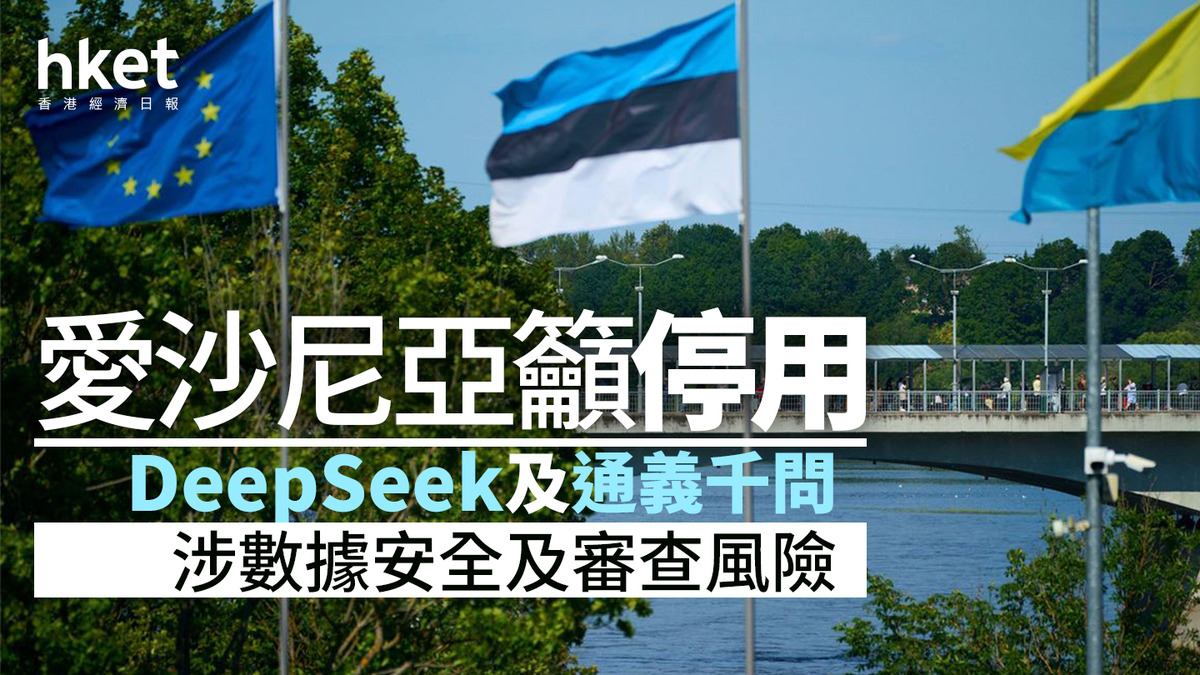
The Estonian government has listed DeepSeek, Tongyi Qianwen, and Botastico as high-risk ratings.
Authorities have called on the government and enterprises to stop using the aforementioned AI tools due to data security and review concerns.
The official emphasized that tools receiving a green light rating still require their own due diligence and risk assessment.
The Estonian Ministry of Justice and Digital Affairs recently announced the results of the latest round of security assessments of artificial intelligence (AI) tools. Citing serious data security risks, it has categorized DeepSeek, developed in China, Alibaba's Tongyi Qianwen under Alibaba Cloud, and the local platform Botastico as “red light” (high risk) ratings, urging government agencies, businesses, and households to cease use.
A total of 25 AI tools assessed, with Gemini and Copilot receiving a “green light.”
Officials: DeepSeek has review risks, Tongyi Qianwen involves data training concerns.
Experts remind: Receiving a “green light” does not absolve the responsibility of conducting due diligence.
Local intelligence agencies previously issued warnings about DeepSeek.
According to a report by Estonian Public Broadcasting (ERR), the Estonian Ministry of Justice and Digital Affairs, in collaboration with the National Information Technology Center and local cybersecurity company Cybernetica AS, conducted a “traffic light” style red, yellow, green safety rating on 14 widely used cloud and AI tools. Along with earlier batches, authorities have completed a total of 25 AI tools’ credibility assessments, which are all publicly available in the government "TARK" AI application directory.
Among other common AI tools, Gemini, owned by Google’s parent company Alphabet (US: GOOGL), Microsoft (US: MSFT) Copilot, and Mistral Vibe, developed in Europe, have all been rated as “green light” for meeting safety requirements. As for the 14 newly assessed tools, apart from the aforementioned three “red light” platforms, it also includes ChatGPT, Cursor, GitHub Copilot, Gemini Notebook, Google Translate, RoVo AI, University of Tartu machine translation service, Mistral, Vectra AI, Lovable, and Bürokratt. The other 11 tools have been rated as either “green light” or “yellow light.”
Liisa Pakosta, Minister of Justice and Digital Affairs of Estonia, specifically mentioned DeepSeek in the department's press release, stating that local government agencies have banned the use of the platform from the start. She stated:
“Regrettably, the Chinese platform DeepSeek has attracted many users due to its low cost, but the information regarding data processing, security measures, and secondary data processors within China is limited, lacking compliant independent verification, combined with the governance of Chinese law, along with records of review and influence risks, make this platform unacceptable.”
She reiterated that government agencies had already prohibited the use of DeepSeek, and authorities now recommend that households and businesses also stop using it.
As for Tongyi Qianwen, developed by Alibaba's cloud computing arm, it has also been categorized as “red light.” Reports citing the assessment results indicated that the primary concern is that user data may be processed within China and used for training AI models.
In addition to the two Chinese platforms, the locally developed AI chatbot and customer service automation platform Botastico was also rated as “red light.” According to business registration information, the platform is operated by software publisher Botastico OÜ, registered in Tallinn in April 2023, led by local entrepreneur Andres Kull. Assessors pointed out that the platform failed to provide proof of compliance with international information security management standard ISO/IEC 27001 or Estonian information security standards (E-ITS), while lacking confidentiality clauses, and some data processing procedures are not transparent enough.
Lisett Reimann-Erik, head of national cyber risk at the Estonian Ministry of Justice and Digital Affairs, stated: “It is difficult for the public and businesses to avoid using AI and cloud services, but the usage process is accompanied by significant risks, uncertainties, and concerns. Therefore, we have completed extensive preliminary assessments for users and provided clear rating results.”
However, Dan Bogdanov, director of the Cybernetica Institute of Information Security involved in the assessment, reminded that receiving a “green light” rating does not exempt users from the responsibility of conducting due diligence, as terms of service and security features may change at any time.
Estonia is not the first to express safety concerns about DeepSeek. The Estonian Foreign Intelligence Service warned in its annual report published in February this year that while DeepSeek advances China's industrial development goals, it may also become a channel for China to disseminate propaganda content to the West.
Even earlier, when the DeepSeek-R1 model was launched in January 2025, Estonian AI researchers pointed out that despite facing US chip export restrictions, its performance could still compare with top Western models, but users were warned to avoid inputting sensitive data, as user data would be transmitted via servers located within China, and the system itself might reflect China's political stance.
This article is reprinted from Hong Kong Economic Daily, with copyright belonging to the original author and original media.
免责声明:本文章仅代表作者个人观点,不代表本平台的立场和观点。本文章仅供信息分享,不构成对任何人的任何投资建议。用户与作者之间的任何争议,与本平台无关。如网页中刊载的文章或图片涉及侵权,请提供相关的权利证明和身份证明发送邮件到[email protected],本平台相关工作人员将会进行核查。