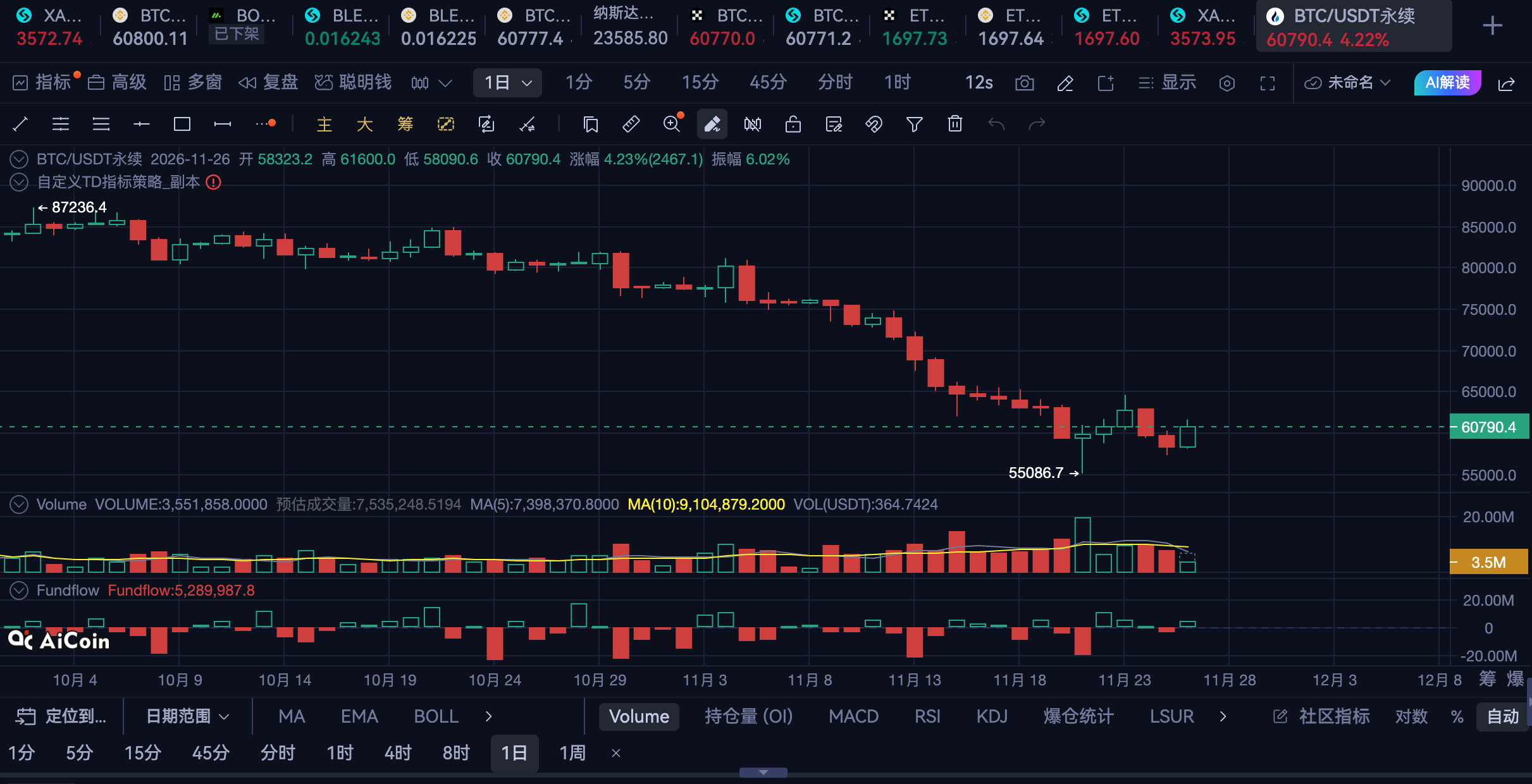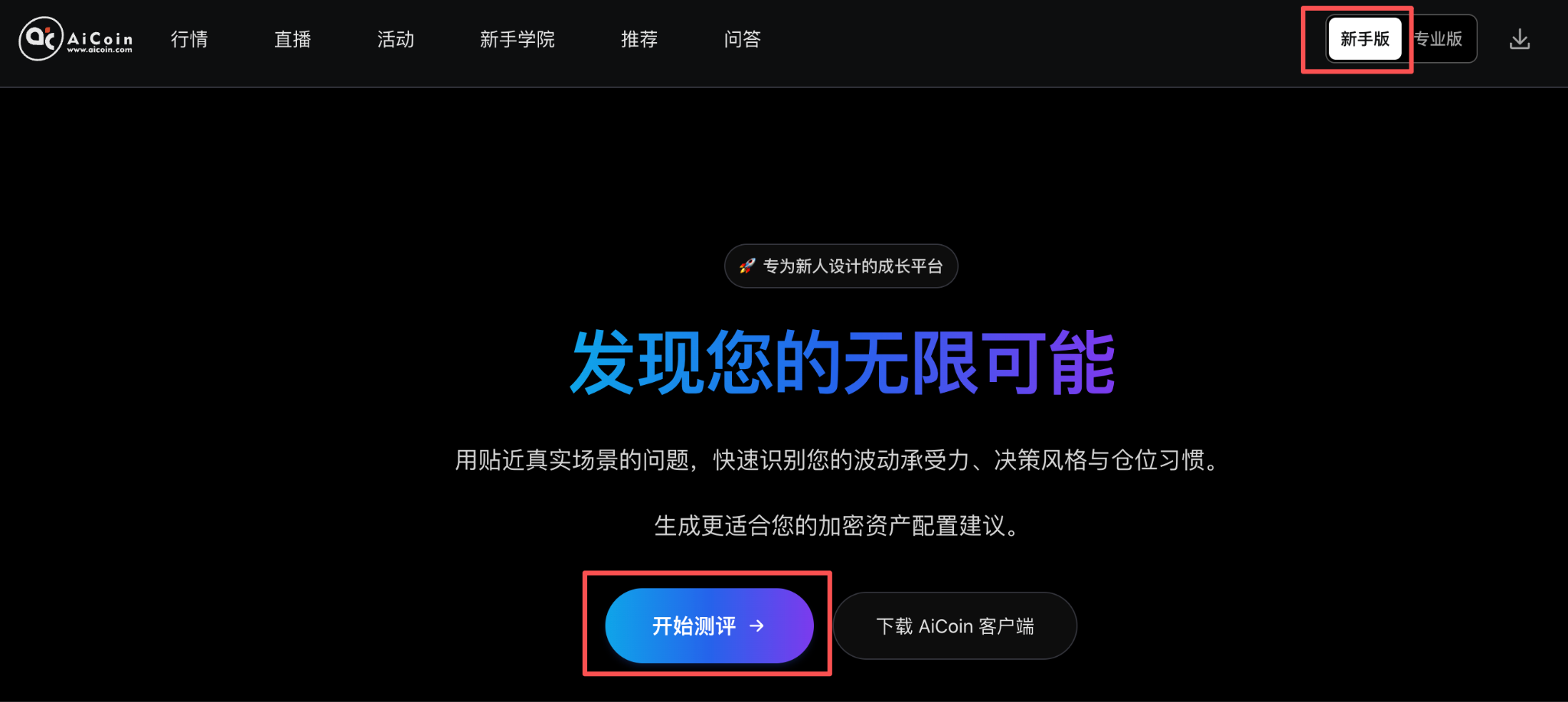
Path: Official homepage - Beginner version - Start assessment
Many newcomers are often first concerned about these questions when they first come into contact with cryptocurrencies: Can I still buy BTC now? Is there still a chance for ETH? How to make money with grid trading? Everyone is participating in airdrops; should I try it too?
But very few people seriously consider another more fundamental question before actually starting to trade:
If your account suddenly loses 10%, 20%, or even more, can you accept it? Do you prefer to participate in the market steadily, or are you willing to endure greater volatility in search of potential returns?
In fact, before entering the cryptocurrency market, one thing is more important than choosing which coin to buy—understanding your own risk tolerance first.
1. Why should you do a risk assessment before entering the market?
If you have ever purchased financial products at a bank, you should be familiar with risk assessment. Before buying, banks usually conduct a questionnaire to understand the client's investment experience, funds usage timeframe, risk tolerance, and return expectations.
The reason is simple: everyone's situation is different. Some people care more about the safety of their principal and can only accept a small amount of volatility; some have a longer investment cycle and are willing to take on certain risks; others have rich investment experience and can understand and bear greater market fluctuations. The same product may not be suitable for everyone.
The cryptocurrency market is no different. Some people are suited to start understanding the market from mainstream spots like BTC and ETH, some are more interested in grid strategies, and others are willing to spend time studying on-chain interactions and airdrop opportunities. But the problem is, many newcomers start trying before they have figured out the risk differences of these products. Seeing others make money from contracts makes them want to try too; seeing others participate in airdrops for profits, they worry about missing out on opportunities. In the end, they may find that they are not suitable for this high-frequency, high-volatility participation method.
Therefore, before entering the cryptocurrency market, it would be wise to do a risk assessment. This is not to limit what you can do, but to help you clarify where to start.
2. AiCoin Beginner Assessment: 13 questions to understand your investment preferences
The assessment feature launched in the AiCoin beginner version aims to help those who have just entered the cryptocurrency market to first recognize their risk preferences and participation habits.
Through 13 questions, the system will categorize your responses into corresponding risk preference types. For example, the assessment result may show that you belong to the "Steady" type. This means that your answers tend to control volatility, focus on the safety of funds, while also being willing to moderately explore other trading methods.
The assessment not only provides a type label but also offers corresponding participation direction references. Taking the steady type as an example, the suggested allocation is roughly as follows:
- 60%: Mainstream spots, focusing primarily on mainstream assets.
- 20%: Low-volatility arbitrage or grid strategies, to understand strategy tools and participate moderately.
- 20%: On-chain interactions and airdrops, exploring the on-chain ecosystem while controlling investment.
It should be particularly noted that these proportions are a reference framework provided by the assessment results and are not investment formulas applicable to everyone, nor do they represent guaranteed profits. The true significance lies in getting newcomers to think: how do they actually want to participate in the cryptocurrency market?
3. What is the use of the assessment results? The key is to help you find your suitable starting point
After completing the assessment, don’t just focus on which type you belong to; it’s more valuable to pay attention to the underlying participation logic.
Taking the steady type as an example, you can understand it from three directions:
- Mainstream spots: Understand basic assets first
For newcomers, first recognizing mainstream assets like BTC and ETH, understanding the rules of spot trading, price fluctuations, and transaction fees is a relatively intuitive starting point for learning. However, mainstream assets also carry the risk of price declines and principal losses, which does not mean there are no risks. - Grid and arbitrage: Understand strategies, don’t just look at returns
Many newcomers think that grid trading and arbitrage strategies are tools that automatically make money. In reality, grid strategies are also influenced by changes in market range, downward trends, and fees; arbitrage also faces execution, liquidity, and counterparty risks. Before actually investing, you should first understand the operational logic of the strategies and the potential losses that may arise. - On-chain interactions and airdrops: Don’t blindly participate just because it’s popular
There are many opportunities in the on-chain ecosystem, but they also require a time and energy investment. Besides the uncertainty of the project itself, you also need to watch for smart contract vulnerabilities, phishing sites, and wallet authorization risks. Therefore, treating this area as a limited participation direction in the assessment can also remind newcomers not to focus all their energy on chasing hotspots.
4. What if the assessment result is different from your own thoughts?
This is actually a very valuable insight.
For example, you initially think you are an aggressive investor, but the assessment result shows you lean towards a steady type. At this point, it would be good to pause and think: Is your understanding of risk still rooted in when the market is rising? When BTC is continuously rising, you may feel you can handle great fluctuations; but when your account actually sees a 20% drawdown, can you still remain calm?
Or perhaps you originally believed you were suited for long-term holding, but you find yourself unable to resist frequently checking prices every day, even letting short-term fluctuations affect your life. These reactions are worth serious consideration.
Of course, risk assessments are merely references based on your responses and cannot fully predict your behavior in the real market, nor can they replace the judgment of your financial situation, investment duration, and actual risk capacity. Understanding yourself is not about labeling yourself; it is about avoiding making decisions that exceed your tolerance without understanding the risks.
5. Entering the cryptocurrency market: Know yourself first, then know the market
Many newcomers may have the order reversed when entering the cryptocurrency market. They start researching which coin will rise without clarifying their own risk preferences; they rush to find high-yield strategies before understanding the differences between spots and contracts.
A more reasonable order should be:
Step 1: Understand your risk tolerance.
Step 2: Recognize different cryptocurrency assets and participation methods.
Step 3: Learn trading rules, fees, and potential risks.
Step 4: Decide whether to participate and how much to invest based on your own situation.
The 13-question assessment provided in the AiCoin beginner version is meant to help newcomers accomplish the first step. If you are also just preparing to enter the cryptocurrency market, take a few minutes to complete the assessment, see which type your results belong to, and then combine with relevant learning content to gradually understand different participation methods.
Investing is not about rushing to follow someone else making money. First know what you can tolerate, and then decide how you want to participate. Understanding yourself before entering the market may be more important than quickly looking for the next opportunity.
The above content is for market observation and educational sharing only and does not constitute any investment advice. Cryptocurrency asset prices are highly volatile and carry the risk of principal loss. Please make independent judgments based on your own situation and pay attention to the usage rules and risk warnings of related platforms.
免责声明:本文章仅代表作者个人观点,不代表本平台的立场和观点。本文章仅供信息分享,不构成对任何人的任何投资建议。用户与作者之间的任何争议,与本平台无关。如网页中刊载的文章或图片涉及侵权,请提供相关的权利证明和身份证明发送邮件到[email protected],本平台相关工作人员将会进行核查。