Original Title: "Who is Buying Cards for China's Major Companies"
Original Author: Dongcha Beating
Several data center financing projects in Southeast Asia have encountered problems.
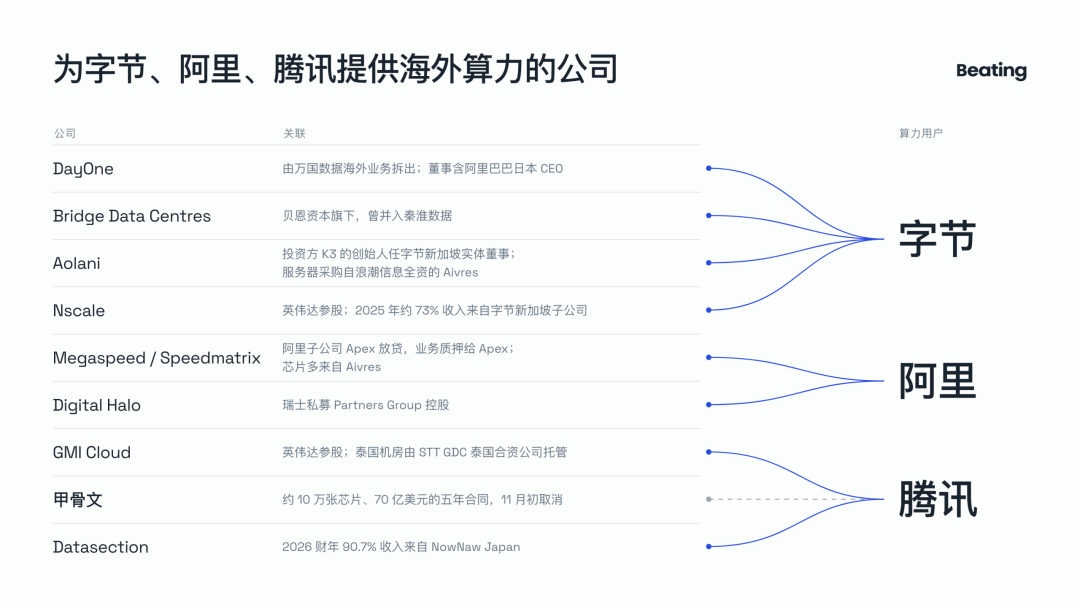
Bridge Data Centres is expanding its loans in Malaysia to $6.6 billion, with some lenders requiring additional due diligence first. Bridge is a company of Bain Capital, and its main tenant at the MY06 park in Johor is ByteDance.
Digital Halo has a $372 million loan that has been fully underwritten, yet one bank has opted out. Its majority shareholder is the Swiss private equity firm Partners Group, and among its customers in Malaysia are Alibaba.
GMI Cloud plans to borrow $300 million to buy chips for a data center in Thailand, which are for Tencent's use. Nvidia just invested in GMI in October, and at least one fund has chosen not to participate in this round.
A week earlier, a $480 million loan led by DBS Bank had been frozen. The borrower is Singapore's Aolani, which intends to use the funds to purchase 97 GB300 servers in Kuala Lumpur, with ByteDance as the remote user.
All four borrowers are not Chinese companies. The data centers are owned by private equity firms from the US and Switzerland, the chips are on the books of companies from Singapore and Taiwan, and the money comes from Wall Street and Singaporean banks. The final users of these chips, however, are ByteDance, Alibaba, and Tencent.
This has been the standard practice for China's major companies acquiring Nvidia chips overseas for the past three years. The major companies do not buy the cards themselves; instead, a non-Chinese company steps in, borrows money, buys chips, and builds data centers with the chips on this company's books. The major companies then sign long-term contracts with this company for several years, paying rent by the hour while remotely using these chips to train models and run services.
The primary reason for this approach is to circumvent US export controls. Companies headquartered in China need US approval to purchase advanced chips themselves, while renting computing power from a non-Chinese company does not have clearly defined restrictions previously. Non-Chinese companies can borrow money from Western banks more freely.
We reviewed loan terms, prospectuses, and regulatory documents from the past three years, and these companies are nominally not Chinese companies, but the relationships among shareholders, directors, and funding are much closer than expected with China's major firms.
In the past, no one scrutinized this relationship because the rules only considered who the chips were sold to. On November 16, the US Department of Commerce released new regulations that shift the focus on where the chip-using company is headquartered, regardless of who the purchaser is. Companies that previously stepped in to buy cards and the banks lending to them have begun to withdraw one after another, transferring the risk of buying cards back to ByteDance, Alibaba, and Tencent themselves.
Companies Stepping in to Buy Cards
China's major companies seek cards overseas because they cannot obtain them domestically.
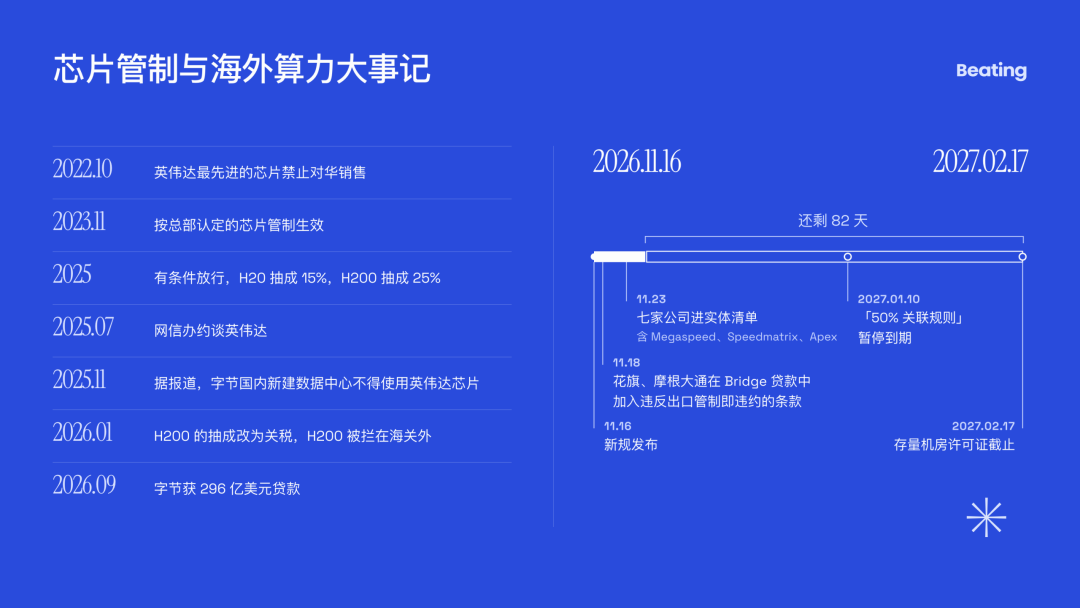
Since October 2022, Nvidia's best chips have not been allowed to be sold to China. In 2025, the Trump administration changed to a conditional release, with a 15% take on H20 and 25% on H200, which again modified the 25% take into a tariff in January of this year.
Post-release, each card still requires approval and payment, and very few are actually approved. The House Foreign Affairs Committee's public records from November 19 show that as of May this year, Chinese companies applied for about 3.44 million H200 and MI325X chips, receiving approval for about 880,000, all marked as "approved, not shipped."
ByteDance applied for approximately 1.015 million, getting approved for 150,000; Alibaba applied for 949,000, receiving approval for 75,000. Both companies also applied for 1.1185 million cards through their subsidiaries in Malaysia, Indonesia, and Thailand, all of which were returned.
Approved cards also cannot enter China, as Beijing is similarly blocking them. In July 2025, the Cyberspace Administration of China interviewed Nvidia, stating that H20 poses "security risks due to potential backdoors." In November of the same year, The Information reported that regulatory authorities did not allow ByteDance to use Nvidia chips in newly constructed data centers in China. In January of this year, H200 was held at customs, with around 600,000 still stuck in Hong Kong.
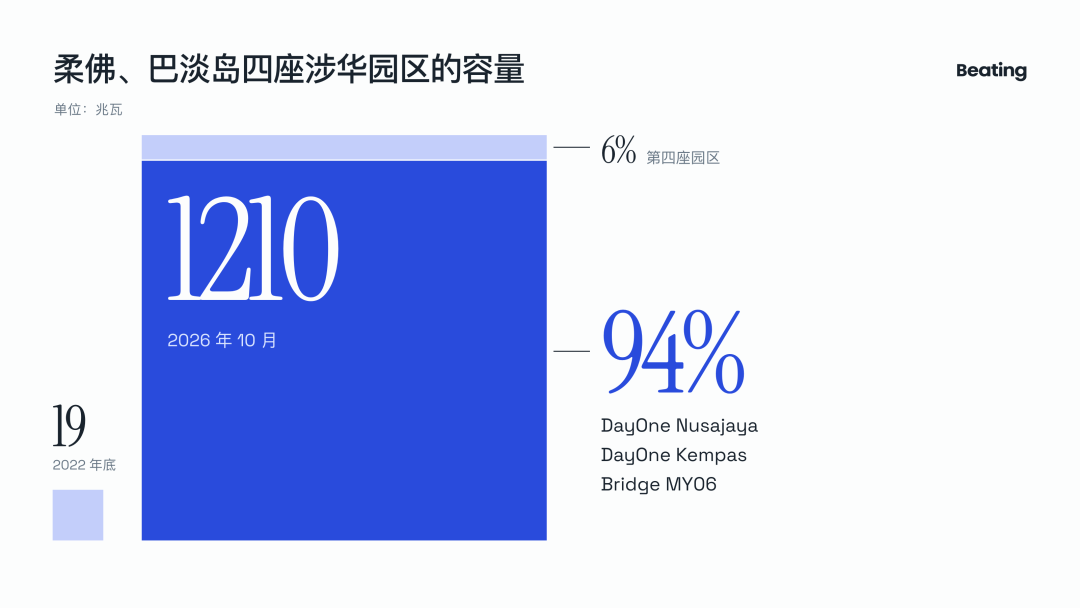
The computing power that major companies are renting remotely overseas is mostly located in Johor, Malaysia. Four parks related to China in Johor and Indonesia's Batam Island had a total of 19 megawatts at the end of 2022, which has now risen to 1,210 megawatts by October of this year, with about 94% concentrated in three parks: DayOne's Nusajaya and Kempas, as well as Bridge's MY06.
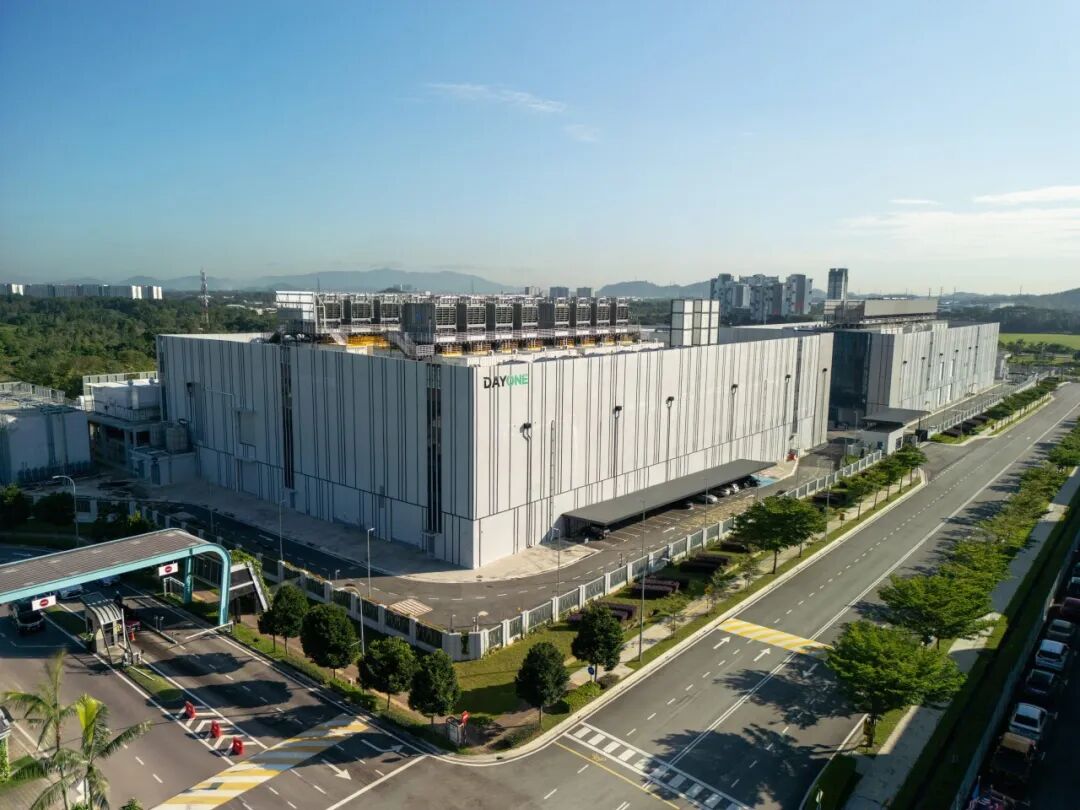
DayOne's data center park located in Nusajaya, Johor, Malaysia
Image source: DayOne
There are two types of companies involved.
DayOne and Bridge are data center operators responsible for building data centers, providing electricity, and renting out cabinets.
Bridge is backed by Bain, and its connection to China comes from Qinhuai Data. Bain integrated Bridge into Qinhuai in 2019, privatized Qinhuai in 2023, and later sold the Chinese operations for about $4 billion to a consortium led by Dongyang Light, leaving only the overseas segment. Drew Chen, who was appointed co-CEO of Bridge in November this year, is a founding member of Bain's Asia PE team.
Bridge's tenants are also changing. In February this year, Bridge informed lenders that the originally allocated 68.4 megawatts for Megaspeed have all been reassigned to Zenlayer. Zenlayer is headquartered in Los Angeles, classifying as a US company under the new regulations, but its founder Joe Zhu was formerly a senior vice president at Blue Coat, and the company has teams in Shanghai, Hangzhou, and Beijing, with B-round funding led by Guangyuan Capital. Guangyuan Capital evolved from the state-owned China Everbright and is also listed among DayOne's C-round investors.
DayOne was originally the overseas business spinoff from GDS. According to the prospectus, GDS gradually retreated to a minority shareholding position, converting the loans given to DayOne into equity, and will no longer consolidate its balance sheet by the end of 2024, terminating trademark licensing and customer referrals by the end of 2025. In January of this year, DayOne spent $385 million to repurchase part of GDS's shares, reducing GDS's stake to 19.4%.
After GDS receded, three other companies held comparable stakes. When filing the prospectus, the four largest shareholders were Coatue and Hillhouse each with 19.5%, GDS at 19.4%, and Zhongfang Capital at 15.6%.
Hillhouse participated since the A-round. When GDS announced its A-round in March 2024, listed investors included Hillhouse and its physical asset platform Rava Partners, along with firms like Boyu Capital. Hillhouse’s current stake is pledged to a batch of lenders, and DayOne's CFO worked at Hillhouse between 2023 and 2026.
Zhongfang Capital is among the heaviest investors. According to the prospectus, four holding entities under Zhongfang Capital subscribed to approximately $1.16 billion in total, with $210 million from A-round being the largest single investment in that round.
This shareholder's office is located in Taipei, and the controlling stakeholder is Chen Zhuwang, who is the long-grandson of Wang Yongqing and nephew of Wang Xuehong. He joined VIA in 1996 and served as CEO of VIA China.
Both GDS and Alibaba personnel are on the board. GDS founder Huang Wei remains a director, holding about 3.5% of the options. Andy Okada is the president of the SoftBank-Alibaba joint venture and is also Alibaba's CEO in Japan.
The chairman and CEO come from the Temasek system. Chairman Lim Ah Doo has served over ten years on the board of ST Telemedia and its subsidiary STT GDC, while CEO Jamie Khoo was a financial executive at ST Telemedia before joining GDS. ST Telemedia belongs to Temasek and still holds around 29% of GDS's Class A shares as of the end of March this year. The new board member Alejandro Aguzín, was the CEO of the Hong Kong Stock Exchange from 2021 to 2024 and previously served as CEO of JPMorgan Asia-Pacific.
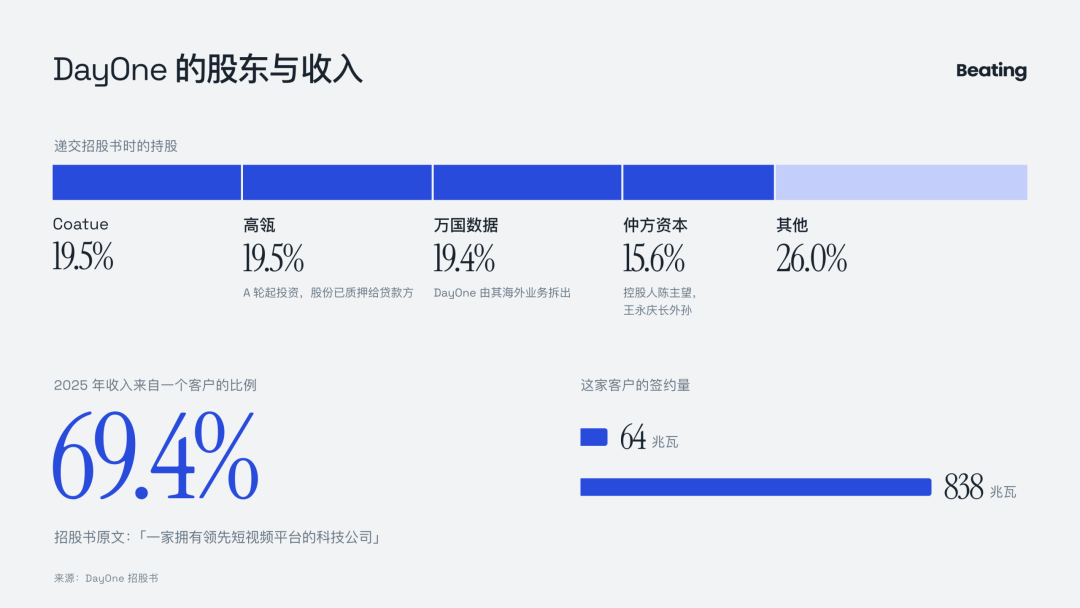
The revenue primarily comes from one client. The prospectus states that 69.4% of revenue in 2025 will come from "a technology company with a leading short video platform," with this client's contracted capacity increasing from 64 megawatts to 838 megawatts. The prospectus also mentions that the company has two existing clients on the Pentagon's "Chinese military enterprise" list. Tencent was added to this list in January 2025, while Alibaba made the list in June of this year.
The other type of company involved is neocloud, which buys chips, builds clusters, and rents computing power to major companies by the hour. The initial loan that got frozen is with Aolani, which is one such company.
Aolani has been renting H100 servers to ByteDance in Malaysia since February 2025 and has prepared around 36,000 B200 for ByteDance this year. Its holding company is registered in the Cayman Islands, with early investors being Singapore's K3 Ventures. K3's founder, Guo Mengxiong, is the grandson of Guo Helian, and according to his disclosures in companies like TVS Motor, he is also a director of ByteDance's Singapore entity.
Aolani procures its servers from Aivres. Aivres was originally Inspur Systems, a subsidiary of Inspur in the US, which was renamed in 2023. Inspur's financial reports and US court documents show that Aivres is held indirectly entirely by Inspur via Hong Kong's KAYTUS Holdings and the British Virgin Islands' KAYTUS Group. According to The New York Times, from April 2024 to February of this year, Aivres shipped at least $5.6 billion worth of servers to Southeast Asia.
Inspur Group entered the entity list in March 2023, and Inspur Information did so in March of last year, while Aivres itself is not on the list. The US "50% affiliation rule" is currently paused until January 10 of next year, and once the rule is reinstated, subsidiaries controlled over 50% by companies listed will also be affected, which includes Aivres owned 100% by Inspur Information.
GMI Cloud is also a neocloud company. The founder, Ye Weiyan, is the son of Ye Jiawen, co-founder of Realtek Semiconductor. The company initially focused on Bitcoin hashing power and has Thai energy group Banpu among its A-round investors. The Thai data center where it buys chips for Tencent is managed by STT GDC's joint venture in Thailand.
STT GDC originally belonged to ST Telemedia and was bought from Temasek by KKR and Singapore Telecom in September of this year. The Thai joint venture company has 51% of its stake held by Frasers Property under the TCC Group, owned by the Su Xuming family.
Bridge's former tenant Megaspeed is backed by Alibaba, which is Megaspeed's founding anchor tenant. In June 2024, Alibaba's Singapore subsidiary Apex lent money to Megaspeed's Malaysian affiliate Speedmatrix, which pledged its entire business to Apex.
According to The New York Times, much of Speedmatrix's chips also come from Aivres, running for Alibaba in YTL's Johor data center. YTL claimed this assertion is "speculative and unsubstantiated."
YTL, mentioned earlier, is Nvidia's earliest partner in Malaysia. In December 2023, Jensen Huang was in Kuala Lumpur announcing AI infrastructure collaborations with YTL. Currently, YTL states that its GPU business has only one 10-megawatt Nvidia DGX Cloud project, fully backed by Nvidia, with the rest being managed services and not providing GPU services to Chinese clients.
There is yet another data center in Johor not covered in this report. Bitdeer, founded by Bitmain's Jihan Wu, has a data center called A201 there, which has purchased more than 100 cabinets of GB300 servers and will start operations next year. Bitdeer claims that over 70% of the capacity has already been committed by clients, with contracts totaling over $1.7 billion, largely financed by client prepayments. According to The New York Times, the computing power of this data center is planned to be sold to a Chinese tech giant. After the new regulations were issued, broker StoneX estimates A201 has a 25% chance of not being realized.
Who is Lending to Them
The companies stepping in to buy cards mainly borrow money. Banks lend to operators to buy chips, with the chips as collateral, and the long-term lease from major companies serves as the source of repayment. The $480 million loan Aolani received is calculated based on a 1.15x debt coverage ratio. According to Natixis, since 2023, the cumulative syndicated loans for ASEAN data centers amount to approximately $48 billion.
From major companies to operators, Citigroup and JPMorgan Chase appear at nearly every stage.
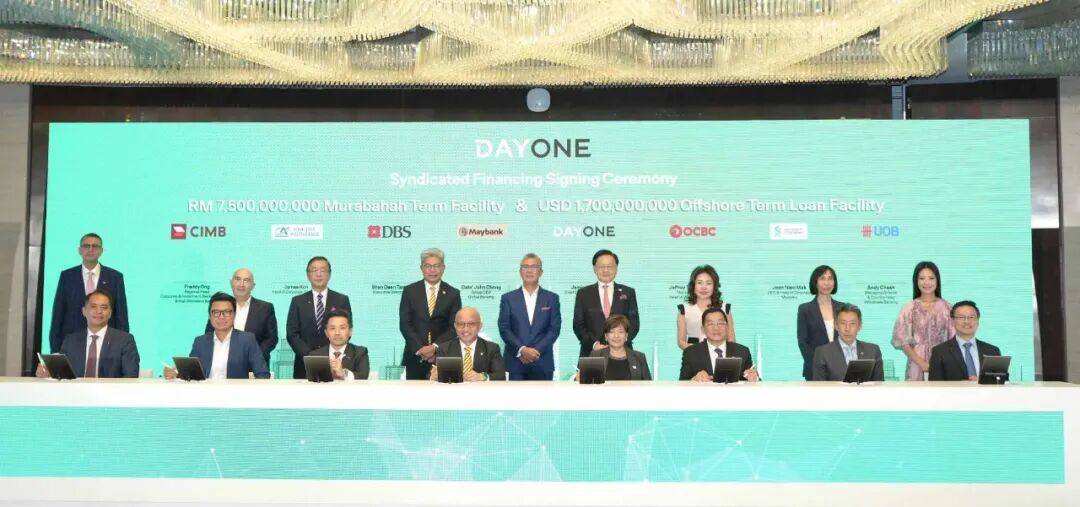
In 2025, DayOne held
a ceremony for a syndicate financing of 15 billion ringgit
Image source: UOB
This September, they led a $29.6 billion unsecured loan to ByteDance, at SOFR plus 68 basis points. For Bridge's $2.8 billion loan last year, they each provided about $120 million; this data center serves both ByteDance and had signed a service contract with Megaspeed. In April of this year, Bain sold at least 40% of Bridge's equity, with the responsibility for this sale lying with them as well. The underwriting syndicate for DayOne’s IPO includes Morgan Stanley and JPMorgan Chase at the forefront, with Citigroup also participating, and JPMorgan Chase serving as the depositary bank for its American Depositary Shares.
Banks in Singapore are responsible for leading and distributing loans. The lead bank for Aolani's loan is DBS, while DayOne secured approximately $3.7 billion of loans in Johor this October, with all three local Singaporean banks involved.
Chinese banks have consistently been present, providing more funding the closer they are to ByteDance. For ByteDance's $29.6 billion loan, 15 Chinese banks contributed $18.9 billion, accounting for 64%.
At the operator level, there are also Chinese banks. In the $2.8 billion loan to Bridge, both Bank of China and Minsheng Bank are listed, and the Industrial Bank also stated in a press release that they are the lead bank for a Bridge overseas syndicated loan. Epoch Digital's data center in Johor has a $488 million loan led by Bank of China and the Asian Infrastructure Investment Bank, with AIIB's project page stating that the first phase of 60 megawatts is fully signed to BytePlus, a subsidiary of ByteDance. A data center in Rayong, Thailand, which has ByteDance as the main tenant, has its first-phase loan led by China Merchants Bank.
Nvidia is also helping these companies with financing by providing guarantees. GMI Cloud's GPU loan in Taiwan is secured by Nvidia's commitment to rent out idle computing power at agreed prices over six years while sharing half of GMI's earnings from other clients. Zankore's $3.1 billion loan in Indonesia has Nvidia providing revenue sharing and credit support. This type of backing currently seems to only be supporting projects for clients that are not Chinese companies.
Nvidia's equity investments are not so clearly separated. It is a shareholder in GMI and also in UK-based neocloud Nscale, participating in several rounds of financing for Nscale since September 2025, and has committed to purchasing $2 billion of convertible bonds in this year’s public documents. About 73% of Nscale's projected revenues of $33 million in 2025 will come from ByteDance's subsidiary Spring in Singapore, and this percentage fell to 52% in the first half of this year, with Nscale predicting it will fall below 20% for the full year.
What the New Regulations Changed
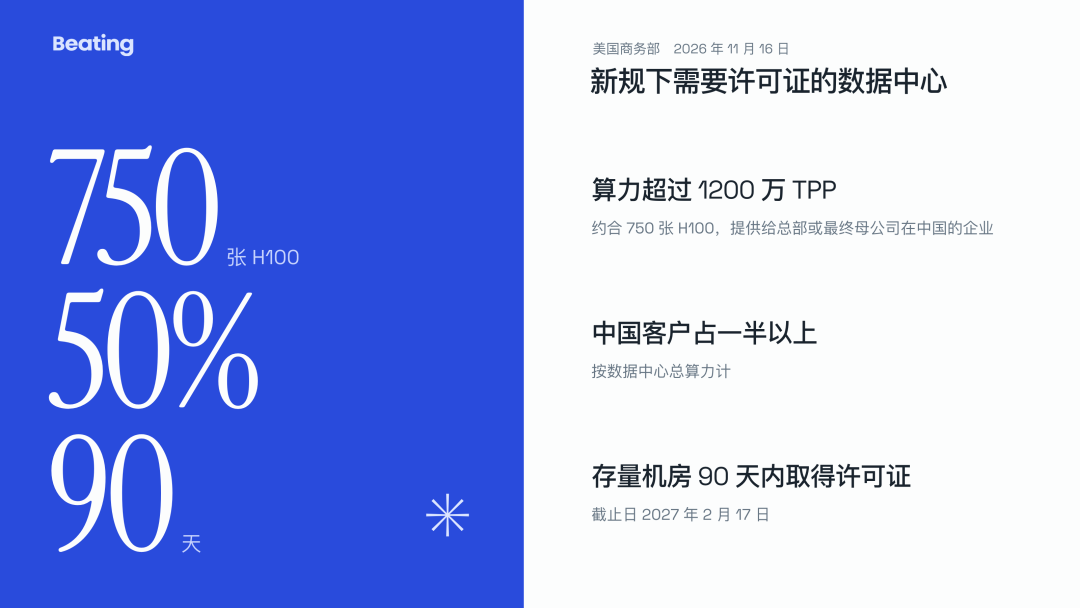
The new regulations released on November 16 draw a line based on the client's headquarters. Regardless of the country in which a data center is built, if it provides computing power of more than 12 million TPP (approximately 750 H100s) to enterprises headquartered in China, or where the ultimate parent company is in China, or if Chinese clients account for over half of total computing power, a license is required to supply it with chips. Existing data centers must obtain licenses within 90 days, with a deadline of February 17, 2027.
This rule could have been much more lenient. Reports suggest that the version driven by Commerce Secretary Raimondo only targeted future shipments, with Chinese customers training models only needing to file a disclosure, and with a higher threshold. That version would have allowed Bitdeer's A201 to pass without issue, while the Cantor Fitzgerald associated with Secretary Raimondo's family is the sales agent for Bitdeer's maximum possible $1 billion share issuance.
There is also the stablecoin giant Tether between Cantor and Bitdeer. In 2024, Cantor secured a roughly 5% stake in Tether. In May of the same year, Tether invested $100 million into Bitdeer, with Cantor also being the placement agent for that transaction. By June of this year, Tether held approximately 19.7% of Bitdeer's Class A shares. After Secretary Raimondo transferred Cantor's shares into a trust for his children, Tether provided a loan to that trust, including collateral of over half of Cantor's stake.
The final version released is stricter. According to Politico, it was pushed by Treasury Secretary Becerra, with Rubio at his side. Becerra had stated that the Treasury had been advocating for Megaspeed to be included on the entity list for months, but "the pen is in the hands of the Commerce Department." A week after the new rules were announced, on November 23, seven companies including Megaspeed, Speedmatrix, and Alibaba's Apex were added to the entity list.
The rules contain three details specifically targeting the practice of having others step in to buy cards.
The first is "indirect buyers." The rules clarify that the regulation identified by headquarters in 2023 "never only" applies to the party directly receiving the goods. If a Chinese company is a direct or indirect buyer in the transaction, or the exclusive or primary user of a data center, it falls under jurisdiction. Prepaid rent to operators or providing loans could lead major companies to be classified as indirect buyers.
The second detail is retroactive. According to the interpretation from the law firm Paul Weiss, BIS believes this regulation has been effective since November 2023, which means past transactions could already constitute violations; thus, BIS is encouraging companies to proactively disclose.
The third detail is a recommendation system exemption. Computing power used only for recommend systems can be exempted from the licensing requirement, provided the data center reports the names of Chinese clients, the amount of computing power used, and what due diligence has been conducted to BIS. This information will be forwarded to the final user review committee that determines the entity list.
Banks Start to Withdraw
The rules give a 90-day grace period, and banks began to take action within a week.
Banks are moving swiftly because financing itself could also be a violation. The general prohibition in Section 10 of the US Export Administration Regulations lists "financing" as a prohibited act, and knowingly providing financing in violation of these regulations could lead to liability, regardless of whether the actor is American or not. In October 2024, BIS specifically issued compliance guidelines for financial institutions, with civil penalties capped at twice the transaction amount; Applied Materials was fined $252.5 million this February according to this standard.
We did not find preceding cases of BIS punishing banks based on this prohibition. However, once rules become retroactive, banks will not only need to reexamine new loans but also the money already lent out. Bloomberg noted that some older loans may be deemed violations of loan terms.
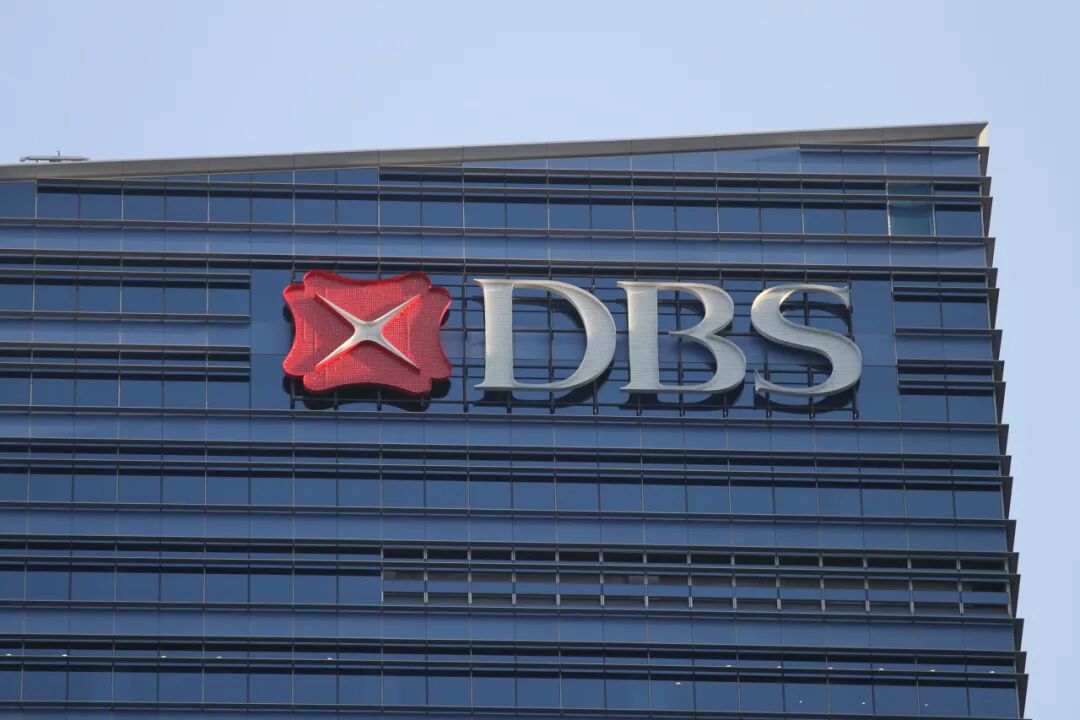
DBS signage outside the DBS building in Singapore
Image source: DBS
On November 18, Citigroup and JPMorgan Chase added a clause to Bridge's loan that violating US export controls constitutes a default, with decisions coming from the banks’ New York headquarters.
Regional banks like DBS earn fees from leading and distributing loans on the premise that loans can be sold and risks can be transferred. The secondary market for loans had already been tight this year, with HSBC and Deutsche Bank seeking risk transfers for data center loans, and Barclays looking for insurance for over $10 billion in AI infrastructure credit, with insurers’ capacity nearly exhausted. Post-regulation, a risk transfer of about $1 billion for UOB slowed down as well. An IFR interview with a Singapore syndicate banker revealed that before the rules became clear, no one was willing to commit even $100 million.
Interest rates are also significantly widened. For ByteDance's self-borrowing, it’s SOFR plus 68 basis points; AirTrunk’s ordinary data center loan in Malaysia adds 225 basis points; Zankore's GPU loan, with an American fintech company as client and Nvidia backing it, adds 330 basis points.
For the same GMI, the loan borrowed in Taiwan with Nvidia's backing has an interest rate of about 3.43%. Meanwhile, the loan for buying chips in Thailand for Tencent has an expected yield in the tens of percentages, with the draft terms stating that if Tencent enters the US restrictive list, it must repay the full amount in advance. Small neocloud companies in the US that lack credit ratings borrow approximately SOFR plus 800 to 900 basis points.
Tencent itself has a rating of Moody’s A1 and S&P A+, yet the GPU loans using Tencent as a tenant are priced similarly to those of small companies in the US without ratings.
The Situations of the Three Companies
The three major companies' methods of acquiring computing power overseas vary, which affects the impact they face.
ByteDance's operation is the largest. According to estimates from SemiAnalysis, around one-fifth of the computing power delivered in China is used by ByteDance alone. The Straits Times reported that ByteDance rents about 90% of the computing capacity in Johor, most of which is CPUs running businesses like TikTok, many of which can utilize the exemption for recommendation systems. The AI-related portion, however, which is under contract with BytePlus for 60 megawatts, is for enterprise AI cloud, and Aolani's 36,000 B200 is for training scale.
This portion of computing power is being blocked, and ByteDance does not have its own chip to compensate. It is the only major platform in China without commercially viable AI accelerated chips. According to Late Post, ByteDance's AI chip is on schedule for trial production this year, but its performance did not meet standards, and the individual responsible for AI chips, Shi Yunfeng, has submitted his resignation.
ByteDance's confidence lies in its capital; nearly two-thirds of the $29.6 billion loan is from Chinese banks, making it the most capable among the three to independently shoulder risks.
Alibaba, besides acting as a tenant, directly lends money to operators through Apex, using the entire business of operators as collateral. By the new regulation's definition of "indirect buyer," this is indeed the practice most likely to be scrutinized. Apex has become the first subsidiary among the three major firms to be included in the entity list.
However, Alibaba is not retracting overseas. The day after the new regulations were announced, Alibaba Cloud in Hong Kong announced plans to build new data centers in nine locations within a year, including Malaysia and Brazil, both of which have been named in the new regulations and now require licenses for shipments. Alibaba is also betting on Tsinghua Unigroup, with Wu Yongming stating in a conference call that the chips from Tsinghua Unigroup can support ultra-large-scale training, with the next generation of Zhenwu V900 poised for mass production in the first quarter of next year; Morgan Stanley estimates that Alibaba hopes to increase the share of self-developed chips in its own computing power from just over 10% to 40-50%.
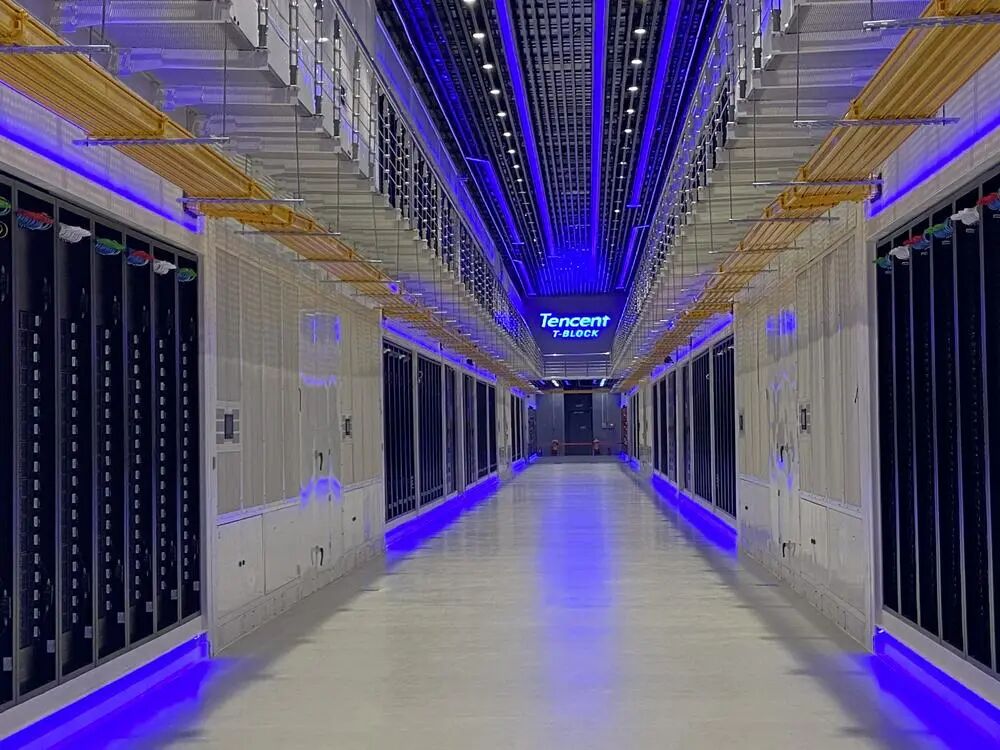
Internals of Tencent’s Guizhou Guian Qixing Data Center
Image source: Caixin
Tencent’s pressure comes in cash flow. It follows a prepaid model, with negative free cash flow of -69.1 billion yuan for the third quarter. The company stated that excluding computing power prepayments, it has positive cash flow of 16.9 billion yuan, while around 86 billion yuan was prepaid in one quarter. By the end of June, Tencent had net cash of 58.2 billion yuan, which turned into net liabilities of 13.7 billion yuan by the end of September.
The largest prepayment went to Oracle. A five-year agreement includes about 100,000 Nvidia chips placed in Oracle's Southeast Asia data center, valued at approximately $7 billion, with Tencent prepaying around 30%. According to the Financial Times, after US officials "expressed concerns," Oracle cancelled the agreement in early November.
Oracle's data center in Southeast Asia includes one leased from DayOne. Bloomberg reports that in 2025, Oracle will be the sole tenant of DayOne's Nongsa park in Batam, Indonesia, while also holding 15% of a joint venture with TikTok in the US, acting as a security partner.
Tencent also has a line in Japan and Australia that has run into problems. Datasection, listed in Tokyo, derives 90.7% of its revenue in fiscal 2026 from a company called NowNaw Japan.
According to a Financial Times report last December, the end customer behind NowNaw is Tencent, involving contracts worth over $1.2 billion in Tokyo and Sydney. Tencent responded at the time that its cloud service usage complies with applicable laws. In August of this year, an additional order worth 79.86 billion yen was canceled. On November 16, Datasection cut its revenue forecast for the fiscal year from 162.2 billion yen to 17.3 billion yen; after several months of negotiations regarding switching from B200 to B300 in Sydney, the landlord terminated the lease.
Intermediaries
Tracing back to the companies buying cards, many of the players are familiar faces. Chinese family capital from Taiwan and Southeast Asia, combined with Singapore's state capital, has served as intermediaries between China and the West for decades, engaging in manufacturing, real estate, and port operations, facilitating the flow of money and goods from both sides. AI computing power is the latest category of this business.
China's major companies have demand, while the West provides chips and US loans; these intermediaries offer an identity acceptable to both sides and a piece of land that can access power.
This business periodically has to choose which side to stand on.
In November 1989, Wang Yongqing visited the mainland for the first time and subsequently proposed building an integrated petrochemical zone in Xiamen's Haicang, abbreviated as the "901 Project." The news caused significant controversy in Taiwan, prompting Taipei to intervene with conditions of tax reductions and a $1.5 billion water supply facility, also bringing down land and water prices. In August 1991, Wang Yongqing accepted the plan from Yunlin Mailiao, which later became Liuqilin. In November 1992, he held a press conference to announce that the Haicang project was halted. Over thirty years later, Zhongfang Capital, controlled by his long-grandson, has become DayOne's fourth largest shareholder.

In 2024, Microsoft's investment cooperation signing scene with G42
Image source: G42, published by The National
The most recent decision on which side to take occurred in the Middle East. In 2023, US intelligence agencies expressed concerns over the relationship between Abu Dhabi AI company G42 and China, and in December, G42's CEO Peng Xiao told the Financial Times, "We can't do both sides." G42 subsequently stopped using Huawei equipment and sold its investments in China, including shares in ByteDance. In April 2024, Microsoft invested $1.5 billion in G42, and exiting China was a condition agreed upon with the US government prior to this investment.
Intermediaries have consistently engaged in business that takes advantage of regulatory loopholes. The remote access loophole has been visible to all parties over the past three years. In 2023, BIS articulated concerns regarding the rule description, stating that Nvidia conducted compliance reviews for every cloud partner, with tenant identities included in bank loan documents. In March of this year, Nvidia indicated that export rules "by design" allow for cloud construction outside regulated countries. The new regulations issued on November 16 have closed this loophole.
A new round of positioning has already begun. Aolani's CEO stated that around half of the contracted amounts currently come from Western clients. According to the Straits Times, four out of DayOne's top five clients are not Asian companies. B300, originally rented to Chinese clients, is being relisted for sale to buyers in the US and Western Europe. On the other side, Nvidia turned around earlier; two weeks before the new rules were issued, it told partners that Chinese clients could account for at most 49%.
In the first three quarters of this year, data centers and cloud computing accounted for 35% of the investments approved in Malaysia. It has effectively already taken a side. In May 2025, a deputy minister announced plans to build national-level AI infrastructure using Huawei's Ascend chips, only a week after the US Department of Commerce remarked that using Ascend anywhere would potentially violate US export controls. The next day, the deputy minister's office retracted the statement, with Anwar describing the announcement as "premature." Two months later, Malaysia began requiring that exports and transshipments of US AI chips must be licensed.
With the release of these new regulations, Malaysia’s Minister of International Trade and Industry Johari stated, "To stay at the table, you have to abide by the US rules." Singapore's Prime Minister Lawrence Wong commented, "We do not enforce US export controls, but we do not want Singapore to be exploited or abused as a conduit."
Intermediaries can still choose sides, but ByteDance, Alibaba, and Tencent cannot.
There are 82 days left until the license deadline of February 17, 2027.
Original link
Click to learn about job openings at Rhythm BlockBeats
Welcome to join the official community of Rhythm BlockBeats:
Telegram Subscription Group: https://t.me/theblockbeats
Telegram Discussion Group: https://t.me/BlockBeats_App
Official Twitter Account: https://twitter.com/BlockBeatsAsia
免责声明:本文章仅代表作者个人观点,不代表本平台的立场和观点。本文章仅供信息分享,不构成对任何人的任何投资建议。用户与作者之间的任何争议,与本平台无关。如网页中刊载的文章或图片涉及侵权,请提供相关的权利证明和身份证明发送邮件到[email protected],本平台相关工作人员将会进行核查。