Custody is evolving from a simple asset safekeeping service into an important layer of trust connecting institutional capital, on-chain finance, and the digital economy.
Written by: Cobo
In November, a significant compliance milestone was reached in the global digital asset infrastructure sector.
After 13 months of review and receiving conditional approval earlier this April, the Office of the Comptroller of the Currency (OCC) officially granted Coinbase an unconditional National Trust Bank Charter, allowing its subsidiary, Coinbase National Trust Company, to begin operations.
For a crypto-native enterprise handling a vast array of institutional assets, this not only signifies further expansion opportunities but also reflects that digital asset custody is achieving a more established institutional positioning within the traditional financial system.
If we broaden our perspective, this is not an isolated incident.
Since the end of 2025, several leading institutions, including Circle, Ripple, BitGo, Fidelity Digital Assets, and Paxos, have pursued or been granted OCC national trust bank charters. Meanwhile, the regulatory framework surrounding crypto asset custody, stablecoin issuance, and banking participation in on-chain operations is also continuously improving in the United States.
A series of developments point toward a trend: digital asset custody is gradually transitioning from specialized support services in the early crypto industry to becoming a critical infrastructure that connects traditional finance and on-chain economies.
With the development of stablecoin payments and AI agents, the role of custody will further extend beyond mere asset safekeeping to encompass rights of use, trading permissions, and execution management of digital assets.
1. Saying Goodbye to “Marginal Narratives”: Custody Becomes the Legal Cornerstone for Mainstream Institutional Entry
To understand the significance of Coinbase's recent OCC approval, we first need to clarify what kind of license it is.
The OCC is a federal financial regulatory agency under the U.S. Department of the Treasury, responsible for overseeing national banks, federal savings associations, and related institutions. Coinbase's approval is for establishing a national trust company, which significantly differs from commercial banks that can fully engage in deposit and loan activities.
National trust banks primarily conduct business around trust, asset custody, and related services and are subject to federal oversight by the OCC. This means that Coinbase can carry out related trust activities within a clearer federal regulatory framework, providing institutional clients with more institutionally certain custody services.
From Coinbase's application documents, it is evident that its planned custody business has already surpassed the traditional notion of cold wallet storage.
For example, Prime Vault utilizes multi-party computation (MPC) technology to offer corresponding independent on-chain addresses for different clients, ensuring safe storage and isolated management of digital assets; Prime Custody allows clients to conduct relevant transactions within the custody system, keeping assets within a qualified custody framework during the transaction process.
Additionally, Coinbase plans to integrate operations across different business entities, allowing custody clients to further access services like staking, financing, and trading, as well as explore payments and on-chain smart contract interactions.
This reflects a noteworthy change: institutions now need not just a vault for storing digital assets, but a complete service system that covers asset storage, management, trading, and operations.
Coinbase is not the only company developing in this direction.
As mentioned at the beginning, in December 2025, the OCC had conditionally approved national trust bank applications from five digital asset-related institutions, including Circle, Ripple, BitGo, Fidelity Digital Assets, and Paxos.
Since then, relevant approvals have made progress, with Ripple announcing on October 26, 2026, that it received final approval from the OCC to establish Ripple National Trust Bank; on November 6, the Coinbase National Trust Company also officially completed its establishment and took effect.
From the initial state-level trust licenses to the entry into the federal regulatory framework, and now the sequential applications for national trust bank charters by various digital asset enterprises, the industry is witnessing a clearer path of institutionalized development.
Behind this trend are broader regulatory policy changes:
- In March 2025, the OCC issued Interpretive Letter 1183, reaffirming that federally regulated banks can engage in crypto asset custody, specific stablecoin-related activities, and participate in distributed ledger network validations while removing the previous additional requirement of acquiring the regulatory agency's non-objection in advance for related activities;
- In May of the same year, the OCC further clarified that federally regulated banks can buy and sell crypto assets they hold in custody based on customer instructions and can outsource certain custody and execution services to third parties, provided that third-party risk management requirements are met;
- In October 2026, the OCC released final rules implementing the GENIUS Act, further specifying regulations around the issuance of payments stablecoins, reserve assets, redemption, risk management, audit oversight, and certain custody activities, which are set to take effect on January 18, 2027;
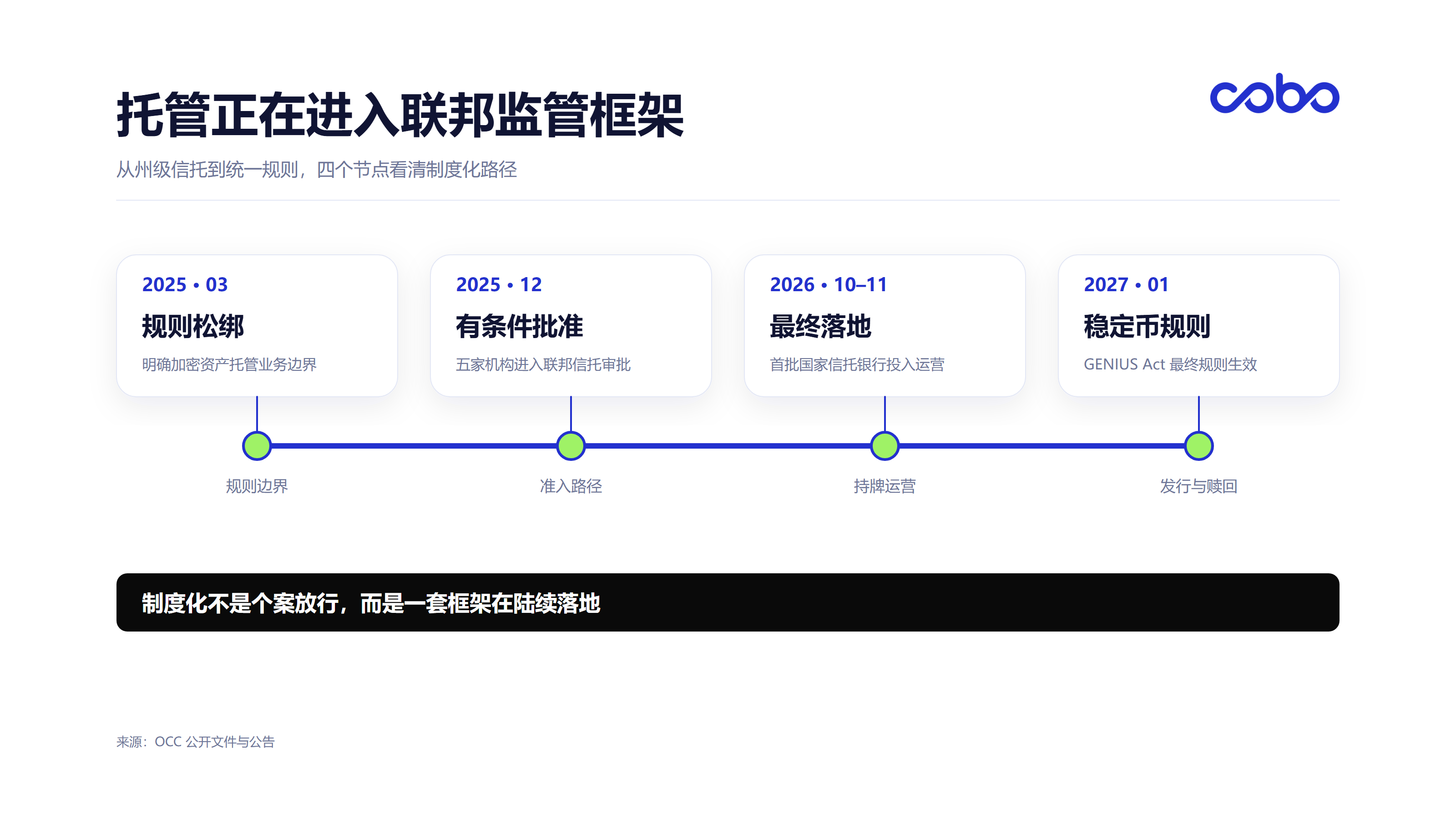
Although these developments individually relate to bank operations, trust licenses, and stablecoin regulation, they collectively point in one direction: digital assets are gradually being integrated into a more mature and clear financial regulatory and service system.
For institutional participants, the gradually clarifying regulatory path helps reduce the uncertainty of business implementation, and professional custody services are destined to become an increasingly important infrastructure for institutions entering this market.
2. Moving from Points to Areas: What Kind of Security System is Needed for Institutional Custody?
If the regulatory license addresses whether custody service providers can operate within a clear institutional framework, then the technical and operational systems determine whether institutions can truly trust them with their assets.
For institutions, the risks associated with digital asset custody are far more complex than those faced by ordinary users when saving private keys. For example, an exchange, fund management firm, or cross-border payment platform often involves multiple business departments, different types of assets, and intricate cash flow processes.
Thus, institutional custody must not only ensure the security of private keys but also clarify asset ownership, operational permissions, transaction approvals, and risk responsibilities, establishing a complete security system that covers assets, keys, permissions, and operations.
First is the issue of asset control and isolation.
Institutions need to clearly distinguish between their own assets and client assets, ensuring that ownership, accounting records, and actual on-chain holdings of assets can correspond with each other. At the same time, clear rules for asset allocation and usage must be established to avoid unauthorized asset transfers or improper use.
Next is permission management and transaction risk control.
Within an institution, asset management typically involves multiple roles, including finance, trading, risk control, operations, and management—who can create wallets? Who can initiate transfers? Who has the authority to approve large transactions? What operations must go through multiple party authorization?
These questions must be constrained by both technology and policy, as institutional wallets typically need to support multi-level role permissions, multi-person approvals, address whitelists, transaction limits, and automation for approval based on business rules; for transactions involving smart contract interactions, checks on target contracts, invocation parameters, and potential risks must be conducted prior to signing transactions to prevent unauthorized operations from directly entering the on-chain execution phase.
Finally, auditing, operations, and risk management.
Institutions need to continuously monitor asset status, transaction records, and fund flows while possessing capabilities for risk monitoring, handling anomalous transactions, internal audits, disaster recovery, and security incident response.
From key generation, backup, and recovery to permission changes, transaction signing, and fund allocations, every critical operation should leave traceable records. Only when the technological architecture, permission management, and operational policies form a complete closed loop can institutions truly establish a sustainable asset security system.

This means that mature digital asset custody is actually a comprehensive system formed by cryptographic technology, permission governance, risk management, and operational policies.
3. Where Will Next-Generation Custody Infrastructure Go?
For financial institutions, trading platforms, and corporate clients truly operating at the business frontline, gaining compliant business access is just the starting point; the ability to manage funds securely and efficiently in a complex on-chain environment ultimately depends on the engineering capabilities of the underlying wallets and custody infrastructure.
This is because the custody logic of traditional trust banks is, in essence, “static”—assets enter cold storage, and delivery is completed through infrequent, manually assisted processes. However, when a modern financial institution, exchange, Web3 enterprise, or cross-border payment platform truly operates its business on-chain, they often face complex challenges that traditional banking structures cannot directly accommodate:
- Multi-chain fragmentation and high-frequency concurrency: Stablecoins and institutional assets are distributed across dozens of heterogeneous public chains, and enterprises need millisecond-level API responses to support thousands of automatic deposits, withdrawals, aggregations, and clearings daily, rather than offline approvals taking hours or even days;
- Balancing autonomy and security: Not all institutions wish to entrust their private keys 100% to a single third-party black box. Beyond compliant full custody, some institutions may prefer to use MPC (Multi-Party Computation) threshold signature technology to achieve fragmentary self-ownership and multi-party collaborative control over private keys, eliminating single points of failure while retaining ultimate control over funds;
- Fine-grained enterprise-level internal controls: Managing an institutional vault involves complex financial permissions that need to be automatically intercepted by a programmable risk control engine embedded at the wallet layer “before transaction signing,” rather than relying solely on post-audit;
These high-frequency and complex practical demands compel wallets and custody systems to possess more comprehensive permission governance, risk control strategies, and automated operational capabilities.
Meanwhile, the development of stablecoin payments and tokenized assets is also expanding the service boundaries of custody infrastructure.
Whether tokenized funds, bonds, or other real-world assets, their issuance, holding, transfer, and settlement require a reliable asset management system. Blockchain does not automatically eliminate custody, ownership, and compliance issues found in traditional finance; rather, these capabilities may be required to be implemented in a more transparent and programmable manner in an on-chain environment.

What has greater long-term imaginative potential is the involvement of AI agents in digital asset management and financial activities.
In the past, wallets were designed specifically for human users, who held private keys, actively initiated transactions through front-end interfaces, and confirmed each operation manually. However, in the Agentic Economy, an increasing number of on-chain operations will be automatically completed by agents 24/7. If complete private keys or unrestricted wallet control are directly handed over to AI agents, it can clearly present severe security risks:
For example, will the agent transfer assets without restrictions? Will it interact with malicious smart contracts? Could it execute unintended transactions due to model hallucinations, prompt injections, or external command manipulations?
This is actually a further extension of the institutional-level custody concept within the agent economy. As the objects managed by custody infrastructure extend from private keys and assets themselves to identities, permissions, and execution strategies, a verifiable, binding, and traceable asset usage rights system must also be established.
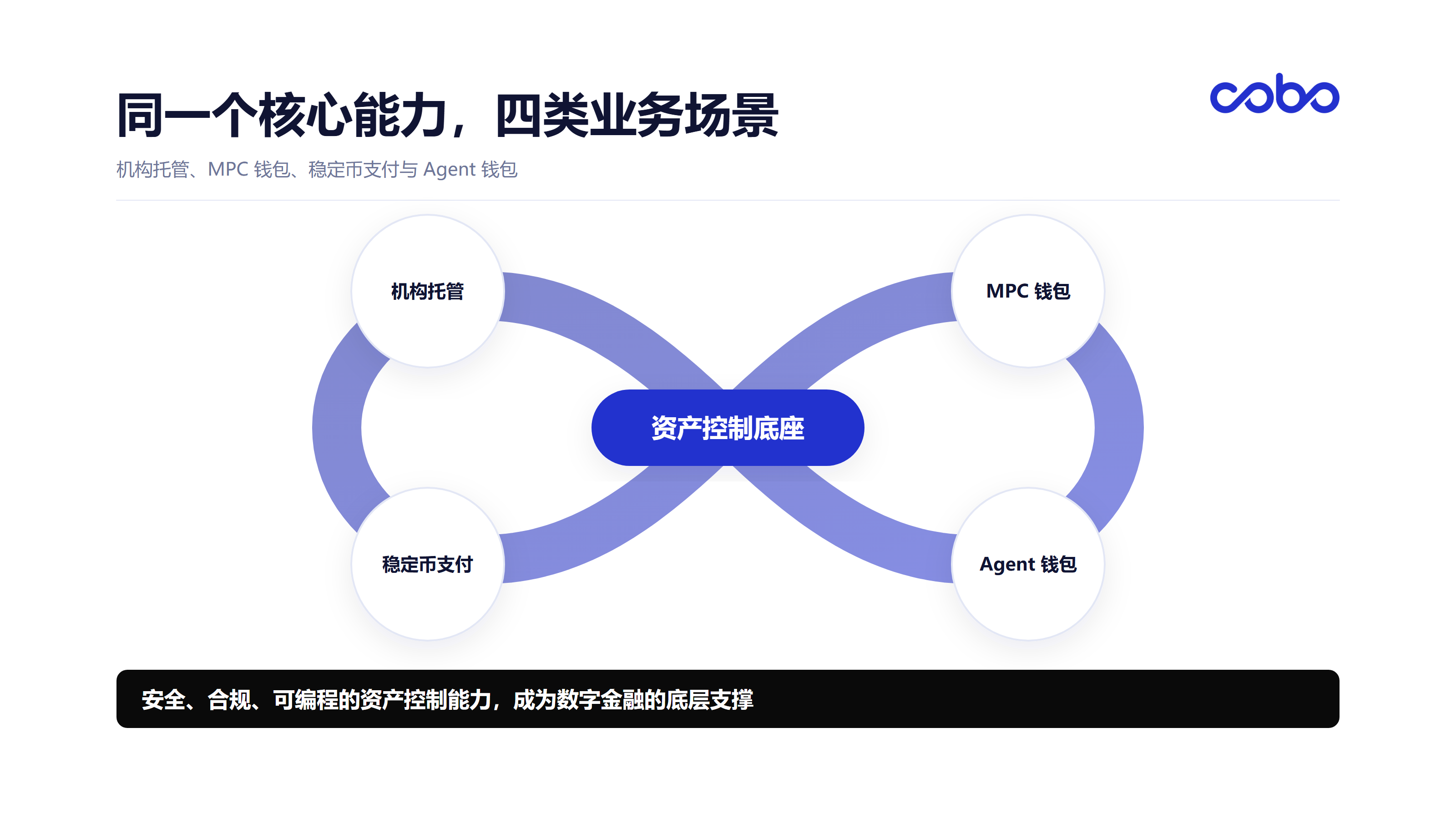
From this perspective, institutional custody, MPC wallets, stablecoin payments, and agent wallets are essentially different scenarios revolving around the same core capability—to manage and efficiently utilize digital assets in a secure, compliant, and controllable manner.
In Conclusion
Coinbase's final approval for the OCC National Trust Charter provides an important institutional footnote for the development of the digital asset custody industry.
From the gradual clarification of the regulatory framework to the continuous improvement of institutional custody systems, and the new asset management needs brought by stablecoin payments and the agent economy, digital asset infrastructure is undergoing an evolution from being technology-driven to a collaborative development of institutions, technologies, and businesses.
Especially against the backdrop of recent global market volatility expectations, it proves that digital asset infrastructure has not moved toward isolation; rather, it is completing compliance-driven transformations at the fastest speed, becoming an integral part of the modern financial system.
For institutions, whether digital assets can be securely held, effectively managed, and efficiently utilized will directly affect their depth and breadth of participation in on-chain finance. For infrastructure service providers, future value also lies in helping clients establish a complete system covering asset storage, permission governance, transaction execution, and business operations.
As more financial activities move on-chain and more assets begin to be autonomously invoked by software and agents, secure, compliant, and programmable asset control capabilities will become an indispensable underlying support for digital finance.
After all, finance can become more open, assets can become more programmable, but regardless of who uses the assets, trust and control must always exist.
免责声明:本文章仅代表作者个人观点,不代表本平台的立场和观点。本文章仅供信息分享,不构成对任何人的任何投资建议。用户与作者之间的任何争议,与本平台无关。如网页中刊载的文章或图片涉及侵权,请提供相关的权利证明和身份证明发送邮件到[email protected],本平台相关工作人员将会进行核查。


