Author: Pink
The supply of US stock tokens is rapidly increasing, but the trading market may not necessarily become simpler.
According to statistics from RWA.xyz, as of November 11, 2026, the total value of tokenized stock assets is approximately $3.88 billion, a 13.41% increase from 30 days ago. These assets are distributed across different issuance systems and blockchain networks and can be traded through centralized exchanges as well as increasingly entering wallets and decentralized exchanges.
For users, with more options available, there is a real calculation to be made: when participating in the movements of Nvidia or Tesla, which platform to trade on and which version of the token to choose can lead to different fees and transaction prices.
Recently, the well-established exchange Huobi HTX announced the launch of spot trading for US stock tokens, covering USDT trading pairs for 20 US stocks and ETF-related tokens such as NVDA, TSLA, GOOGL, MSTR, and QQQ.
As major centralized exchanges compete fiercely, with increasingly homogeneous products, Huobi HTX has chosen to directly address the most sensitive trading pain point: "fee structure," attempting to reshape the entry into US stock token trading with extreme cost advantages.
Fee Reconstruction: Fee Differences Should Be Viewed in Terms of Transaction Volume
For users with high-frequency trading or continuous rebalancing needs, trading costs are not a one-time experience, but can significantly increase with transaction volume due to hidden losses. Below are the public spot fee rates and discounts for stock tokens from some major platforms:
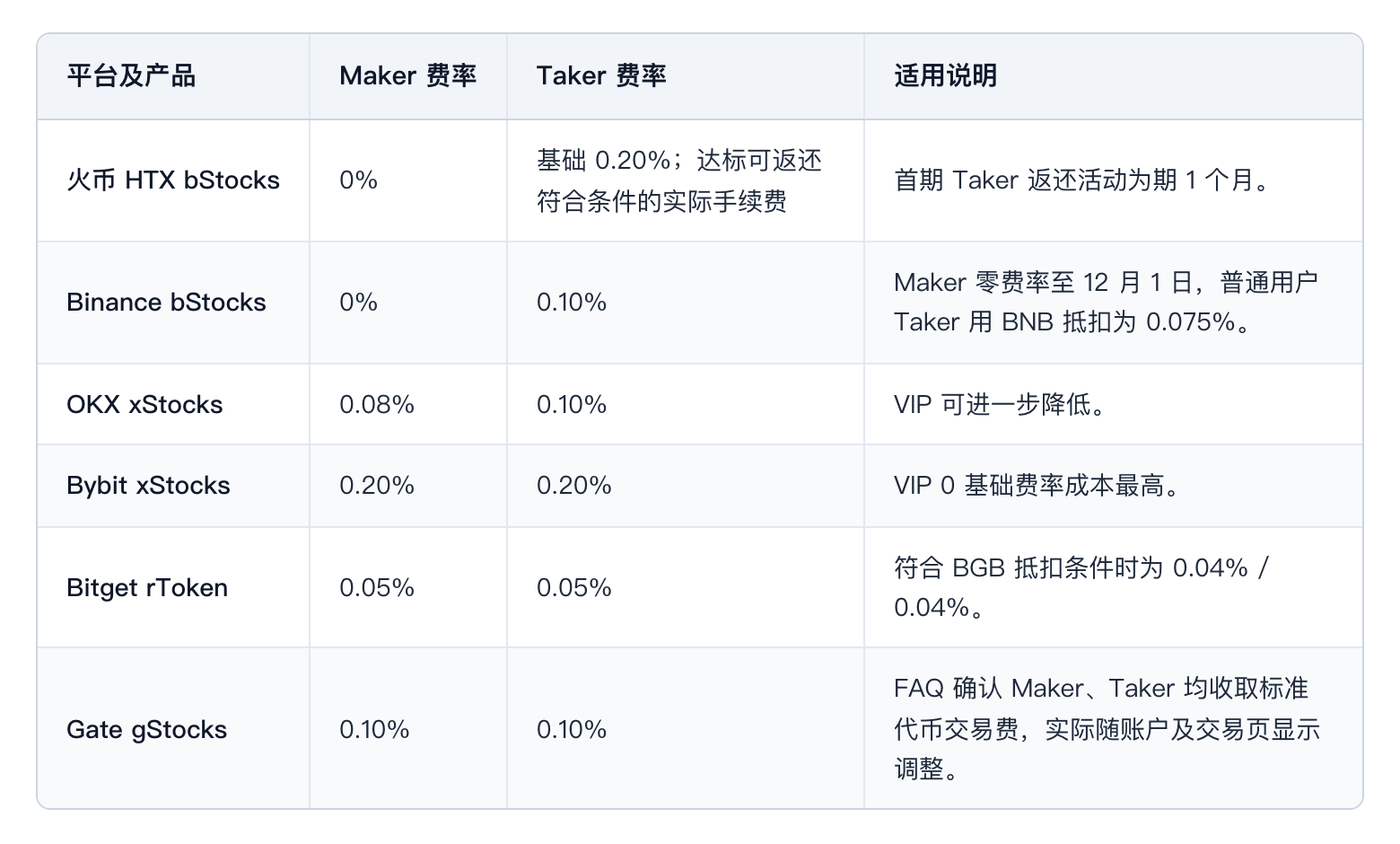
Figure: Spot fee rates and discount situations for stock tokens on some major platforms (as of November 11, 2026, compiled according to standard user rates and applicable discounts; different products may have varying trading mechanisms and service scopes, actual rates and eligibility for discounts are subject to the platform's page)
Huobi HTX's fee plan provides clear cost-saving paths for users with different trading habits:
- Maker: enjoys a direct 0-fee policy, saving on recurring friction costs with each rebalance.
- Taker: according to the platform's published plan, during the designated first refund period of one month, as long as the effective daily trading volume reaches 10,000 USDT and meets the activity rules, they can receive a 100% refund of trading fees, effectively achieving “zero-cost” trading in all scenarios.
Putting the fee differences into real trading scenarios makes the accounting clear.
For example, with a total transaction volume of 1 million USDT (counting buys and sells separately): on the platform with the highest rates at 0.20%, the fee alone would cost 2,000 USDT; even at the industry's lower rate of 0.05%, the cost would still reach 500 USDT.
However, on Huobi HTX, if all these trades are completed through makers, the corresponding trading fees would be zero, effectively saving the trader a pure profit.
From Zero Fees to High Depth: Using Cost Advantages to Leverage Positive Liquidity Cycles
For traders, fees are an important factor affecting actual trading costs; for trading platforms, the value of the fee mechanism goes beyond just lowering user trading thresholds, but also its potential impact on market liquidity supply.
Especially in the emerging market of US stock tokens, trading depth, bid-ask spreads, and order execution efficiency are still in a continuous improvement phase. Attracting more liquidity providers to participate in making orders and improving the effective depth of the order book has become an important topic for trading platforms to enhance their market competitiveness.
From this perspective, Huobi HTX's introduction of "Maker Zero Fees" is not only to subsidize retail investors but also provides professional market makers and quantitative trading teams with more attractive trading cost conditions for high-frequency order participation.
In the startup phase of emerging assets like US stock tokens, market depth often determines the retention of significant funds. By directly eliminating the making costs for market makers, Huobi HTX can attract external professional liquidity injections in a very short time, rapidly narrowing the bid-ask spread.
When the market depth is thick enough, the slippage losses for ordinary users and large funds decrease, thereby forming a positive liquidity cycle of “zero fees, high depth, and low slippage.”
In an Era of Homogenization, Every Penny Saved is Competitiveness
Compared to platforms like Binance, Bybit, and Bitget, Huobi HTX entered the US stock token spot market relatively late. However, for traders, who goes online first is not the core issue; who offers the lowest trading friction is the hard truth.
As Nvidia, Tesla, and QQQ gradually become the "standard configuration" for major trading platforms, the assets themselves are no longer scarce, and users' choice criteria will quickly converge to the most intuitive trading costs. Huobi HTX, with its combination of “Maker Long-term Fee Waiver + Taker Full Refund for Meeting Standards,” has directly broken through the existing fee bottom line of the industry.
Trading habits change by offering real monetary fee discounts, which is the breakthrough strategy for newcomer Huobi HTX to capture the marketplace for US stock tokens.
Note: The content of this article is not investment advice, nor does it constitute any offer, invitation to offer, or recommendation of investment products.
免责声明:本文章仅代表作者个人观点,不代表本平台的立场和观点。本文章仅供信息分享,不构成对任何人的任何投资建议。用户与作者之间的任何争议,与本平台无关。如网页中刊载的文章或图片涉及侵权,请提供相关的权利证明和身份证明发送邮件到[email protected],本平台相关工作人员将会进行核查。