6 securities will be excluded from MSCI due to the Non-Operating Company rules, and 4 new companies, including BNB Standard, will be added to the watchlist
Written by: ChandlerZ, Foresight News
The clash between traditional financial indices and the crypto treasury model has finally reached its final ruling.
On November 12, the global core stock index compiler MSCI officially released the "Final Impact List of Non-Operating Companies." Notable companies such as Strategy (MicroStrategy), known for holding a large amount of Bitcoin, Japan's Metaplanet, and Upexi, which holds Solana assets, are on the final exclusion list. The related adjustments will take full effect after the close of the U.S. stock market on November 30.
Compared to the initial list published in early October, MSCI's actions this time reveal a tighter review network, with the total number of companies excluded increasing to 6, while an additional 4 listed companies involved in crypto tokens and new concepts have been added to the watchlist, including the highly regarded BNB treasury listing subject BNB Standard.
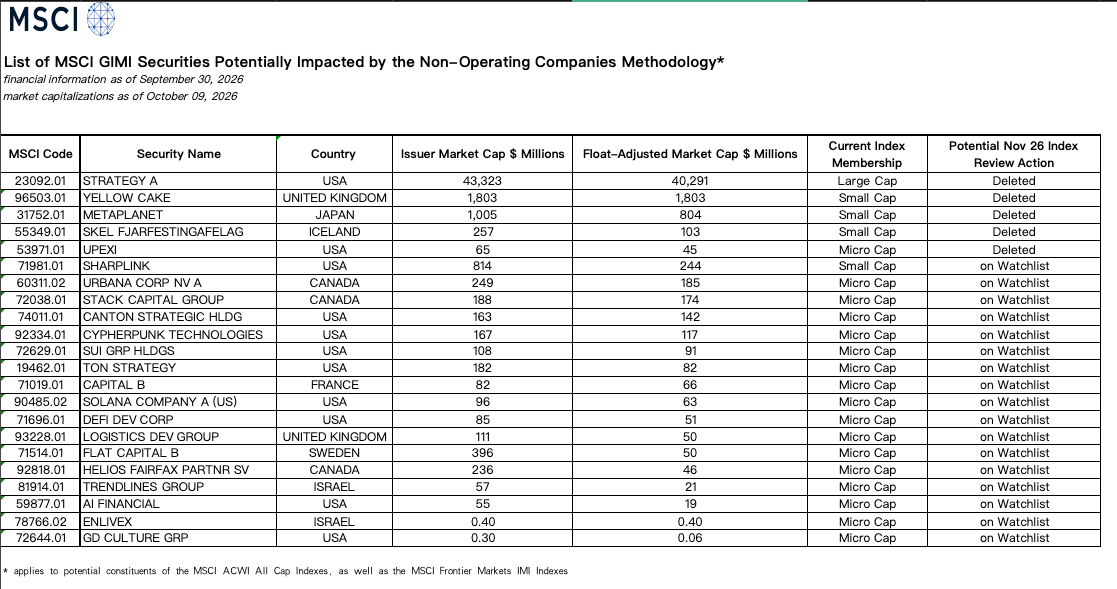
At the same time, two companies that were previously on the watchlist have quietly disappeared, only to be found on another list of delisted micro-cap stocks. This cleansing storm of traditional index standards against fund-like/asset custody-type U.S. stocks is rapidly deepening.
6 companies face immediate exclusion, MicroStrategy's defense is ineffective
MSCI is a financial service company that compiles global stock indices, and its indices are used as investment benchmarks by many funds. Companies included in the index can receive allocations from funds tracking the corresponding index; once excluded, the related funds must adjust their holdings.
The final list includes 25 securities, of which 6 are marked for exclusion, and 19 are on the watchlist. All 5 companies proposed for exclusion in the preliminary list from October remain on the final list.
- Crypto asset camp: Strategy (MicroStrategy), Metaplanet (Japanese Bitcoin treasury company), Upexi (Solana treasury and token exposure).
- Non-crypto entities but also asset-holding types: Yellow Cake (UK uranium investment company), Skel Fjarfestingafelag (Icelandic investment company), and the newly added 6th company, UK cellular agriculture tech investment firm Agronomics.
MSCI's scrutiny extends beyond the crypto circle, but the crypto space undoubtedly bears the brunt of the impact.
Strategy is the largest company on the exclusion list. As of the closing of the U.S. stock market on November 12, the stock price of Strategy was $122.35, up 1.06% for the day, with a total market capitalization of about $51.7 billion. After MSCI published the final list, Strategy's stock price fell in after-hours trading, currently at $120.2, a drop of 1.76% from the closing price. According to JPMorgan analysts, if MicroStrategy is completely removed from the MSCI flagship stock index, it is expected to trigger an outflow of about $2.8 billion from passive index funds.
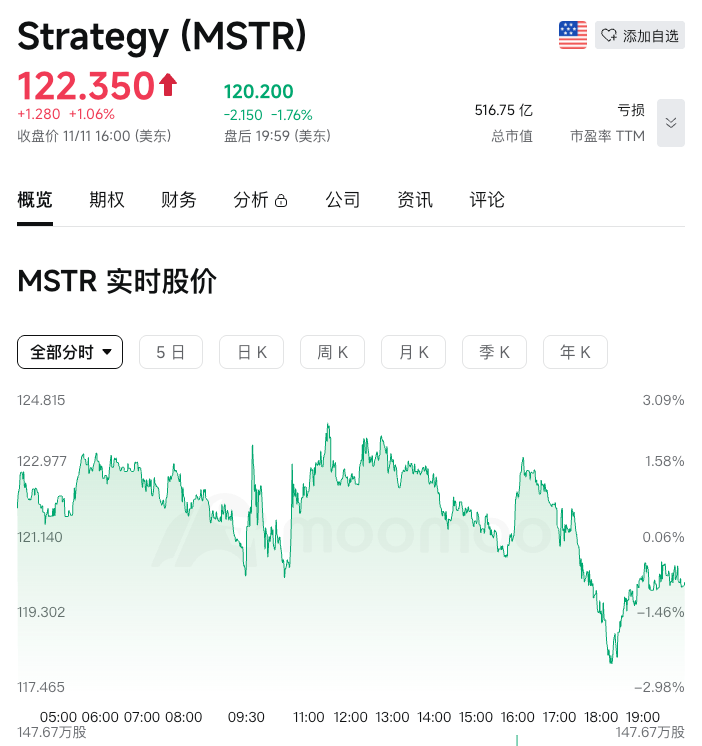
Although adjustments at the index level do not mean that MicroStrategy must sell its underlying reserves of hundreds of thousands of Bitcoins, it directly undermines the liquidity flywheel necessary for its survival, which relies on issuing stocks and bonds to buy BTC, lifting stock prices and further financing. Without passive allocations as a bottom support, the valuation premium of its stock and refinancing thresholds may come under significant pressure.
MicroStrategy had previously strongly opposed MSCI's classification of it as a non-operating company, arguing that its Bitcoin business is part of the group's core operations, accusing traditional financial metrics of being unable to fairly evaluate the new asset liability model. However, from the final outcome, MSCI did not compromise with the crypto leveraged giant.
19 companies placed on probation watchlist, BNB Standard joins with 4 new faces
In addition to the 6 excluded securities, there are 19 securities on the watchlist. Compared to the preliminary list from October, MSCI has issued 4 new "yellow cards," including: BNB Standard, Streamex, APG Securities, and Quantum Solutions.
Among them, BNB Standard's stock code is BNC, formerly known as CEA Industries. The company provides investors with indirect exposure to BNB through publicly listed shares while also operating retail and industrial equipment businesses.
Notably, BNB Standard (stock code: BNC) is particularly eye-catching, as it has a core reserve based on BNB.
- The company, which was formerly CEA Industries, after undergoing a business transformation, emulates MicroStrategy's model: holding approximately 515,500 BNB (according to disclosed data up to the end of July) through a publicly listed company, providing U.S. investors with spot risk exposure to BNB without facing compliance barrier limitations.
- MSCI data shows that BNB Standard currently has a total market capitalization of about $220 million. Being added to the watchlist means it is also heavily weighted in tokens and does not meet operational cash flow standards, placing it in the exclusion warning database of traditional index institutions.
The other newly added companies on the watchlist operate different businesses: U.S. listed company Streamex runs a commodity tokenization platform that has launched tokenized products related to gold; Japan's listed company Quantum Solutions involves AI computing power, gaming, and has previously engaged in crypto asset treasury operations. APG Securities is a Vietnamese securities company.
The companies previously on the watchlist, including SharpLink, SUI Group Holdings, TON Strategy, Capital B, Solana Company, and DeFi Development Corp, remain on the final watchlist.
Other companies continuing under observation include Urbana, Stack Capital Group, Canton Strategic Holdings, Cypherpunk Technologies, Logistics Development Group, Flat Capital, Helios Fairfax Partners, Trendlines Group, and AI Financial. Together with the previously mentioned 6, a total of 15 companies appear on both versions of the watchlist.
According to MSCI's new rules, companies first undergo screening for operating assets, and those that do not pass are subjected to five financial ratio screenings. If at least four criteria touch on exclusion conditions, they may lose eligibility for index inclusion. For existing components, MSCI requires that both the most recent two annual reporting periods have not passed the screening for a company to be excluded according to this rule; companies that have not yet met exclusion conditions may enter the watchlist.
Previously, MSCI had taken temporary measures for companies where digital assets accounted for at least 50% of total assets, restricting part of the index weight adjustment for the related securities. With the implementation of these new rules in the November index review, these temporary measures will also end.
Why did two shell companies suddenly fall into the micro-cap wasteland?
In this list update, a particularly obscure detail is that two companies bizarrely disappeared from the non-operating list, but this is not because they proved their innocence and escaped trouble.
The two companies are Enlivex, a biotech and prediction market token concept stock, and GD Culture Group, a Nasdaq-listed Chinese stock that previously disclosed Bitcoin treasury plans. They both ranked on the watchlist during the preliminary review in early October but were both excluded from the final non-operating list in November.
However, comparing it with the global micro-cap index adjustment list released by MSCI on the same day reveals that Enlivex will be directly excluded from the MSCI Israel Micro Cap Index; GD Culture Group will also be directly removed from the MSCI U.S. Micro Cap Index.
MSCI did not explain the overlapping logic in both reports, but considering the fundamentals of both companies, the reasoning is not difficult to see. Enlivex had previously received a delisting warning from Nasdaq and was forced into a reverse stock split of 1 share into 16 shares; GD Culture has also long faced extremely low liquidity and compliance scrutiny. Their removal from the watchlist of non-operating companies is likely because their micro-cap market value or listing compliance status has already breached the bottom line, directly disqualifying them from entering the micro-cap index, thus eliminating the need for a second review under the non-operating rules.
Conclusion
From the temporary weight restrictions on crypto assets to the final implementation of the non-operating company rules at the end of November, the traditional financial index's liquidation of listed companies' derisking and speculative fundization has become a foregone conclusion.
The bottom-line logic of MSCI is very simple: stock indices are a tool for pricing the real economy and real operating companies, not an ATM for providing passive incremental funds to closed token trusts that lack operational entities.
As the November 30 effective date approaches, the actual shock wave of capital fleeing MicroStrategy will undergo its first test; meanwhile, the watchlist, which includes as many as 19 companies covering BTC, BNB, SOL, TON, and SUI exposures, officially enters the countdown to the edge of the index.
免责声明:本文章仅代表作者个人观点,不代表本平台的立场和观点。本文章仅供信息分享,不构成对任何人的任何投资建议。用户与作者之间的任何争议,与本平台无关。如网页中刊载的文章或图片涉及侵权,请提供相关的权利证明和身份证明发送邮件到[email protected],本平台相关工作人员将会进行核查。


