Stablecoins have seen an outflow of 14.2 billion USD in the last 30 days, and the Federal Reserve is set to raise interest rates in December, putting pressure on the bullish front.
Written by: Maher, Foresight News
BTC has been under pressure recently. According to Bitget market data, BTC has declined since reaching a recent high of 87,000 USD at the end of September this year, first falling below the important levels of 80,000 USD and 76,000 USD, even dipping to a low of 72,732 USD. Currently, the Bitcoin price is fluctuating around 74,000 USD. ETH has also adjusted from a September high of 2,800 USD down to 2,005 USD, nearly falling below the 2,000 USD support line.
Additionally, on November 12, MSCI (Morgan Stanley Capital International) will remove Strategy and Metaplanet from its global index based on a new screening method for non-operating companies, which has also brought considerable pressure to the market.
According to CoinMarketCap data, the market has fallen into a state of panic.
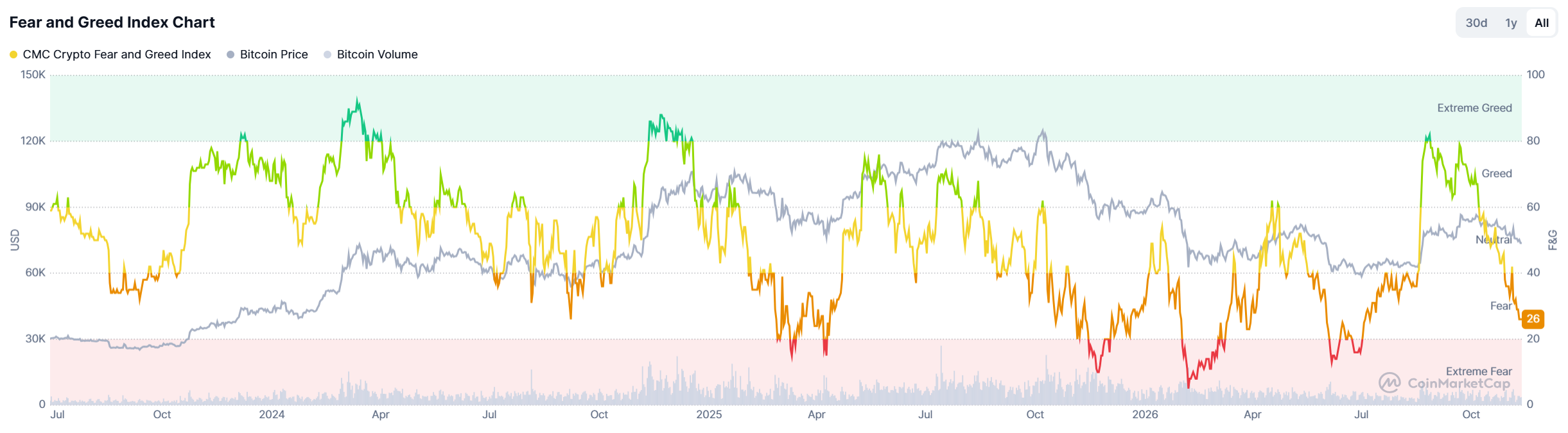
Why is the crypto market struggling to rebound and experiencing sharp declines?
NASDAQ Correction and Jensen Huang Scandal
The sharp correction in the crypto market is not an isolated event but rather a tragic macro resonance with the U.S. tech sector—especially the unexpected black swan event in the AI sector.
The NASDAQ index began to correct in early October and has seen four consecutive weekly declines, raising concerns in the U.S. AI market.
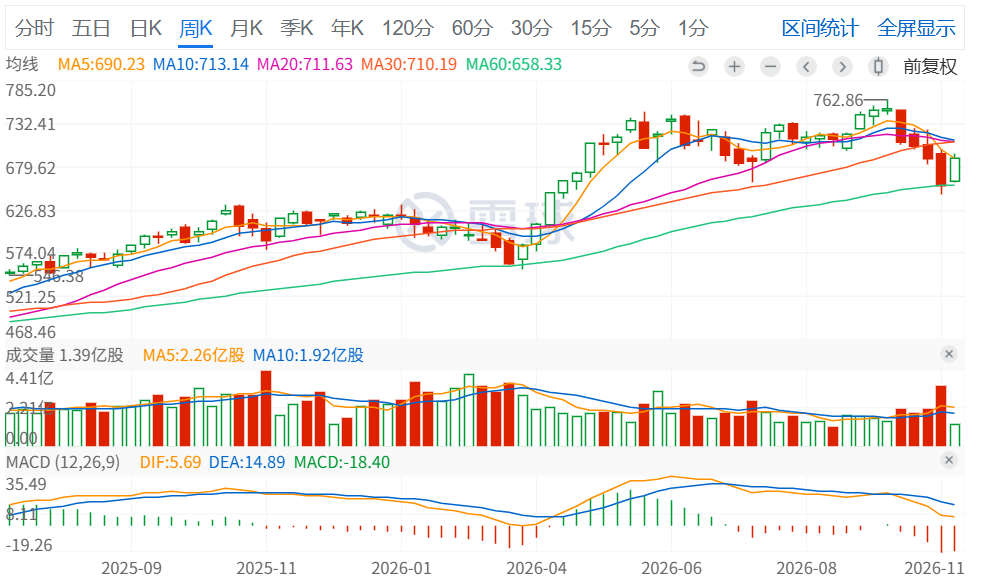
NASDAQ 100 Index ETF Weekly Chart
Recently, NVIDIA, as a global risk asset benchmark, has exploded with shocking news.
NVIDIA founder and CEO Jensen Huang admitted to an affair with a female executive (Alice Huang), prompting the NVIDIA board to urgently initiate an independent review. More critically, amid a collective lawsuit from shareholders, The Wall Street Journal reported that the board is considering removing Jensen Huang, leading to a nearly 8% drop in NVIDIA’s stock price in after-hours trading.
The “leather jacket guru’s” personal moral collapse has instantly transformed into systemic risk for the entire tech stock sector. Accompanied by Wall Street’s heightened concerns about national security risks and turmoil in AI leading companies, panic sentiments have quickly spread, triggering a new wave of tech stock declines.
As a highly elastic correlated asset with the NASDAQ, BTC has become a withdrawal machine for institutional funds seeking safety.
After CPI Data, December Fed Rate Hike is Certain
This week’s U.S. October CPI data has reinforced the market’s expectations for a Fed rate hike in December. The overall CPI in October rose by 0.4% MoM, higher than the market expectation of 0.3%; core CPI increased by 0.3% MoM, also exceeding the expected 0.2%. After the data was released, traders’ pricing for the rate hike at the December meeting showed a notable shift to the right.
According to Polymarket data, as of November 12, the market bets an 86% probability of a 25 basis point rate hike at the December Fed meeting, while the probability of a 50 basis point hike or more is about 10%, with a mere 3% chance of holding the rate unchanged. The probability of a 50 basis point hike was nearly zero before the CPI announcement but rapidly increased afterwards. A 25 basis point hike remains the most mainstream pricing result, but the possibility of a larger hike has already been taken into consideration.
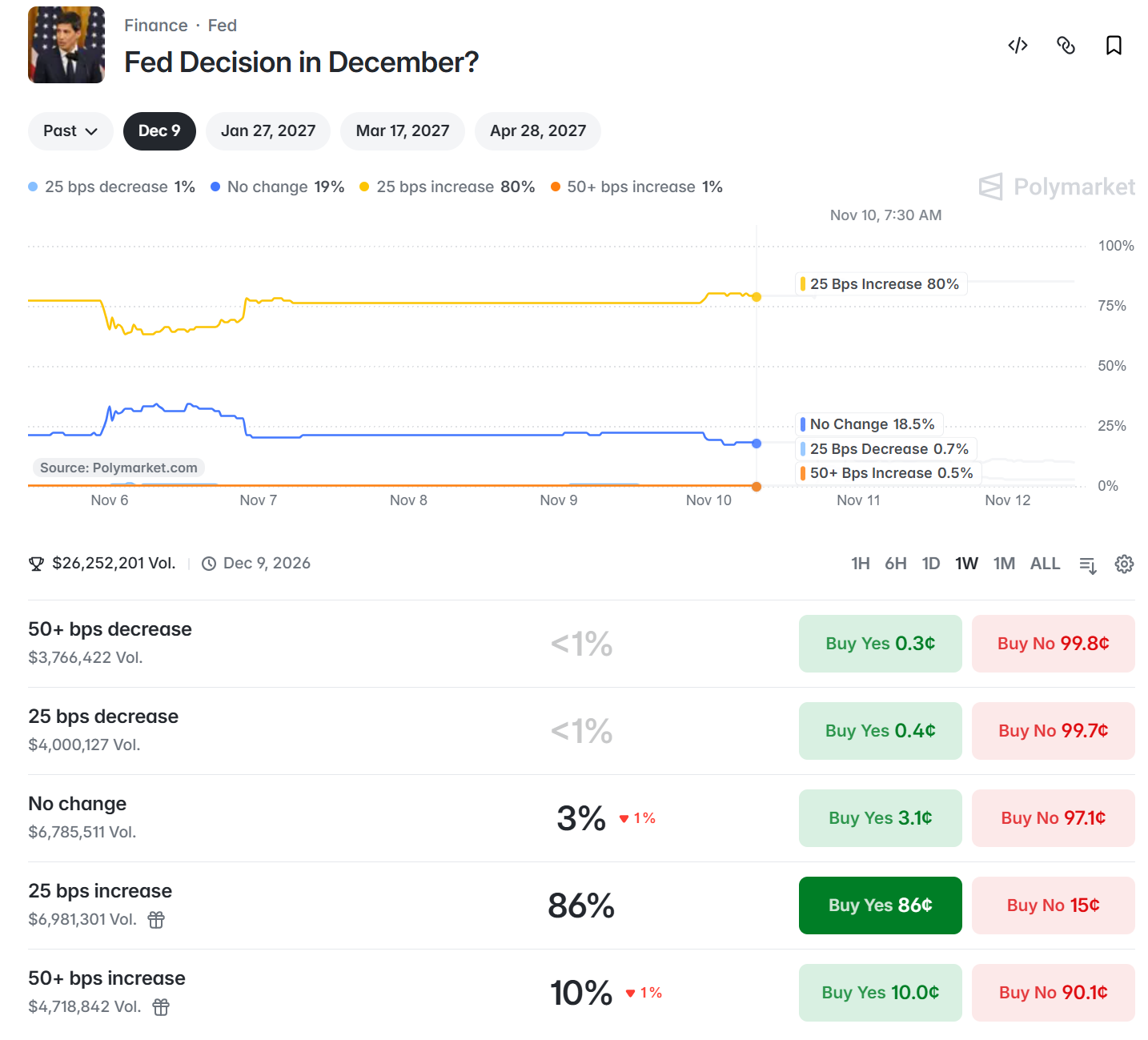
Fed Governor Waller previously stated that if the October core CPI reading is at 0.3% or higher, he would consider supporting a 50 basis point rate hike at the December meeting. Following the CPI data, the focus of market discussions has shifted from “whether to raise rates” to “raise by 25 basis points or 50 basis points.” The current federal funds target range is 3.75%-4.00%. If a 25 basis point hike occurs, the range will shift to 4.00%-4.25%.
The rising rate hike expectations put pressure on risk assets. U.S. Treasury yields have risen significantly after the CPI data, the U.S. dollar has strengthened, and the stock market has come under pressure. For the crypto market, higher rate expectations imply a further tightening of the liquidity environment and a corresponding decrease in risk appetite. With Tether supply already contracting, if the Fed confirms its rate hike path in December, the incremental funds available for market allocation will become even more limited.
Stablecoin Supply Has Seen a 14.2 Billion USD Outflow in the Past 30 Days
The total market capitalization of stablecoins has continued to fall. According to DefiLlama data, as of November 12, the total market capitalization of stablecoins across the market is approximately 286.9 billion USD, a 0.12% decrease from the previous day, a 1.47% decrease from the previous 7 days, and a 4.82% decrease from the previous 30 days.

Among them, USDT’s market capitalization is about 175.7 billion USD, accounting for 61.22%; USDC’s market capitalization is about 69.9 billion USD.
The on-chain report released by Glassnode on the same day showed that the supply of major stablecoins has decreased by 14.2 billion USD in the past 30 days, the largest monthly contraction since June 2022. At that time, the market experienced nearly 30 billion USD in supply shrinkage over 30 days following the Terra collapse, and Bitcoin subsequently fell to around 15.5 thousand USD in November of that year.
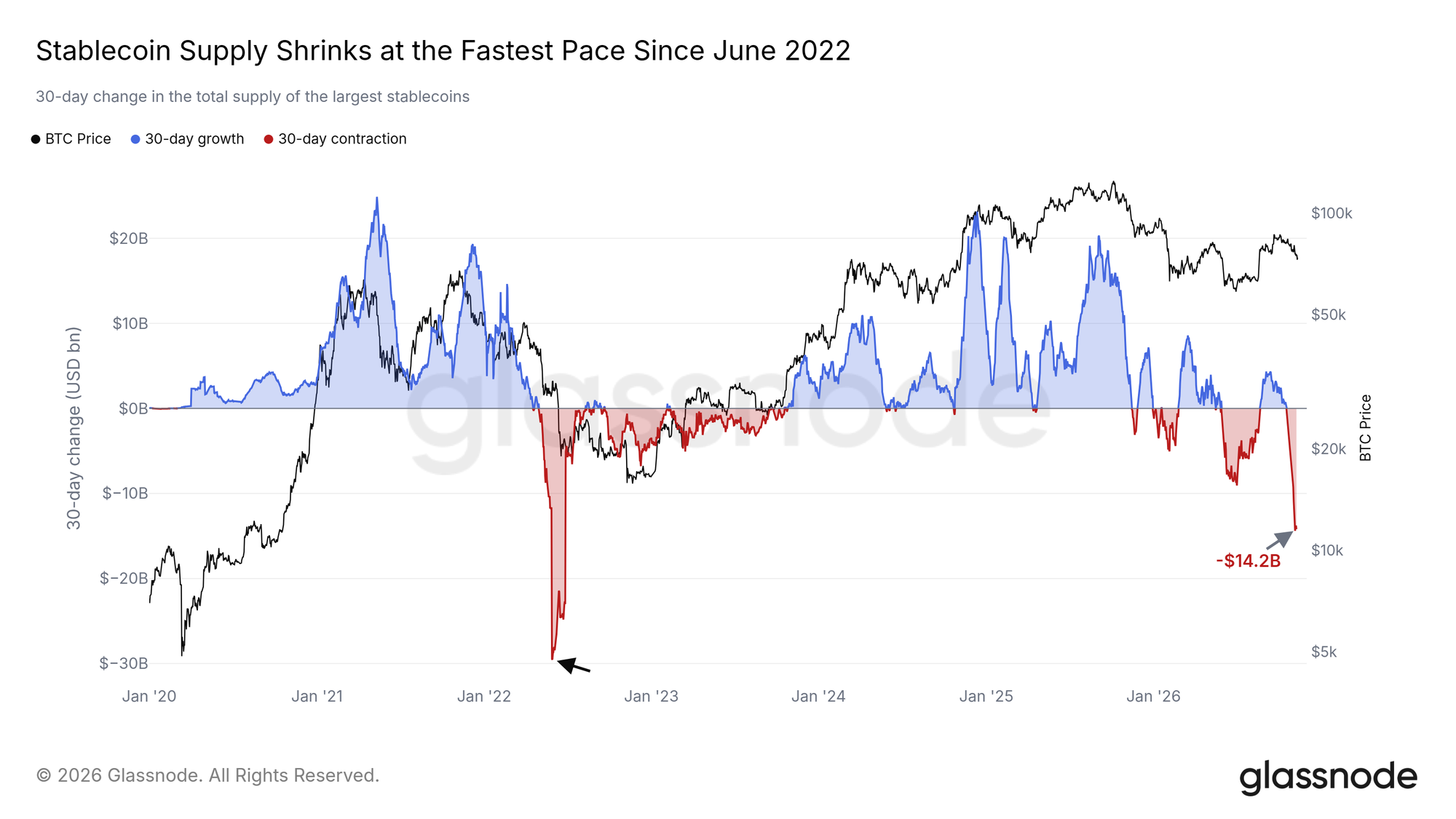
Glassnode noted in its report that the decrease in supply indicates that holders are redeeming stablecoins for USD and exiting the market, which corresponds to a reduction in the “fuel” available for driving a rebound. Meanwhile, some smaller stablecoins are being redeemed at a faster pace, while a few varieties like RLUSD and USDe have seen slight increases, but overall have failed to reverse the net outflow pattern.
The total supply of stablecoins has currently reverted to nearly the 280 billion USD range, the lowest level since September 2025. From a longer time perspective, since reaching a peak of about 315 billion USD in mid-May this year, it has cumulatively shrunk by about 21 to 23 billion USD, representing a decline of nearly 7%.
Stablecoins, as a core settlement asset and liquidity source for crypto trading, continue to shrink, forming a synchronous pressure on spot prices and heightened fear sentiment. In the absence of new stablecoin minting and net inflows, the market's available dollar liquidity pool continues to narrow, correspondingly weakening the incremental funding support needed for a short-term rebound.
Future Trends
Glassnode indicates that BTC has currently fallen below the short-term holder cost basis (STH-CB) of 75,600 USD. If it continues to fall below 73,000 USD, the market will enter a longer consolidation cycle.
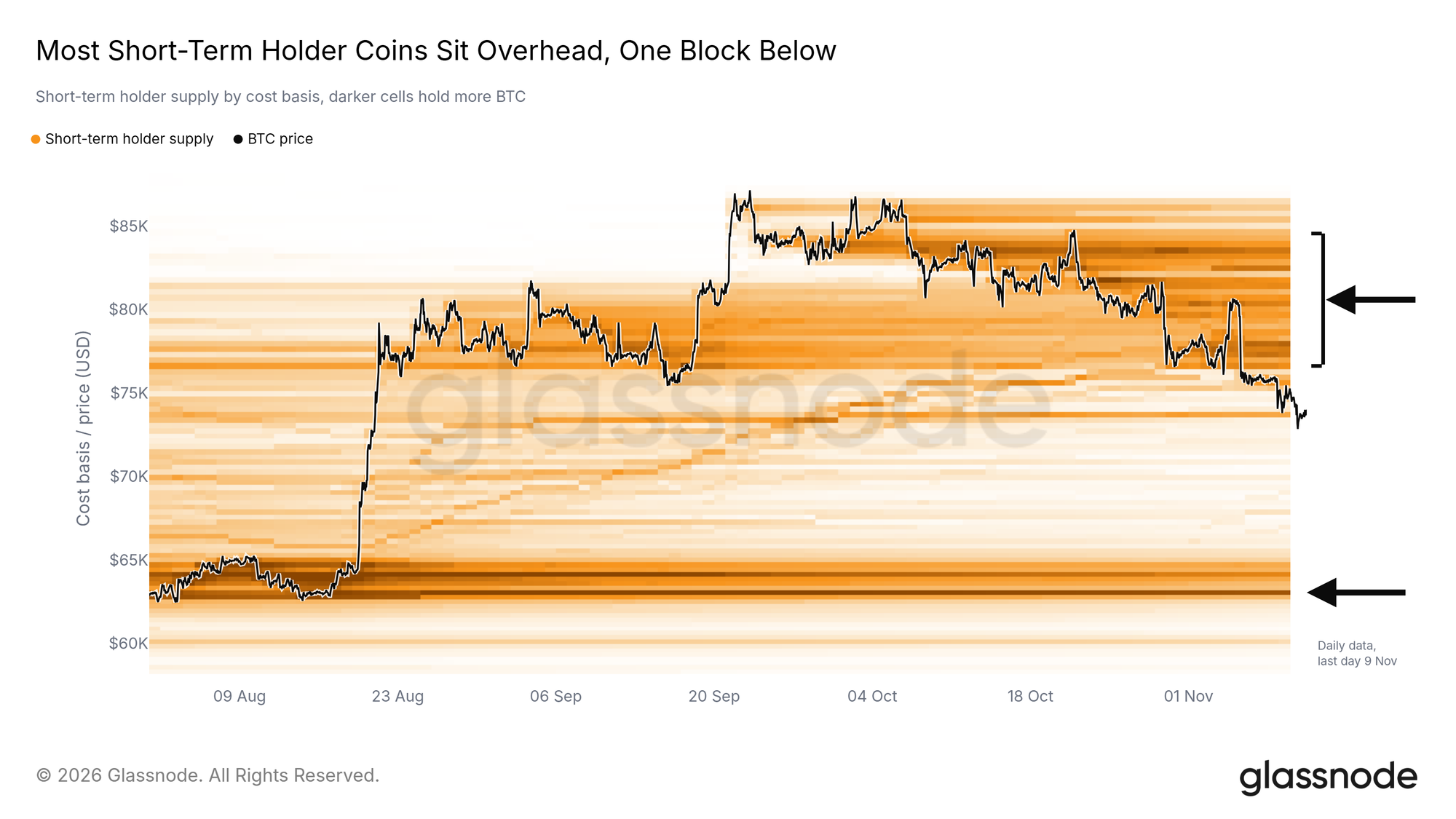
Moreover, Glassnode stated that the largest liquidation point for Bitcoin is near 60,000 USD. These are positions established by bulls before a significant price surge at the beginning of August, which have yet to test their entry points.
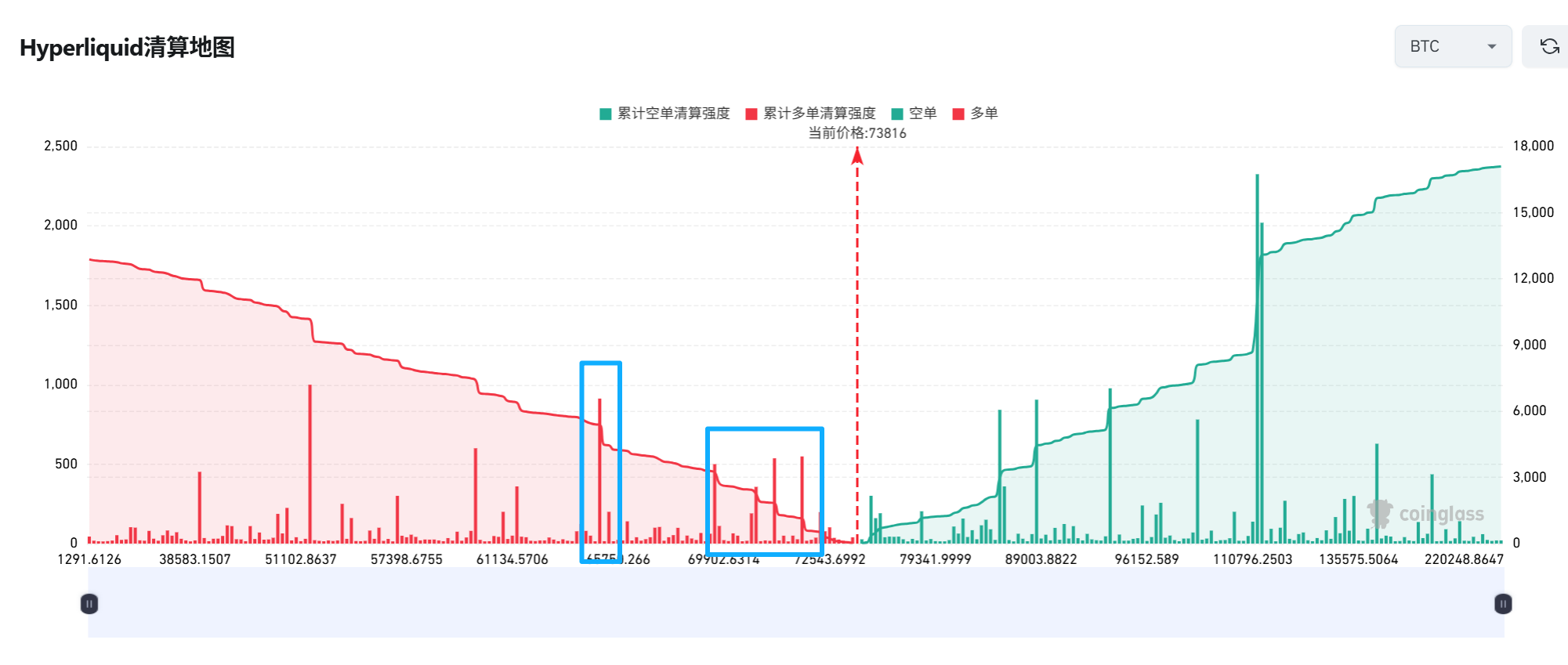
Hyperliquid’s liquidation chart shows that if BTC continues to decline, there are large long positions around the 70,000 and 65,000 USD marks, and if these levels are broken, it will lead to high liquidation intensity.
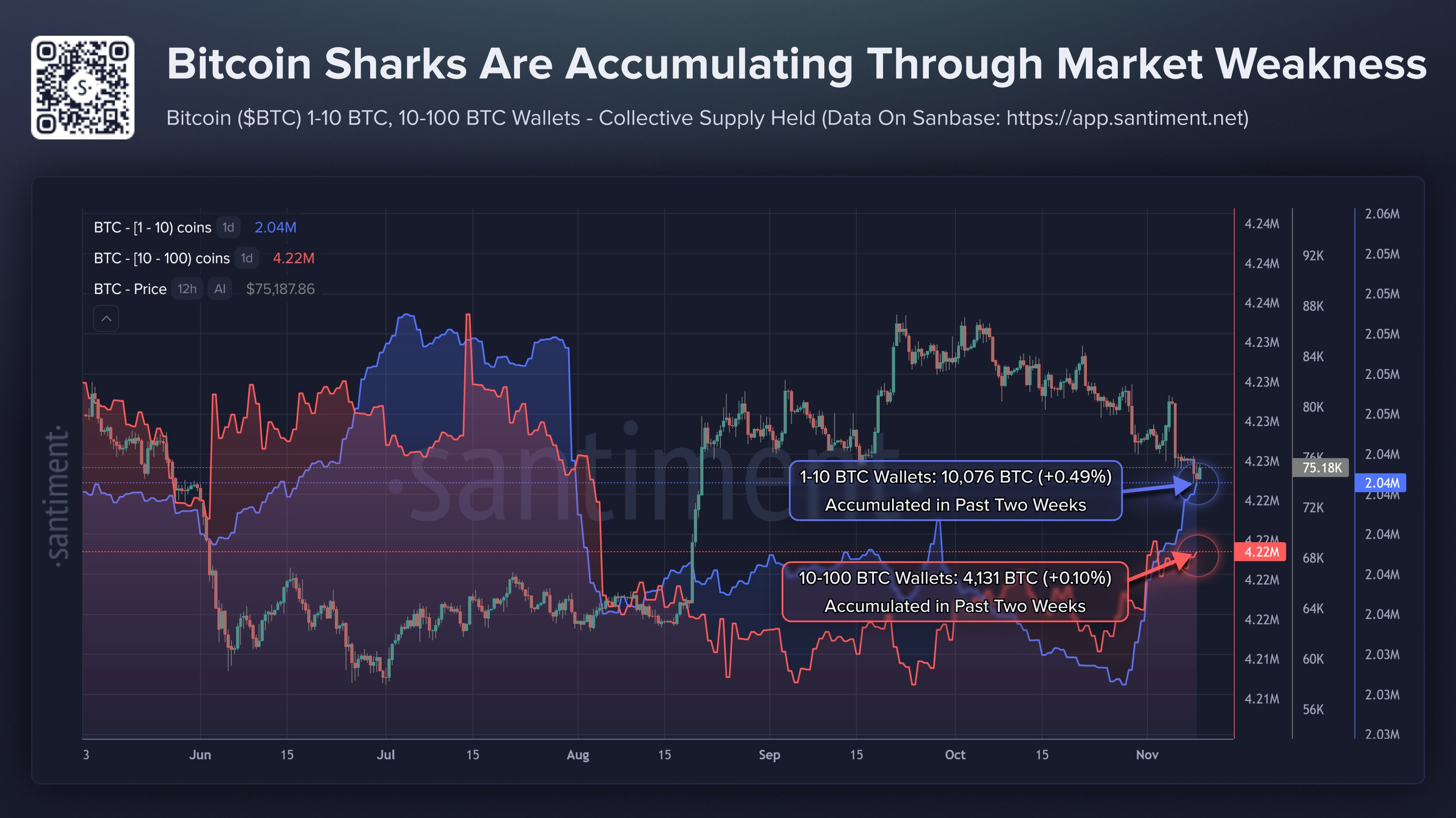
On November 10, Santiment noted that wallets holding 1 to 10 BTC increased holdings by 10,076 BTC in the past two weeks, while wallets holding 10 to 100 BTC added 4,131 BTC, totaling over 14,000 BTC, during which Bitcoin's price dropped to 75,000 USD. “These wallets tend to be more patient than retail investors, often accumulating during periods of market panic and reducing holdings after increases. If the price stabilizes at 75,000 USD and holdings continue to rise, it will strengthen signals of forming a local bottom. However, if it breaks below recent lows and these wallets begin to sell, the signal weakens.
On November 11, Santiment continued to report that, according to its statistics from social platforms like X, Reddit, and Telegram, the ratio of bullish to bearish comments for BTC, ETH, and XRP is 0.82:1, 0.88:1, and 0.49:1, respectively. Santiment believes that the clearly bearish sentiment among retail investors may create conditions for a market rebound. If bearish comments continue to outnumber bullish comments, especially among larger capitalization crypto assets, a rebound in the market may occur.
Wintermute commented on November 10 that after the U.S. midterm elections where the Democrats regained control of both chambers of Congress, the market has begun to reassess the regulatory risks facing the AI industry, where previously favored AI trades due to Washington policies have cooled. If the Fed raises rates amid the correction in AI assets, the tightening of liquidity and decline in risk appetite may simultaneously put pressure on the crypto market. The U.S. spot Bitcoin ETF saw a net outflow of 1.28 billion USD last week, marking the largest weekly outflow since June, erasing the cumulative net inflows for the year; only recorded net inflows on Wednesday throughout the week. Meanwhile, over 1 billion USD in positions have been liquidated across the market, with Ethereum's liquidation volume exceeding that of Bitcoin.
Looking ahead, the market needs to remain cautious until Bitcoin reclaims the 50-week moving average. If Bitcoin closes daily below 73,000 USD and the 200-day moving average, the next focus will be 68,000 USD, and previously rebounding altcoins may face greater selling pressure. Only if Bitcoin reestablishes and stabilizes above 80,000 USD and the spot Bitcoin ETF resumes net inflows on a weekly basis might a shift towards a more positive outlook occur.
免责声明:本文章仅代表作者个人观点,不代表本平台的立场和观点。本文章仅供信息分享,不构成对任何人的任何投资建议。用户与作者之间的任何争议,与本平台无关。如网页中刊载的文章或图片涉及侵权,请提供相关的权利证明和身份证明发送邮件到[email protected],本平台相关工作人员将会进行核查。


