95% of Pump.fun's revenue explains why meme coins find it hard to generate significant market movements.
Written by: Sparsity
Translated by: Saoirse, Foresight News
"The trading environment on the blockchain is not friendly to participants." "All KOLs are taking the opportunity to profit." "Yet we are still promoting packaged traders."
These issues are widely criticized, but seeking the crux only from the end of the trading chain is akin to neglecting the fundamentals. The consensus among holders within the meme coin trading circle has collapsed: no one is willing to hold positions long-term. Participants are turning to arbitrage, massive token launches, block packaging, and incentivized calls—because these paths are profitable. The root of the problem lies at a higher level, namely the platforms that control this trading ecosystem. As the largest meme coin issuance platform, Pump.fun's incentive mechanism precisely fosters these behaviors criticized by many, ultimately shaping the meme coin market into one where supply expands infinitely and demand continues to dwindle.
Currently, public opinion is calling for KOLs to take responsibility for their advocacy, which is not unwarranted. However, if Pump.fun, which issues incentives, is not held accountable while merely restraining the callers, it will only address the symptoms and not the root cause.
Pump.fun's revenue from tokens headed to zero
In the past thirty days, Pump.fun has captured 92% of the issuance volume and 84% of the trading volume of meme coin issuance platforms across the chain. It is this platform that decides which behaviors can be profitable in this trading ecosystem.
95% of the platform's revenue comes from trades involving tokens still in the binding curve phase or with market capitalizations below $250,000. In the binding curve trading zone, each transaction incurs a 1.25% fee: 0.95% goes to Pump.fun, and 0.30% goes to the token creators. In other words, regardless of price fluctuations, a complete round trip of a buy and sell results in transaction costs of up to 2.5%.
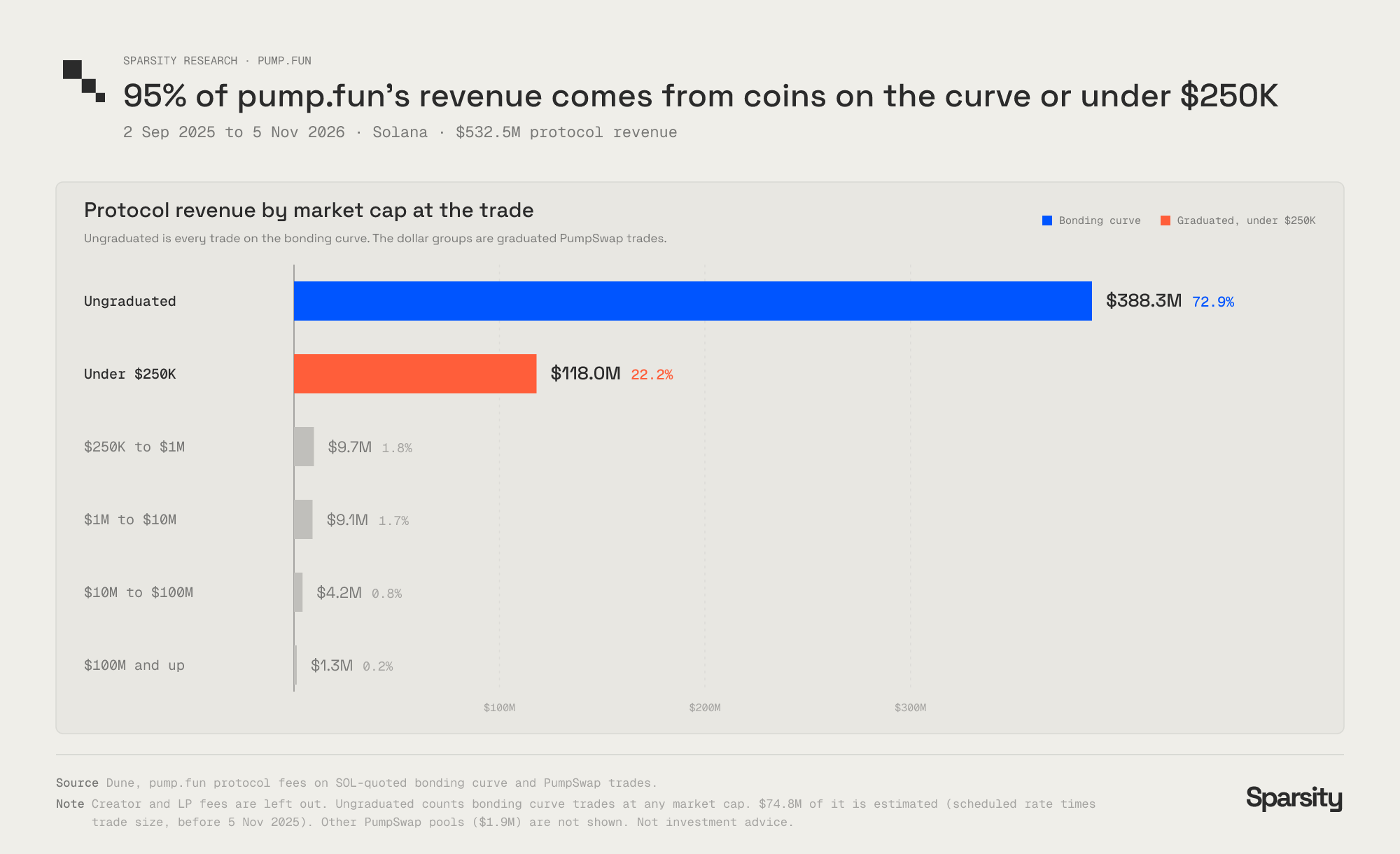
From September 2, 2025 to November 5, 2026, 95% of Pump.fun's protocol revenue came from tokens within the binding curve or with a market value under $250,000.
The platform's earnings are concentrated in the early stages when token market values rise to hundreds of thousands of dollars, while the subsequent price movements have little impact on the platform's revenue.
Analyzing the longevity of tokens, the conclusion is equally clear: three-quarters of the platform's revenue derives from tokens that have been online for less than one hour, and 87% of revenue comes from tokens that have been online for less than a day. Pump.fun's revenues are highly concentrated in the first hour after a token's launch.
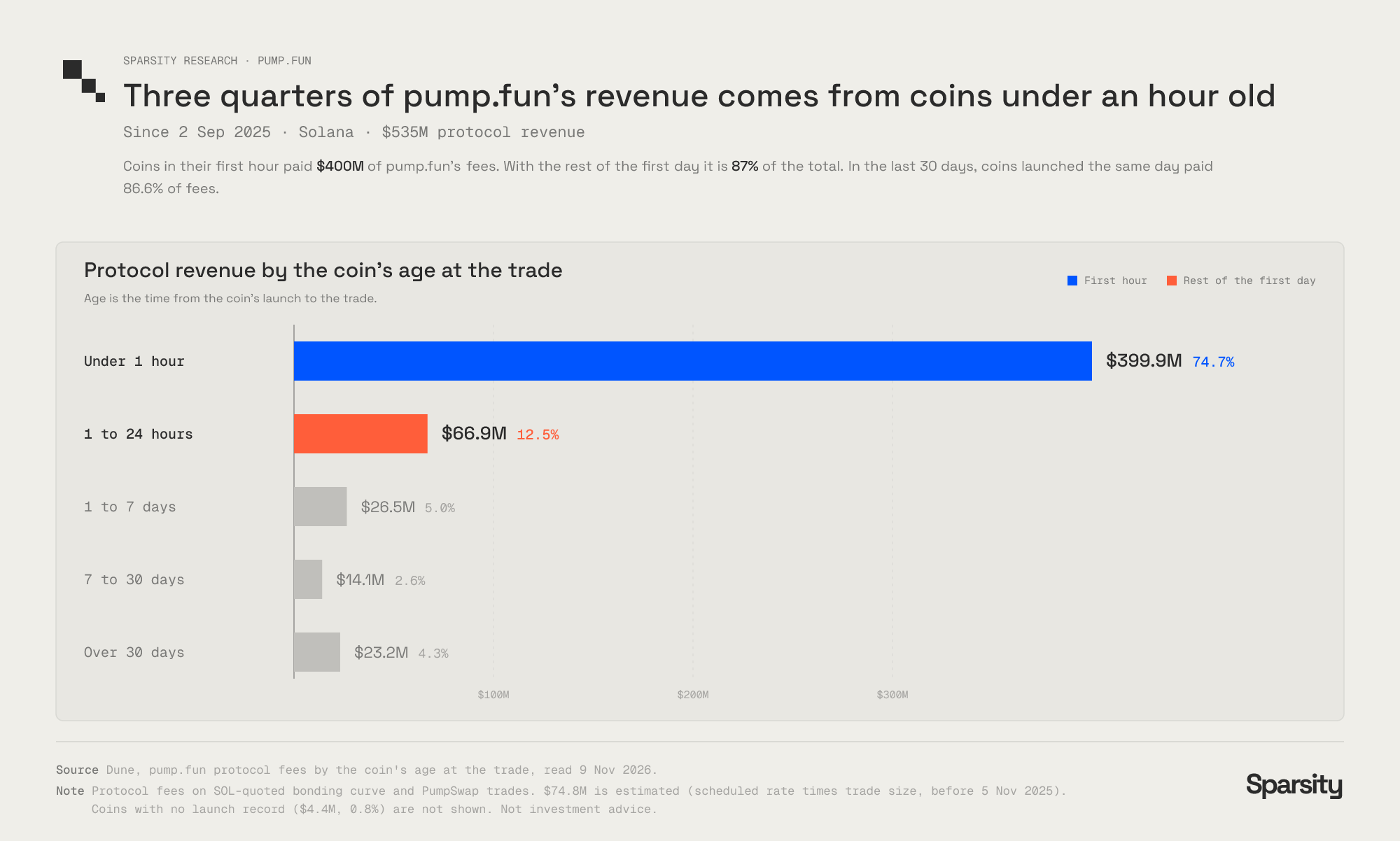
Since September 2, 2025, nearly 75% of Pump.fun's revenue came from tokens listed for less than an hour, with the first day contributing 87% of total revenue.
Those tokens that eventually grow to become top choices contribute almost negligible fees to the platform: fifteen top tokens with a combined peak market value of $1.4 billion generated approximately $1.5 million in fees for Pump.fun; meanwhile, smaller market cap tokens, either within the binding curve or valued under $250,000, contributed a collective $506 million. In simple terms, a thousand tokens that drop to zero at a $20,000 market cap yield more revenue for the platform than a single popular token that rises to a $100 million valuation.
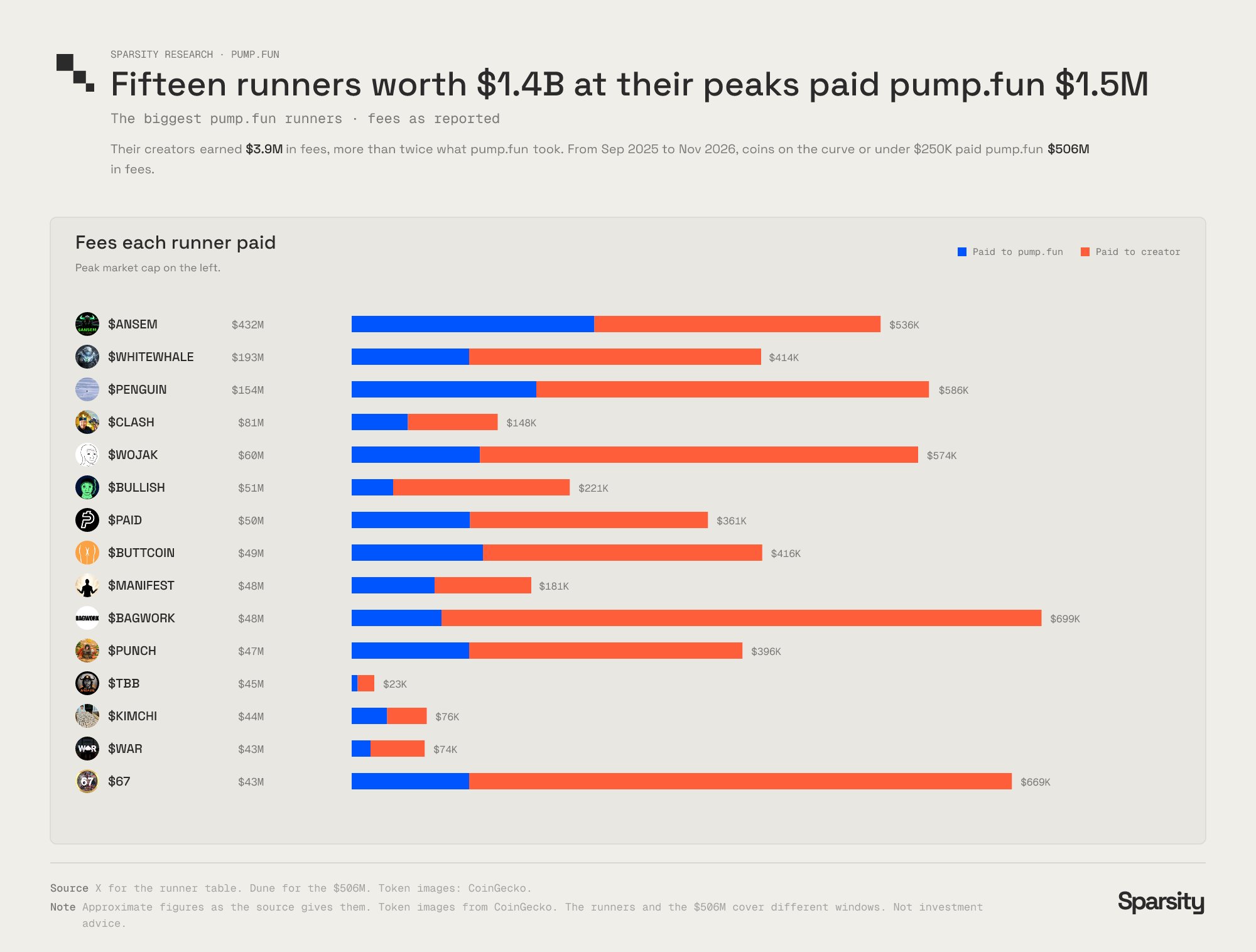
The fifteen top tokens with a combined market value of $1.4 billion contributed only $1.5 million to Pump.fun, far less than the $506 million from small-cap tokens.
The fees contributed by these fifteen premier tokens account for less than 0.33% of the total contribution from small-cap tokens.
Therefore, the design of the platform's product mechanism aims to continuously accept more new tokens for listing. All incentive rules on the platform guide the market to pursue token quantity—the scale of trading volume is the foundation of platform revenue.
The underlying logic of four types of incentive behaviors
Every class of chaotic phenomenon criticized by the community has a corresponding revenue logic within the platform's mechanism: packaged launches, batch issuing workshops, call incentives, and player confrontation modes all generate trading fees, from which Pump.fun takes a cut for every transaction.
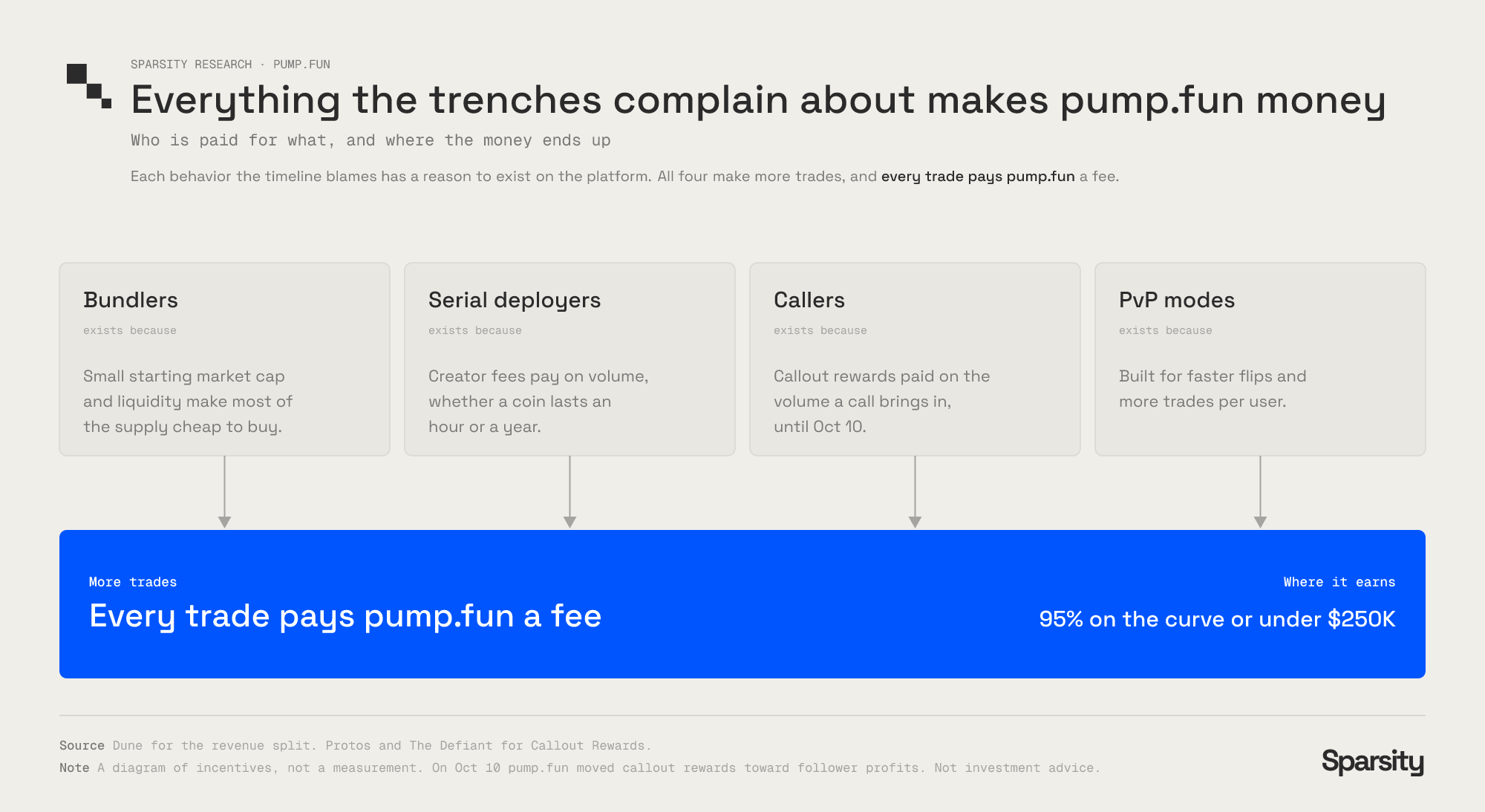
Market chaos such as packaged launches, batch issuances, shout-outs, and PvP confrontations increases transaction frequency, allowing Pump.fun to earn fees from each transaction.
Bundlers: Achieving listing profits through extremely low initial market value and liquidity
Bundlers thrive because the standards for the initial market value and liquidity of tokens are set too low. Traders can invest a small amount of SOL, distributing it across dozens of wallets to accumulate a significant volume during the block's launch, then quickly dump their holdings to ordinary traders. The lower the initial market value, the lower the cost of this operation, and this initial parameter is set by Pump.fun.
Batch issuers: Issuing multiple new tokens, with creator fees calculated based on transaction volume
Developers who issue tokens in batches are numerous because creator fees reward issuance behavior rather than the long-term operation of tokens. Whether a token lasts for only an hour or circulates long-term, creators can withdraw 0.30% from every transaction. Hence, the rational strategy is to issue as many tokens as possible, harvest early trading volume, and quickly shift to the next target. The top twenty-five issuing addresses collectively issued 761,000 tokens, but less than 1% of these succeeded in "graduating," while the addresses collectively earned $128 million.
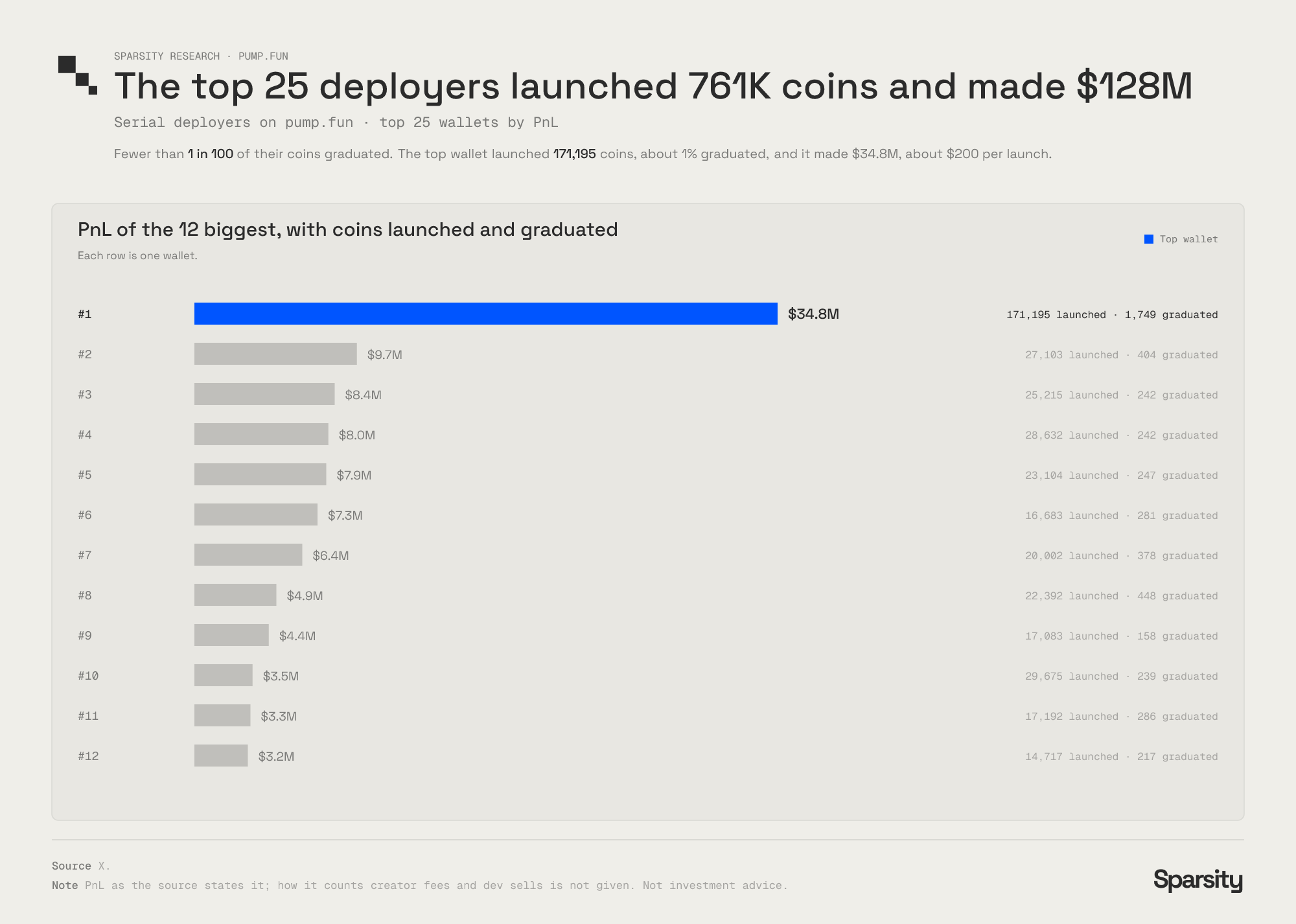
The top 25 issuing addresses on Pump.fun issued a total of 761,000 tokens and earned $128 million, with a graduation rate of less than 1%.
The top address alone issued 171,195 tokens, with an average profit of about $200 per token.
Of course, these batch issuing workshops occasionally produce popular tokens: two wallets have issued tokens that reached peak market values of $122 million and $327 million, respectively. However, for the issuers, creating a hit is just an incidental result; their core source of profit remains the early trading volume itself.
Call KOLs: Preference for small-cap tokens, incentives calculated based on trading volume
The shout-out incentive mechanism has opened up a new monetization channel for promotional marketing, turning shout-out behaviors into profit pathways. Since August, the platform has distributed $29.6 million in shout-out rewards to 51,115 wallets, with distribution highly uneven: ten wallets share 16% of all rewards, while the median bonus for average recipients is only $13. The top ten wallets earned an average of about $485,000.
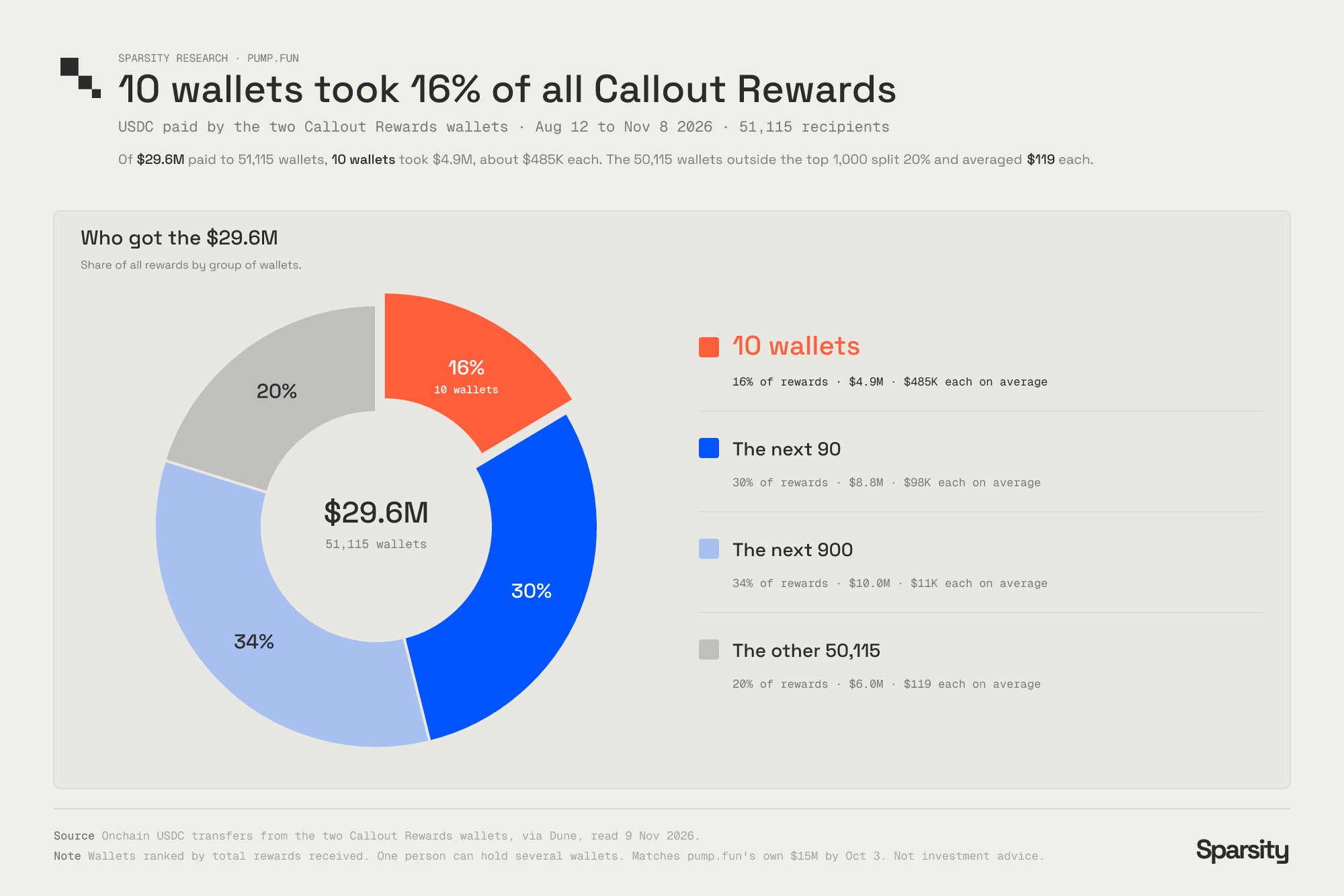
From August 12 to November 8, 2026, Pump.fun's shout-out reward distribution was highly concentrated, with only ten wallets sharing 16% of the total $29.6 million reward.
The incentive amount is calculated based on the trading volume generated by the shout-out, and since small-cap tokens have thin markets, they are most easily driven in price by trading. In August, among the top fifty earners for shout-outs, forty advocated tokens with an average market value of less than $100,000; twelve of them promoted tokens with an average market value of even less than $10,000.
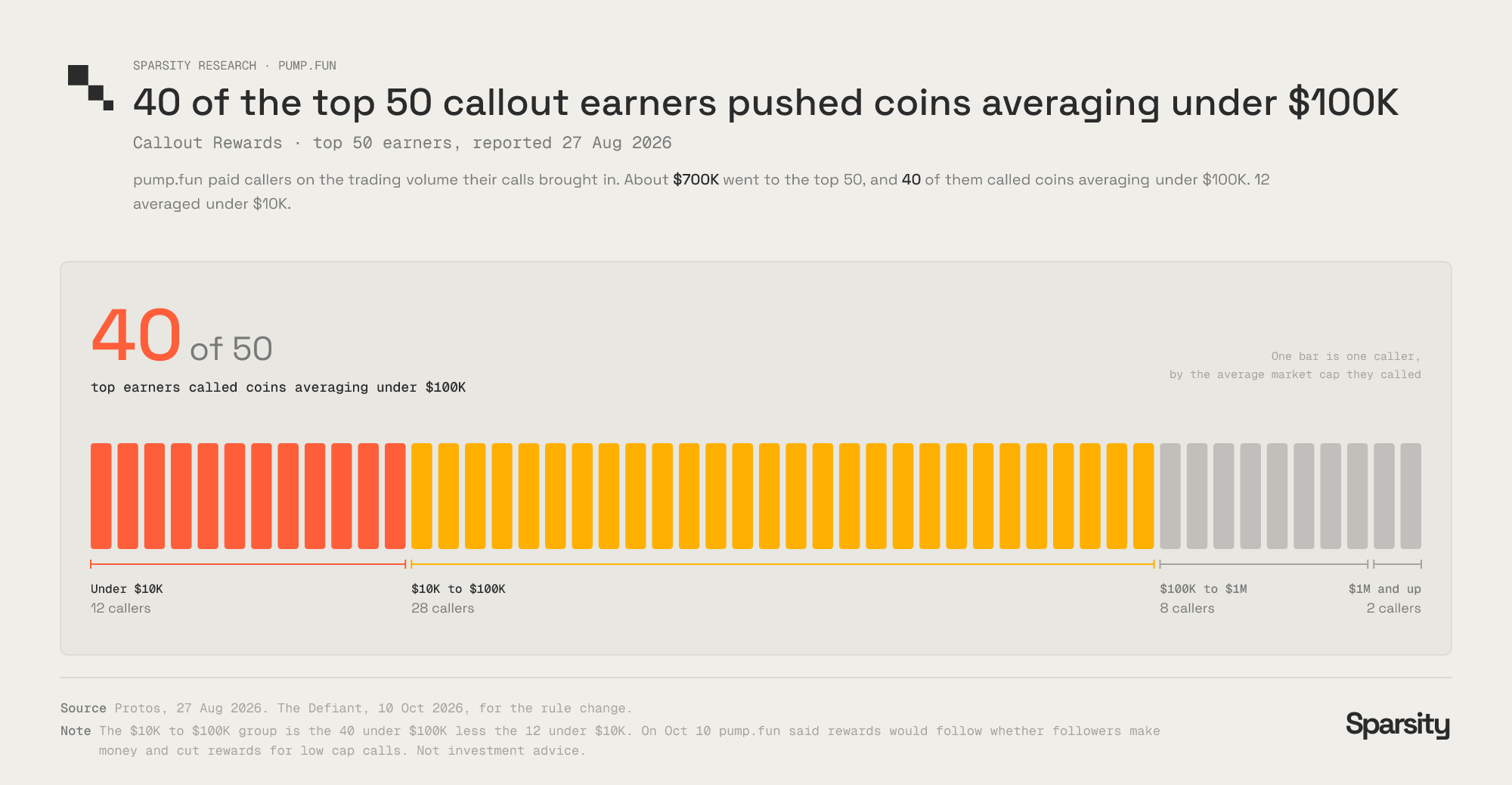
Among the top 50 earners on Pump.fun, 40 promoted tokens with an average market value of less than $100,000.
Pump.fun has already received the criticism from the market. The platform announced on October 10 that subsequent incentives will be tied to follower profits and will reduce the reward weight for shout-outs of small-cap tokens. However, in the three weeks following the adjustment of the rules, the proportion of rewards directed at tokens with median market values below $100,000 among the top twenty earners rose from 68% to 94%, while the total amount of bonuses distributed weekly actually increased by 53%.
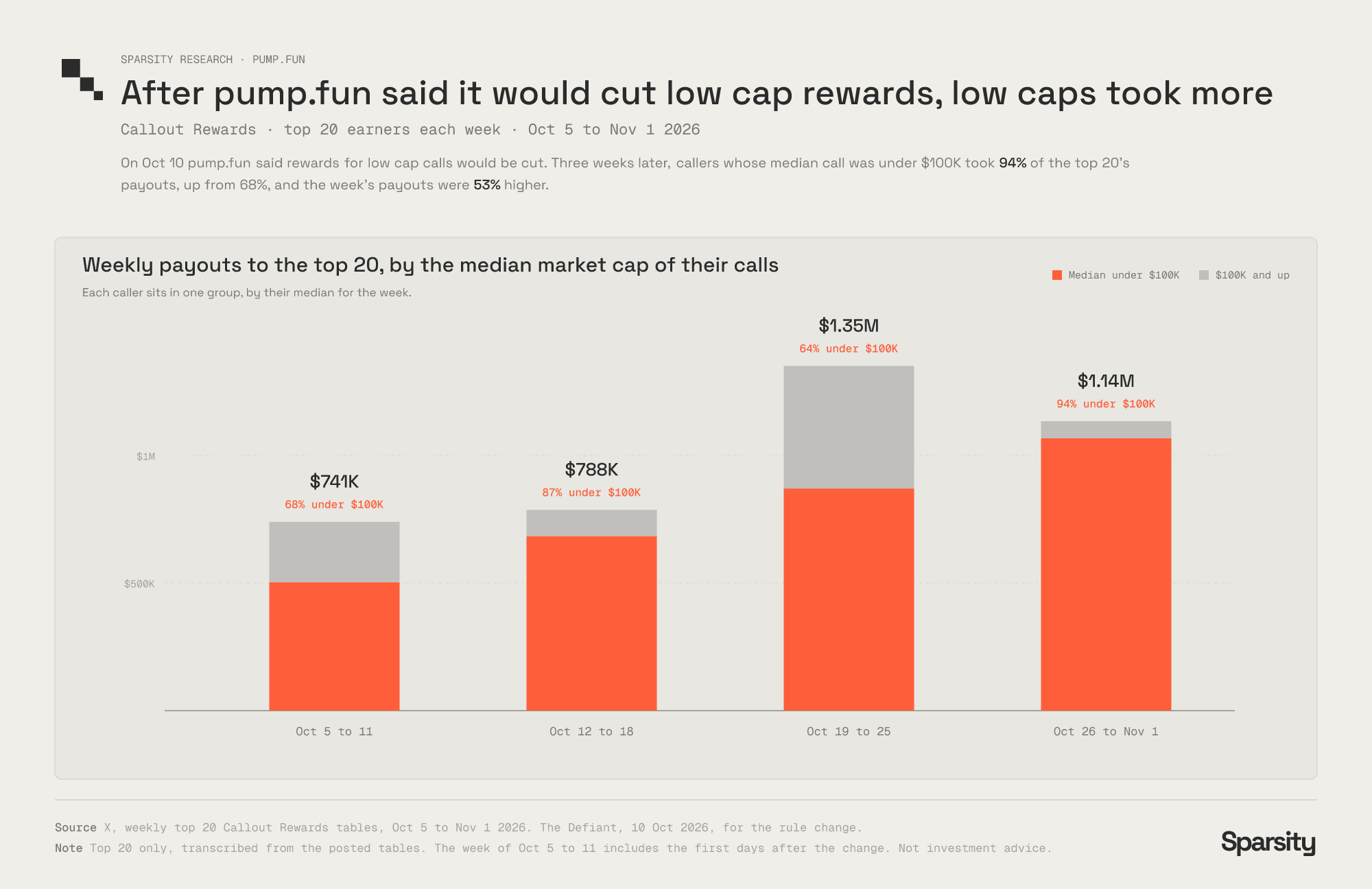
After Pump.fun announced the reduction of shout-out rewards for low-market tokens, the proportion of rewards for low-market tokens actually rose to 94%.
As the bonus scale expands, the proportion of rewards corresponding to small-cap token shout-outs also rises.
Ultimately, the ones bearing the losses are the traders following the shout-outs. The research team tracked fourteen shout-outers: ten promoted tokens with median market values below $100,000, and their followers together lost $926,000 the day after the shout-outs were published. The token being called out saw its median price rise by 6% one minute after the announcement, then drop 48% after one hour, and after one day the drop reached 74%. Regardless of the price fluctuations, the shout-outers can still reap rewards.
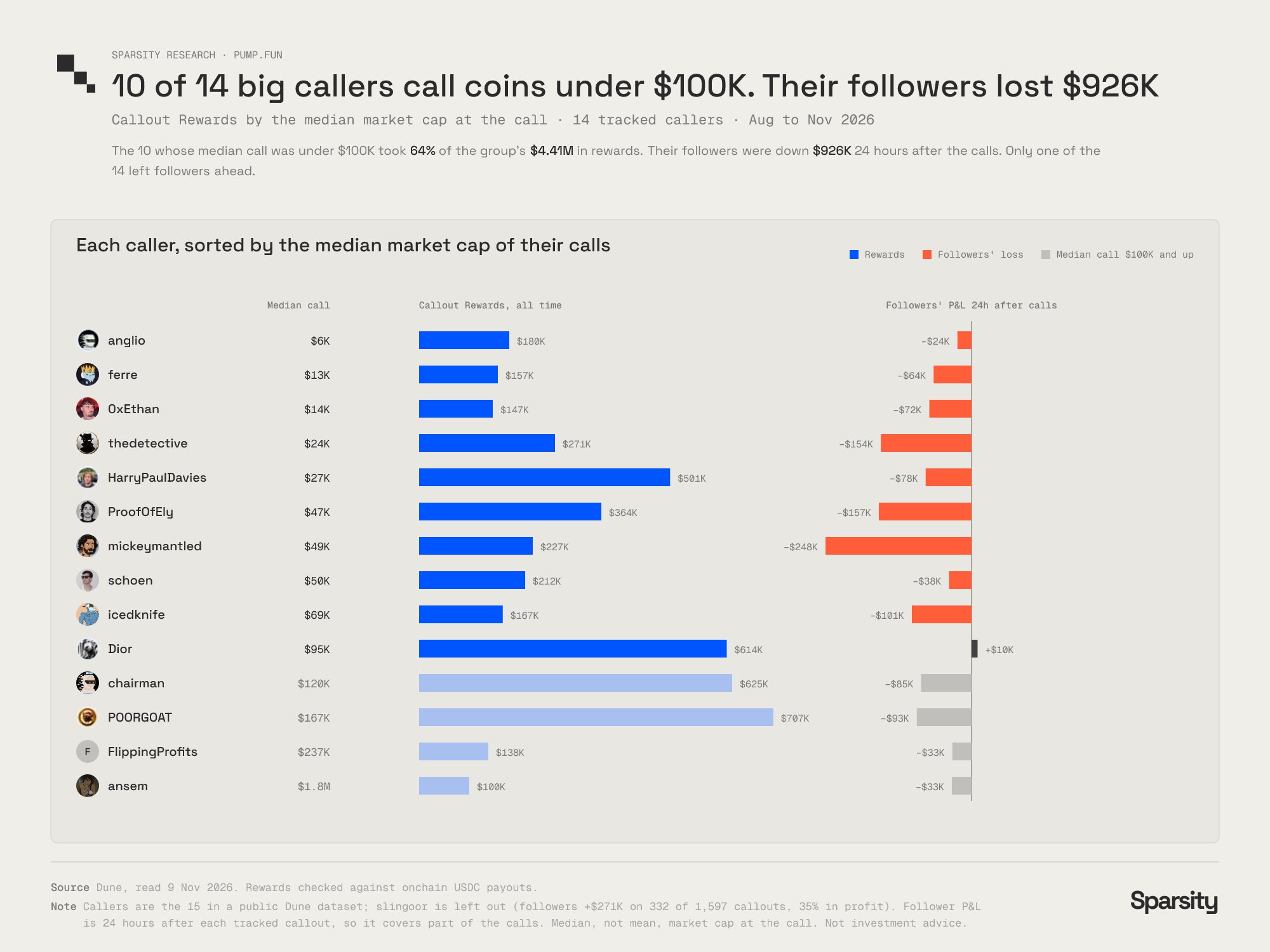
Among the 14 top shout-outers, 10 primarily targeted tokens with market values under $100,000, leading to a total loss for their followers of $926,000.
Of the fourteen, only one shout-outer managed to render a small profit of $10,000 for followers. All promoted tokens saw lower median prices the day after the shout-out.
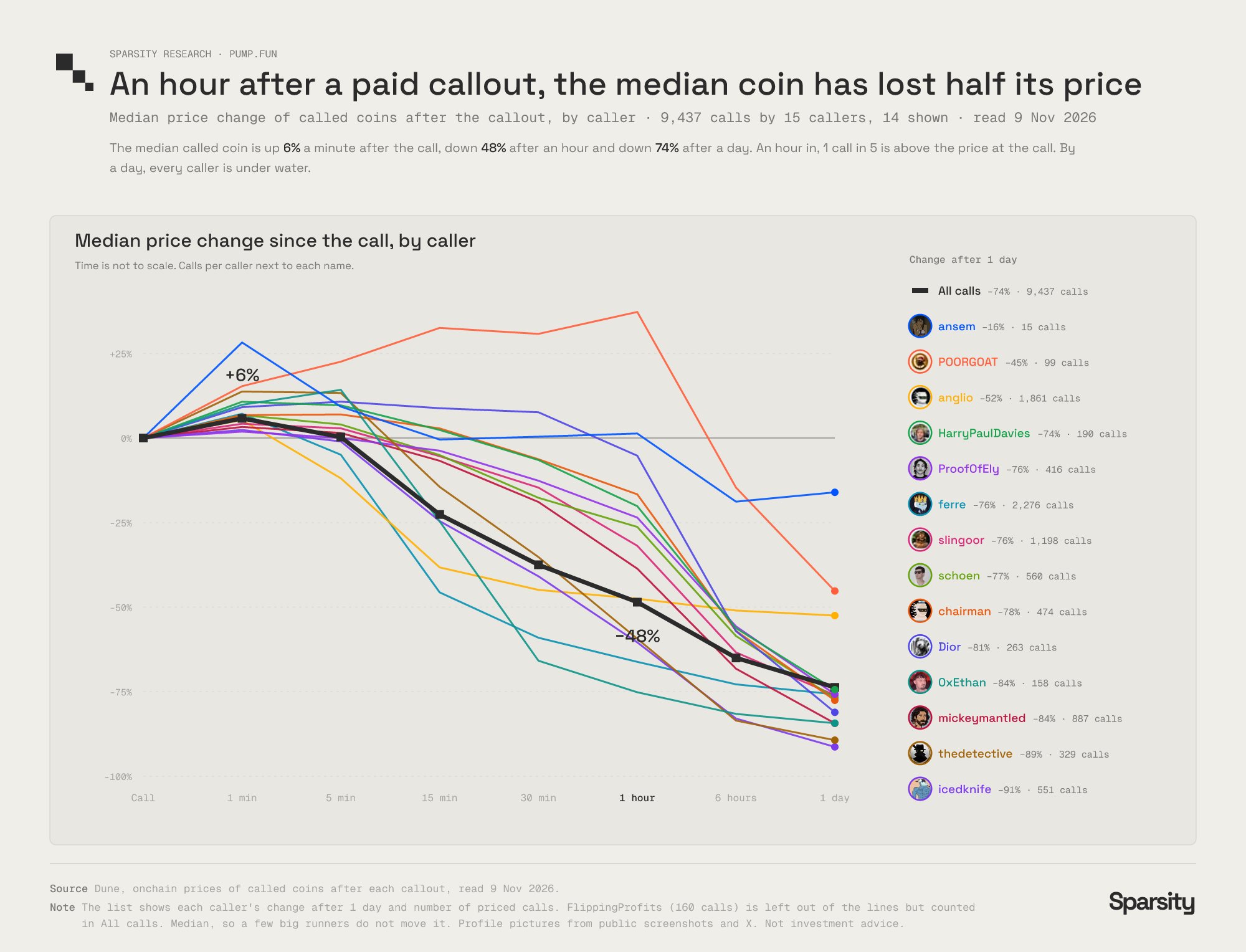
Tokens lost 48% of their median price one hour after the paid shout-out, with a drop of 74% after one day.
The public's confusion about why KOLs continue to recommend tokens that cause losses for followers has much to do with this: the platform's incentive design inherently encourages such behaviors.
PvP player confrontation mode: Aimed at increasing individual user transaction frequency
The underlying logic of the player confrontation mode is that the market lacks new capital, allowing seasoned traders to extract profits from novices. The original intention behind designing this mode is to promote faster transactions and increase the trading frequency of individual users, as each transaction generates fees. Pump.fun itself has already taken down one of its models—Tokenized Agent—as of June 30, citing excessive token launch channels that fostered a "malignant player confrontation ecology."
Unlimited supply expansion and shrinking demand
This incentive mechanism, when running for the long term, will segment the market into two ends: the demand side: participating in speculation on small dog tokens, with long-term statistics showing most incur losses, and only a few wallets gain substantial profits; the supply side: issuing tokens, almost without risk, to earn profits.
Becoming a supply side has almost no barriers; tokens can be issued with one click. Arbitrage methods are already mature: quickly leveraging the hype of popular tokens, fabricating false trading volumes to create an illusion of activity, and bulk purchasing old wallets for issuance, with this playbook iterating and optimizing every month.
Thus, more and more participants who originally leaned towards holding tokens are transitioning to become issuers. Issuing tokens is profitable, while holding positions tends to incur losses; every new participant who sees this will become a new issuer, collectively sharing from an already shrinking pool of buyers’ funds. This is the root of the collapse of the holding consensus: not that traders subjectively refuse to hold positions, but the platform rules make long-term token holding a disadvantageous choice.
This trend is reflected intuitively in the performance of new token quality: the total issuance volume of Pump.fun is currently approximately at the same level as at the peak of the market in late 2024. In the fourth quarter of 2024, there were 3.16 million token issuances, resulting in 207 tokens with market values exceeding $10 million; however, in the third quarter of 2026, there were 3.05 million issuances, producing only 24.
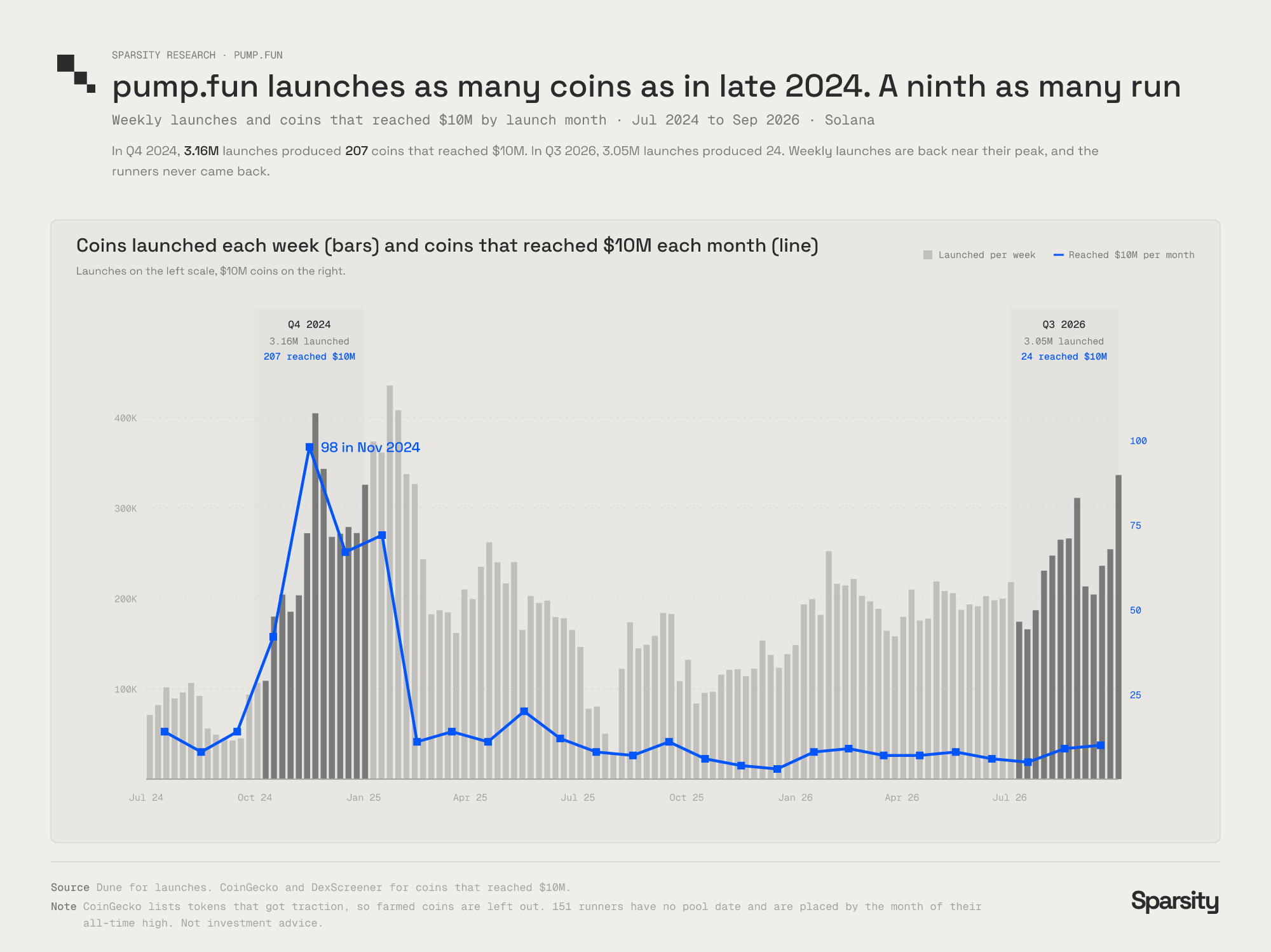
Tokens lost 48% of their median price one hour after the paid shout-out, and after one day they dropped 74%.
New tokens are now being issued at over 300,000 weekly. The probability of a popular token being spawned from every 100,000 issuances has dropped from 6.5 to 0.8.
Some opinions indicate that the transaction volume within the binding curve has continued to rise since June, which is true. However, the combined trading volume of the binding curve and PumpSwap has shrunk from $25–30 billion per month in Q1 2026 to $13.8 billion in October. The platform profits through transaction volume; while traders who buy tokens derive profits from the tokens becoming hits—currently, the output scale of hits is merely one-ninth of what it used to be.
The survival data of tokens further corroborate this conclusion: Among 24.4 million cumulative issuance records on Pump.fun, only 312 tokens maintained a market value above $100,000 by the time of statistical review, about one token survives for every 78,000 issued, resulting in a survival rate of only 0.0013%.
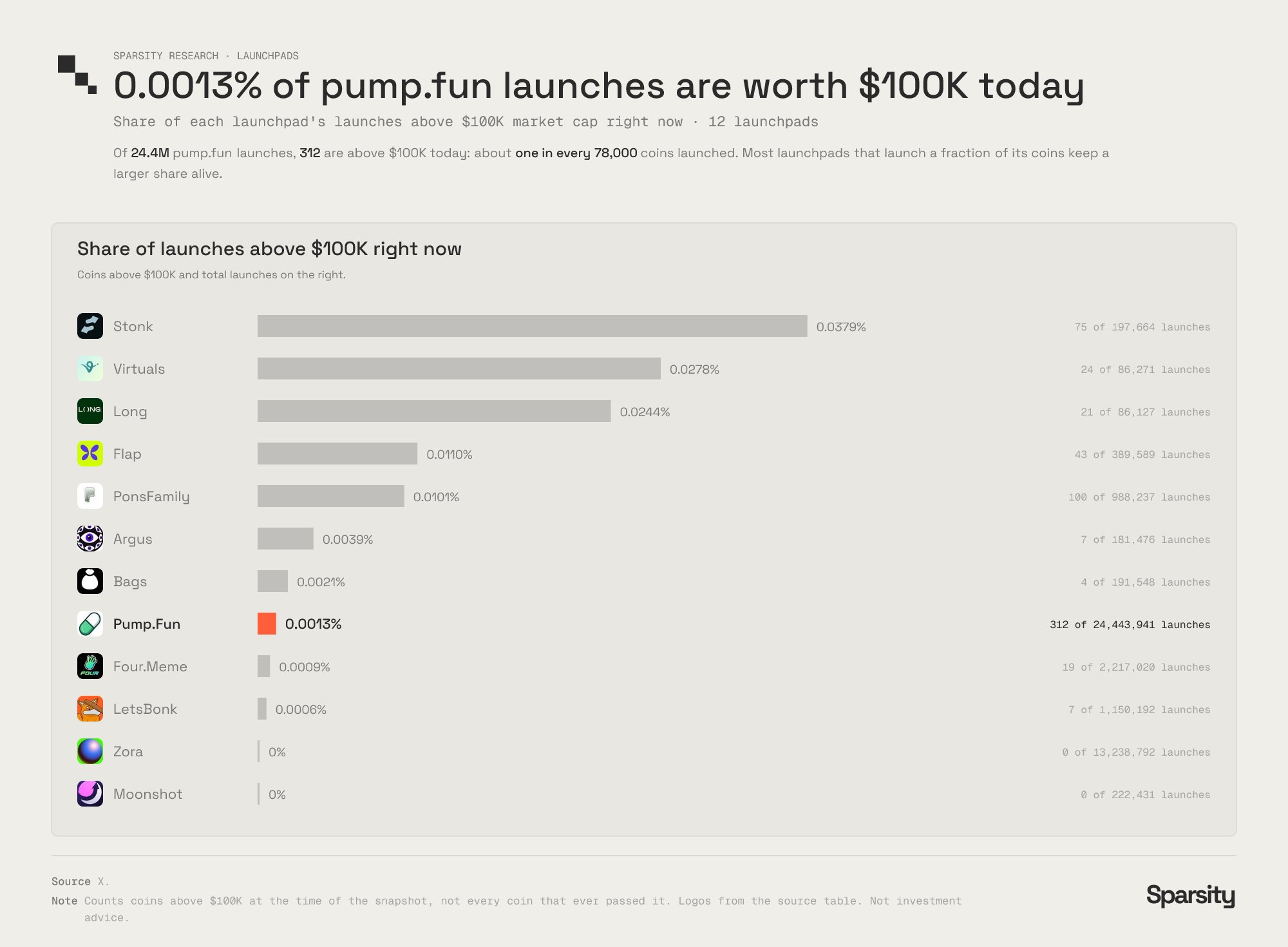
Of the tokens issued by Pump.fun, only 0.0013% currently hold a market value exceeding $100,000, translating to only one surviving token for every seventy-eight thousand.
Pump.fun's token survival rate is lower than that of most similar platforms with issuance scales far smaller than its own.
This is the first market we observe where supply is rapidly expanding while demand continuously diminishes. Without the platform’s incentive mechanisms nurturing this system, it could hardly have developed to its current scale.
Market participants also promote the cycle
This system was constructed by Pump.fun, but the trading volume that maintains its operation comes from the traders themselves. The arbitrage behaviors mentioned can generate profits only if there are counterparties completing transactions, and often this counterparty is us.
We condemn the chaos while simultaneously driving traffic with our own behaviors: We criticize bundlers but then turn to focus on and follow their next launches; some profit by arbitraging on popular tokens, and within the community, posts praise their clever operations; certain KOLs shout out twenty different tokens daily, with audiences paying attention solely to the speed of news rather than the potential profitability for their followers. Of the fourteen tracked shout-outers, only one endows their followers with profits, while the others collectively suffer losses of $926,000 in a single day.
We bear a double cost for this: first, the trading volume we contributed, from which Pump.fun and creators extract fees; second, our attention, as each round of hype and every shout-out essentially competes for this attention.
Long-term holding is no longer a feasible strategy
A year ago, the mainstream thought was to discover potential tokens early and endure volatility for long-term holding. However, currently, the price median of shout-out tokens drops 74% the day after. The traders that can remain are those who sell off first. For individuals, early selling is a rational decision, but when everyone acts this way, it cuts off the potential for tokens to experience prolonged periods of price increases. If no one is willing to hold tokens longer than the first hour after launch, then the tokens will never grow to a million-dollar market cap, and it is precisely this first-hour window that contributes to three-quarters of Pump.fun's revenue.
Changes traders can make
We do not have to wait for Pump.fun's permission to make adjustments. Hold onto the tokens you truly believe in, rather than frequently flipping them at the first sign of market fluctuations; the yardstick for evaluating shout-out KOLs should be whether their followers can profit, not how frequently they post; stop spreading the notion that arbitrage and packaged launches are clever trading strategies; direct trading volume toward other issuance platforms—those that incentivize long-term token survival rather than promote high-frequency trading.
None of the above actions can directly rectify the underlying incentives, but every transaction that no longer flows into this harvesting system will reduce the platform's fee income.
Reconstruction direction for the incentive mechanism
We are not contract engineers; the following are merely reform ideas, not directly implementable engineering solutions. The core of all concepts is to shift the revenue distribution point from the first hour after token launch to a later time:
Increase the initial market value of tokens, paired with deeper initial liquidity; increase liquidity with compounding growth relative to trading volume, continuously expanding the capital pool;
Fees should not only be allocated to creators, but also to token holders and liquidity providers; set unlock mechanisms for creator fees that tie the release rhythm to token lifespan;
Shout-out incentives should not be calculated based on trading volume but should favor holding behavior: whether KOLs can receive bonuses will depend on whether their followers continue to hold and are in profit days later, rather than on the transaction volumes resulting from the shout-outs.
Such adjustments may maintain the vitality of the meme coin trading ecosystem, and Pump.fun itself has the financial conditions for trial and error: it holds approximately $2.84 billion worth of assets on-chain, controlling the entire issuance chain. A market capable of continually fostering prolonged popular meme coins will inevitably generate more long-term revenue for the platform than the current model that incessantly depletes buyer funds. The platform's choice of short-term harvesting is simply because the current model yields higher profits, yet this model is unsustainable.
Even if the above plans are implemented, they may still be insufficient. Such reforms will raise the costs for the supply side (issuers, arbitrage bundlers), but cannot change one reality: the tool advantages held by the supply side will always be challenging for demand sides to catch up.
Concept for issuing models detached from binding curves
All the previous proposals are still based on the context of binding curves. A further innovative thought is to completely abandon the binding curve issuance model:
In this new model, all participants pay the same subscription price. Without binding curves, early entry into blocks no longer has a price advantage, and targeting rapid purchases loses its significance. The issuer sets the minimum and maximum fundraising limits; if the minimum isn't met within a fixed window (24 or 48 hours), the contract automatically refunds in full, ensuring no losses for buyers on failed issuances. Once the fundraising amount hits the upper cap, the contract automatically generates a liquidity pool from which LP tokens are destroyed or permanently locked, and the developers cannot access the funds raised. Each wallet is given a subscription cap, for instance, at a maximum of 1% of the total fundraising amount, to prevent whales or bots from acquiring the majority of tokens.
The platform only collects fees upon successful fundraising; platforms will not earn income from thousands of failed issuances. Cost charging for the issuance platform thus shifts from each transaction to every successful fundraising.
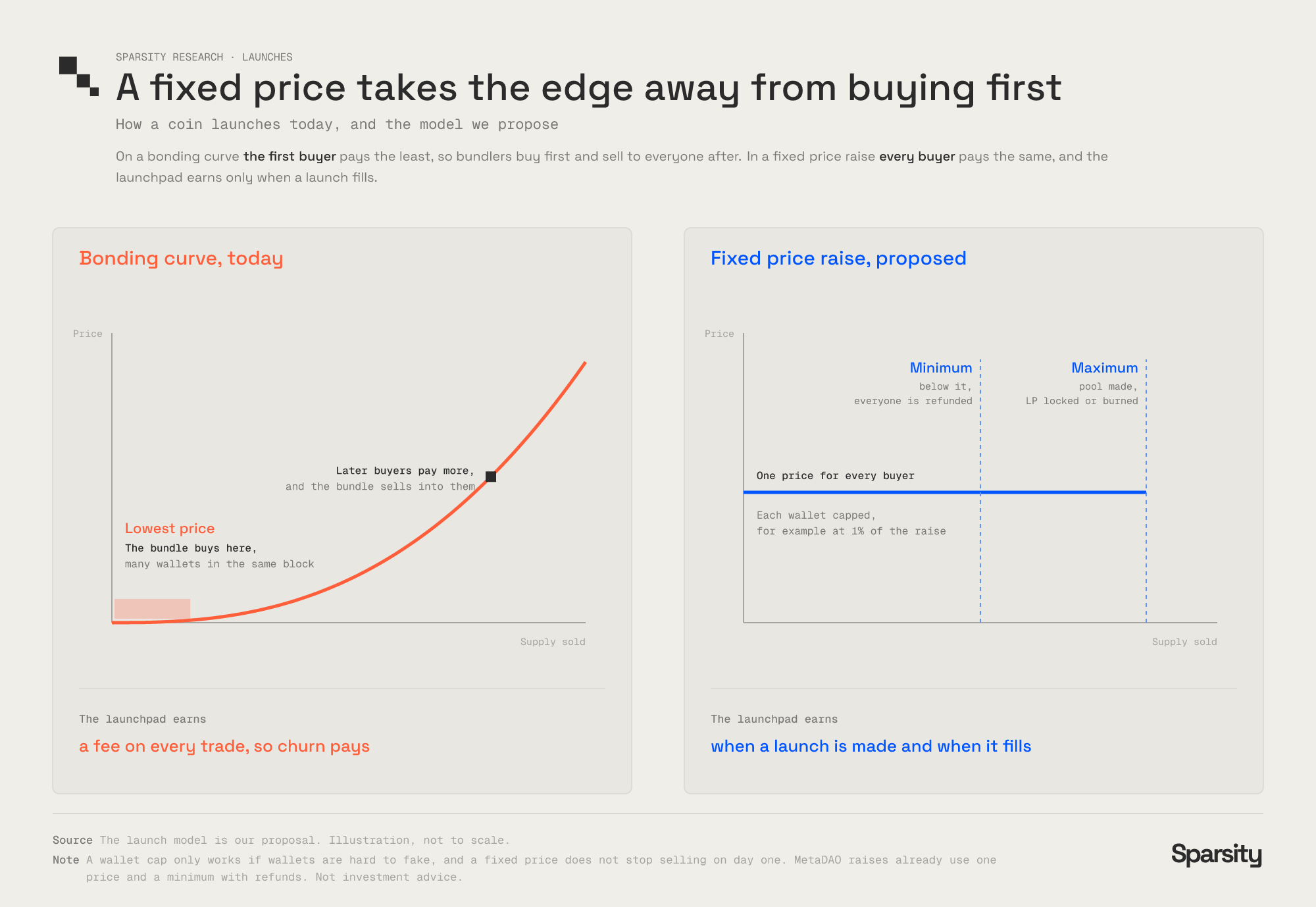
In the current binding curve model, early purchases have the lowest cost and are suitable for arbitrage bots to buy ahead; whereas in the fixed-price fundraising model, all buyers face the same price, eliminating early purchase advantages.
This plan can eliminate issues like targeted rapid purchases, block sniping, and developers absconding with liquidity under the binding curve mechanism, while also removing incentives for "issuing dozens of tokens in bulk, betting on just one to explode."
However, this model still has shortcomings that need to be objectively addressed: the effectiveness of single wallet limits against witch attacks is limited, as the current cost of purchasing bulk old wallets is low, allowing bundlers to still split funds and circumvent restrictions using numerous witch wallets. Setting a unified subscription price cannot prevent significant sell-offs on the first day of the token's launch; it merely achieves fairness in the initial phase.
Future development trajectory
The current narrative surrounding meme coins has reached its end. We believe that unless the underlying issuance model undergoes a complete overhaul (similar to the previously mentioned approach of deriving platform income from successful fundraising rather than profiting from transactions and token failures), meme coins will unlikely restore their former ecosystem.
As long as there are issuance platforms relying on token failures and frequent trading to generate income, this fertile ground for meme coin trading will lose its vitality, and long-term holding will continue to become a disadvantageous strategy. New things will eventually emerge, but they will not take the form of the current meme coins, and it will not be quick to arrive.
免责声明:本文章仅代表作者个人观点,不代表本平台的立场和观点。本文章仅供信息分享,不构成对任何人的任何投资建议。用户与作者之间的任何争议,与本平台无关。如网页中刊载的文章或图片涉及侵权,请提供相关的权利证明和身份证明发送邮件到[email protected],本平台相关工作人员将会进行核查。


