"Seppuku" Clause, Cancer Disclosure and Dismissal: Why Did a Former EF Employee Sue?
Written by: angelilu, Foresight News
The Ethereum Foundation (EF) has a mission statement that has now become the controversial backdrop for an employment lawsuit in the United States federal court.
On November 4, former Ethereum Foundation protocol support team lead Kayleen Fulton (community name Nixo) filed a lawsuit in Colorado against EF-related entities, manager Bastian Aue, and Vitalik along with six others. The case has recently received concentrated media coverage. Nixo is the sole plaintiff, and the 53 employees who participated in the joint letter did not file a collective lawsuit.
The complaint raised two questions for resolution: Why did management dismiss the two organizers of the joint letter ten days after recognizing their commitment to the direction of the EF mission? Did Nixo's disclosure of her cancer diagnosis and potential need for treatment leave affect that decision? She believes both are related, but these allegations are still subject to court review.
Why Did "Seppuku" Appear in the Mission Statement?
The EF board released the EF Mandate on March 13, outlining the foundation’s mission and decision-making principles. The document emphasizes resistance to censorship, open-source, privacy, and security, explaining that the foundation is a participant in Ethereum and cannot represent or dominate the entire network.
A specific section titled "Source Seppuku License" triggered employee dissent. It states that if software authors, maintainers, etc., do not uphold their commitments or modify the license, they should "end their lives with a sword." According to the complaint, before the final version was released, 79 employees voted to remove this section, but it was still retained as part of the illustration in the document.
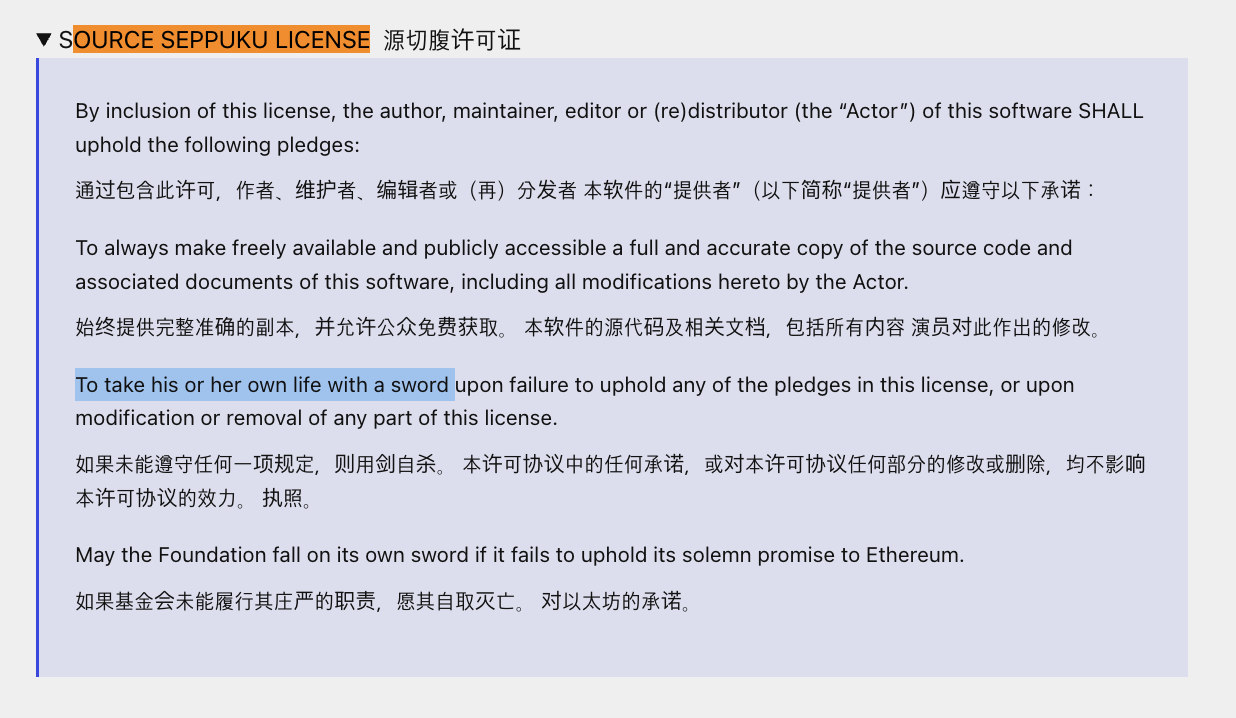
"Seppuku" is the most striking phrase in this controversy, but it cannot solely explain the later dismissals. What truly transformed the document into an employment dispute was the subsequent demands for statements: According to the complaint, Aue asked employees on March 20 to submit a form by a deadline, committing to the direction established by the Mandate; failure to submit would be taken as choosing to leave EF.
Management clarified the meaning of the wording. One employee asked whether filling out the form meant they really had to commit suicide. Aue replied that this wording is an artistic expression in the document, chosen deliberately, but should not be taken literally; the form later specified that employees' commitments were not related to the literal meaning of "seppuku." The focus of employee opposition gradually shifted to why the controversial text was retained and why employees had to express their views within a short timeframe.
After Management Accepted the Joint Letter, Two Organizers Were Still Dismissed
On March 25, the letter organized by Nixo and colleague Trent Van Epps ultimately garnered signatures from 53 members of the agreement department, about half of its staff. The letter expressed support for the overall direction of the Mandate and a willingness to continue working, but stated they could not sincerely commit under the given circumstances; the signatories also declared that they had not resigned.
Two days later, Aue informed employees that he understood the joint signatures as dissatisfaction with the process and form, while acknowledging their separately made commitment to the content of the document. He also stated that if he could do it all over again, he would handle many aspects differently. According to the complaint, all 53 signatories at that time retained their jobs.

The controversial "Source Seppuku License" text is retained in the final document as part of an illustration.
The complaint states that the final version converted the complete clause into a small image with a glitch effect, making it impossible to find the term "seppuku" when searching the PDF text; sentences within speech bubbles could still be searched. The plaintiff emphasized that EF changed the presentation but retained the original text of the clause.
On the morning of April 6, Aue notified Trent and Nixo of their dismissal, with about a 30-minute interval between the two notifications. Nixo stated that Aue acknowledged her past performance in the call but expressed a "loss of confidence" without providing more specific reasons. Based on this, she claims the dismissal of the two joint letter organizers is related to employee dissent. The timeline makes this claim worth questioning, but it is still insufficient to establish retaliation.
Another concurrent timeline involves her medical condition. Nixo stated that she informed management in writing on March 24 that she had cancer; the email clearly stated that she had not yet applied for vacation or accommodations in work arrangements, and she could still fulfill her duties, but her treatment plan might affect her work later. She was dismissed 13 days later. She claims in her complaint that the employer did not properly handle her rights to medical leave and made adverse decisions because of her illness and anticipated treatment needs. The court will still review the relationship between these allegations and the dismissal separately.
What Did Vitalik Say? How Does the Community View This Controversy?
The complaint records that Vitalik participated as a director in the discussions around the Mandate. On March 5, he told employees that the document was still under revision, particularly concerning the parts that caused more concern. After the controversial wording remained in the final version, the complaint quotes him as saying that the foundation could have chosen less offensive expressions, but that was not the mental state they wished to present at the time.
Nearly a month after the dismissal, Nixo spoke with Vitalik on May 1, and the complaint indicates that the latter part of the conversation was recorded. According to the complaint, Vitalik questioned what kind of internal interactions EF should encourage: if employees could "stir up noise" to achieve desired outcomes, others might also adopt such strategies to drive change within the organization. He also stated that in hindsight, management should have given employees weeks, rather than just a few days, to decide whether to confirm the Mandate.
This statement reflects Vitalik's concern about pressure on organizational decision-making, rather than him directly admitting that "Nixo was dismissed due to the joint letter." Nixo perceives it as evidence supporting her claims of retaliation; how much Vitalik knew about and participated in specific personnel decisions remains to be further substantiated. There has been no public response from him concerning this lawsuit in the materials found thus far.
The community also has differing views on this matter. Crypto attorney Gabriel Shapiro expressed in a public post that it is understandable for organizations to ask employees to confirm their commitment to the mission direction, and the term "seppuku" should not be taken as a real suicide demand. Internal discussions among employees cited in the complaint indicate that some individuals' dissatisfaction has long exceeded the literal interpretation: they are more concerned about why dissenting opinions did not alter the final text and whether employees can voice objections without fearing job loss. Shapiro's viewpoint is personal commentary and does not replace EF's defense in court.
Lawyers for EF's Singapore affiliate denied in a May response that Nixo experienced unlawful acts or retaliation and asserted the validity of the termination agreement; this response has now been presented through the plaintiff's complaint.
This lawsuit concerns a dismissal and raises a more enduring question: as an institution operating in the Web3 field for many years, how can EF ensure that employment decisions withstand scrutiny while formulating its mission, requiring employees to express their views, and handling dissent? The principle of decentralization can guide network construction but will not automatically provide employees with clear channels for complaints.
A more reliable approach is to establish procedures before conflicts arise: employees can question decisions without fear of being perceived as resigning; dismissals should have explainable and reviewable justifications; matters concerning illness and leave should have clear handling processes; in multinational employment, employees should be informed about who the employer is and who is responsible for decisions. Whether these arrangements can be effective depends on whether they truly constrain management, rather than just being written in the mission statement.
免责声明:本文章仅代表作者个人观点,不代表本平台的立场和观点。本文章仅供信息分享,不构成对任何人的任何投资建议。用户与作者之间的任何争议,与本平台无关。如网页中刊载的文章或图片涉及侵权,请提供相关的权利证明和身份证明发送邮件到[email protected],本平台相关工作人员将会进行核查。


