Author: Insights4VC
Translation: TechFlow
TechFlow Overview: Over the past decade of global fintech waves, Europe's Revolut and Latin America's Nubank have taken vastly different paths to growth, becoming two representative paradigms of the new generation of digital banks. Revolut relies on diversified fee services, high-frequency foreign exchange trading, and innovations in cryptocurrency to rapidly expand globally, while Nubank builds a high-barrier profit engine based on a large customer base of credit card holders without physical branches, deep local deposit-lending spreads, and extremely low service costs.
This research report provides a comprehensive review of the financial performance, balance sheet structure, license expansion, and stablecoin internationalization strategies of Revolut and Nubank as of the end of 2026. By dissecting the underlying logic of both companies in terms of valuation multiples, credit risk exposure, and regulatory compliance, it offers substantial empirical references for understanding the future business dynamics and new paradigms of the global digital banking industry.

Methodology Explanation: This report aims to systematically outline the latest business developments, financial performance, international expansion paths, and digital asset strategies of Revolut and Nubank, rather than directly comparing or judging their valuation levels.
The financial and operational indicators presented in the report mainly serve as background references. Due to the objective differences in the reporting statistical periods, accounting standards, statistical caliber, and underlying business models between the two companies, the relevant data are not absolutely comparable.
On November 4, Revolut confirmed its valuation reached $115 billion. Previously, the company completed a share transfer transaction involving prominent institutions such as Glade Brook, Coatue, Durable Capital Partners, T. Rowe Price Associates, and Baillie Gifford.
This latest valuation marks a 53% increase from its $75 billion valuation in 2025, and more than 150% growth compared to the $45 billion valuation achieved in 2024.
This transaction belongs to the secondary market's transfer of existing shares, where current shareholders sell part of their holdings, rather than Revolut engaging in a new round of primary market financing. The $115 billion figure reflects the equity pricing agreed upon by both parties in the transaction and does not represent the actual amount of financing received by the company.
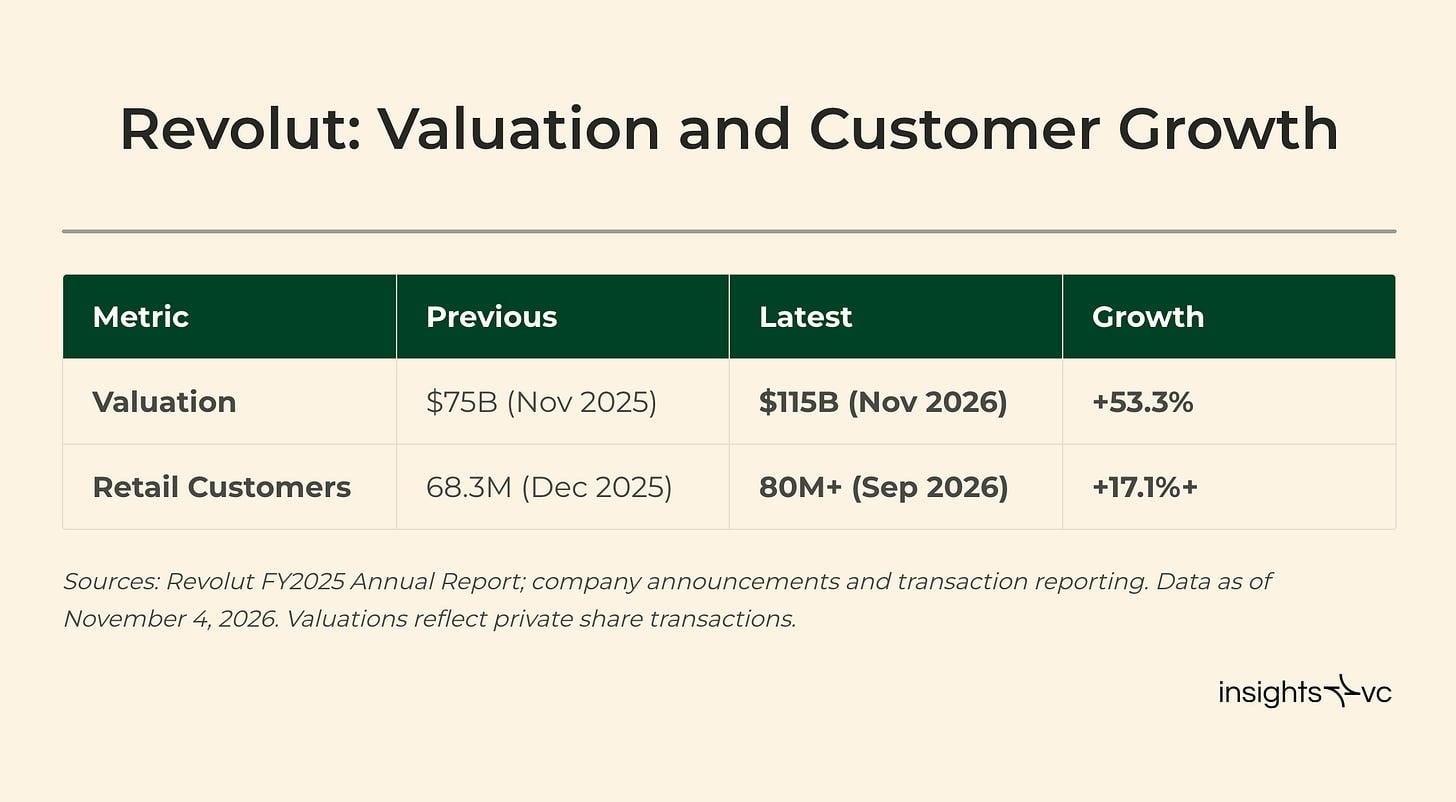
Figure: Historical growth curve of Revolut's valuation and secondary market transaction valuation trends
Since we published a research report on Revolut in March, the market landscape has undergone significant changes.
The company has expanded its banking license business into several new markets, obtained more key regulatory permissions, and significantly increased its global customer base from 68.3 million at the end of 2025 to over 80 million.
The latest audited financial report covering the entire year of 2025 corroborates its strong profitability.
In GBP terms, the company's total revenue for the year grew by 46% year-on-year, reaching £4.52 billion (approximately $6 billion); the pre-tax profit reached £1.71 billion (approximately $2.3 billion); and the net profit reached £1.31 billion (approximately $1.7 billion).
In the 2025 fiscal year, revenues from the card payment business were approximately $1.3 billion, subscription revenue was $936 million, wealth management contributed $876 million, and foreign exchange trading revenue was $800 million.
It is important to note that the wealth management segment also includes traditional securities and commodities, which are non-crypto businesses; attributing all contributions to digital assets would overstate the realization of cryptocurrency contributions.
Interest income was £974 million (approximately $1.3 billion), correcting the dollar label used in Insights4VC's earlier articles.
Based on the GBP financial statements, fee income and other non-interest income accounted for approximately 76% of the consolidated total revenue. In terms of business segments, enterprise-level business Revolut Business contributed 16% of total revenue.
Subscription services provide a stable recurring revenue stream for the company, while card, foreign exchange, and wealth management revenues are directly driven by user engagement.
Interest income introduces sensitivity to deposit interest rates and yield on interest-bearing assets. Although the bank has established diversified revenue sources, the diversification of business does not imply equal resilience across all segments.
According to the non-rounded GBP financial data, its net profit margin for the 2025 fiscal year was 28.9%, lower than the 37.9% pre-tax profit margin more commonly referenced by the market. Both figures pertain to the full-year performance of mature operations and cannot be directly applied to the profitability of its newly established banking entities.
The $67.5 billion total customer funds of interest involves various legal structuring arrangements.
Corresponding to its underlying £50.183 billion assets, this includes £36.143 billion of on-balance sheet fiat currency balances and £14.04 billion of cooperative bank savings and flexible cash funds.
Among the on-balance sheet fiat currency balances, £27.194 billion belongs to customer bank deposit accounts, and £8.949 billion is in electronic money.
This total figure primarily reflects the breadth of fund distribution within the Revolut ecosystem and does not all belong to a deposit pool directly usable for loan disbursement.
The official disclosed loan-to-deposit ratio of 6.2% is calculated based on total loans and on-balance sheet customer deposits, completely excluding the aforementioned cooperative institutional savings and money market funds.
As of December 2025, Revolut disclosed its credit asset portfolio size was approximately $2.9 billion, while high liquidity investments like cash and government bonds accounted for nearly 90% of total assets.
This balance sheet structure explains how it captures substantial profits while only bearing extremely low risks of consumer credit defaults.
However, this also makes its profitability highly dependent on macro interest rate changes, platform trading activity, and customer acquisition costs.
The capital resources at the group level total £4.9 billion, classified entirely as core Tier 1 capital (CET1). This metric cannot be mechanically compared with the capital adequacy ratios of individual Brazilian bank subsidiaries.
Another metric correction directly pertains to the interpretation of its user stickiness. During 2025, the number of users using it as their primary bank account grew by 45% year-over-year.
This does not mean that 45% of Revolut's overall customer base uses it as their primary bank (there was a misinterpretation of this in the previous March report).
The investment logic of the two companies is completely different: while the rapid growth of primary account users is indeed encouraging, it does not allow outsiders to infer its true penetration rate in the total customer base and corresponding revenue contribution ratios.
The establishment of banking licenses is gradually supporting Revolut's global ambitions. Its official announcement in November listed the banking services that began operations in 2026 in the UK, Mexico, Australia, and New Zealand.
The New Zealand regulatory authorities confirmed its bank registration license on November 3, and Revolut immediately began launching local banking products on the same day.
Swiss operations are still in the licensing application stage: the company committed on September 16 to invest over 150 million Swiss francs within five years, and the license approval is still underway.
Additionally, Revolut has obtained full banking licenses in France and Colombia.
The bank license obtained in France in August establishes a second core banking hub in Europe outside of Lithuania, with plans to gradually transition its core customer base from Western Europe.
The approval of the Colombian license in September indicated that about 200,000 users are already on a waiting list, with the expectation to officially commence operations in 2027.
These two key licenses greatly expand its potential business space, but neither has yet formed a mature revenue scale.
In the US market, the Office of the Comptroller of the Currency (OCC) issued a permit on September 2, which Revolut publicly announced on September 3, granting preliminary conditional approval, though further regulatory reviews and operational standards still need to be met.
In Argentina, the announcement on September 24 involved the regulatory approval for the acquisition of Banco Cetelem. This process clearly divides the acquisition approval, transaction closure, and subsequent formal customer operations into three independent steps.
Treating all the countries that have made progress as fully operational mature banks would clearly exaggerate their actual global distribution network.
Rapid cross-border expansion has also increased the compliance and risk management governance burden.
On October 27, Reuters citing the Financial Times reported that the UK's Prudential Regulation Authority (PRA) is reviewing its product approval mechanisms, and other independent reports indicate that an independent expert review mechanism under Article 166 has been introduced.
Previously, the Financial Times also disclosed that the European Central Bank imposed regulatory restrictions on it in 2025 due to product approval deficiencies.
It should be objectively clarified that such announcements are part of routine regulatory interventions and do not represent a final determination of illegality or the latest regulatory penalties.
However, from a business perspective, tightening regulations regarding new product launches will directly constrain the pace at which banking licenses can convert into actual operating income.
Revolut's cryptocurrency business licenses also show a high degree of localization.
On October 19, its Gibraltar entity obtained a distributed ledger technology (DLT) regulatory license, at which time the company announced that its cryptocurrency user base had exceeded 16 million.
In the European Economic Area, the related business is operated uniformly under the MiCA regulatory framework by Revolut Digital Assets Europe.
The Gibraltar license primarily provides another institutional foothold for its global expansion but does not represent an unrestricted passport to serve all sovereign countries.
The launch of the euro stablecoin EURR marks an expansion of its cryptocurrency map beyond trading brokerage.
This project was publicly announced on August 8 and initiated phased pilot testing for eligible customers in Denmark, Poland, and Portugal on the Ethereum network.
Bridge Building of Stripe acts as the issuer, while Revolut provides the front-end brand and vast distribution channels, focusing on smooth interchange between euros, cryptocurrency assets, and external self-custody wallets.
Currently, neither official announcements nor annual reports explicitly disclose the actual circulation volume, payment settlement scale, independent profitability of EURR, nor do they publicly share Revolut's share in the underlying reserve interest income.
The Profit Engine Built by Nubank
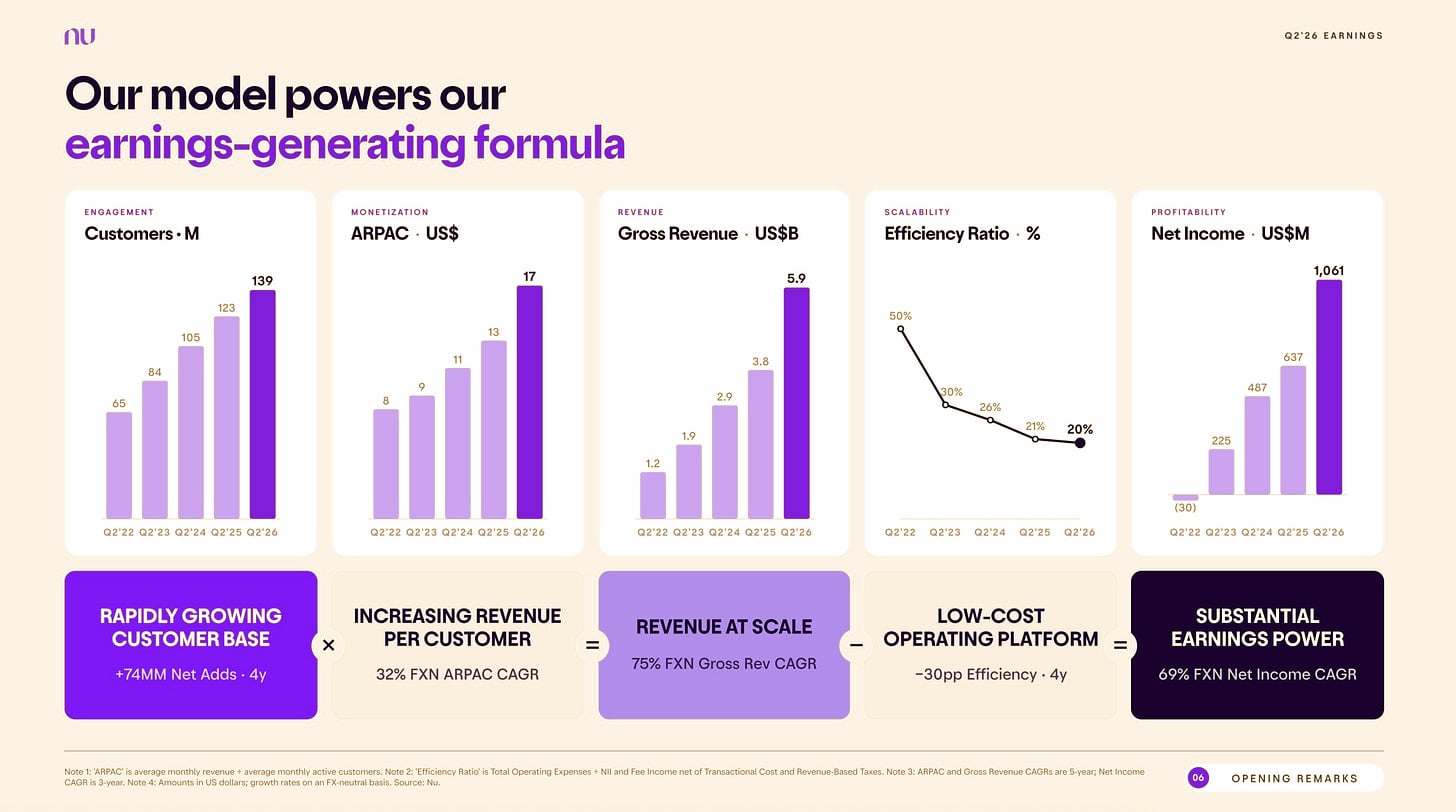
Figure: Core financial data of Nubank and the panorama of user penetration in Latin America
As of the statistical point, Nubank's parent company Nu Holdings has recently disclosed its Q2 2026 financial report, revealing a total global customer count of 138.9 million.
Among these, nearly 118 million are from Brazil, over 15.8 million from the Mexican market, and more than 5 million from the Colombian market.
The subsequent announcement in September further confirmed that its user scale across Latin America has surpassed 140 million. The core operational ratios cited here are based on the financial disclosures at the end of June.
The platform's average monthly active rate reached 83.5%, with Brazil's market exceeding 86%.
Nubank's accounting standards for active customers are extremely strict: they require actual revenue-generating behavior within the past 30 calendar days, rather than just logging into the app.
In the second quarter, the average revenue per active customer (ARPAC) climbed to $17.1, while the average monthly service cost per customer was only about $1.
It is worth noting that this service cost metric encompasses transaction processing, customer support, and daily operational expenses, excluding massive core expenditures such as loan credit loss and comprehensive management expenses; therefore, subtracting them directly does not yield the accurate net profit per customer.
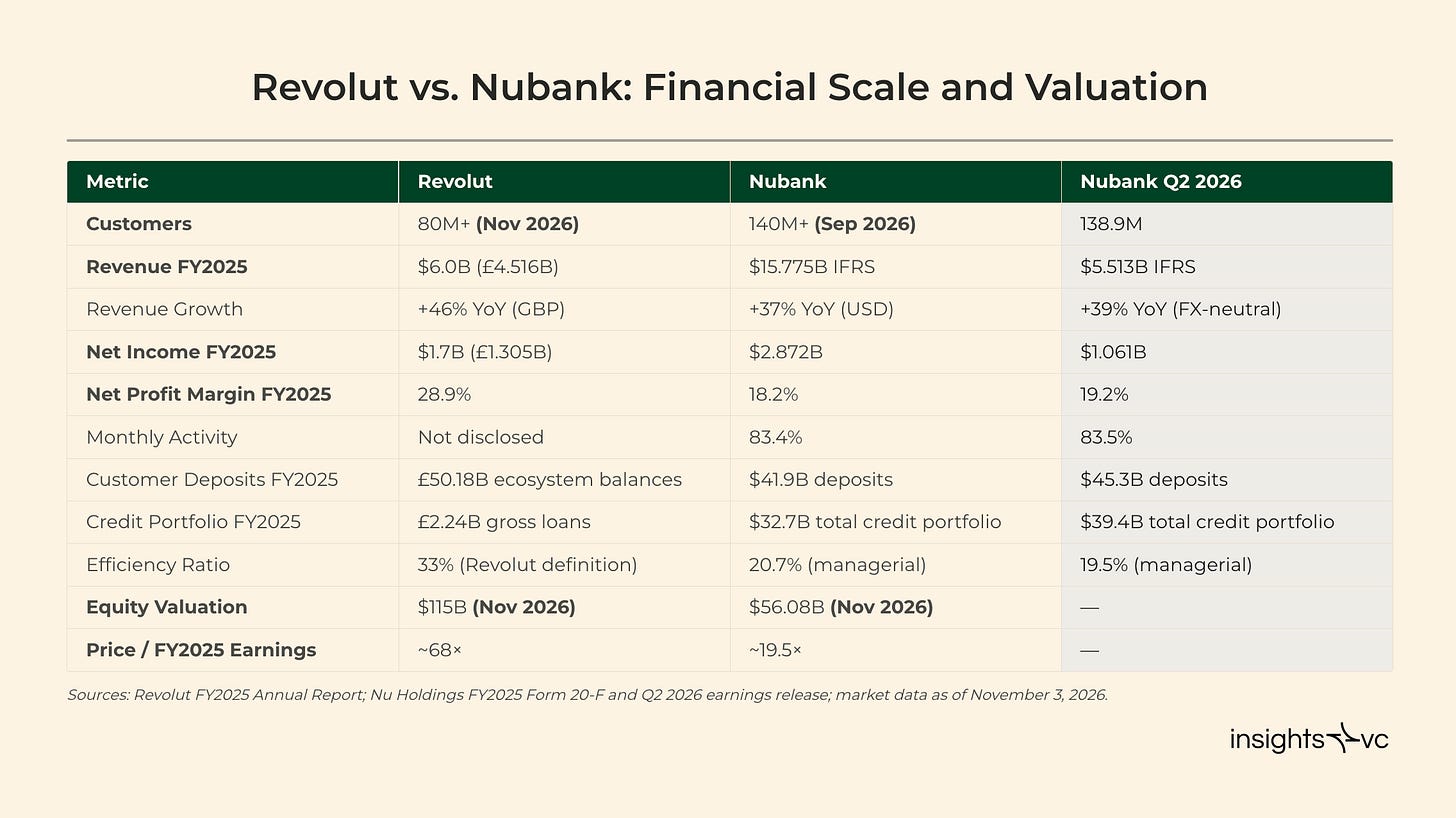
Figure: Horizontal comparison of customer size, activity level, and per-customer monetization metrics between Revolut and Nubank
According to management accounting standards adopted by Nubank, second-quarter revenue reached $5.876 billion, with a year-on-year growth of 39% in fixed exchange rate terms, and a quarter-on-quarter growth of 6% after excluding the effects of exchange rate fluctuations.
If calculated directly at the disclosed nominal dollar amount, the year-on-year and quarter-on-quarter growth rates would reach 55.8% and 10.5%, respectively.
Quarterly net profit was $1.061 billion, growing by 49% year-on-year in fixed exchange rates, while the nominal dollar increase reached 66.6%.
The currency exchange adjustment effect is the core reason for the significant growth rate discrepancies between the two statistical approaches.
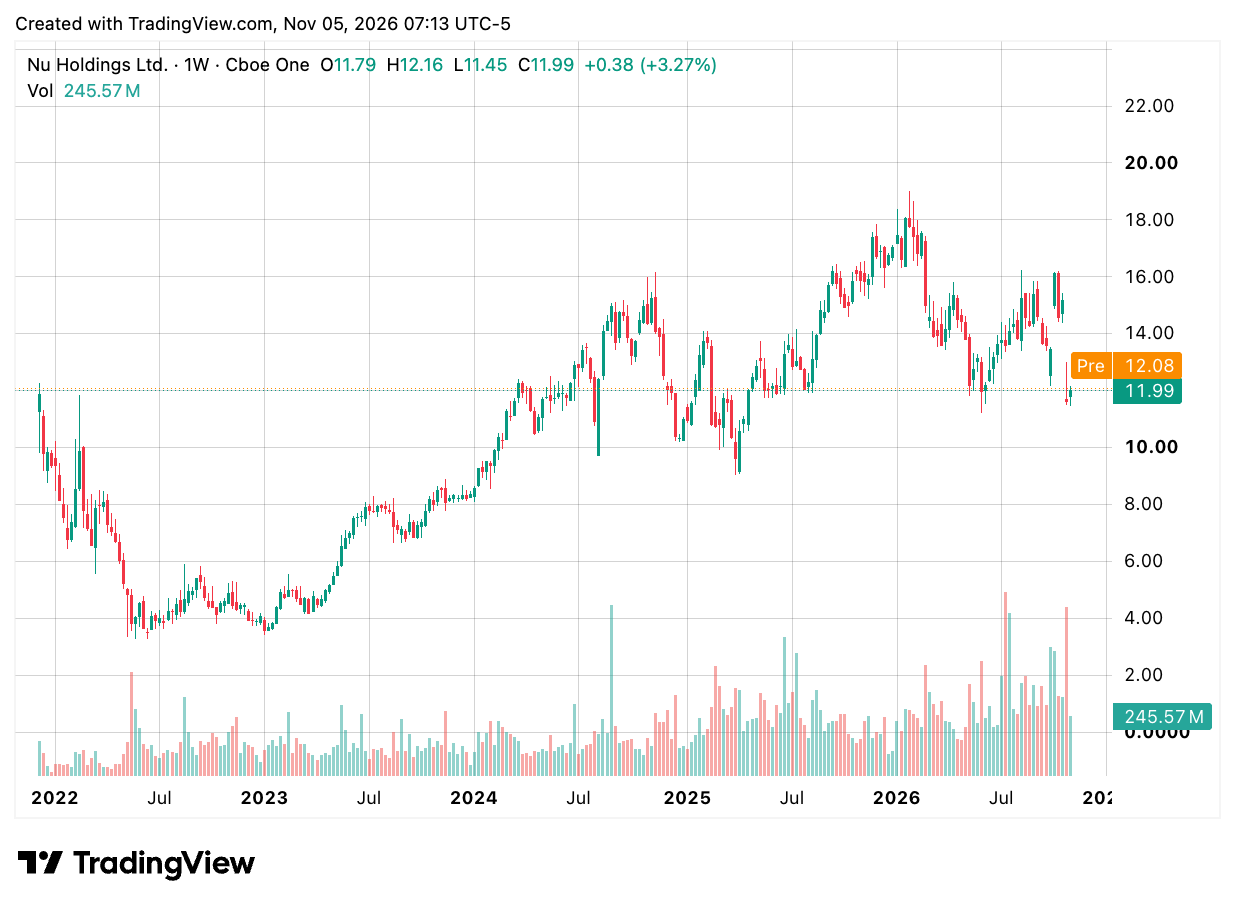
Figure: The public trading trends of Nubank's parent company Nu Holdings on the New York Stock Exchange
Real Logic of Management Accounting Standards and International Standards Adjustments
According to International Financial Reporting Standards (IFRS), Nu's total revenue is $5.5132 billion, which includes $4.7606 billion from interest income and net income from financial instruments, and $752.6 million from fees and commissions.
However, in its management reports, total revenue has been adjusted upward to $5.8757 billion.
The bridging item in the official report reflects a net adjustment of $362.4 million, including a credit adjustment of $64.9 million, interest and tax adjustments for idle funds of $233.8 million, and adjustments for commission income of $63.8 million.
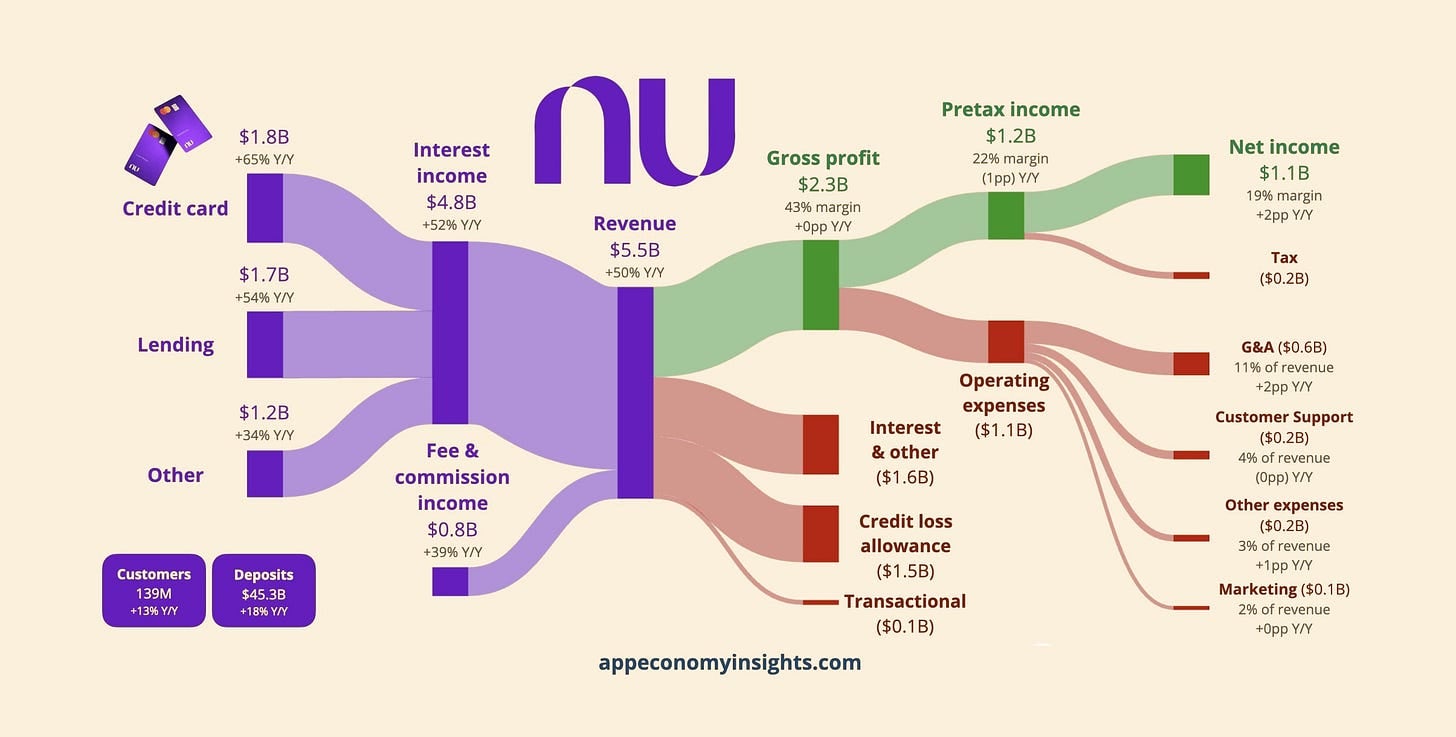
Figure: Breakdown of adjustments between Nubank's International Financial Reporting Standards and management financial metrics
The adjustments further extend to various detailed cost items under revenue.
Cost of funds was adjusted from $1.5567 billion to $1.3721 billion; credit costs increased from $1.4822 billion to $1.6908 billion; transaction costs were slightly adjusted from $127.8 million to $130.8 million; and a new turnover tax of $240.9 million was added to direct costs.
As a result, gross profit increased from $2.3465 billion to $2.4411 billion, operating expenses decreased from $1.1056 billion to $806.2 million, and pre-tax profit rose from $1.2363 billion to $1.6303 billion.
Income tax expenses also increased from $175.2 million to $569.2 million, while the final net profit attributable to the parent company remained unchanged at $1.061 billion.
These reclassifications of accounting subjects and equivalent tax rate adjustments profoundly illustrate that management total revenue, IFRS revenue, and net interest income should never be confused.
In the second quarter, Nubank achieved net interest income of approximately $3.7 billion, with a remarkable net interest margin (NIM) of 22.9%, and the risk-adjusted net interest margin still high at 12.4%.
In the composition of management gross profit, credit business contributes 41%, idle fund income accounts for 34%, and commissions and fees make up 25%.
It should be emphasized that these proportions represent gross profit contributions, not revenue shares.
Idle funds interest and commission constitute a major portion of stable gross profit, but credit business still dominates most of the performance volatility risk exposure.
In its total credit assets of $39.4 billion, the credit card overdraft balance is approximately $26 billion, unsecured personal loans are $10.3 billion, and secured loans are $3.1 billion.
Customer deposits total $45.3 billion, with the composite interest-bearing liabilities cost maintaining at 88% of the Brazilian interbank lending rate.
This relative benchmark funding cost mechanism is drastically different from absolute interest rate environments: the high local interest rate environment in Latin America raises yields on idle funds while simultaneously increasing the cost of the bank's liabilities and putting pressure on borrowers' repayment capabilities.
Despite an annualized 33% return on equity (ROE) being exceptionally attractive, credit quality metrics still require cautious consideration.
The overdue rate for consumer credit disclosed by Nubank shows a divergent trend: the short-term delinquency rate for loans overdue between 15 and 90 days has improved to 4.8%, while the rate for loans overdue over 90 days has risen to 6.9%.
Management attributes the short-term improvement primarily to seasonal factors and openly admits it has proactively expanded into higher-risk borrower groups.
According to sensitivity calculations, if the second quarter's credit cost of $1.691 billion rises by 10%, other conditions remaining unchanged would erode approximately $169.1 million in pre-tax profits, equating to 10% of management's pre-tax profits. This is a scenario calculation, not a loss prediction.
Capital adequacy constitutes another significant constraint. As of the end of June, its core Tier 1 capital adequacy ratio (CET1) in the Brazilian prudent financial consortium was 11.9%, and the total capital adequacy ratio was 15.7%, down from 13.0% and 16.6% at the end of the previous year.
This consortium complies with local regulatory standards, but the continued expansion of credit risk-weighted assets indicates that rapid lending is quickly consuming capital surplus.
Maintaining high returns does not exempt the need for profit retention or cross-border capital allocation, and the capital adequacy of the Brazilian subsidiary does not represent the overall capital situation of Nu Holdings.
Nubank's expansion focus in Brazil has increasingly turned to deep exploration of existing customers.
The high-end brand Ultravioleta targets high-net-worth customers, while the Croma brand, launched in July, aims to fill the gap between mass retail and premium banking.
By bundling subscription services, high-interest savings, and premium credit card benefits, the company continually strengthens the core account linkage.
Nubank sets a stringent recognition standard for primary bank accounts: requiring customers to transfer at least half of their post-tax monthly income into NuAccount, and the penetration rate is only calculated among eligible active customers who have maintained accounts for at least 12 months.
This strict metric cannot be directly equated with the primary account growth disclosed by Revolut.
Mexico serves as the clearest battlefield where the two giants face off.
Nubank's local customer base reached 16 million in July and officially started banking operations on August 6; Revolut began banking operations on January 27 and surpassed 500,000 users by June 8.
Despite differences in reporting timelines, this highlights the massive barrier accrued by Nubank's localized early mover advantage.
Moreover, over 5 million customers in Colombia and approximately $3.3 billion in deposits constitute the third major core battleground, yet Brazil still holds absolute dominance.
Nubank's self-developed deep learning model NuFormer may have far-reaching impacts on risk control credit approvals and service cost implications.
The company claims this model has been deeply deployed in credit card and unsecured loan operations in Brazil and Mexico, with SME credit and Colombian card operations also undergoing testing.
The company has simultaneously disclosed that its AI-enabled customer service has taken over more than 60% of customer inquiry dialogues in Brazil.
However, these figures belong to company-disclosed operating data, not independently verified profit attributions by third parties.
The predictive optimization of AI models theoretically helps improve credit security, but defaults on new loans often require time to manifest.
Furthermore, the monthly average service cost per customer has slightly risen from $0.8 a year ago to approximately $1, indicating that AI has not yet directly and significantly compressed the absolute cost per customer.
Nu Global Reshaping Cross-Border Distribution Model
Nubank Crypto announced in March that its number of coin-holding customers has surpassed 7 million, with a product line covering cryptocurrency buying and selling, on-chain custody, and USDC conversion features.
Its wealth management product Earn Crypto launched SOL staking services on March 17, with promotional annualized returns of 6%.
It should be clarified that the USDC loyalty points rebate program launched in the early stages of the Brazilian market is an independent product, and its initial interest rate in January 2025 cannot be directly considered as the current long-term fixed income yield.
The Nu Global account officially unveiled on September 10 fully adopts Circle's USDC and EURC as the underlying balances for US dollar and euro settlements.
Official documents in October claimed to offer up to 3.50% in US dollars and 2.20% in euros as floating annualized returns, with daily interest accrual and no lock-up period restrictions.
This account supports cross-border transfers to over 35 countries, equipped with a Mastercard virtual debit card, and enables digital asset transactions at a rate of 0.8% per transaction.
The platform waives account management and transfer fees, with individual transfer limits ranging from $1 to $10,000.
The virtual card directly deducts from the USDC balance, while EURC must first be converted to US dollars and does not support ATM withdrawals.
The underlying financial infrastructure of Nu Global has clear cooperative providers: the Swiss licensed digital asset bank Sygnum is responsible for foreign exchange trading, asset transactions, underlying custody, and issuing Swiss bank guarantees.
However, the legal counterparty that Nu Global users contract with is Nu Global AG, rather than establishing a creditor relationship directly with traditional deposit banks.
The service terms grant users contract-based rights to claim repayment, rather than legal ownership of specific isolated tokens on-chain.
In bankruptcy liquidation scenarios, users will be treated as unsecured creditors of Nu Global and can assert independent rights of compensation based on bank guarantees, with the repayment process constrained by guarantee terms and related compliance liquidation costs.
In terms of compliance, Nu Global AG is subject to self-regulatory audits for anti-money laundering by the Financial Services Standards Association (VQF).
Its user agreement explicitly states that the company is not directly prudentially regulated by the Swiss Financial Market Supervisory Authority (FINMA), and account funds do not enjoy any official deposit insurance protection.
Therefore, external promotions should not inaccurately package Sygnum's banking guarantees as Swiss official deposit insurance or FDIC coverage in the United States.
Nubank's bank accounts set up in the US mainland are entirely legally separate from the aforementioned structure.
Customer deposits are actually held at Lead Bank, a cooperating bank covered by the FDIC, providing a floating annualized return of 3.50% and with no minimum balance requirements.
Nubank's independently applied national bank license received conditional approval in January but the product launch in September is being conducted through a cooperating bank model.
Currently, the actual user penetration rate and revenue contribution of Nu Global have not been individually disclosed in the financial report, and there is no public financial evidence suggesting that this business has made a significant incremental contribution to the parent company's consolidated net profit.
Comprehensive Simulation of the Business Economic Model
Revolut has demonstrated through its actual performance that it can achieve extremely high profitability while maintaining very low credit risk exposure.
In contrast, Nubank's massive consumer credit base gives a decisive position to risk control in credit approvals, serving vast transaction data and main bank account links that deeply feed back into credit decision-making.
When evaluating its outstanding operational efficiency, potential credit default risks must be taken into account.
Local inflation and benchmark interest rates in Latin America directly affect borrowers' repayment capabilities and the thickness of net interest margin, while dollar-denominated investors also face exchange rate adjustment risks.
Conversely, Revolut's extensive fee income significantly reduces dependence on credit margins, yet also exposes profitability to changes in payment transaction volumes, speculation activity, and customer acquisition costs.
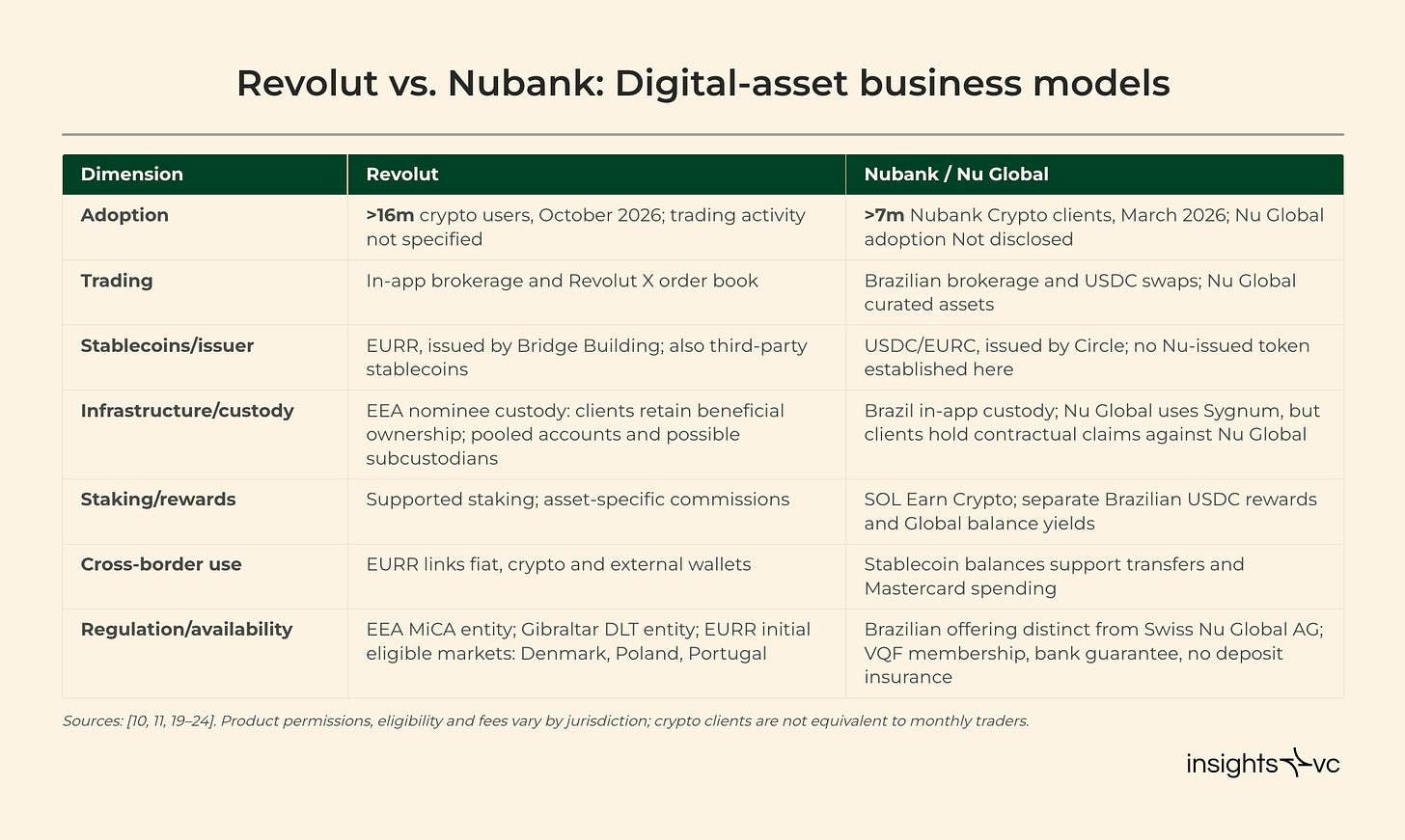
Figure: Balance sheet and income structure showdown between Revolut and Nubank
The stablecoin architecture allows digital banks to expand their distribution reach without replicating heavy asset entity networks in every sovereign country.
Revolut launched the private-label stablecoin EURR, firmly controlling the user experience while delegating issuance and compliance capabilities to Bridge.
Nubank, on the other hand, directly introduces mature native tokens from Circle and establishes a foundation with Sygnum Bank.
Currently, both solutions have not confirmed entitlement to interest-sharing income from underlying government bond reserves, with their business returns primarily deriving from foreign exchange trading, card transaction volumes, or distribution agreement commissions.
Zero-fee transfers also imply that increased scales of payment transactions do not necessarily lead to proportionate growth in commission revenue.
Nubank's core competitive moat is deeply rooted in its unbreakable customer relationships and credit stickiness in the local Latin American market.
In contrast, Revolut has built entirely different customer acquisition channels based on its international multi-currency cards, ultra-low exchange rates, B2B enterprise services, and cross-European customer base.
While stablecoins indeed enhance the user experience for cross-border products, the localized accumulation of risk control data, payroll stickiness, and merchant acquisition networks cannot be transferred across borders.
The Mexican market has become the most realistic testbed for the strategic collision between the two giants, and the vast majority of their existing users still remain in different geographic territories.
Revolut's next core test lies in converting its large lightweight user base into deep users who maintain high funds.
For example, the company claims that in Ireland, 80% of adults hold Revolut accounts, but a Reuters analysis on November 4 pointed out that its average revenue per customer and average deposit levels still show significant gaps compared to traditional century-old banks.
a16z partner Alex Immerman also pointed out that the penetration rate of primary bank accounts and customer asset accumulation levels are the most critical indicators for assessing future ceilings.
As of the close of US stocks on November 3, Nubank's approximately $56.08 billion market capitalization was only about half of Revolut's latest private equity trading valuation of $115 billion.
Nubank's audited net profit attributable to the parent company in the past four quarters was $782.7 million, $894.8 million, $871.4 million, and $1.061 billion, respectively, accumulating a total net profit of $3.610 billion over the past twelve months (TTM), corresponding to a price-to-earnings ratio of about 15.5 times.
If calculated based on the projected $2.9 billion net profit for the entire year of 2025, the price-to-earnings ratio is approximately 19 times.
In contrast, for Revolut, based on its $1.7 billion net profit for the 2025 fiscal year, its current trading valuation implies a price-to-earnings ratio of approximately 68 times.
The two companies exhibit significant differences in terms of exchange rate adjustments, provision accrual, tax fee mechanisms, and liquidity premiums in equity trading, and historical net profits should never be mechanically equated with future steady-state earnings.
Scenario simulations suggest that to support Revolut's high valuation of $115 billion, under the assumption of a 30 times price-to-earnings ratio, its annual steady-state net profit must reach approximately $3.8 billion; if the price-to-earnings ratio reverts to a more mature 20 times, then the annual net profit must soar to $5.75 billion, while its disclosed net profit for the 2025 fiscal year was only $1.7 billion.
This simulation is not a performance guide but visually reflects the extremely high profitability expectations embedded in the current valuation, an expectation built on the premise that existing profit margins, tax rates, and capital requirements will not be eroded in future global expansions.
Future Planning and Recent Core Issues
Revolut's recent roadmap intertwines established markets and pending regulatory permits.
Its wholly owned New Zealand bank has officially launched and introduced savings products; the Swiss license is still under review, and the five-year investment commitment cannot guarantee a specific approval date; Argentina has received acquisition approval, but subsequent closure and formal operations will take time; and the US national bank license has obtained conditional approval, planning to commence formal operations in 2027.
The company set a target in September to exceed 100 million global customers by mid-2027, but the subsequent mention of ambitions to have 100 million active users in over 100 countries should not be confused with a certainty commitment for the same timeline.
The euro stablecoin EURR remains in compliance pilot stages, with broader rollout plans expected to be implemented later in 2026.
Other fiat-pegged stablecoins are under development but have yet to finalize formal release timelines.
Although the Gibraltar DLT license has been obtained, the company has stated that the specific regions and business details supported by this entity will be announced subsequently.
These concepts primarily pertain to distribution planning and should not be equated with realized revenue expectations.
Nubank's fully licensed bank in Mexico is now officially operational, and the upcoming key test lies in enhancing customer usage depth and optimizing funding costs on the liability side.
Its US cooperating bank services and Nu Global are opening registration in batches, planning to connect underlying interoperability with Brazil, Colombia, Mexico, and the United States over the coming months.
The official announcement also stated that it will offer up to 4.50% annualized return on savings with balances under $10,000, but this comes with the prerequisite of simultaneously holding an account and credit card and completing three compliant transactions in 34 days.
The independently applied US bank license is still in a conditionally approved status, with the OCC requiring capital infusion within 12 months of the January approval and operational launch within 18 months.
Additionally, in August, the company also advanced the application process for a fully functional commercial banking license in Brazil.
Similar currency payment and cryptocurrency account functions rely fundamentally on entirely different balance sheet structures and customer rights relationships.
Nubank's profit foundation is firmly built on local consumer lending, the interest margin on idle funds, and deep customer stickiness.
Revolut's extremely high valuation multiples preemptively hedge expectations for substantial profits from its global distribution network in the future.
While stablecoins have provided a new technical pipeline for reaching and servicing vast global users, neither giant has yet disclosed enough product unit economic models, and stablecoin businesses are still insufficient to sustain their current exorbitant valuations.
免责声明:本文章仅代表作者个人观点,不代表本平台的立场和观点。本文章仅供信息分享,不构成对任何人的任何投资建议。用户与作者之间的任何争议,与本平台无关。如网页中刊载的文章或图片涉及侵权,请提供相关的权利证明和身份证明发送邮件到[email protected],本平台相关工作人员将会进行核查。


