How attractive is the national trust bank charter from the US OCC? Which crypto companies have already received OCC trust bank approval?
Written by: KarenZ, Foresight News
If the integration of crypto with traditional finance is likened to a long-distance race, obtaining the national trust bank charter from the Office of the Comptroller of the Currency (OCC) is a crucial breakthrough along this journey.
This charter has clear business boundaries. Approved institutions mainly engage in asset custody, trust, and related settlement services and do not automatically gain all business permissions of traditional commercial banks. The type of trust bank discussed in this article does not accept public retail deposits and does not offer FDIC deposit insurance protection.
The significance of this licensing race lies in which financial business sectors approved companies can enter. Stablecoin reserve management, digital asset custody, and payment settlement are becoming the foundational infrastructure battleground for crypto companies.
To understand the OCC approval list, it is essential to clarify three questions: Which legal entity is approved? What business activities are allowed? What stage is the approval process at? These details also help to understand why the OCC has become the regulatory entry point of choice for crypto companies and how this licensing race will affect the US digital asset industry.
First, clarify: What is the OCC charter?
The Office of the Comptroller of the Currency, or OCC, is the federal banking regulatory agency under the US Department of the Treasury, responsible for chartering and supervising relevant institutions in the US federal banking system.
Unlike state-level financial regulatory agencies, the national bank charters issued by the OCC belong to the federal level. For crypto companies, the national trust bank charter (National Trust Bank Charter) is of utmost importance.
National trust banks are not the same as commercial banks as we generally understand them. Traditional commercial banks can accept deposits, issue loans, and conduct payment and settlement activities, provided they obtain the necessary authorizations and meet regulatory requirements. The business scope of a national trust bank charter mainly revolves around trust and fiduciary services, including asset custody, safekeeping, fiduciary management, and related activities.
This means that a crypto company that obtains a national trust bank charter does not automatically gain the ability to accept public deposits or issue loans like conventional commercial banks. More importantly, such charters do not typically mean that the digital assets deposited by customers will receive FDIC (Federal Deposit Insurance Corporation) deposit insurance. Digital asset custody and safekeeping of deposits are two different things.
So, why do crypto companies place such importance on this charter?
First, there is the federal regulatory framework. Different states in the US have varying regulatory requirements for digital asset custody, fund transfers, and financial services. For instance, in New York State, digital asset firms may need to obtain a BitLicense issued by the New York Department of Financial Services (NYDFS) or other applicable authorizations. By obtaining a national trust bank charter, businesses can operate approved activities under a federal regulatory framework, reducing redundant state regulatory requirements within the scope of federal law prioritization.
Second, the institutional trust brought by the regulatory identity. For large asset management institutions, corporate clients, and financial institutions, whether the custodian is under federal banking supervision is a critical factor in assessing cooperative risks. An OCC charter can provide a more unified regulatory framework for digital asset custodians, which also means they must undertake more stringent governance, capital, liquidity, compliance, and risk management obligations.
Finally, stablecoin business. Stablecoin issuers need to manage reserve assets, handle redemptions, ensure fund security, and establish relationships with banks, custodians, and payment networks. The national trust bank charter can provide a federal regulatory foundation for some of these activities.
It is important to note that the OCC's national trust bank charter is not a license specifically established by the GENIUS Act (the US "Guidance and Establishment of a National Innovation Act for Stablecoins"). Its legal basis primarily comes from the National Bank Act. The GENIUS Act further establishes a federal regulatory framework for payment stablecoins.
In Interpretive Letter 1183 issued by the OCC in March 2025, it has already clearly reiterated that federal banks can engage in crypto asset custody, stablecoin reserve-related activities, and conduct legal payment activities using distributed ledger technology and stablecoins, provided they meet the criteria.
On October 21, 2026, the OCC announced the final rules for the implementation of the GENIUS Act, further clarifying the regulatory requirements for payment stablecoin issuers and related custodial activities under its jurisdiction.
This implies that the US is gradually forming a federal system from bank charters to stablecoin issuance regulation.
What exactly has been approved by "OCC approval"?
Before sorting through the list of companies, it's essential to distinguish between two concepts: Conditional Approval and Final Approval. They are not the same thing.
If the OCC believes that the proposal from the applicant institution meets the relevant legal and regulatory policy requirements after reviewing the application, it may grant Preliminary Conditional Approval. This means that the application has received provisional recognition, allowing the company to continue advancing its banking establishment process, but it still must meet a series of pre-operational conditions.
For example, enhancing corporate governance structures, establishing internal control and risk management systems, meeting capital requirements, implementing anti-money laundering measures, customer identification systems, and completing system and personnel preparations, among other conditions. Until all these conditions are fully met, the OCC can still modify, suspend, or even withdraw its prior approval.
Final Approval means that the regulatory agency has completed the corresponding stage of review and allows the bank to officially start operations after meeting the final opening conditions.
It is important to note that OCC's final approval does not mean that the company can operate all banking businesses without restrictions. What activities can be conducted still depends on its charter type, approval documents, and business plan.
Additionally, existing state trust companies can apply to convert to national trust banks. Currently, many crypto companies have received preliminary conditional approval from the OCC, but very few have reached the final approval stage.
Which crypto companies have received OCC trust bank approval?
From a timeline perspective, US crypto companies have undergone three phases in their pursuit of OCC licenses: early exploration in 2021, concentrated approvals at the end of 2025, and ongoing expansion in 2026.
As of November 3, 2026, companies that have received related approvals from the OCC include Anchorage Digital, BitGo, and other institutions that have entered the federal banking regulatory system, as well as Circle, Ripple, Coinbase, Crypto.com, and others which have already or are in the process of establishing or converting to national trust banks.
Six companies have completed federal conversion or announced final approvals
- Anchorage Digital: Approved to convert from state trust in January 2021 (bank entity: Anchorage Digital Bank, N.A), and is one of the first crypto-native companies to enter the federal banking regulatory system.
- BitGo: Approved to convert from state trust on December 12, 2025 (bank entity: BitGo Bank & Trust, N.A.), and can provide digital asset custody, wallet infrastructure, settlement, and related services under the federal regulatory framework.
- Paxos: Approved to convert from state trust on December 12, 2025 (bank entity: Paxos Trust Company, N.A.). Paxos had received preliminary conditional approval from the OCC to establish Paxos National Trust back in April 2021. However, the approval documents at that time stipulated that if it did not formally open within 18 months after preliminary approval, that approval would become invalid. Paxos did not complete the establishment of the national trust bank according to its initial plan. On August 12, 2025, Paxos resubmitted an application to the OCC, but this time chose a different path: converting the already-operating Paxos Trust Company in New York into a national trust bank.
- Fidelity Digital Assets: Converted in December 2025 (bank entity: Fidelity Digital Assets, N.A.). Notably, the OCC's Conditional Approval No. 1355 document, while using conditional approval terminology for the overall transaction, also clearly states that the temporary bank has obtained final approval and authorization to commence operations, pending completion of pre-opening requirements. Fidelity has since started providing digital asset custody and trading services through Fidelity Digital Assets, N.A., and launched its own stablecoin, Fidelity Digital Dollar (FIDD), in 2026.
- Circle: Announced final approval on July 10, 2026 (First National Digital Currency Bank, N.A., operating under the name Circle National Trust). It is important to note that Circle National Trust is not the direct issuer of USDC. According to OCC approval documents, Circle plans for a limited-purpose trust company in New York to assume the USDC issuance function, while the national trust bank is responsible for the related reserve management and custody infrastructure.
- Ripple: Announced final approval on October 26, 2026 (bank entity: Ripple National Trust Bank). The bank's business plan includes managing independent reserve assets supporting RLUSD, acting as trustee for RLUSD reserve assets, and providing digital asset custodian services to institutional clients. It is also crucial to note that RLUSD is still issued by Standard Custody & Trust Company, regulated by the New York Department of Financial Services, and not directly issued by Ripple National Trust Bank.
Aside from Ripple's new progress in October, the remaining five are all listed in OCC's operating trust bank list as of September 30, 2026.
Ten companies have obtained conditional approvals
This year, Stripe's Bridge, digital asset and cryptocurrency financial services company Protego, Crypto.com, Coinbase, Laser Digital under Nomura, Morgan Stanley, Connectia Trust under Sony Bank, World Liberty affiliated institutions, enterprise-grade white-label stablecoin infrastructure Bastion, Catena Labs, and Agora have successively obtained conditional approvals from the OCC. Among these, Bastion received conditional approval for converting a state trust, while the others received preliminary conditional approvals for new banks.
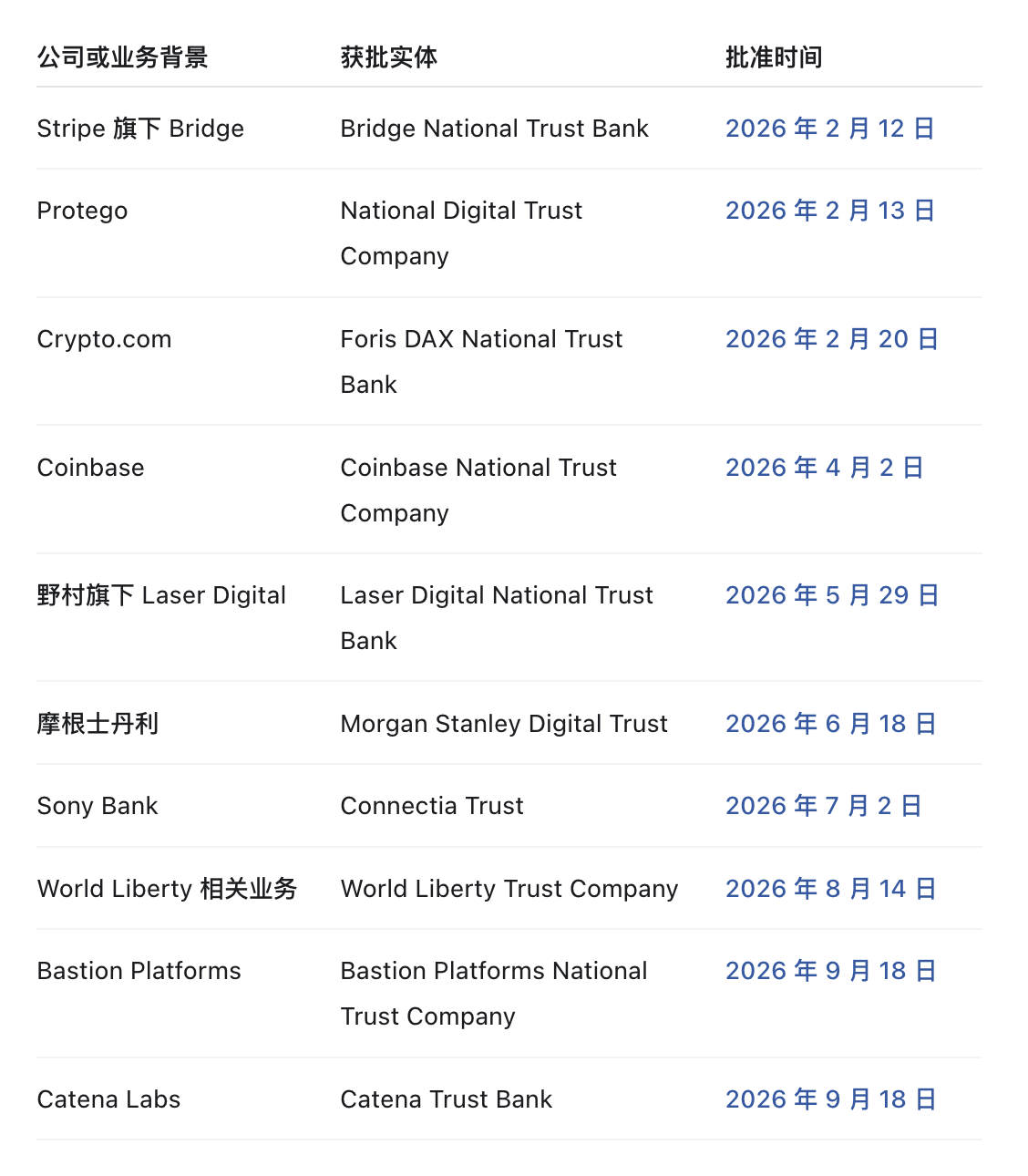
Among this batch of companies, several cases are worth further attention.
Bridge is a stablecoin infrastructure company under Stripe. Its application documents indicate that the proposed bank will be wholly owned by Bridge Ventures LLC, which is a wholly-owned subsidiary of Stripe, planning to conduct USD stablecoin issuance, reserve management, collateral trust, and digital asset custody services. This means that Stripe is extending stablecoin infrastructure further into the federal banking regulatory system through Bridge.
Coinbase's application is also notable. Its proposed national trust bank is a wholly-owned subsidiary of Coinbase Global, focusing primarily on digital asset custody and related businesses.
Laser Digital is the digital asset business department under Japan’s Nomura Group. Its proposed bank will provide digital asset, securities, and fiat custody services to institutional clients and allow clients to conduct related trading and staking activities within the custody asset scope.
The application from World Liberty Financial affiliated institutions pertains to USD1. OCC documents indicate that this bank plans to issue USD-backed stablecoins, manage reserves, and provide digital asset custody services. It is noteworthy that the application documents also state that it plans to take over BitGo, becoming the exclusive issuer and custodian of USD1.
Bastion's business focuses more on enterprise-grade stablecoin infrastructure, aiming to provide white-label stablecoin issuance, custody wallet services, and related services for other regulated stablecoin issuers.
It is also important to note that Protego had received preliminary conditional approval back in 2021, but the application then did not finalize its operations. Its related application entity, Protego Holdings Corporation, applied again in 2025 to establish National Digital Trust Company and obtained new preliminary conditional approval on February 13, 2026.
Catena Labs stands out among this batch of applicants. Its direction differs from traditional crypto custodians. According to the company’s official introduction, its goal is to establish a financial institution serving AI Agents and related enterprises, allowing Agents to complete financial activities such as payments, collections, currency exchanges, and asset management under authorization, while enabling enterprises to retain control over funds. The proposed Catena Trust Bank will provide custody, investment management, trust, conversion, clearing, and execution services for fiat, investment securities, and digital assets.
Several other companies are queued to apply for national trust bank charters
In addition to the aforementioned crypto-related companies that have received OCC approval, there are several other firms queued to apply for national bank charters.
According to the OCC's latest published list of digital asset license applications, pending applications include Ramp, Rain, Modern Treasury, Gurufin, zerohash, Dakota, Payward (the parent company of Kraken), EDX, Payo, and others. Among these, Ramp, Rain, and Modern Treasury represent fintech, stablecoin payments, and enterprise payment infrastructure directions respectively, while Payward and EDX come from the crypto trading platform sector. Additionally, Galaxy announced on October 29 that its Galaxy Digital LP has submitted an application to the OCC to establish a national trust bank.
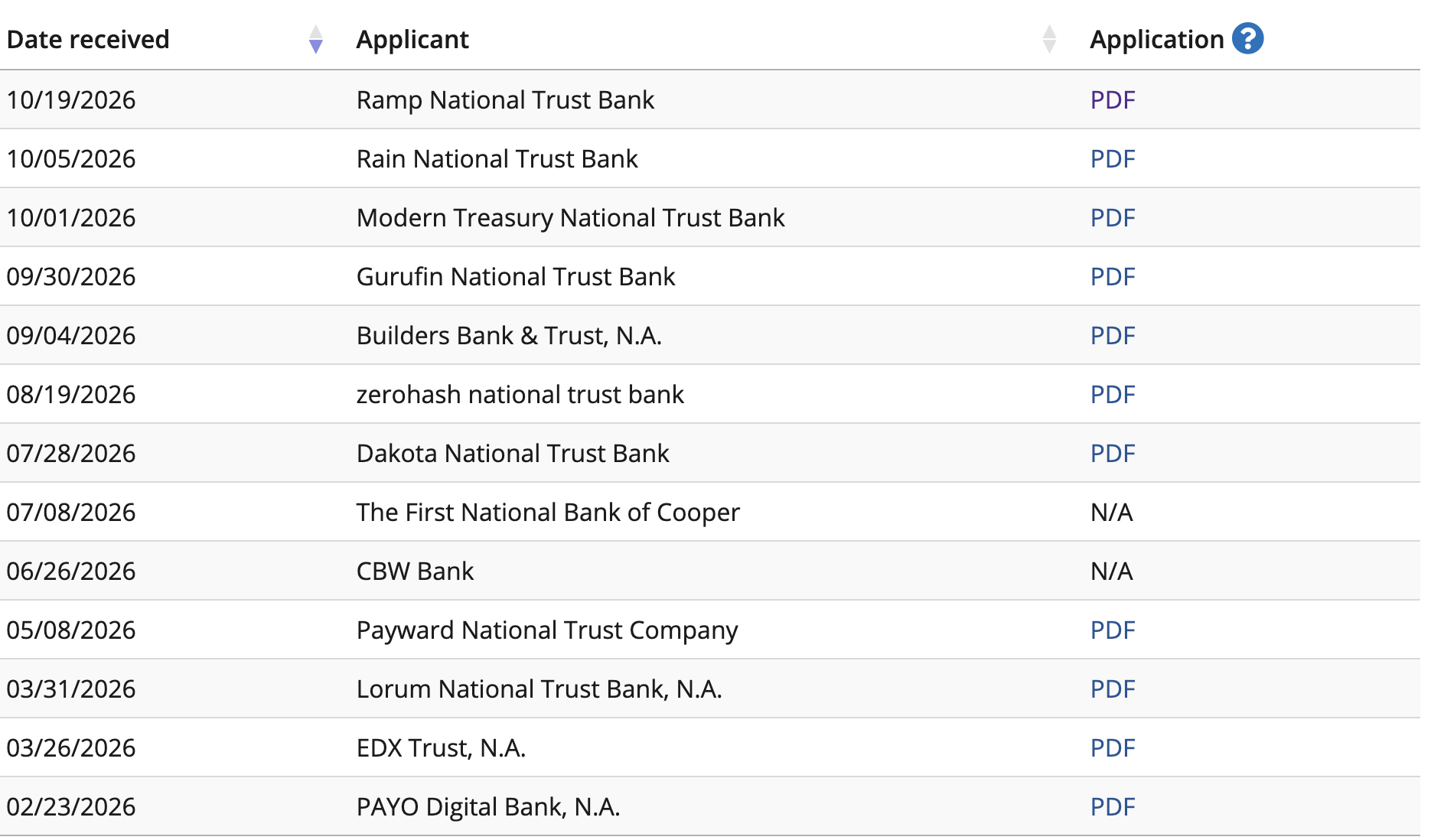
Source: OCC Official Digital Assets Licensing Applications page
The real change worth noting: OCC is integrating crypto into the federal financial infrastructure
From these approvals and regulatory documents, it can be seen that the OCC is incorporating certain digital asset businesses into the existing banking regulatory framework, explicitly stating which entities are responsible for asset custody, reserve management, and related transaction duties.
A direct change is the permission arrangement for interstate operations. Fidelity Digital Assets, N.A., upon converting to a national trust bank, voluntarily relinquished its previous Iowa remittance license. The OCC subsequently confirmed that this bank can conduct federally authorized business without needing to obtain separate remittance licenses from each state.
Another change is that the responsibilities behind stablecoins are becoming more specific. Although approved as trust banks, the business arrangements of different companies still vary.
This integration is also occurring bidirectionally. In 2025, the OCC reaffirmed that federal banks and federal savings associations can engage in crypto asset custody, certain stablecoin activities, and participate in independent node validation networks of distributed ledgers, further confirming that banks can buy and sell custodial assets as per client instructions, outsourcing related services under appropriate risk management conditions. Therefore, while crypto companies enter the banking system, traditional banks are also conditionally allowed to participate in similar businesses.
Next, it will connect to the new stablecoin system. The OCC announced the final implementation rules of the GENIUS Act in October 2026, stating that the rules and act will go into effect on January 18, 2027. To become an approved issuer of payment stablecoins, a trust bank must meet both banking and stablecoin issuer requirements; existing bank charters cannot substitute for obligations under the separate system.
Further reading: "Countdown to the GENIUS Act: What Did the OCC Final Rules Change?"
Conclusion
From Anchorage Digital's early acquisition of the OCC federal charter to five companies receiving concentrated approvals by the end of 2025, followed by Circle and Ripple receiving final approvals in 2026, the US crypto industry is gradually integrating into the federal banking regulatory system.
The deeper significance of this change is that crypto companies are using the national trust bank charter as a foundation to further compete for positions in stablecoin reserve management, digital asset custody, payment settlement, and institutional financial services.
In the future, the metrics for measuring the competitiveness of crypto companies may extend from transaction volume and stablecoin market value to the extent of their control over financial infrastructure. Whoever can establish a reliable connection between traditional finance and on-chain economics may occupy a more advantageous position.
免责声明:本文章仅代表作者个人观点,不代表本平台的立场和观点。本文章仅供信息分享,不构成对任何人的任何投资建议。用户与作者之间的任何争议,与本平台无关。如网页中刊载的文章或图片涉及侵权,请提供相关的权利证明和身份证明发送邮件到[email protected],本平台相关工作人员将会进行核查。


