
Written by: Frank, MSX
On November 3, the U.S. midterm elections concluded.
The Democratic Party comprehensively seized control of both the House of Representatives and the Senate, achieving key turnarounds in traditionally red or swing states such as Texas, Iowa, Kansas, and Ohio.
This "blue wave" fundamentally rewrites the governing environment for the last two years of Trump's presidency.
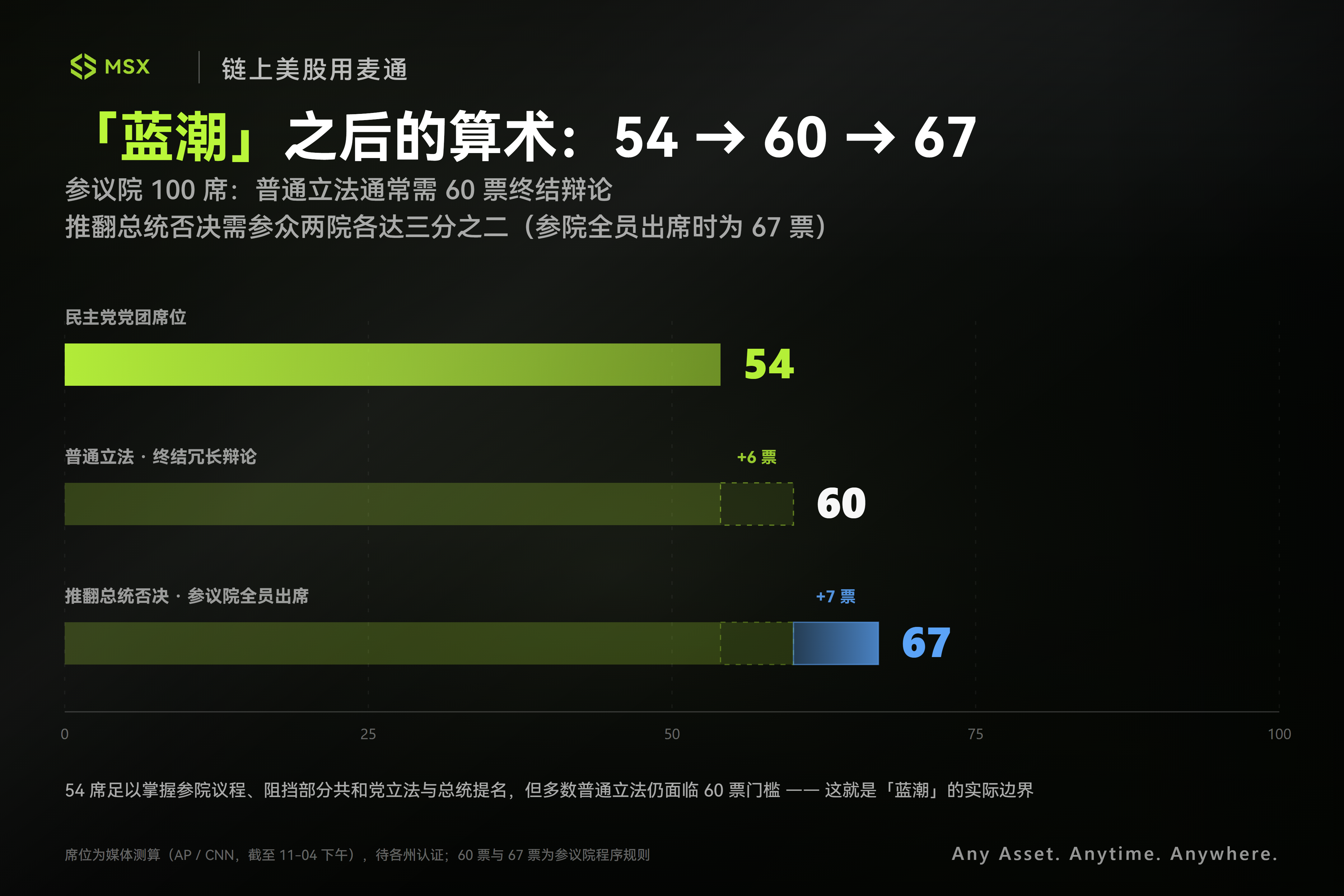
Trump quickly made his stance clear, stating that he would use presidential veto power as necessary to counteract this, which is not an empty statement: Although the Democrats control both chambers of Congress, they would still need to overcome the formidable barrier of a two-thirds absolute majority in both the House and Senate to overturn a presidential veto.
Thus, what the "blue wave" truly changes is the oversight and checks on the executive branch, the prioritization of regulatory agendas, and the boundaries of legislative battles over the next two years.
In the U.S. stock market, this also means that policy expectations for some sectors may improve, while the regulatory easing that some companies previously relied on may face renewed challenges.
Follow official X for U.S. stock information
Join official community to discuss hot topics
1. Marginal Improvement in Policy Expectations: Clean Energy, Power Equipment, and Cybersecurity
The first premise to emphasize is that the Democrats regaining control of Congress does not automatically mean the clean energy subsidies cut by the Trump administration will return.
The "Inflation Reduction Act" passed in 2025 has significantly revised or prematurely terminated multiple clean energy tax credits; any new legislation to restore these subsidies would struggle to overcome the dual hurdle of "60 Senate votes + presidential veto power."
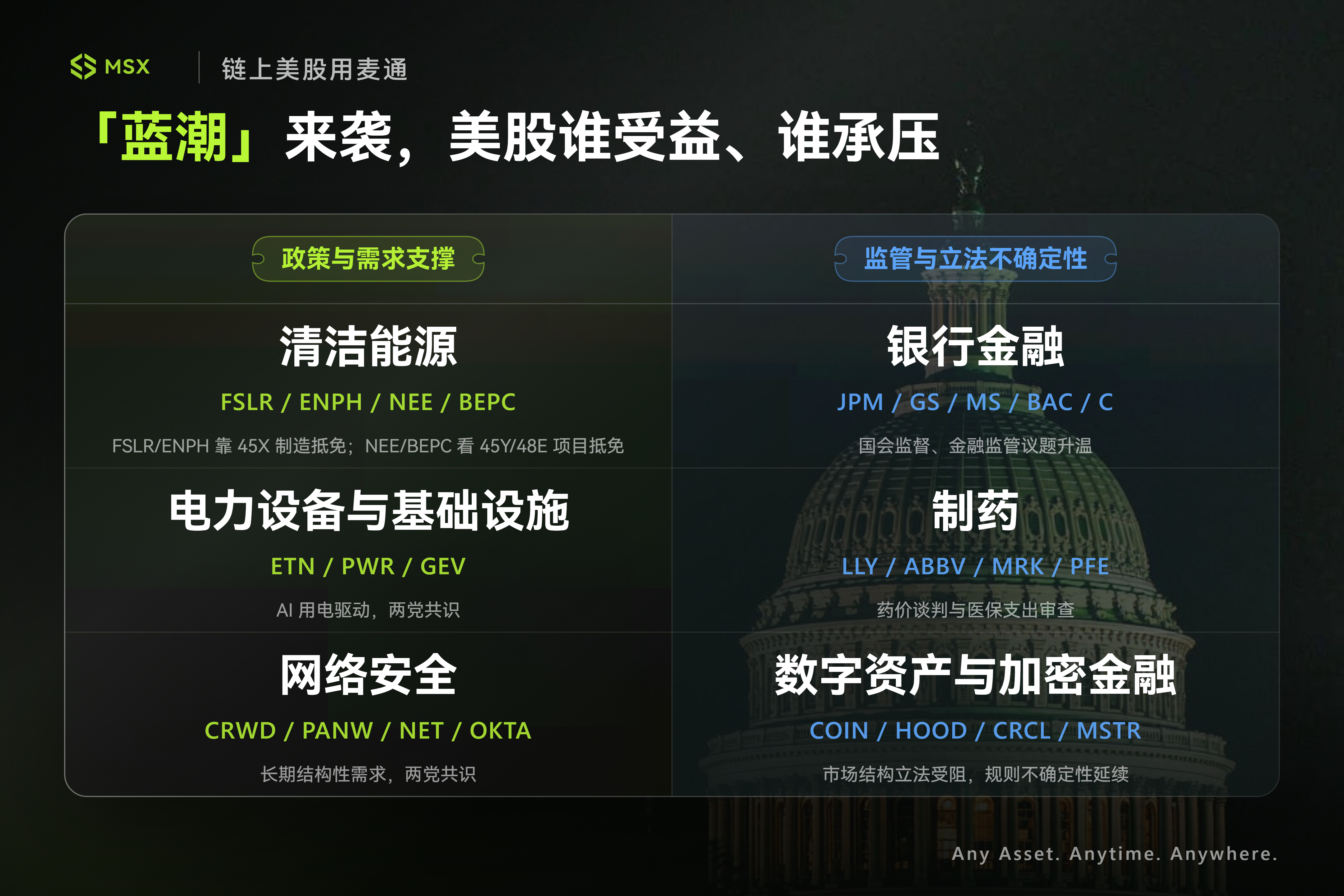
First, clean energy, including FSLR / ENPH / NEE / BEPC, for this sector, the blue wave more likely signifies marginal improvement in policy expectations rather than a comprehensive return of subsidies.
First Solar (FSLR) and Enphase Energy (ENPH) primarily involve solar modules, inverters, and domestic manufacturing supply chains in the United States, with a focus on the 45X manufacturing tax credits, tariffs, and supply chain policies; NextEra Energy (NEE) has both regulated utility operations and renewable energy generation; Brookfield Renewable (BEPC) mainly secures long-term returns through global renewable energy assets.
Next are power equipment and infrastructure, including ETN / PWR / GEV, which are not directly related to party changes but are guided by clear industry logic.
Eaton (ETN) provides power management and electrical equipment; Quanta Services (PWR) engages in power grid, transmission and distribution, and energy infrastructure construction; GE Vernova (GEV) covers generation equipment and grid technology; whether under Republican or Democratic governance, the AI competition and energy security will not easily exit America's policy agenda.
The ongoing expansion of AI data centers means that the U.S. must tackle issues such as power supply, substation construction, grid upgrades, and inadequate generation capacity, making this a bipartisan investment theme.
Finally, cybersecurity, including CRWD / PANW / NET / OKTA.
CrowdStrike (CRWD), Palo Alto Networks (PANW), Cloudflare (NET), and Okta (OKTA) cover areas such as endpoint security, cybersecurity platforms, cloud security, and identity verification; the proliferation of AI is expanding the attack surface for enterprises and governments, and security investments in cloud infrastructure, identity permissions, and critical systems will continue to increase.
The core driver for this sector is still the security demand of the AI era, along with long-term network defense investments by governments and businesses; the Democratic Party's strengthening of government cybersecurity supervision may provide additional policy attention, but it does not mean these companies will immediately gain new orders (see further reading "As AI Agents Flood Into Internal Networks: The 'Cybersecurity' Battlefield Has Changed").
2. Rising Regulatory and Legislative Uncertainty: Banking, Pharmaceuticals, and Crypto Finance
Compared to the industry demand logic on the left, the banking, pharmaceuticals, and crypto finance sectors are much more sensitive to congressional hearings, regulatory personnel, and legislative tug-of-wars.
First, the banking and financial sector, including JPM / GS / MS / BAC / C.
JPMorgan (JPM), Goldman Sachs (GS), Morgan Stanley (MS), Bank of America (BAC), and Citigroup (C) are important representatives of large U.S. financial institutions. With the Democratic Party regaining control of Congress, issues such as consumer protection, regulation of large financial institutions, capital requirements, and competition in financial markets may see renewed focus.
Particularly noteworthy is the competition between traditional banks and stablecoins; the banking sector has long worried that the reward mechanisms of stablecoins could siphon off traditional deposits, thus affecting the cost of funds and deposit bases for banks.
However, as core regulatory bodies like the Federal Reserve and the Treasury Department are still dominated by the executive branch, pressure from Congress is more likely to manifest as hearings and legislative constraints rather than a sudden reversal of regulatory rules.
Next, the pharmaceutical direction, including LLY / ABBV / MRK / PFE.
Eli Lilly (LLY), AbbVie (ABBV), Merck (MRK), and Pfizer (PFE) need to pay attention to changes in U.S. drug pricing, healthcare spending, and the drug supply system.
The Democratic Party has long advocated for reducing residents' healthcare costs. Eli Lilly, AbbVie, Merck, and Pfizer must confront this long-standing concern, with congressional oversight inevitably shifting back to Medicare drug price negotiations, PBM (pharmacy benefit manager) reforms, and the pricing power of large pharmaceutical companies.
However, the market also does not need to panic excessively; the healthcare negotiation mechanism established by the "Inflation Reduction Act" already exists, and the next two years will be more about strict supervision and expanding the scope of existing clauses rather than suddenly introducing a new round of radical price controls under a divided government.
Lastly, there are digital assets and crypto finance, covering COIN / HOOD / CRCL / MSTR.
This sector's policy sensitivity is especially noteworthy, but the business characteristics of the four companies are not the same. Coinbase (COIN) is a crypto trading and financial infrastructure platform; Robinhood (HOOD) is a comprehensive retail financial platform; Circle (CRCL) is a USDC stablecoin issuer; Strategy (MSTR) is a publicly traded company centered on Bitcoin treasury.
In September of this year, the Senate pushed to temporarily shelve the "CLARITY Act," which not only involves the Democratic Party's questioning of Trump's family's conflict of interest in crypto business but also concerns the conflicting interests between banks and crypto companies regarding stablecoin reward mechanisms.
Following the blue wave, this political game may become further complicated. For COIN and CRCL, the inability to clarify rules will affect business expansion and market expectations; HOOD is also influenced by traditional brokerage business; MSTR more depends on Bitcoin prices and its own financing capabilities.
3. The Truly Undervalued Variable: Where Will AI Data Centers Move?
This election also has an intersection worth studying: some states where the Democrats made breakthroughs happen to be important markets for data center construction and AI infrastructure investment in the U.S.
For example, states like Ohio, Kansas, and Maine not only appeared on the key turnaround list for this round of congressional elections but also involved local voting related to data center construction.
According to statistics from Ballotpedia, on November 3, a total of 41 local measures related to data center construction were voted on in ten states, of which the direction of 28 measures was to limit development, involving construction bans, approval suspensions, and increased local reviews.
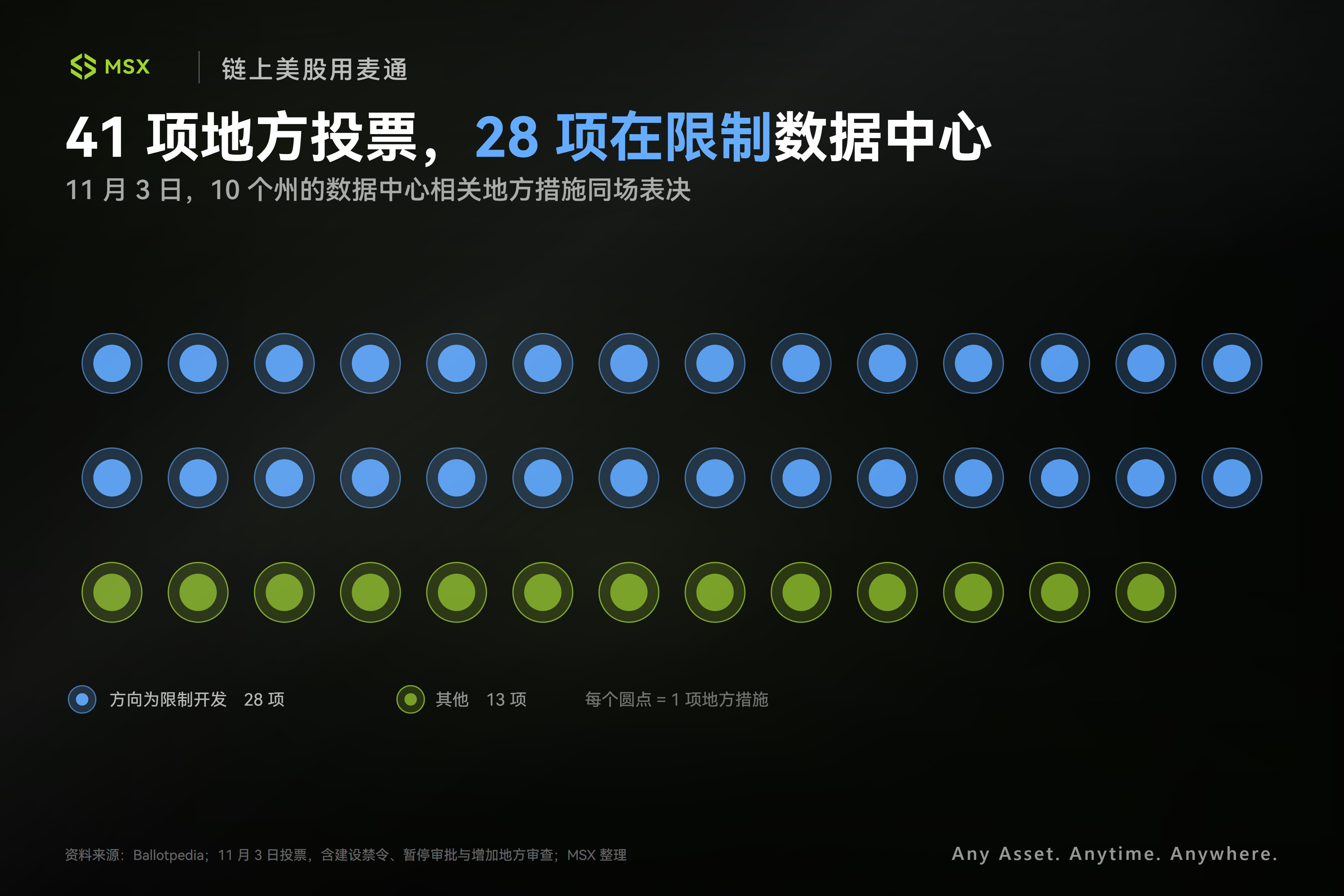
This reveals the increasingly sharp underlying contradictions of AI infrastructure in the U.S.: the U.S. does not lack the will to build AI, but the power consumption, water resources, and land consumed by data centers are igniting backlash from local voters.
In the past year, the Trump administration opened federal lands, accelerated environmental assessments and energy configurations to pave the way for computational power expansion; however, under the dual pressure of the blue wave and local public opinion, the hidden institutional costs of new large computing facilities in the U.S. are rising.
This also brings two breakthrough paths to the forefront:
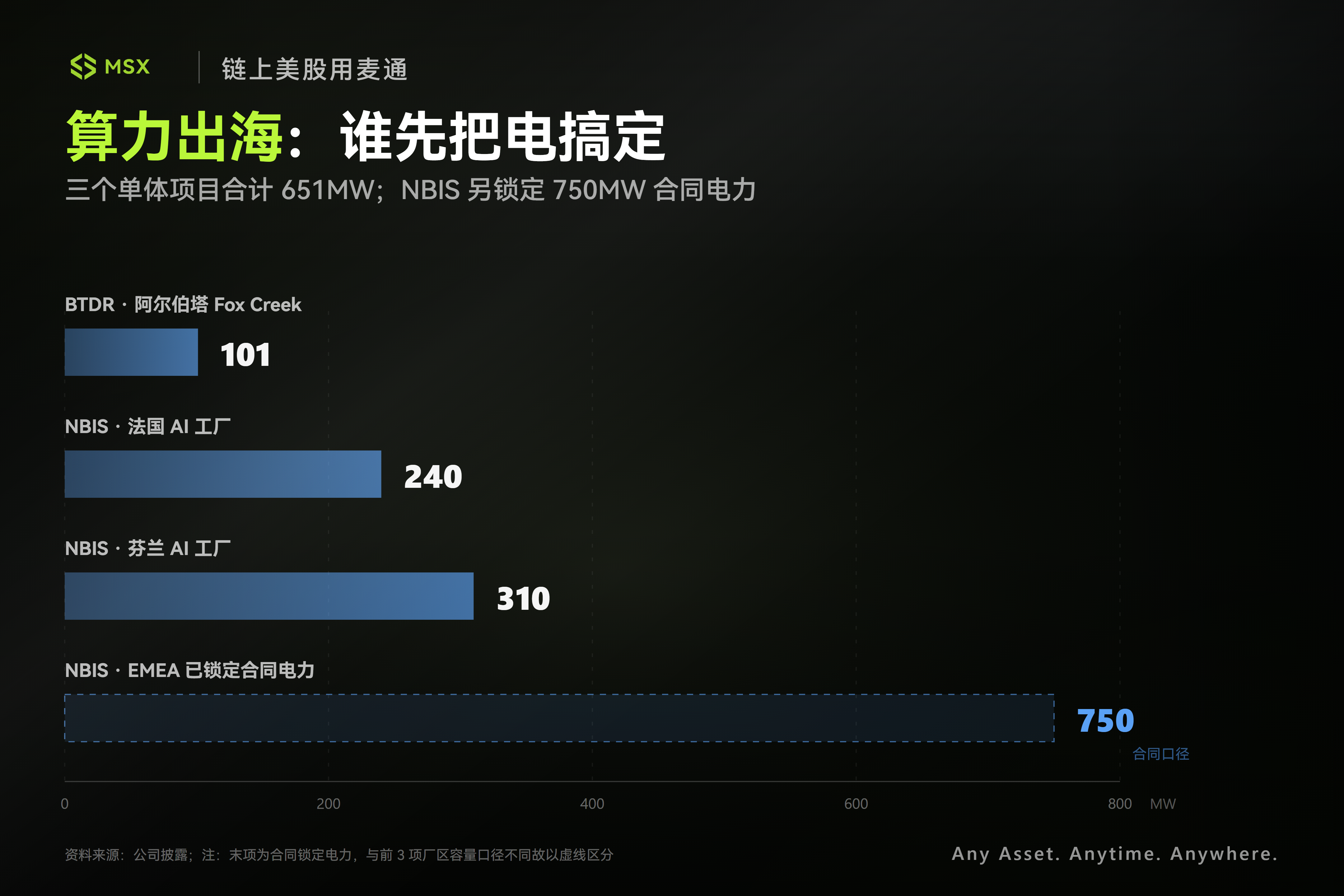
- Integration of computing power and energy "going overseas": To avoid queueing in the U.S. grid and community resistance, cross-regional targeting of low-cost electricity has become the new logic for computing infrastructure, for example, Bitdeer (BTDR) promotes a vertically integrated project in Fox Creek, Alberta, Canada, building a self-owned 101 MW natural gas power plant paired with about 100 MW of computing facilities, initially serving Bitcoin mining and reserving switching space for AI/HPC; Nebius (NBIS) takes a dual layout in Europe and the U.S., constructing AI factories with maximum capacities of 310 MW and 240 MW respectively in Finland and France, with over 750 MW of contracted power secured in the EMEA region, while its gigawatt-level AI factory in Independence, Missouri has already broken ground, using global asset allocation to hedge against approval and power bottlenecks in a single market;
- Nuclear power, as one of the few baseload power sources with bipartisan support, may undergo reevaluation: In June 2024, the U.S. Senate overwhelmingly passed the "ADVANCE Act" with a vote of 88 to 2, establishing a bipartisan consensus on nuclear energy development. In the face of high-density computing power's continuous electricity demand 24 hours a day, the longevity of existing nuclear power plants, capacity expansions, long-term power purchase agreements (PPAs), and small modular reactors (SMRs) will continue to attract capital premiums — however, due to lengthy approval and construction processes, nuclear energy is more suitable as a long-term bottom asset;
Finally, there is another variable that cannot be ignored: traditional oil and gas.
In this election, inflation and living costs were significant backdrops for the Republican Party's defeat; high energy prices directly affect residents' living costs and may in turn limit the government's energy policy space.
Overall, this round of "blue wave" primarily shifts the market from a "one-sided policy tailwind" to a "normalized institutional friction" in pricing over the next two years.
For U.S. stock investors, instead of excessively trading policy noise from Capitol Hill, it is better to allocate chips to those grid and security infrastructures that neither party can refuse, as well as computing power players who can transcend borders and solve power bottlenecks on their own.
免责声明:本文章仅代表作者个人观点,不代表本平台的立场和观点。本文章仅供信息分享,不构成对任何人的任何投资建议。用户与作者之间的任何争议,与本平台无关。如网页中刊载的文章或图片涉及侵权,请提供相关的权利证明和身份证明发送邮件到[email protected],本平台相关工作人员将会进行核查。


