Author: Prathik Desai (The Token Dispatch)
Translation: Deep Tide TechFlow
Deep Tide Guide: Tokenized deposits are becoming a key grip for global mainstream banks embracing blockchain, with platforms like JPMorgan's Kinexys achieving daily transaction volumes in the tens of billions. However, individual banks’ proprietary consortium blockchain ledgers limit tokenized deposits to isolated liquidity islands within single bank account systems.
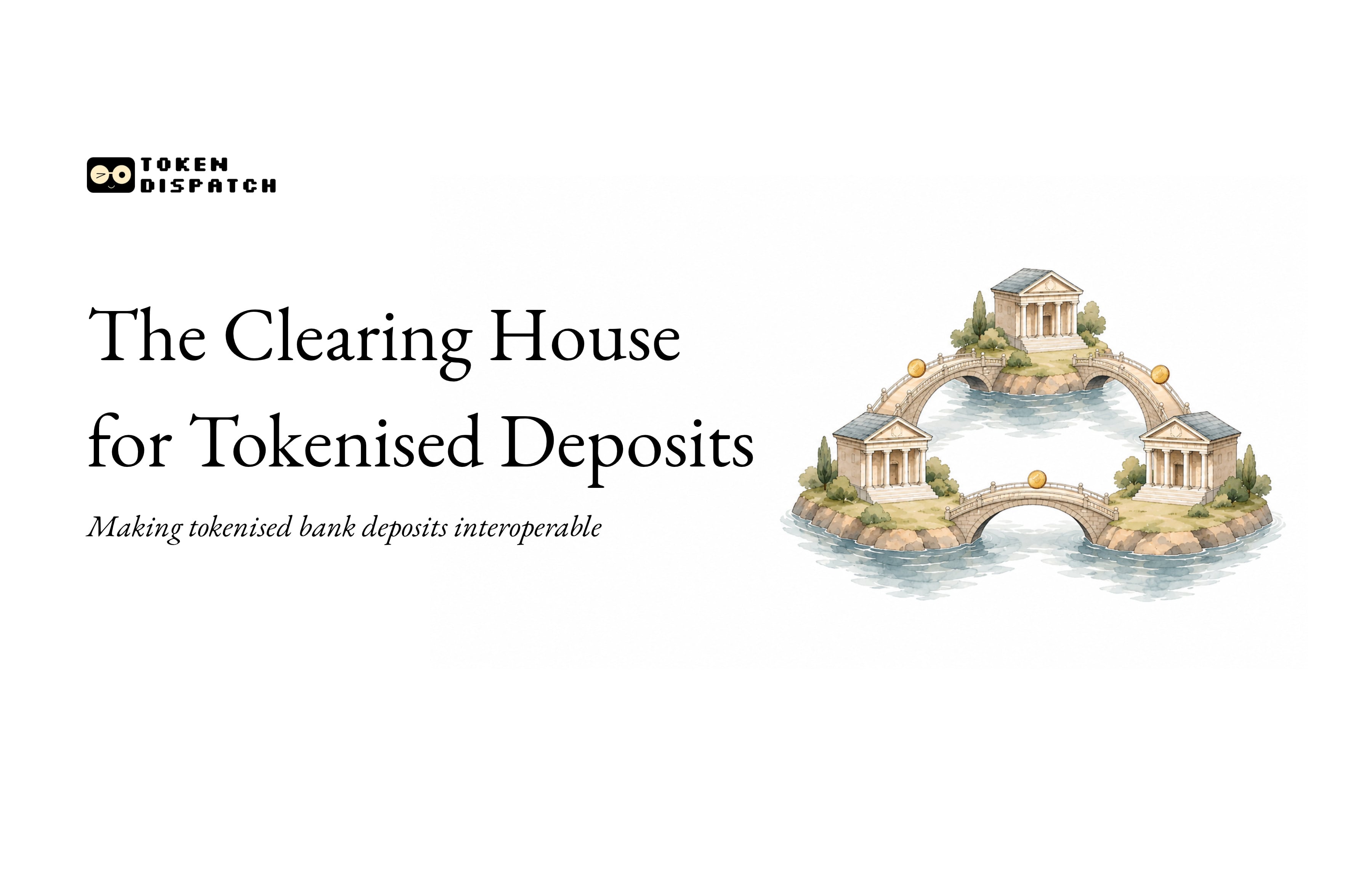
This predicament is strikingly similar to the historical emergence of centralized clearinghouses in New York in the mid-19th century, as banks dealt with the cumbersome task of bill clearing. Today, the U.S. clearinghouses that manage CHIPS and RTP have launched an on-chain money network, aiming to establish a unified interbank real-time settlement hub for all commercial banks in the nation.
Building an interoperable clearing layer for tokenized deposits is not only about the seamless alignment of the banking system with central bank reserve currency but also about creating a core moat for traditional financial institutions to counter private stablecoins and restructure the 24/7 real-time payment ecosystem.
Hello,
The core utility of currency depends on its liquidity.
Imagine transferring money to a friend who has an account at another bank: behind the scenes of the mobile banking app, the two banks complete settlement, maintaining the same value of funds in both accounts at all times.
In recent years, commercial banks have been reconstructing deposit forms to address a relentless digital world, leading to the emergence of tokenized deposits.
Giants like JPMorgan, Citibank, and HSBC have launched tokenized deposit services.
These tokenized deposits can circulate in real-time 24/7 and have programmability. However, they currently operate only within specific closed banking ecosystems.
Tokenized deposits essentially represent debt certificates of the issuing bank, making them unusable on the distributed ledgers of other banks.
Although tokenized deposits have programmability, the toughest challenge lies in how to connect them across different banking ecosystems.
In this article, I will delve into why breaking down banking barriers and allowing tokenized deposits to flow freely between different banks is the core where maximum value converges.
Now, let's get into the main text.
Re-emergence of the Era of Porters
On September 24, seven British commercial banks completed two mortgage refinancing transactions in a way that was unprecedented.
Borrowers' funds remained locked in their personal accounts accruing interest, and at the moment the transaction was finalized, the funds were released instantly, with no party needing to wait for settlement.
Seven banks, including Barclays, HSBC, Lloyds, and National Westminster, collaborated through a shared platform.
The UK Finance organization commissioned London-based software company Quant to build this network. Without this shared base, the tokenized deposits issued by each bank would have become isolated islands.
The Bank for International Settlements (BIS) also pointed this out in its report in September.
If interoperability is lacking, tokenized deposits cannot cross the "KYC boundary" of commercial banks.
This means that a token issued by my bank holds no meaning on the ledger of another bank because the latter has neither conducted a thorough review of the former nor agreed to accept the debt certificate from that bank.
This is the biggest bottleneck facing the current vision of asset tokenization.
Tokenized bonds or funds are only considered truly settled when instantaneous swaps occur between the asset side and cash side.
However, on the largest tokenized repo platform to date, although securities assets operate on-chain, cash settlement still relies on traditional banking clearing channels.
The global tokenized U.S. Treasury fund size has grown to about $14.5 billion, yet a majority of these funds still utilize the old traditional settlement methods.
But this is not an insurmountable dead end; financial history has provided solutions to similar problems.
In the early 1850s, commercial banks in New York sent porters across the city daily to deliver checks for interbank settlements.
As more banks opened, this point-to-point manual clearing network completely collapsed.
In 1853, banks joined forces to establish a unified clearinghouse that centralized net settlement for all payable checks on a daily basis.
This institution is now known as The Clearing House. It is jointly owned by about 25 of the largest commercial banks in the U.S., responsible for operating the two national core payment clearing systems, CHIPS and RTP.
Today, the new challenge facing banks is that tokenized deposits spread across various commercial bank ledgers must be able to instantly align with central bank legal reserve currency even on weekends.
To address this pain point, major banks are reaching consensus on establishing a shared universal layer for centralized processing of interbank clearing of different banks’ issued tokenized deposits.
On September 24, The Clearing House selected Quant through a bidding process to operate the orchestration layer of its "On-Chain Money" network.
This network is expected to officially open to all U.S. commercial banks in the first half of 2027.
Unprecedented Strategic Window
The clearing layer in financial infrastructure inherently has monopoly attributes.
Once a country’s banking system jointly establishes a unified rulebook and settlement location, this structure often remains unchanged for decades.
When The Clearing House launched the Real-Time Payments (RTP) network in 2017, it was hailed as the first new core payment system in the U.S. in over 40 years.
The basic logic of the industry is such: once the critical technology stack and clearing seat entry window open and core seats are occupied, that door shuts for an entire generation.
In 2016, after bidding, The Clearing House hired Vocalink, a company controlled by British banks, to build the RTP network. Vocalink had previously successfully created the UK's Faster Payments system.
Today, the RTP network processes approximately $7 billion in funds daily. A decade later, The Clearing House issued another request for proposals and selected another technology builder from London.
Unlike before, several foundational seats capable of retaining substantial value are currently being opened simultaneously.
The rise of tokenized currencies has forced every major banking system worldwide to confront and solve the same challenge within just 18 months.
On the same day, Quant successfully secured the two largest domestic tokenized currency infrastructure contracts in both the U.S. and U.K.
Meanwhile, the Society for Worldwide Interbank Financial Telecommunication (SWIFT) chose to build a shared ledger independently. Currently, 17 banks are participating in the pilot, and SWIFT expects to expand to at least 19 banks covering five major currencies by the end of 2026.
Tech giants like Chainlink, IBM, ACI, and Oracle are all competing to provide pathways for commercial banks to access this network.
Regional banks in the U.S. have jointly launched the Cari network built on ZKsync.
The European Central Bank (ECB) has completely avoided hiring private orchestration service providers, with its self-built Pontes link having gone live on September 21, directly using central bank reserve currency for the final settlement of tokenized assets.
So, what is the core value of this clearing hub seat? The answer is liquidity efficiency.
The CHIPS system, responsible for large payment clearings under The Clearing House, is expected to see daily average processed funds exceed $2 trillion in 2025.
Thanks to its multilateral real-time netting and hedging mechanism, commercial banks need only allocate about $96 billion in liquidity positions to complete settlements; without this mechanism, it would require as much as $442 billion in funds.
The Clearing House estimates that the system saves member banks up to $5.5 billion in funding costs annually. This is the core power of an excellent clearing layer: enabling the entire financial system to operate smoothly with a fraction of the funds originally required.
In contrast, the current state of tokenized deposits development shows that Morgan Stanley’s Kinexys, the largest bank token network, achieves a daily transaction volume of about $7 billion.
This scale only accounts for about 0.3% of CHIPS's daily transaction volume and is limited to JPMorgan’s internal clients. Industry leaders are still constrained by their walled gardens.
This huge gap represents a historic strategic opportunity. No matter how large a single bank is, it cannot fill this void alone; only a collaboratively built shared clearing layer can completely break the deadlock.
Who Will Capture the Value?
This new clearing layer will generate extremely large economic value.
The commercial logic of shared banking infrastructure has always been thus: the $5.5 billion savings from CHIPS flow back directly to its member banks. The Clearing House is owned by the banks that use it, and its pricing mechanism similarly serves this system.
Vocalink is a classic example of “technology builders earning development fees, while asset owners pocketing rent.”
It has built the fundamental network for both the UK Fast Payments and the U.S. RTP systems that facilitate trillions of dollars in circulation. In 2016, Mastercard acquired 92.4% of Vocalink’s shares for roughly $700 million, against the backdrop of its annual revenue of £182 million.
This huge premium entirely fell into the hands of the British banks that held Vocalink shares. While it represented a significant exit return for technology builders, the technology side has not gained long-term returns from the vast financial system they created.
Today, Quant has deeply embedded itself within the shared tokenized currency infrastructure of the world’s two top financial centers.
If all goes well, it will become a tech company with significant valuation potential. However, the banks’ alliance that leads and gathers these networks will capture far more value than the technology vendors themselves.
Therefore, the true ultimate winners are the conveners and rule-makers of the ecosystem, such as The Clearing House, UK Finance, and SWIFT.
Only institutions that master the rules of entry, pricing power, and clearing standard-setting authority can capture the vast majority of core value within the ecosystem.
The next beneficiaries will be the commercial banks that access the network earlier, including many small and medium-sized banks.
There are currently 4,238 banks insured by the Federal Deposit Insurance Corporation (FDIC) in the U.S., with 90% being community banks that cannot afford to independently operate blockchain nodes.
Quant’s solution for these small and medium banks to issue tokenized deposits through The Clearing House is the most compelling argument for a utility-level shared network against the “monopolistic situation led by JPMorgan.” Without this foundation, tokenized finance would become the exclusive privilege of Wall Street giants.
The potential structural risk is that although commercial banks eliminate fragmentation within their own clubs, they may replicate new liquidity barriers between different clubs.
Right within the U.S., there currently exist the networks of The Clearing House, the Cari network, the Kinexys system, and a planned stablecoin project by 21 banks set to launch in 2027.
Huntington Bank and KeyBank are both simultaneously engaged in the Cari and The Clearing House, illustrating the coexistence of fragmentation within the tokenized deposit ecosystem.
When commercial banks jointly master this “cross-chain translator,” it evolves into a public utility, and utilities often cannot retain excessively high tolls. Achieving underlying interoperability is where value will converge and where all core players will fiercely compete.
Interoperability sounds like a dull technical term, but its actual significance goes far beyond that.
It is essentially the watershed between “business gift cards” and “universal legal tender”: the former can only be used at the issuing merchant, while the latter is universally accepted at face value without conditions.
Modern banking systems have taken over a hundred years to establish the ironclad rule that "1 dollar from Bank A is completely equivalent to 1 dollar from Bank B." Central bankers refer to this as the "Singleness of Money."
Current tokenized deposits operating individually break this understanding, while interbank interoperable clearing mechanisms are the key puzzle pieces that will re-stitch it together.
From a purely technical perspective, making connections is not difficult; communication interactions between different ledgers can already be completed.
The real deep difficulty lies in establishing entry frameworks: which interbank-issued token certificates is one bank willing to accept? What risk control rulebook must be executed? Where exactly does final clearing settle?
The UK provides the answer through settlement with central bank reserves, the ECB chooses to build direct connection channels on its own, while in the U.S., the clearinghouse is drafting rule guidelines, with Quant responsible for building the underlying interbank dispatch switchboard.
If the global banking system can successfully solve this dilemma, the financial world will usher in several profound changes.
First, money will no longer be a slave to time.
In the traditional system, a transfer initiated on Friday evening often stalls in the clearing channel until the following Monday, as the settlement system behind the scenes shuts down for the weekend. Financial officers of businesses are forced to keep large amounts of idle cash as a buffer to cope with the settlement vacuum period.
Once banks enable real-time cross-bank instant clearing around the clock, this dormant liquidity will be completely reactivated.
Second, tokenized assets will finally welcome a true cash settlement base.
The tokenized U.S. Treasury fund with a scale of $14.5 billion, along with the repo and bond markets behind it, will be able to achieve instant delivery versus payment (DvP) on the same chain track with fiat fund.
The counterparty risk in traditional trading, where “one party has delivered the asset while the other party's cash has yet to arrive,” will be completely reduced to zero. This is the core value that large financial institutions care about in tokenization and represents a long-missing piece on the fiat side.
Third, asset scale will no longer constitute an insurmountable moat.
The reason JPMorgan can self-establish a token network relies entirely on its large self-operated client base, which small community banks cannot hope to replicate.
Shared infrastructure enables the 90% of small and medium institutions that account for the total number of U.S. banks to gain tokenized financial service capabilities equal to those of top Wall Street banks at the same time.
The more far-reaching impact lies in the restructuring of the competition landscape.
The decentralized stablecoins have conquered territories in their first ten years because their core selling point is that dollars should transfer freely across any entities at all times.
Tokenized commercial bank deposits with interoperability, while fully inheriting this 24/7 circulating characteristic, perfectly retain federal deposit insurance, interest-earning demand deposits, and compliant credit expansion capabilities, thus forming a powerful downward impact on private stablecoins.
Within ten years, the financial community will no longer deliberately mention the concept of “tokenized deposits.”
It will completely merge with ordinary bank deposits, just as no one today specifically emphasizes “electronic payments.”
End customers will never need to directly perceive the underlying clearing and settlement layer. This property of an invisible infrastructure that subtly nourishes is what endows it with unparalleled commercial value.
This concludes today's content; see you next time.
Stay curious, Prathik
免责声明:本文章仅代表作者个人观点,不代表本平台的立场和观点。本文章仅供信息分享,不构成对任何人的任何投资建议。用户与作者之间的任何争议,与本平台无关。如网页中刊载的文章或图片涉及侵权,请提供相关的权利证明和身份证明发送邮件到[email protected],本平台相关工作人员将会进行核查。


