Author: Alea Research
Translation: Shenchao TechFlow
Shenchao Guide: In the fierce competition for Ethereum Layer 2, the underlying open-source codebase has gradually evolved into a public good, making it difficult to build long-term commercial barriers relying solely on technical forks. However, Optimism is paving a brand new enterprise-level commercialization path: packaging its core engineering development and fully managed operational capabilities into high-availability services (OP Enterprise), charging major giants like Sony, Kraken, Uniswap, and Coinbase high maintenance service fees and SLA guarantee fees.
At the same time, Optimism is injecting the real cash flow generated by its created protocols into the token economy system. Through a transparent on-chain governance mechanism, half of the profits generated from the super blockchain network and enterprise services are mandated to be used for monthly public market off-market buybacks of OP tokens, providing the most direct value capture support for token holders.
With South Korea's financial regulation officially allowing tokenized securities (STO) in 2027, several mainstream financial institutions in Korea are fully laying out based on OP Stack. From technical outsourcing to real revenue buybacks, to the on-chain settlement of traditional financial compliant assets, Optimism's business map is undergoing a profound qualitative change.
Soneium, a blockchain under Sony, comes with a commercial contract that clearly states high availability metrics.
The Optimism Foundation guarantees the daily operation and maintenance of the chain with a 99.9% uptime guarantee. If the service commitment is not met, it must provide service deduction points.
Kraken also handed over the operation of its Ink chain's sequencer to the foundation in July, and subsequently Uniswap Labs' Unichain adopted the same strategy.
Coinbase is gradually migrating Base to self-developed client software but continues to purchase the highest level of technical support services from Optimism.
Optimism builds OP Stack as a public good while commercializing it by charging enterprises that maintain stable operations on the chain.
Its own public chain is also rapidly expanding, with the total value locked (TVL) on OP Mainnet having surged by 69.2% since January 1.
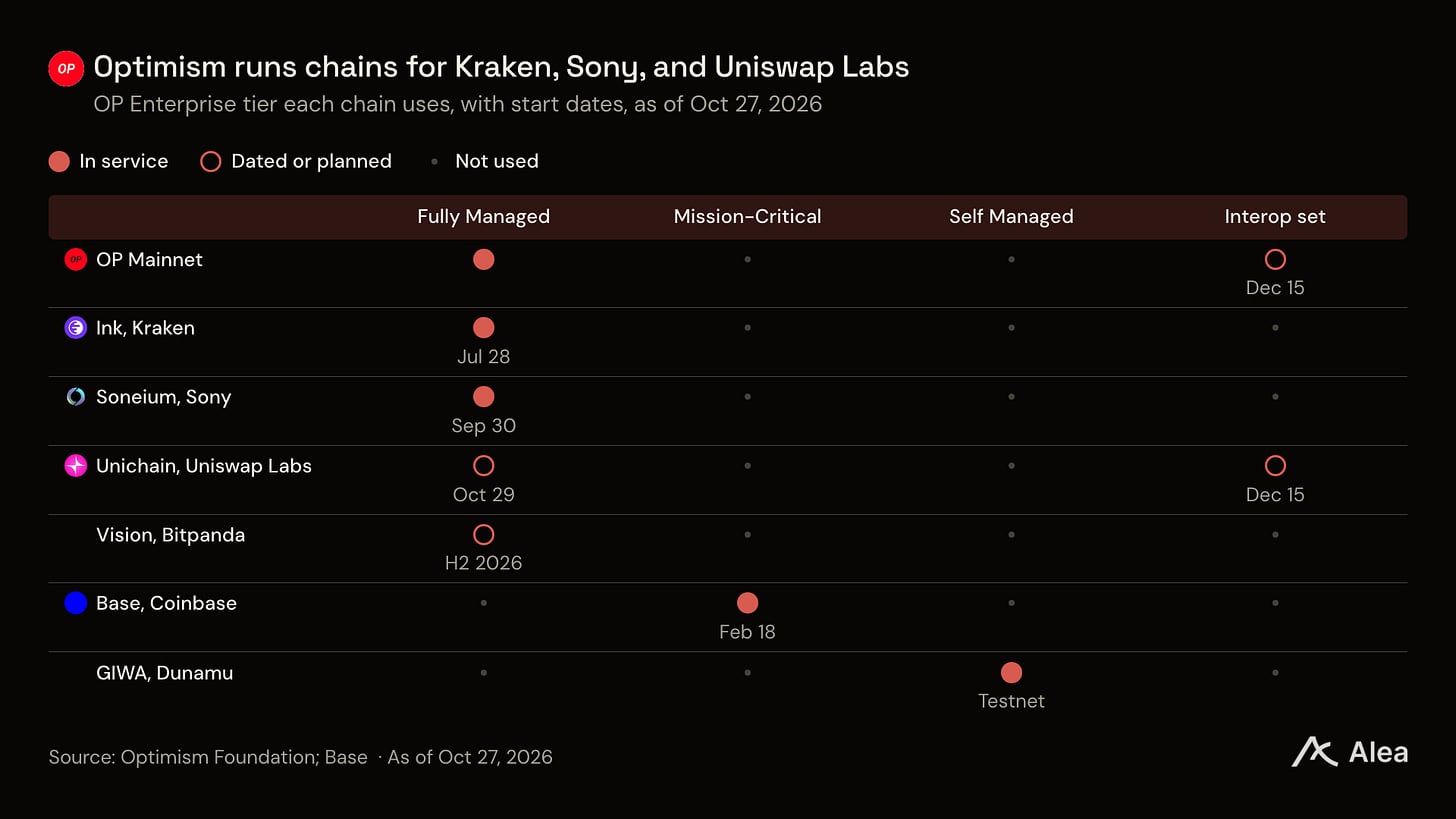
Image: Fully Managed guarantees 99.9% availability, Mission-Critical provides 99.95% availability, Self Managed is run by clients’ self-built hardware
Key Points
• Optimism provides full operational services for blockchain-owning enterprises: This year, Ink, Soneium, and Unichain have all transferred the operation of their sequencers to the Optimism Foundation, while Base continues to purchase top-tier technical support from Optimism during the construction of its self-developed client.
• Official operations chains lock assets of $2.49 billion: Outside of Base, chains operated by Optimism account for 43.0% of the asset value in the OP Stack ecosystem. As of the closing on September 30, the single chain scale of OP Mainnet reached $1.97 billion; and among the total scale of $21.8 billion across the entire tech stack, Base occupies $16 billion.
• OP Mainnet’s locked value increased by 69.2%: From January 1 to September 30, its TVL climbed to $483 million. Among them, ether.fi migrated its crypto card product and $220 million TVL from Scroll in just three days.
• Korean market establishes a timeline for implementation: KB Securities in Korea plans to issue tokenized money market funds (MMF) on OP Mainnet, with February 4, 2027, set as the official launch day for Korea’s first tokenized securities.
• Half of super chain income is used for OP buybacks monthly: As of October 27, the Collective treasury has accumulated 14.39 million OP. From the perspective of valuation multiples, OP Stack has a fully diluted valuation of $25.5 million for every $1 billion in locked assets, while the corresponding valuation for Arbitrum's 18 chains reaches as high as $140.4 million.
What OP Enterprise is selling
OP Enterprise, an enterprise-level service, was officially launched in January this year, offering three different service levels.
In the fully managed model, the foundation and OP Labs are responsible for deploying, managing, and upgrading the on-chain network, explicitly promising 99.9% uptime in the contract and providing emergency response within 30 minutes in case of significant failures.
Base purchases the highest specification of mission-critical service, raising the availability commitment to 99.95%, shortening emergency response time to 15 minutes, and providing dedicated technical account managers.
The self-managed model allows clients to manage their underlying hardware facilities, but OP Labs still promises to respond to technical issues within one hour.
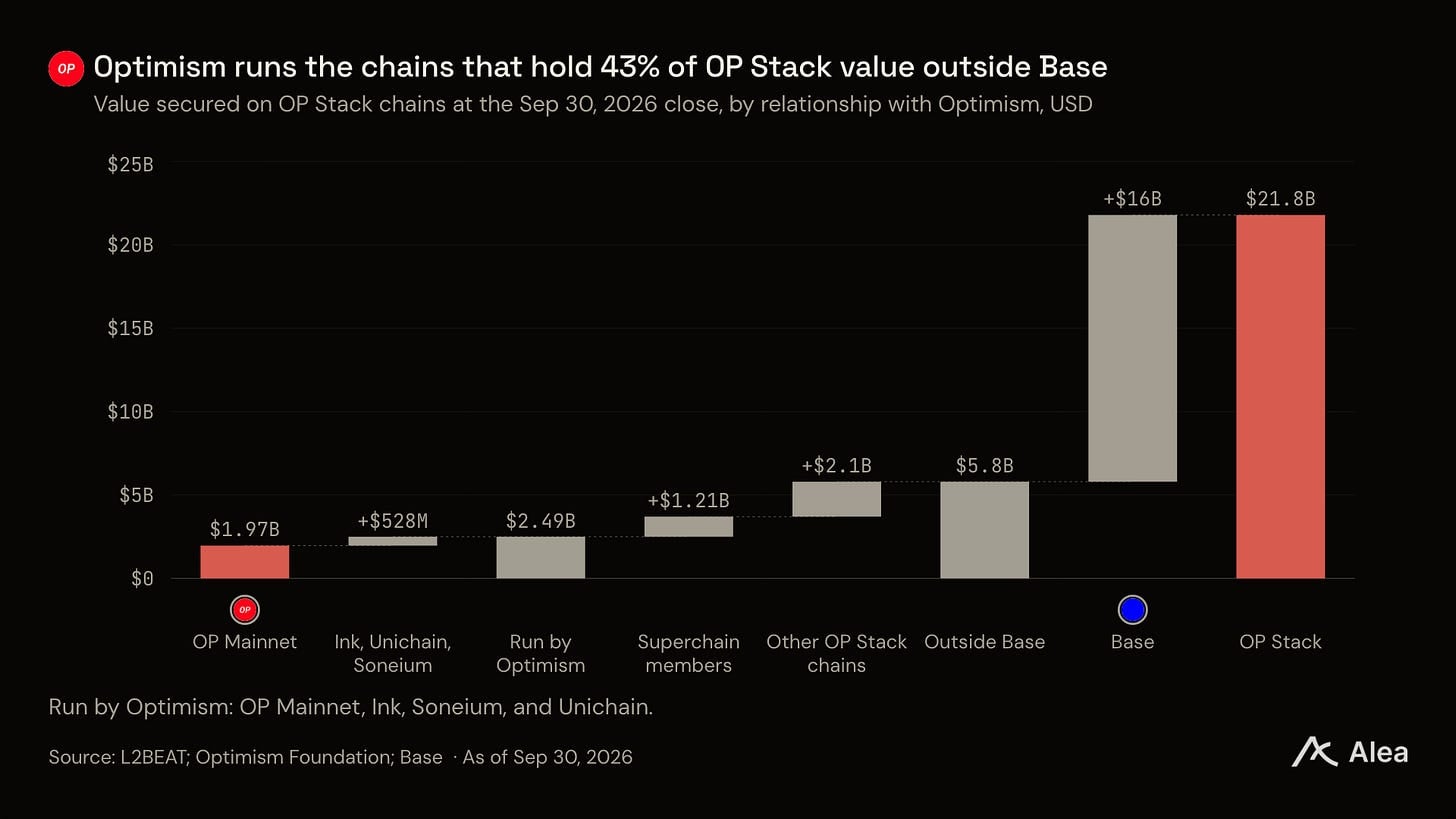
Image: Base purchases top-tier support from Optimism while transitioning to self-developed clients, Unichain is included in the Optimism managed chain camp
The Ink chain under Kraken completed its transition from Gelato on July 28, while Sony's Soneium officially accessed fully managed services on September 30.
During the handover of the sequencer, Uniswap Labs continues to retain the revenue-sharing arrangement of Unichain and Collective.
The Vision chain under European fintech platform Bitpanda plans to launch in the second half of 2026; while Dunamu, the parent company of South Korean exchange Upbit, operates GIWA in self-managed mode, with the testnet having completed about 100 million transactions.
Companies controlling their own blockchains can fully retain user sequencer fees, ecological applications, and asset deposits within themselves, a business model favored by major cryptocurrency exchanges.
OKX is also migrating its X Layer from Polygon CDK to OP Stack in December, joining the super chain camp represented by Kraken's Ink.
Continuous inflow of assets into OP Mainnet
The total value locked (TVL) on OP Mainnet has strongly increased from $285.8 million at the end of 2025 to $483.4 million as of September 30, with an increase of 69.2% since January 1.
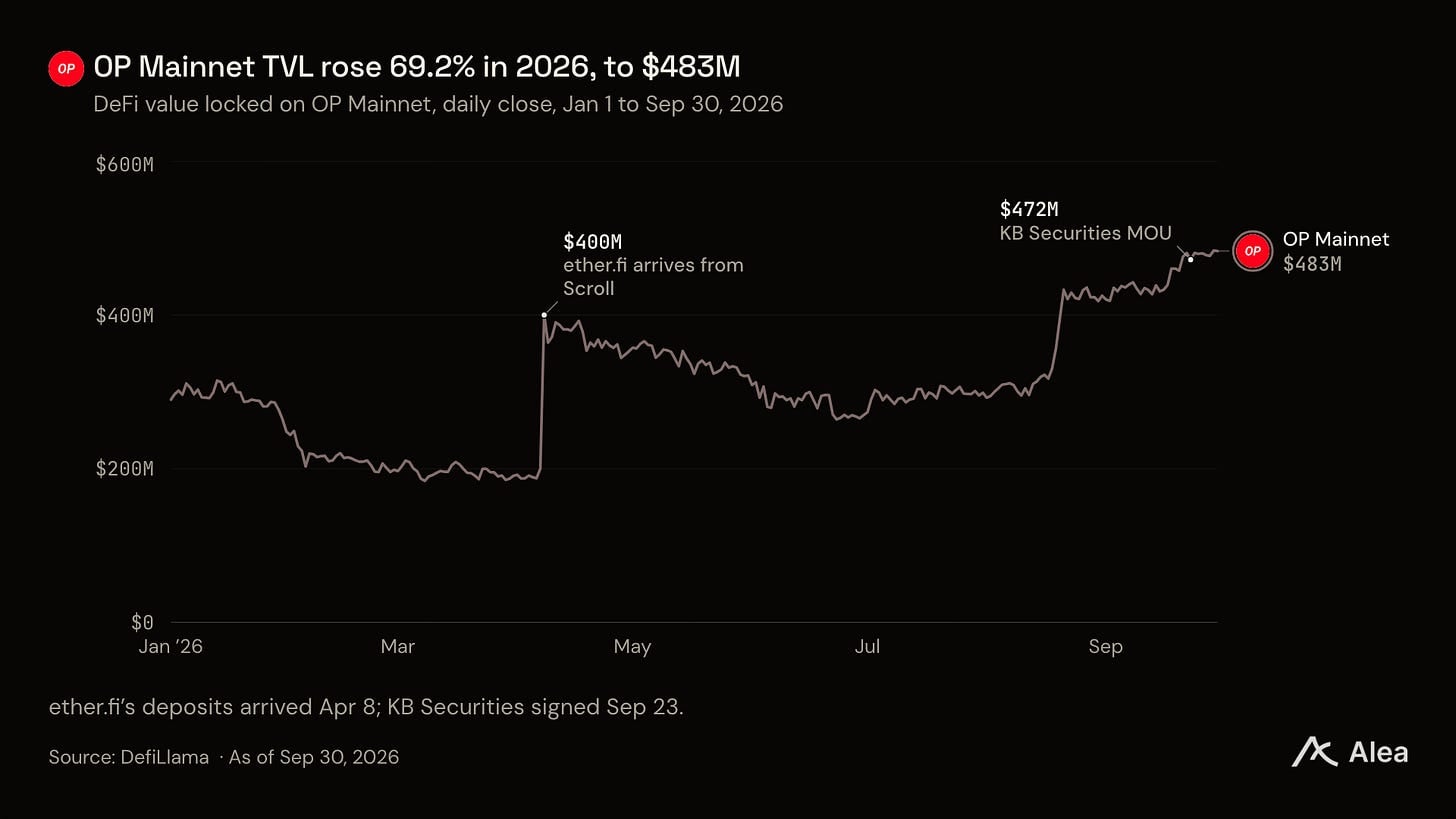
Image: OP Mainnet's locked value trend shows the influx of funds from ether.fi migration and KB Securities collaboration
Most of the growth occurred on April 8. At that time, the liquid staking protocol ether.fi migrated its crypto card product and $220 million TVL from Scroll within just three days.
Throughout the migration process, 70,000 active Visa crypto debit cards operated smoothly with zero downtime switch.
Two leading South Korean securities firms are planning to launch compliant financial products on the same network.
KB Securities is planning to issue tokenized money market funds on OP Mainnet in partnership with tokenization pioneer Securitize, which will be fully responsible for tokenized minting, fund administration, and transfer registration.
Meritz Securities also signed a cooperation agreement on October 21 to conduct in-depth research on issuing and distributing compliant tokenized assets on the OP Stack network, including OP Mainnet.
Korean market opens on February 4
Currently, South Korea has 11.3 million verified cryptocurrency users, but its local banks and brokerage firms have previously been unable to conduct cryptocurrency asset trading due to regulatory restrictions.
On September 4, regulators opened a new pathway for financial institutions: the South Korean Financial Services Commission (FSC) established February 4, 2027, as the official launch date for the first phase of tokenized securities (STO).
The first phase includes institutional-level money market funds, bonds, and split-type fragmented investment products, with the public opinion consultation period for the relevant regulatory draft ending on November 11.
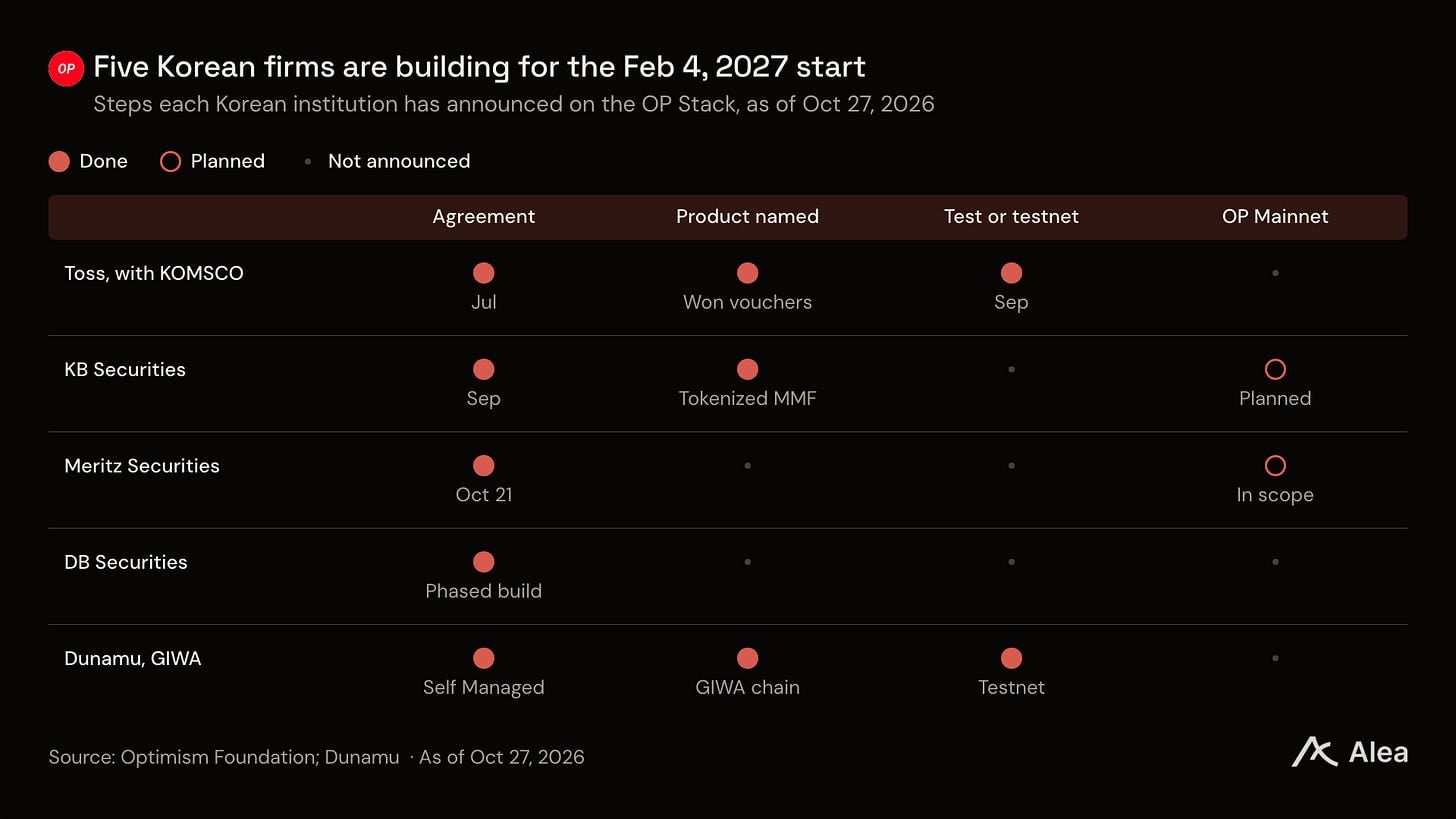
Image: Specific progress of five South Korean financial institutions advancing tokenized securities business based on OP Stack
Before the above deadline arrives, five well-known South Korean companies have announced research and development efforts based on OP Stack, with parties currently at different stages of business advancement.
In September, the digital finance platform Toss and the Korea Minting and Security Printing Corporation (KOMSCO) completed a full-process electronic voucher payment test, achieving instant completion of consumption and on-chain settlement within a single transaction.
DB Securities is also promoting phased system development. Each company has chosen a compatible architectural model based on the characteristics of its initial product: KB Securities and Meritz Securities chose a shared network model, while Dunamu opted to build a dedicated independent chain.
Before the official launch of the tokenized market in Korea, Optimism and Uniswap Labs plan to achieve direct cross-chain transfer of native ETH between OP Mainnet and Unichain on December 15, a proposal currently awaiting approval through on-chain governance voting.
How protocol fees convert to OP buybacks
The gas fees paid by OP Mainnet users consist of four parts: base fee, priority fee, data publishing fee to Ethereum L1, and operator fee.
After paying the necessary data availability cost to the Ethereum mainnet, the chain transfers all net profits to the Collective treasury;
while the member chains of the super chain must pay 2.5% of their total protocol revenue or 15% of net profits (whichever is higher).
On Unichain, the fee vaults inject funds into the FeeSplitter contract, proportionally returning L1 costs to the chain operators, paying a designated share to Optimism, and allocating the remainder to Uniswap Labs.
Meanwhile, OP Enterprise corporate clients directly pay technical support and operational service fees to the Optimism Foundation.
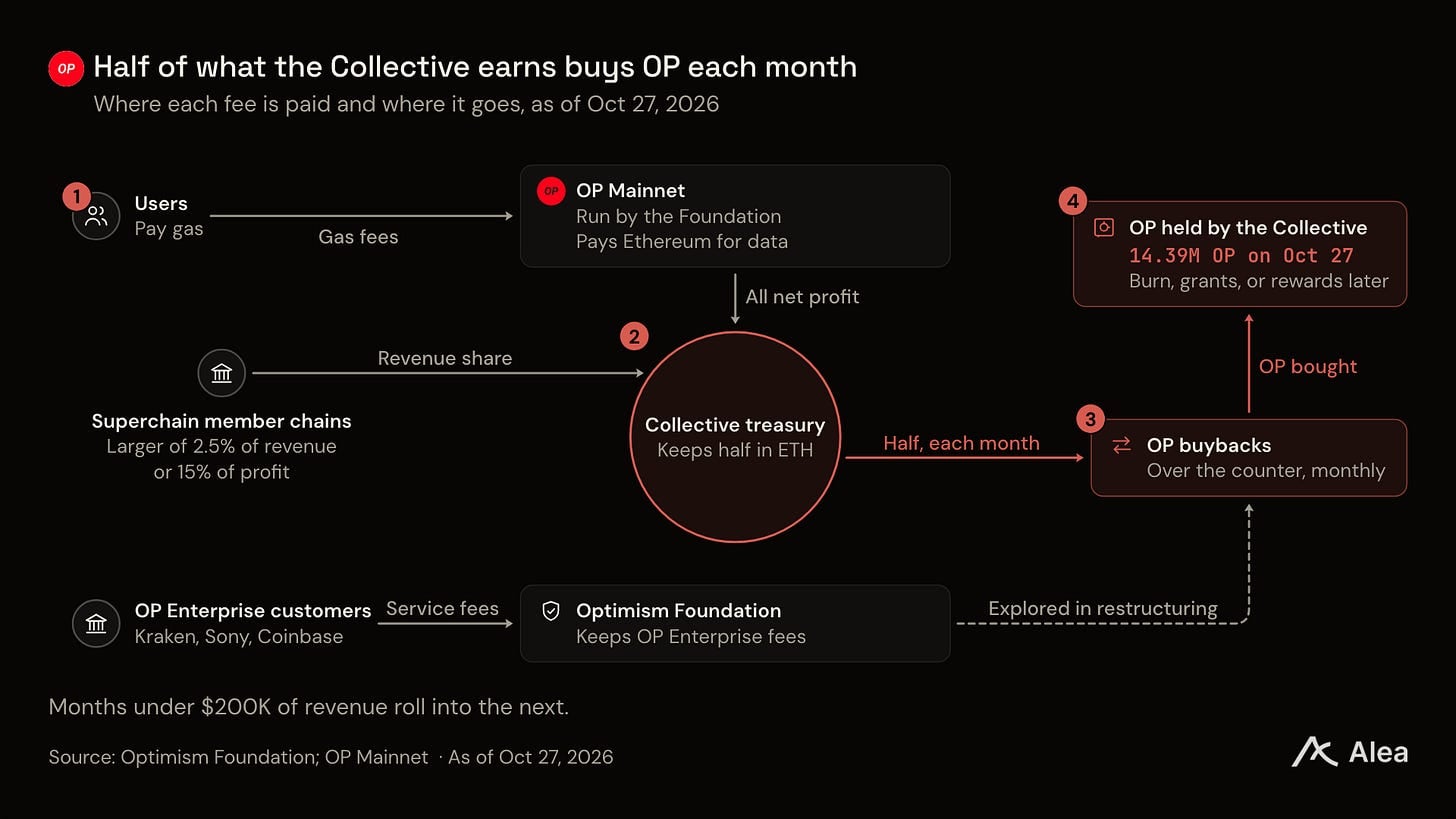
Image: Flow of Optimism protocol fees and monthly OP token buyback execution mechanism framework
Every month, exactly half of the total revenue from the Collective protocol is used to buy back OP tokens through over-the-counter (OTC) transactions within the established execution window, without considering price fluctuations.
Collective will securely store the OP tokens obtained from buybacks in the treasury, and future community governance can decide whether to burn them, use them to fund ecological growth, or distribute them as dividend rewards to participants securing the network by staking.
Buybacks funded by first-quarter income totaled 513.9 ETH to purchase 9.45 million OP; the buyback delivery of 4.94 million OP from the fourth batch was also successfully completed on October 1.
As of October 27, the Collective treasury held a total of 14.39 million OP, accounting for 0.63% of the total circulating supply of the token.
The tightening of the token supply side is equally significant.
In the year ending April 2026, the governance fund released only 13.4 million newly minted OP to the market (compared to 28.7 million in the previous year), with retro funding releasing 14.2 million (down from 20.3 million in the previous year), while airdrop releases amounted to zero.
Moreover, when Base ends its original revenue-sharing arrangement, it proactively relinquished all unallocated parts of a total of 118 million OP funding quota.
Currently, service fees paid by OP Enterprise corporate customers go directly to the foundation. As the foundation reorganizes and optimizes the legal entity structure of Collective, it is exploring the possibility of including this significant corporate cash flow into the token buyback pool as well.
Market valuation pricing for super chains
Using the scale of locked assets protected and carried by the technology stack as a benchmark, OP's current trading valuation multiple is less than one-fifth of ARB’s.
As of the closing on September 30, the market assigned a fully diluted valuation (FDV) of only $25.5 million for every $1 billion in locked assets on OP Stack;
in contrast, across all 18 chains in the Arbitrum ecosystem tracked by L2BEAT (including Robinhood Chain), ARB’s valuation corresponds to an astonishing $140.4 million for every $1 billion in locked assets.
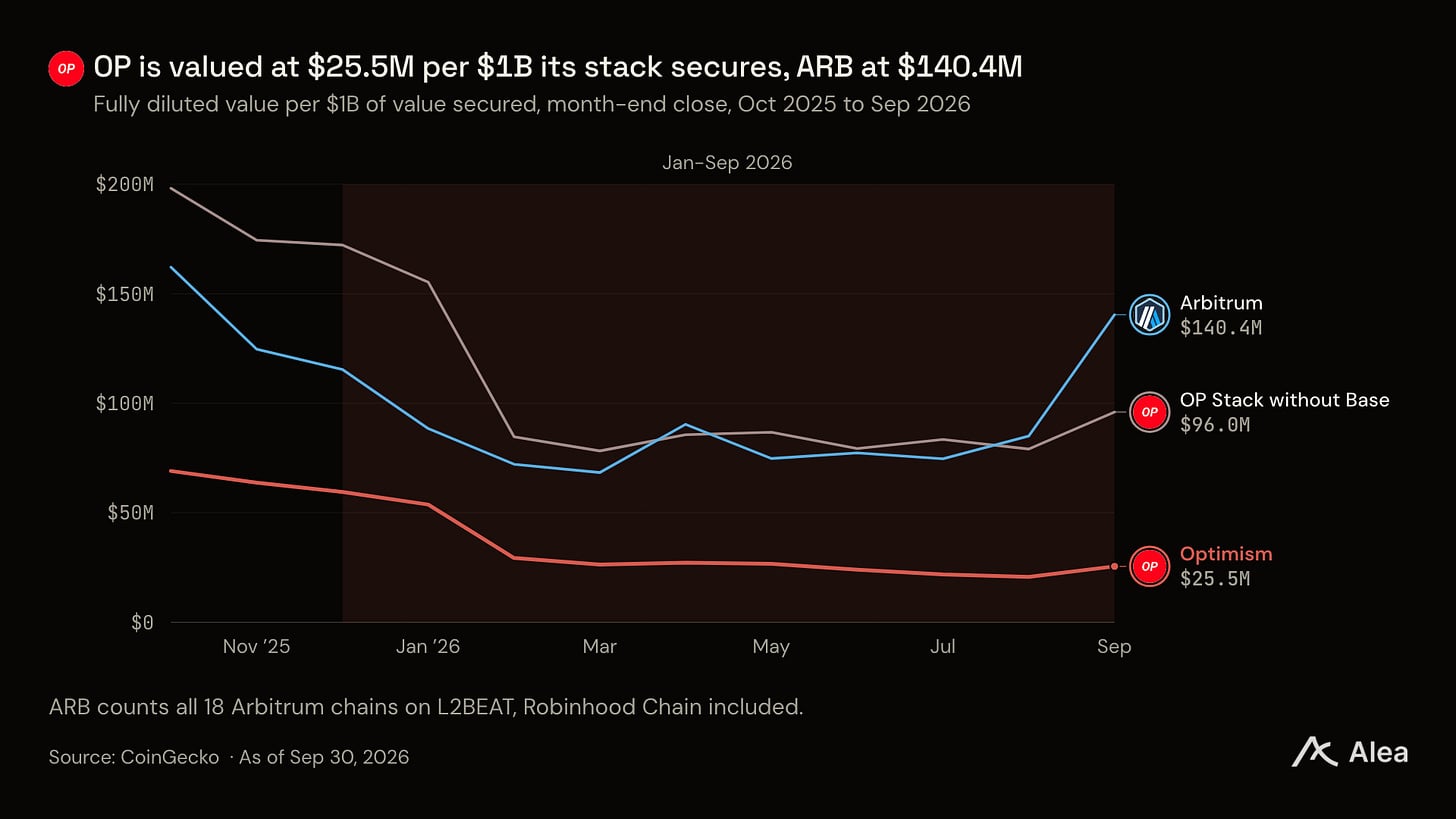
Image: Comparison of OP and ARB's fully diluted valuation multiples relative to locked values in each ecosystem
Even if excluding the large Base, OP's valuation multiple remains significantly lower than ARB's:
Based solely on the $5.8 billion in locked assets on the remaining OP Stack chains, OP has a fully diluted valuation of $96 million for every $1 billion of protected assets, which is about two-thirds of ARB's valuation multiple.
On October 27, OP closed at $0.1118, an accumulated increase of 36.4% compared to its low of $0.0820 reached on August 18;
its 30-day average price also rose from $0.089 on August 20 to $0.134 on October 21.
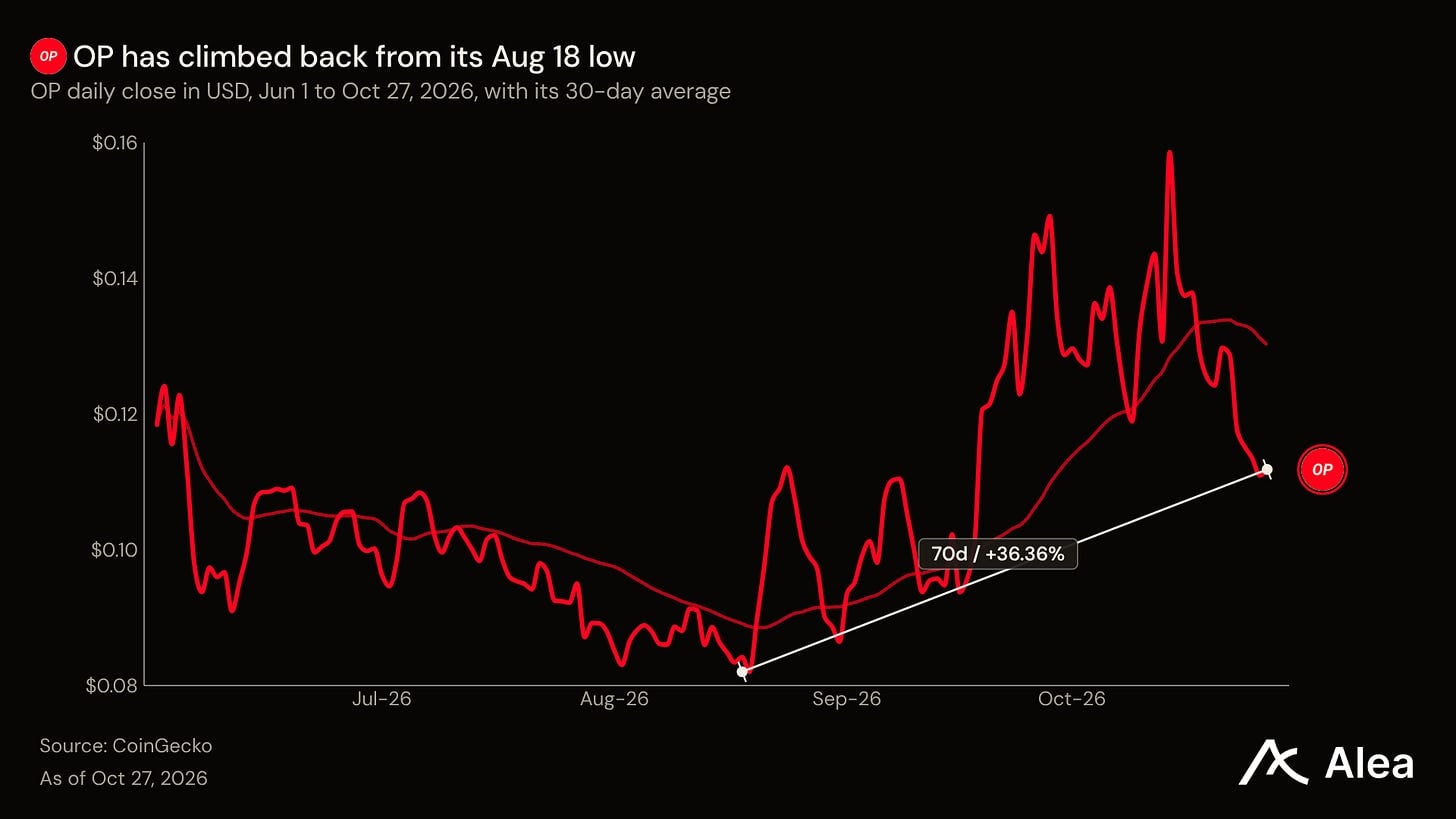
Image: Daily closing price of OP and the 30-day moving average trend has rebounded over 36% since the low on August 18
Scenario evaluation: How much OP can corporate service fees buy back?
Currently, the buyback budget mainly relies on network revenue sharing.
From January to September, Collective recorded a total revenue of 1115 ETH, with Base contributing 849 ETH (all paid by March).
Since April, the average monthly revenue is approximately $29,500; calculated at the closing price of $0.1118 on October 27, this amount could buy back approximately 0.14% of the circulating OP tokens on the secondary market annually.
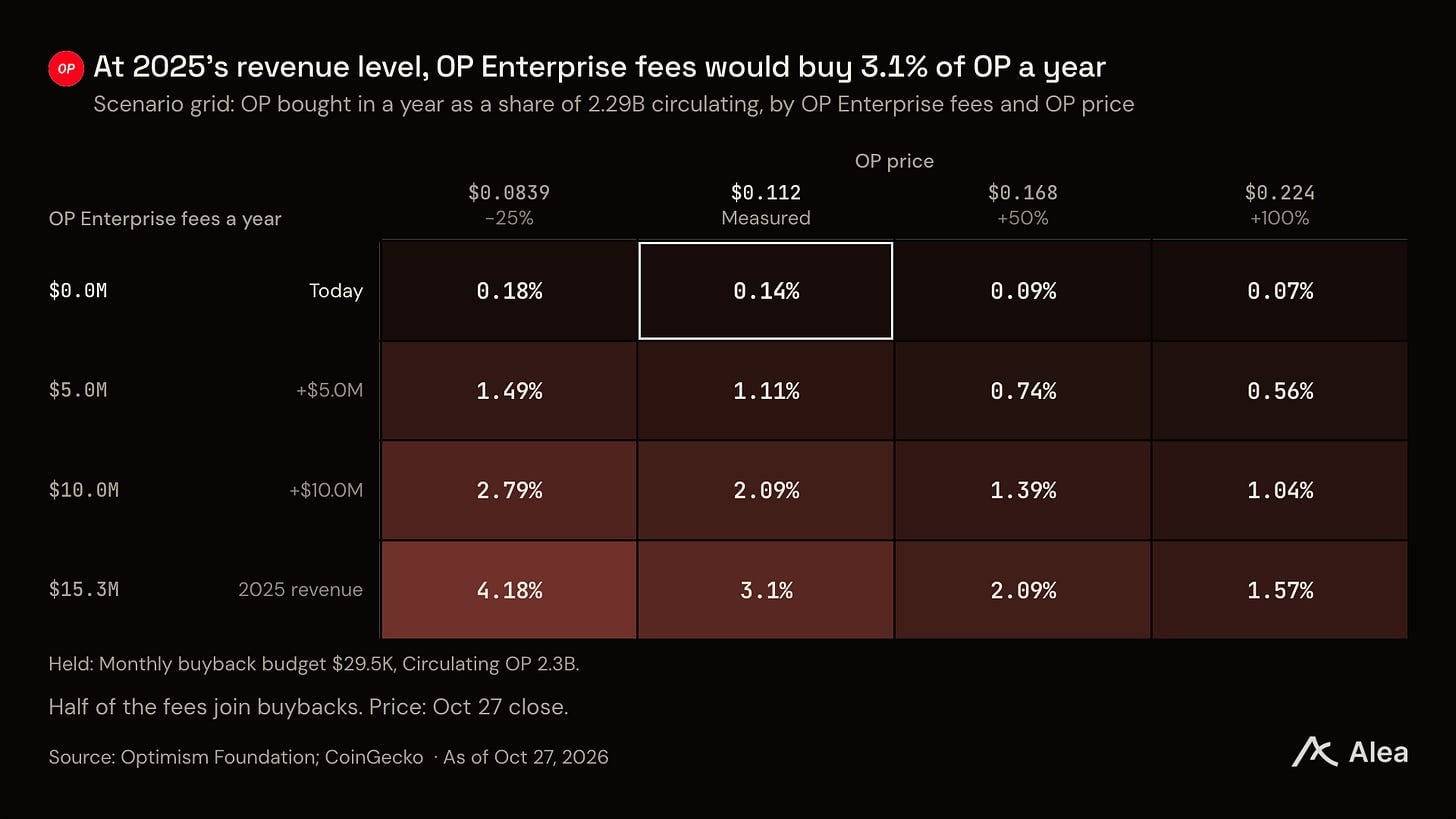
Image: Scenario analysis of OP buyback as a proportion of circulating supply under different token prices and enterprise annual fee scales
However, the addition of OP Enterprise corporate service fees will fundamentally restructure the buyback volume.
If half of the corporate service fees are allocated to token buybacks according to existing revenue-sharing practices, each $5 million increase in annual fee scale could buy back nearly an additional 1% of the circulating OP annually.
If corporate service fees reach the $15.3 million revenue level set by Collective in 2025, the annual buyback proportion could soar to 3.1% of the circulating supply.
The foundation plans to issue 272.9 million OP to the circulating market within the year ending in April 2027, most of which will come from the ecological development fund tied directly to OP Enterprise business expansion and OP Mainnet ecological prosperity.
Optimism successfully transforms the underlying code that drives the operation of 54 mainnet chains into a mature commercial service that attracts giants like Kraken, Sony, Uniswap Labs, and Coinbase to pay for it.
For OP, the next core focus is whether the physical legal restructuring can quickly finalize the allocation of these corporate service fees.
The comprehensive launch of the Korean market on February 4, as well as the planned native cross-chain interoperability between OP Mainnet and Unichain on December 15, will jointly demonstrate the astonishing speed of expansion of this corporate customer list to the market.
免责声明:本文章仅代表作者个人观点,不代表本平台的立场和观点。本文章仅供信息分享,不构成对任何人的任何投资建议。用户与作者之间的任何争议,与本平台无关。如网页中刊载的文章或图片涉及侵权,请提供相关的权利证明和身份证明发送邮件到[email protected],本平台相关工作人员将会进行核查。


