Author: AiPlot Research Institute
Focus: RWA / Digital Assets / In-depth Analysis of Financial Infrastructure
1. Investment Conclusion: The Core Asset of Robinhood Chain is Not a Chain, but a Distribution Entry Point
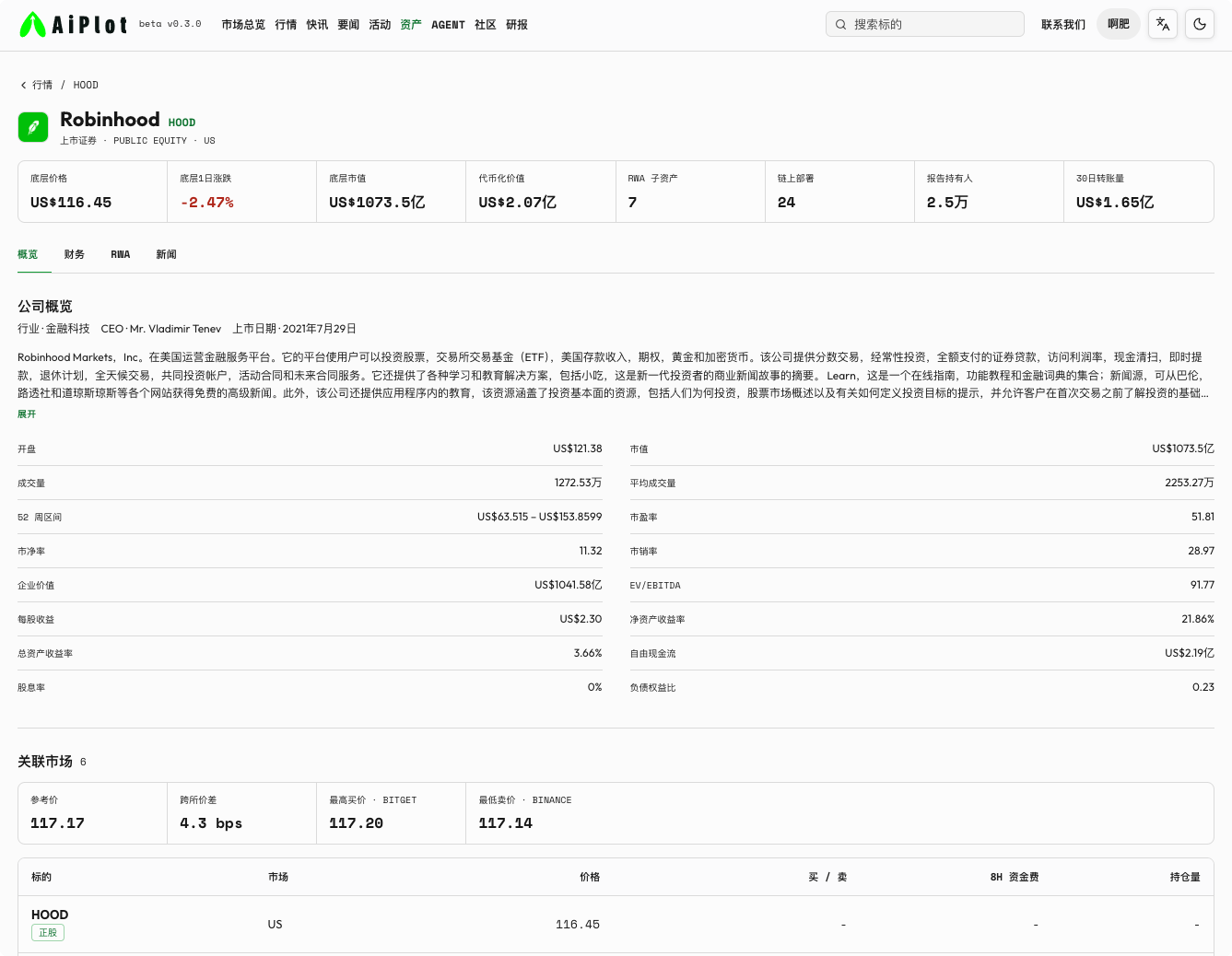
The RWA narrative of Robinhood Chain can easily be misinterpreted as “Robinhood launched a chain, and then moved stocks onto it.” From a business model perspective, the truly scarce resource it possesses is not just a Layer 2 technology, but:
- Tens of millions of retail financial users;
- Entry points for stocks, ETFs, crypto assets, and cash management products;
- Self-custody wallet of Robinhood Wallet;
- Real asset supply of Stock Tokens;
- On-chain trading and DeFi environment of Robinhood Chain;
- Potential combinations of stablecoins, lending, AMM, and Agentic Trading;
- User familiarity with the Robinhood brand and interface.
This fundamentally distinguishes Robinhood Chain from ordinary new public chains: ordinary public chains need to first establish assets, users, applications, and liquidity; Robinhood can theoretically provide distribution for on-chain assets through its existing financial app and user base.
However, there is a gap between “theoretically distributable” and “already formed a closed loop.” Robinhood's official support page clearly states that Robinhood Chain is independent of Robinhood’s brokerage and crypto accounts, and will not affect users’ investments, crypto balances, or portfolios in the main app.
This is precisely the key gap in the current RWA narrative:
Robinhood has distribution capability, but the financial balance sheet of the main app has not been fully merged with the on-chain balance sheet of Robinhood Chain.
2. What Exactly Are Robinhood Stock Tokens
1. They Are Not Stocks Themselves
Robinhood officially states that Stock Tokens are tokenized debt securities issued by Robinhood Assets (Jersey) Limited, providing holders with economic exposure to the underlying stocks or ETFs, but do not grant holders legal or beneficial ownership rights to the underlying securities or their issuers.
This means there is an important distinction between Stock Tokens and traditional stocks:
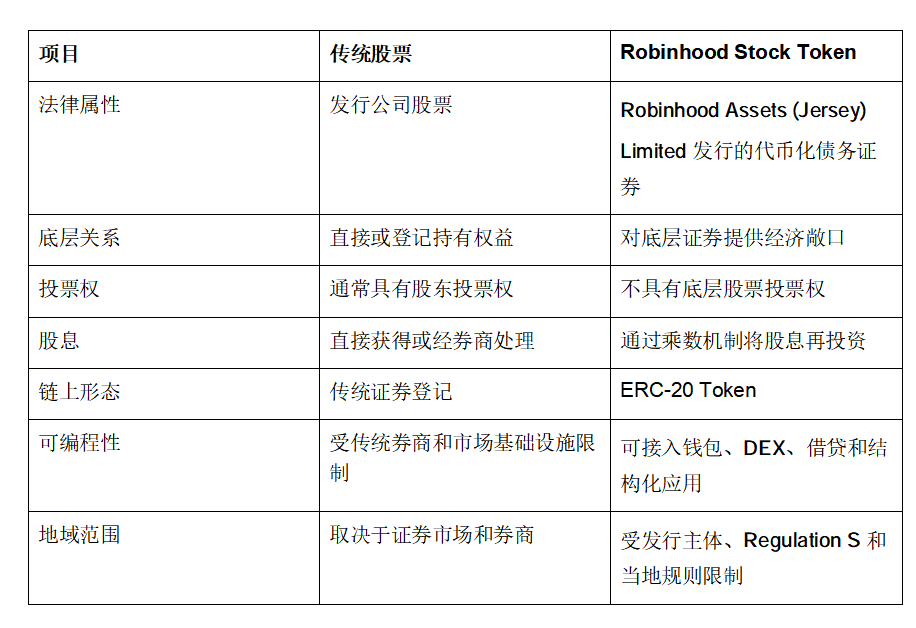
Therefore, when studying Robinhood RWA, one must avoid directly referring to “tokenized stocks” as “stocks on-chain.” A more accurate phrasing would be: on-chain debt securities issued by offshore entities, supported by underlying securities and providing economic exposure.
2. No Equity Rights, Why Still Belong to RWA
The key to RWA is not whether the token confers complete shareholder rights, but whether the token has a verifiable economic link to real-world assets, securities, debts, cash flows, or commodities.
Robinhood Stock Tokens:
- Linked to the price and economic performance of real stocks or ETFs;
- Supported by underlying assets;
- Involves real-world issuers, custodians, and redemption mechanisms;
- Can be transferred and combined in the form of on-chain tokens;
- Subject to securities, issuance, and geographic restrictions.
Thus, they belong to RWA, but qualify as “economic exposure securities RWA,” rather than “full shareholder rights stock tokens.” Both can have market value, but the risk, legal rights, and valuation frameworks cannot be conflated.
3. What has Robinhood Chain Formed Currently
1. An Open Layer 2 Targeting RWA
Robinhood officially defines Robinhood Chain as:
- Permissionless;
- Ethereum compatible;
- Layer 2 for traditional markets, crypto assets, and RWA;
- Supports Stock Tokens and ETFs for on-chain holding, transfer, and combination;
- Uses ETH to pay Gas;
- Supports Robinhood Wallet and other EVM-compatible wallets.
Robinhood's official announcement regarding the mainnet in July 2026 also mentioned that Robinhood Chain is built on the Arbitrum Platform and collaborates with ecosystem partners like Uniswap, Pleiades, Alchemy, BitGo, and Chainlink to provide infrastructure for AMM, trading, lending, and oracles.
2. The On-chain Product Form of Stock Tokens
Robinhood Stock Tokens are standard ERC-20 tokens that can:
- Be recognized and held by wallets;
- Be traded on DEX;
- Have prices read by smart contracts;
- Be used as potential collateral in lending protocols;
- Be utilized in structured products and portfolio management;
- Be traded and redeemed in the secondary market under certain conditions.
Robinhood's documentation also states that each Stock Token has a Chainlink price source, dividends, and stock splits reflected through on-chain multiplier mechanisms, where the original token quantity can remain unchanged, but the ratio of underlying stocks per token is adjusted.
The key aspect of this design is that it transforms stock-type RWA from being a closed product viewable only in a single front-end interface to having a degree of protocol combinability.
3. But the Main Market is Still Subject to Permissions and Geographic Restrictions
The issuance of Stock Tokens is not entirely permissionless. Robinhood's documentation states that primary issuance subscribed directly by RHJ is currently available only to Authorised Participants who have passed KYB verification, while ordinary users primarily engage in secondary trading and combination through existing tokens.
Additionally, Stock Tokens are not available to U.S. persons and have restrictions in Canada, the UK, Switzerland, and other regions.
Therefore, “Robinhood Chain is permissionless” and “Stock Tokens can be freely purchased by everyone” are two different propositions:
- The blockchain infrastructure can be deployed and interacted with permissionlessly;
- Specific RWA assets can still have issuance, holding, transfer, and geographic permissions.
This is also a typical structure of institutional RWA: what is open is the settlement and development environment, while the securities assets themselves are restricted.
4. Why More RWA Assets on-chain is Just the First Step
1. The Number of Assets Cannot Directly Create Financial Activity
More stocks, ETFs, bonds, government bonds, and money market funds on-chain can expand asset options, but without users, trading, collateral, and settlement demand, assets will remain listed as tokens.
The next phase of Robinhood RWA needs to transition from “asset supply” to “asset productivity”:
- Stock Tokens can lend stablecoins;
- ETF Tokens can become collateral for portfolios;
- Government bond Tokens can serve as low volatility cash management assets;
- Tokenized funds can enter yield and treasury products;
- RWA can be automatically called and settled by Agents;
- Tokens can be part of a unified asset portfolio within Robinhood Wallet.
This aligns closely with the Aave route analyzed earlier: the first piece of the puzzle for RWA is tokenization, the second piece is collateralization and capital efficiency.
2. Robinhood Needs to Expand from “Stock Tokens” to “Balance Sheet Tokens”
If users can only trade Stock Tokens, the business of Robinhood Chain resembles an on-chain securities trading venue more; if users can borrow USDC with stock Tokens, manage cash with government bond Tokens, pay fees with stablecoins, and include earnings in portfolios, then Robinhood Chain begins to approach a financial balance sheet.
In the future, one can observe whether Robinhood will gradually expand:
- Tokenized stocks and ETFs;
- Tokenized government bonds and money market funds;
- Private market and Pre-IPO assets;
- Commodity, forex, and index exposures;
- Productive RWA related to AI, GPUs, and data centers;
- Stablecoins usable for lending, collateral, and payments.
5. A True Turning Point: Integration of Robinhood App with Robinhood Chain
1. Currently Integrated is Wallet, Not Complete Brokerage App
Robinhood's official announcement in July 2026 states that Stock Tokens can be provided in Robinhood Wallet, and eligible users can trade on Robinhood Chain and deploy Tokens into lending pools or as trading collateral.
However, Robinhood's official support page also states that Robinhood Chain is independent of Robinhood’s brokerage and crypto accounts, and that on-chain accounts will not change the portfolio and balances in the main app.
This means that there are currently at least three relatively separate account and product layers:
- Robinhood Brokerage: Traditional accounts for stocks, ETFs, and other financial products;
- Robinhood Crypto: Crypto trading and related products;
- Robinhood Wallet / Chain: Self-custody wallet, Stock Tokens, and on-chain DeFi.
Users need to understand the differences in accounts, assets, permissions, and risks across these layers. For crypto-native users, this layering may be acceptable; for ordinary retail users, it still presents friction in entering RWA.
2. What Happens if True Integration is Achieved
Assuming in the future Robinhood can, within a compliant framework, more closely connect the user entry point, stock assets, and on-chain wallet of the main app, four changes may occur:
First, user acquisition costs decrease. Ordinary users do not need to understand cross-chain, private keys, Gas, and Tokens, but simply select on-chain assets or functionalities within the familiar Robinhood interface.
Second, on-chain asset supply expands. Robinhood can map more eligible financial assets to on-chain products instead of relying on crypto users to proactively purchase.
Third, RWA trading volume shifts from crypto-native traffic to retail financial traffic. This could be more significant than simply increasing the number of Tokens.
Fourth, financial product portfolios start to merge. Users can place stocks, ETFs, stablecoins, and on-chain yield products within the same asset management interface.
However, this integration will also introduce higher compliance, custody, suitability, client asset segregation, and technical risks, not merely a simple product button upgrade.
6. How RWA Data of Robinhood Chain Should Be Interpreted
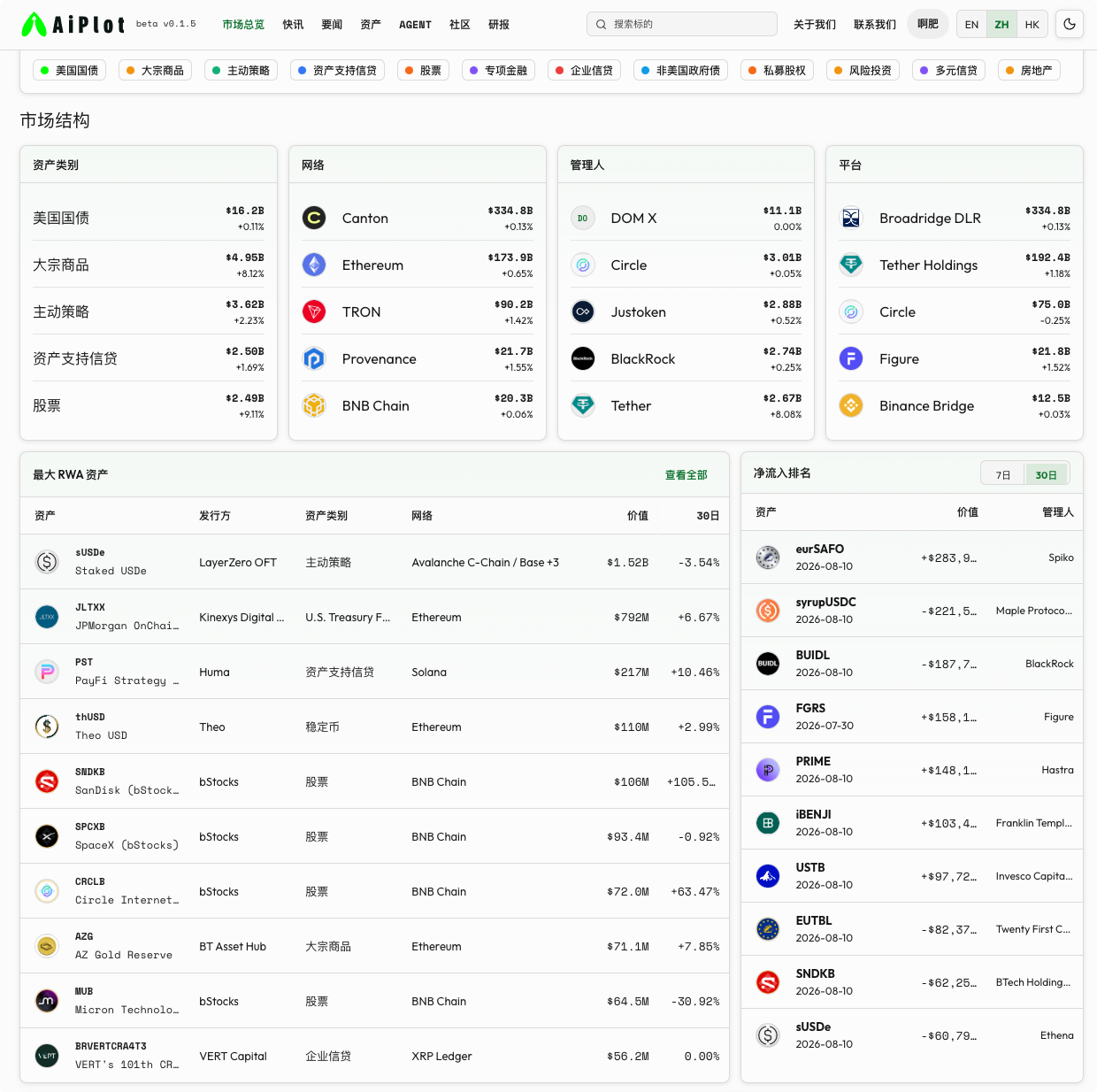
The RWA market cap on Robinhood Chain is approximately $295 million, with daily trading volume having reached around $120 million, and the cumulative trading volume for tokenized stocks on DEX has been about $10.4 billion, indicating a high number of on-chain holders.
These data indicate that Robinhood Chain's Stock Tokens have formed a certain level of trading interest, but one must pay attention to statistical measures when studying them.
1. Market Cap, Daily Trading Volume, and Cumulative Trading Volume Cannot Be Used Interchangeably
- RWA Market Cap: Reflects on-chain Token balance or estimated asset value;
- Daily Trading Volume: Reflects trading activity at a specific point in time, potentially influenced by single-day events and market making;
- Cumulative DEX Trading Volume: Reflects the number of trades and turnover, but does not represent asset scale or retained funds;
- Number of Holders: Reflects address distribution, but does not necessarily equate to real independent investors.
Therefore, the $295 million RWA market cap and the $10.4 billion cumulative DEX trading volume are not contradictory; the latter may entail a higher turnover rate, arbitrage, market making, and short-term trading.
2. High Number of Holders May Result from Robinhood’s Retail Distribution
The high number of holders on Robinhood Chain is related to Robinhood’s retail user base.
This may be Robinhood's most significant competitive advantage: it does not have to rely solely on the crypto community for organic dissemination, but can reach a broader retail user base through wallets and trading products.
However, the number of holders still requires further breakdown:
- Average balance per address;
- Concentration of the top 10, 100, 1,000 addresses;
- User holding time;
- Ratio of real purchases to airdrops/incentives;
- Active trading addresses versus dormant addresses;
- Whether a large number of addresses are controlled by the same entity.
If the number of holders is high, but most addresses have small balances and low trading frequency, it indicates a broader distribution; if it also involves long-term holding and borrowing usage, it indicates that the assets have entered retail asset allocation.
3. The Intersection of Meme and Stock Tokens May Amplify Trading Volume
Stock Tokens on Robinhood Chain may combine with Meme, Perp, DEX, and reward activities, creating high-frequency trading. This can increase trading volume but does not necessarily elevate the financial quality of RWA.
Researchers need to differentiate between two types of trading:
- Asset allocation trading: Long-term holding, portfolio rebalancing, collateral borrowing;
- Attention trading: Meme, arbitrage, short-term speculation, and incentive-driven turnover.
The long-term value of Robinhood Chain depends on whether the former gradually expands, rather than simply pursuing higher daily trading volume.
7. The Triple Value Transmission of Robinhood Chain
First Layer: Robinhood Users → Wallet Users
This is Robinhood’s most direct advantage. Traditional financial users can be guided to self-custody wallets and on-chain assets, provided that user experience, risk disclosure, and account systems are sufficiently simple.
Second Layer: Wallet Users → Stock Token Liquidity
Once users enter the wallet, Stock Tokens, stablecoins, DEX, and lending products create an asset cycle. Assets are no longer solely a one-way purchase, but can flow and combine on-chain.
Third Layer: Stock Token Liquidity → Robinhood Chain Ecosystem
If large amounts of assets, trading, and lending are concentrated on Robinhood Chain, it may bring:
- Demand for ETH Gas;
- AMM transaction fees;
- Lending interest and protocol income;
- Use of oracles and infrastructure;
- Development of ecosystem applications;
- Long-term collaboration with issuers and market makers.
Robinhood Chain's official support page shows that the network uses ETH to pay Gas. Thus, theoretically, the growth of RWA transactions may transmit through block space demand to ETH, but actual value capture still depends on whether transactions are genuine, Gas costs, batch settlement, Rollup structure, and whether applications cover fees.
8. Robinhood's Real Moat: The Combination of Financial App and On-chain Openness
The strategic significance of Robinhood Chain may not be to become the most decentralized or most general public chain, but rather to combine two complementary capabilities:
- Robinhood App: Users, brand, fiat, compliance, and traditional financial products;
- Robinhood Chain: 24/7 trading, composable assets, smart contracts, and open development.
The problem with traditional financial apps is that assets and applications are locked within account systems; the issue with pure DeFi is that user acquisition, compliance, and real asset supply are insufficient. Robinhood's opportunity lies in establishing a less frictional bridge between the two.
That is why “integration of App and Chain” is more important than “more RWA on-chain.” More assets can only expand the product shelf; an App—Chain closed-loop can bring sustained customer flow and asset usage.
9. Three Possible Product Forms in the Future
1. On-chain Wealth Management for Stock Tokens
Users hold stocks and ETFs in Robinhood, mapping part of their assets to on-chain through the wallet for stablecoin borrowing, automatic rebalancing, and yield management.
2. RWA-Supported Payment and Consumption Accounts
Stablecoins combined with tokenized cash, government bonds, or money market funds become tools for users' daily payments and account balance management. Robinhood can form a more complete capital cycle between trading, payments, lending, and investments.
3. Agentic Portfolio
Robinhood has announced plans to allow eligible users to connect AI models to Robinhood data and tools through Trading MCP, setting funding limits and safety boundaries.
In the future, Agents may, with user authorization:
- Read stock and Token prices;
- Identify cross-market opportunities;
- Adjust on-chain and traditional asset portfolios;
- Automatically pay Gas and transaction fees;
- Borrow stablecoins using RWA collateral;
- Execute cross-chain or cross-account rebalancing.
This will connect Robinhood Chain with the previously discussed machine-native economy: Stock Tokens are not only assets for human investors but may also become financial objects that AI Agents can read, call, and manage.
10. Main Risks: The RWA Narrative is Strong, but Legal Rights and Account Closed Loop Still Need Verification
1. Stock Token is Not Equity
Without voting rights and no direct legal or beneficial rights to the underlying stocks means investors bear risks related to issuers, custodians, and structural arrangements. Token prices which are tied to stock prices do not equate to ownership of the stocks themselves.
2. App and Chain Are Currently Not Fully Merged
The official support page clearly states that Robinhood Chain is independent of the main brokerage and crypto accounts. Whether and to what extent they can be integrated in the future remains dependent on regulatory, technical, and product design factors.
3. Trading Volume May Exceed Real Asset Allocation Demand
High-frequency turnover, market making, and Meme trading can quickly inflate DEX trading volumes but do not necessarily create stable lending demand and long-term user retention.
4. Tension Between Permissions and Openness
The chain itself can be permissionless, but Stock Tokens are subject to geographic, investor qualification, and issuance restrictions. Developers can freely deploy applications but may not be able to freely issue or transfer underlying securities-type assets.
5. RWA Expansion Requires Deeper Financial Infrastructure
If Robinhood continues to expand into bonds, funds, real estate, private markets, or GPUs, it needs to address custody, valuation, redemption, corporate actions, oracle, clearing, and bankruptcy segregation issues. The throughput of the chain is not the main bottleneck; asset legal and financial engineering are.
11. Conclusion: The Breaking Point of Robinhood Chain Lies in "Financial App Transforming into On-chain Entry Point"
The RWA of Robinhood Chain has currently completed several important moves:
- Launched an Ethereum-compatible Layer 2 targeting RWA;
- Issued Stock Tokens provided by Robinhood Assets (Jersey) Limited;
- Distributed real asset exposure through Robinhood Wallet, DEX, and on-chain applications;
- Supports combinations of Stock Tokens with lending, collateral, and structured applications;
- Plans to promote Agentic Trading and broader on-chain financial products.
However, this is still a stage where “products and infrastructure have emerged, but user balance sheets have not been fully integrated.”
More RWA assets on-chain, along with genuine integration of the Robinhood App with the chain, constitute the true moment of RWA's emergence. The core of this judgment is correct:
The number of assets determines shelf width, while the App—Chain closed loop determines actual customer flow, and collateral and payment functions determine asset productivity.
If Robinhood can ultimately connect users, cash, stocks, and ETFs from the main App with Wallet, stablecoins, Stock Tokens, and DeFi within compliance, its competitive advantage will not just be having a new chain but possessing a retail-focused on-chain financial distribution system.
Conversely, if the main App and Chain remain separated long-term, and Stock Tokens primarily rely on crypto user trading, with RWA trading volume driven by short-term Memes and incentives, then Robinhood Chain may merely be a trading-oriented Layer 2 with strong brand assets, rather than a true bridge between traditional finance and DeFi.
The RWA of Robinhood Chain has not yet truly emerged. The real emergence is not about “how many stocks got listed again,” but whether ordinary users can seamlessly integrate traditional assets, stablecoins, and on-chain finance into the same account and balance sheet.
For more data and analysis, please follow Aiplot:
📖 Community Communication:
Telegram:
https://t.me/+IIYMcJigBAo4Mjg1
The content of this article reflects only the author's personal opinions and does not represent the position of this platform. The viewpoints, conclusions, and suggestions in this article are for reference only and do not constitute any investment advice related to this platform. The market carries risks, and investment should be cautious.
免责声明:本文章仅代表作者个人观点,不代表本平台的立场和观点。本文章仅供信息分享,不构成对任何人的任何投资建议。用户与作者之间的任何争议,与本平台无关。如网页中刊载的文章或图片涉及侵权,请提供相关的权利证明和身份证明发送邮件到support@aicoin.com,本平台相关工作人员将会进行核查。