Author: Andjela Radmilac
Translated by: Baihua Blockchain

Just as the fashion industry often digs out some once-embarrassing old styles from the depths of the wardrobe and wears them again, the investment field is no different. Cryptocurrencies from the millennial era brought profit-generating Dogecoin and a variety of bizarre financial instruments themed around food. Today, Generation Z, dressed in JNCO baggy jeans and holding ironically-themed digital cameras, has entered the market, and at least in one corner of the market, they have shown a strong interest in the traditional investment methods of their parents' generation.
Low-rise jeans are back in style, and it is clear that their risk tolerance for investment portfolios has also dropped to a low point.
BN Research's report on August 12 examined how different age groups utilize direct equities, tokenized stocks, and traditional financial perpetual contracts on the platform. The youngest users are not those who keep leveraging or frequently adjusting their positions. Among all three product types, Generation Z has the lowest turnover rate of any eligible labor group. These findings cover a short period of Binance user data; direct equity products will reach significant scale only by June 2026.
Believe it or not, the most traditional, conservative, and unimaginative portfolio in the cryptocurrency market may actually belong to these Generation Z youths (Zoomers).
Contrarian with Management Fee Rates
This difference is most easily reflected in ETFs.
At the beginning of August, ETFs accounted for 25% of Generation Z's direct equity trading volume, up from 14.6% in June. Millennials accounted for only 9.5% at the beginning of August, which means the younger cohort directed over twice as much stock trading into fund products.
The capital flowing into these funds is more telling than the trading volume itself. Unleveraged ETFs accounted for 18.5% and 21.9% of net capital inflows from Generation Z stocks in June and July, respectively, while the share flowing into individual stocks dropped from 77% to 74.2%.
In July, Generation Z's overall stock allocation performed poorly, with net investment down 17.4%, but the inflow of unleveraged ETFs was almost unaffected, only slightly down by 2%. In contrast, inflows into individual stocks fell by 20.4%, and leveraged products plummeted by 28.5%.
Generation Z was also the only group in Binance's data that saw an actual increase in ETF holders in July, up 2.9%, while millennial ETF holders decreased by 4.5% and Generation X by 5.9%.
Thus, it is far from simple to say that young traders occasionally buy the S&P 500 ETF (SPY) during breaks from more thrilling speculative trades. When Generation Z chooses to tighten their strategies, ETFs have become their safe haven for continued investments.
Their individual stock investments are not as stable as local pension portfolios, but they are by no means a lottery-style speculative approach.
In accounts where Generation Z has only ever bought and never sold, the average single purchase amount for direct stocks is highest for Schwab U.S. Dividend Equity ETF (SCHD), at $16,567. Broadcom follows at $12,370. Overall holdings show a significant tilt toward semiconductors and AI, but the lower average purchase amounts are for companies with intense retail speculation, including an average of $633 for Tesla and $514 for Nvidia in bStocks.
In other words, Generation Z remains enthusiastic about technology and AI, but large capital has not blindly flowed into the hottest concepts where the most fervent believers are concentrated.
Holding behaviors corroborate the same trend. The report shows that about 22% of Generation Z direct equity accounts have never placed a sell order, compared to 19% for Generation X and 9% for the baby boomer generation. Millennials actually lead this category at 30%, finally breaking the accusations of financial recklessness against them.
Once the scope is expanded from “never sold” to “bought more than sold,” Generation Z jumps to the top.
About 76% of Generation Z bStocks accounts are net buyers, the highest among all generations, exceeding millennials by 9 percentage points. In terms of direct stocks, 77% of Generation Z is continuously accumulating, while Generation X is at 74% and baby boomers at 68%.
They not only trade less frequently. In Binance's product section designed to provide asset ownership rather than short-term derivatives trading, the vast majority of them are steadily increasing their holdings.
Perpetual Contracts for Speculation, ETFs for Long Holding
When examining perpetual contracts, this behavior appears even more peculiar, as theoretically, a generation that has grown up alongside cryptocurrencies should be well-versed in such tools. They do use these tools, but the aggressiveness is far less than that of older traders.
Generation Z accounts conduct an average of 13 traditional financial perpetual contract trades per month, while millennials have 17, Generation X has 16.5, and baby boomers have 19. Only 14% of Generation Z perpetual contract accounts meet high-frequency trading standards, lower than the 18% for millennials and Generation X, and even below the 16% for baby boomers.
This leads to a rather dramatic scenario: a 22-year-old trading stocks on a cryptocurrency trading platform has a lower frequency of perpetual contract trading than a senior parent.
We also found similar patterns in the use of leveraged and inverse ETFs. 88.2% of Generation Z traditional financial perpetual accounts have no trading records on leveraged or inverse ETFs, compared to 84.5% for millennials and 85.9% for Generation X. In bStocks, 98.9% of Generation Z accounts avoided such products, again a higher avoidance rate than other eligible labor groups.
Baby boomers still hold the fishing pole. They avoid leveraged and inverse products to the highest proportion overall, reaching 98.9% in direct stocks, while Generation Z is at 96.5%.
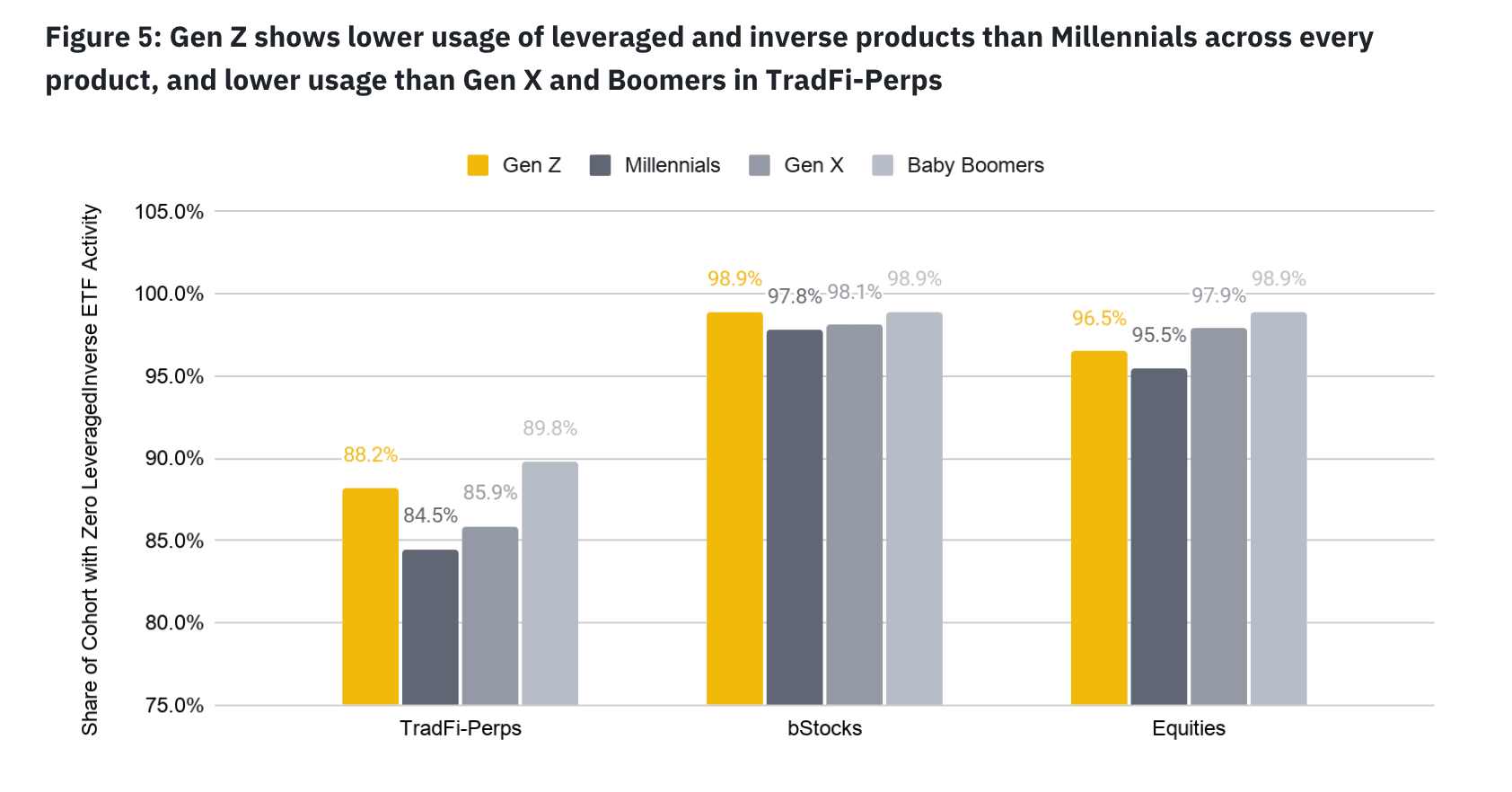 The chart shows Generation Z's low levels of leveraged and inverse product usage (Source: BN Research)
Thus, young people have not completely transformed into old-fashioned retirees. However, among those not yet approaching retirement age, their behavior patterns are surprisingly leaning toward conservatism.
A deeper difference lies in what Generation Z speculates on versus where they allocate their capital.
Leveraged and inverse ETFs accounted for 9.25% of Generation Z's direct equity trading volume in July, but only 3.93% of net capital inflows. By early August, that net inflow share further dropped to 2.65%.
This indicates that leverage is being fully utilized: as a short-term speculative tool, rather than a place for capital to settle.
Traditional financial perpetual contracts also display a similar pattern. About 60% of Generation Z accounts are net buyers, the highest proportion across age groups, but the actual net flow contributes less than 1% of total trading volume. Traders often open and close positions frequently without leaving any settled capital.
The stock market is completely the opposite. The net flow ratio for Generation Z direct stocks is 26.5%, with an average net inflow of $1,898 per account.
This distinction explains why merely exploring whether young investors use perpetual contracts can be misleading. They do use them, but long-term capital flows elsewhere.
Binance's previous research on a new generation of investors provides a reasonable explanation for this. Generation Z already accounts for about 44% of Binance direct stock and bStocks users, and 45% of traditional financial perpetual contract users, becoming the largest user group for stocks and bStocks while sharing equal footing with millennials on perpetual contracts. More than 90% of traditional financial users are located in emerging markets, where the barriers to acquiring U.S. stock assets through local traditional brokers are quite high.
For these users, the cryptocurrency trading platform effectively serves as the brokerage tool with the lowest entry barrier.
They are familiar with the operating interface, funds already exist in their accounts, and they support fractional trading while allowing access to the market outside of normal U.S. stock trading hours. Binance reported that among direct stock users, 13% are emerging market Generation Z clients with stock assets below $2,000.
This makes the above investment behavior easier to understand. Trading platforms do not need to mold each young user into a perpetual contract speculator, because it can also serve as a platform for young people to purchase conventional assets.
We Once Put Money into “Pickle Jars”
This contrast is amusing because some financial tools that emerged during the early crypto cycle seem absurd when measured by traditional standards.
Pickle Finance once set up “jars” and “farms,” including mechanisms for automatically compounding profits from other protocols and rewarding depositors. These concepts have their financial logic, but the superficial terms make them sound like a pension plan drafted during a chaotic episode in a large supermarket.
ShibaSwap similarly uses “bury” to refer to token staking within its interface, with a product lineup filled with terms like SHIB, LEASH, and BONE. Cryptocurrency has packaged already bewildering operations into commands suitable for an ambitious Shiba Inu to execute.
This decade-long baptism has led to a reasonable presumption: those born in the Dogecoin era, with no memory of the traditional world, would have a higher tolerance for financial chaos.
However, Binance's data presents the opposite picture: young users are allocating more and more stock capital to unleveraged ETFs, trading less frequently than millennials and Generation X, and the exposure to leveraged products is extremely small in their actual net investments.
This does not mean they have abandoned crypto assets. A 2023 survey by the FINRA Foundation and the CFA Institute showed that 55% of U.S. Generation Z investors hold cryptocurrencies, and CryptoSlate has previously reported the widespread interest among young Americans in investing in crypto assets.
A more intriguing possibility is: using cryptocurrency and preferring extreme financial risk have never been the same thing. For those who are first encountering finance through trading platform apps, Binance does not necessarily represent a rebellious substitute for traditional brokers. It is merely the financial interaction interface they are most familiar with; once stocks and ETFs appear within, their investment taste does not need to adhere to the fervent labels of the early crypto world.
This is precisely what distinguishes Generation Z from the millennials that followed and the distant baby boomers.
They are not systematically building traditional pension portfolios. Exposure to semiconductors, AI concept stocks, tokenized stocks, and 24/7 markets is in no way a replica of the 1990s wealth management model. But when using these cutting-edge products, they display a surprisingly old-fashioned intuition: buying assets, holding more than selling, and not subjecting every position to high leverage.
The crypto industry has spent years packaging finance in bizarre ways to attract young people. Yet the youngest clients seem to have embraced this interactive interface while leaving the bizarre and restless behind.
The fashion industry can bring back wide jeans; the financial sector has also returned to the simplest investment vision: buy an asset, set it aside for a while, and wait for it to bring good returns. The spacious pockets, clearly, can hold both.
Article link: https://www.hellobtc.com/kp/du/09/6450.html
Source: https://cryptoslate.com/gen-z-investors-have-portfolios-boomers-would-approve-of/?__cf_chl_rt_tk=QX9SaAL_xzGf9sXD1zeTIGWTwE2xCrvIE_RQz_Slkv0-1789959510-1.0.1.1-qQ.Sh3moHhwqCiWLLRN1qwmPJy6ccyYkUTWX6qHajnc
免责声明:本文章仅代表作者个人观点,不代表本平台的立场和观点。本文章仅供信息分享,不构成对任何人的任何投资建议。用户与作者之间的任何争议,与本平台无关。如网页中刊载的文章或图片涉及侵权,请提供相关的权利证明和身份证明发送邮件到support@aicoin.com,本平台相关工作人员将会进行核查。