

This article is jointly produced by PANews and BIT American Stocks, BIT American Stocks offers over 10,000 U.S. mainboard stocks and ETFs, supports stablecoin deposits and withdrawals as well as traditional U.S. dollar wire transfers, and provides full shareholder rights and dividend voting rights.
Strong Non-Farm Payrolls Hand Over "Rate Hike Chips", Bitcoin Loses $80,000 but Decline is Limited
Last week, Bitcoin experienced a round of “non-farm shockwaves”. After Federal Reserve Governor Waller released dovish signals on Thursday, Bitcoin briefly surged to around $82,000. However, on Friday, the non-farm data unexpectedly skyrocketed: August saw an increase of 162,000 jobs, nearly three times the market expectation, causing the probability of a rate hike to jump from about 50% to around 60%. The two-year U.S. Treasury yield rose to 4.41%, the highest since January 2025, prompting Bitcoin to retreat from $82,000 to around $79,500.
However, the magnitude of this pullback is far less than the previous decline under the combination of “rising rate hike expectations + surging U.S. Treasury yields.” The funding situation provides an explanation: U.S. spot Bitcoin ETF saw a net inflow of approximately $987 million last week, marking a positive trend for the third consecutive week; the total inflow over the past three weeks reached approximately $3.8 billion, the strongest three-week period since 2026.
Bitcoin faces heavy resistance concentrated between the 50-week moving average and the $82,000 to $84,000 range. Several technicians mentioned that BTC has not yet effectively surpassed the 50-week moving average and has also not broken the May high of $83,000, so strictly speaking, it cannot confirm the formation of a higher high; Colin Talks Crypto reminded that historically, the end of a bear market often requires two consecutive weeks of closing above the 50-week moving average; Doctor Profit suggests that if $82,500 is broken significantly, the next target can be seen at $88,000.
In terms of support levels, the market is focusing on the $77,000 to $78,750 range. Killa stated that Bitcoin tends to "enter a range of fluctuations" after a significant rise, indicating that $77,000 is a key observation point. However, Dirk Crypto Diggy noted that current daily, 12-hour, and 4-hour levels have all shown bearish divergence, and September and October are generally weaker months in the bear market cycle; thus, those chasing highs need to be wary of “profit taking.” The options market signals are also worth noting: traders are buying insurance for “major volatility on CPI day”: if spot BTC can consolidate above $78,500 and bullish positions continue to accumulate in the options market at $82,000 to $85,000, a price breakthrough is likely to trigger passive buys from market makers; conversely, if CPI is hot and volatility rises, selling hedges may amplify pullbacks.
BIT Asset Management Head Daniel YU stated that September has historically been a weak month for Bitcoin, with price drops occurring in 9 out of the last 15 years. As the current 50-day and 200-day moving averages for Bitcoin are expected to form a “golden cross” around September 11, coinciding with the August CPI announcement date. This week’s PPI and CPI data will directly determine market pricing ahead of the Federal Reserve’s meeting on September 15-16: if CPI is moderate, the combination of “golden cross + ETF inflow” has a chance to turn $80,000 from a resistance level into support; if CPI is hot, with rate hikes overlapping and September's seasonality, the risk of a pullback to around $77,500 or even the $72,000–$74,000 range will significantly increase.
Today's Highlights:
Data: APT, LINEA, CHEEL, and PEAQ Tokens Will Experience Large Unlocks This Week
Ondo Finance Will Stop Minting USDY on Aptos and Noble Starting September 8
Michael Saylor: The Goal is to Re-Anchor STRC Around September 8
Upbit 24-Hour Trading Volume Rankings: XRP, RAY, BTC, ORCA, ETH
Bitcoin Spot ETF Saw a Net Inflow of $987 Million Last Week, a Positive Trend for Three Consecutive Weeks
Ethereum Spot ETF Saw a Net Inflow of $218 Million Last Week, Also a Positive Trend for Three Consecutive Weeks
SOL Spot ETF Saw a Net Inflow of $6.1751 Million Last Week, a Positive Trend for Ten Consecutive Weeks
XRP Spot ETF Saw a Net Inflow of $18.9602 Million Last Week
HYPE Spot ETF Saw a Net Inflow of $12.2734 Million Last Week
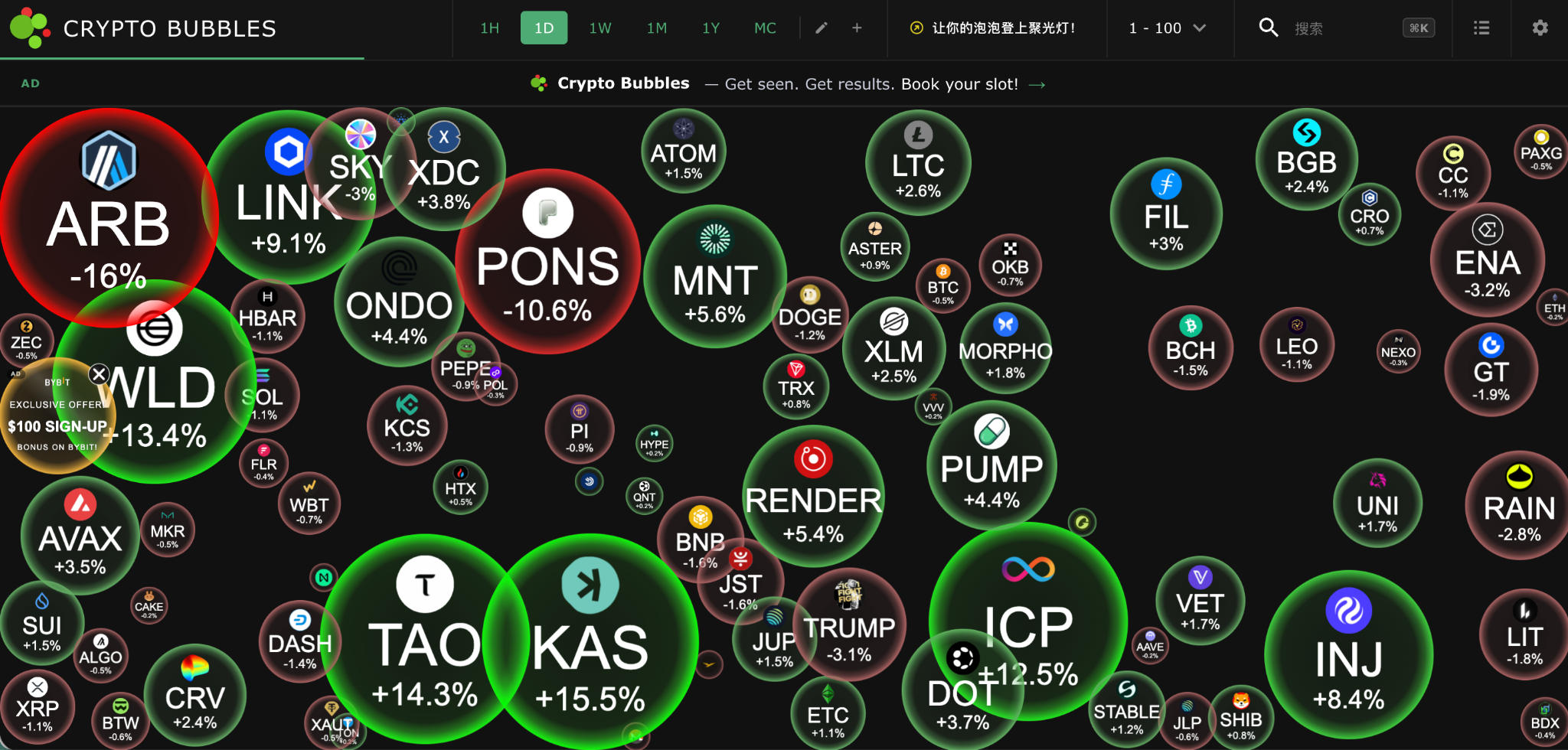
Today’s Largest Gains in Market Cap Among the Top 100 Coins: KAS up 15.5%, TAO up 14.3%, WLD up 13.4%, ICP up 12.5%, LINK up 9.1%.
Non-Farm Exceeds Expectations, Rate Hike Expectations Rise, U.S. Stocks under Pressure, AI Hardware Strengthens Against the Trend
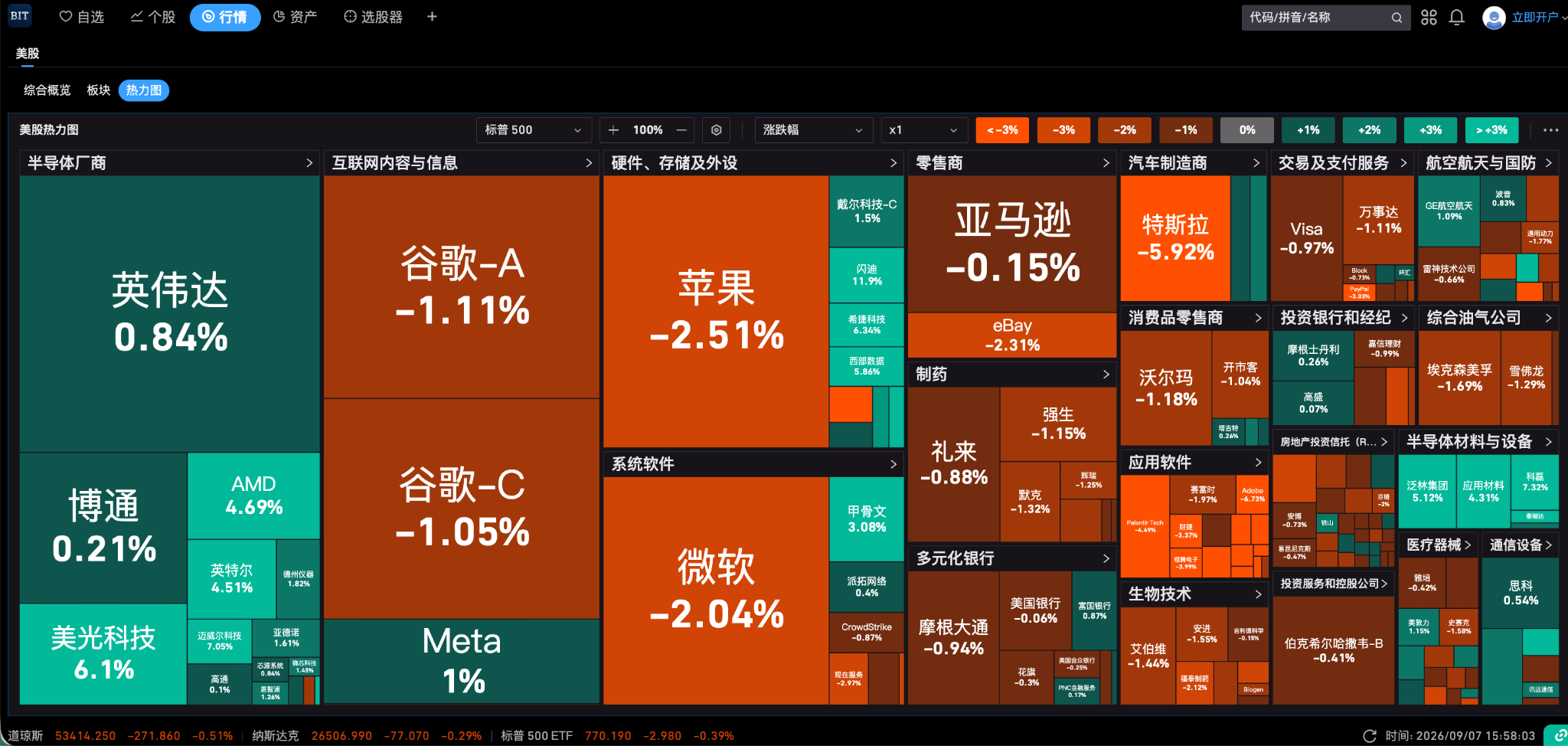
On Monday, U.S. and Canadian stock markets are closed for Labor Day, halting U.S. stock market liquidity. Last Friday’s closing price remains the last reference point before the holiday: the Dow Jones fell 0.51%, the S&P 500 fell 0.38%, and the Nasdaq fell 0.29%. The non-farm data is the only catalyst, indicating that strong employment may lead to higher and longer-lasting interest rates. This week, the market will face key data validation ahead of the Federal Reserve's September meeting, with traders keenly watching Thursday's PPI and Friday's CPI data.
U.S. Treasuries are the key variable weighing on the stock market. Matt Maley, Chief Market Strategist at Miller Tabak, pointed out that the 10-year U.S. Treasury yield at 4.8% is an important threshold; if it continues to stay above this level, the impact will extend beyond the bond market to overvalued growth stocks, commercial real estate, and other long-duration assets. Michael Chen from Ark Invest in Hong Kong also believes that “fiscal dominance” is forcing investors to demand higher risk compensation.
Tesla plummeted nearly 6% on Friday, marking its largest single-day drop recently. The Cybercab launch event was not live-streamed, Elon Musk was absent, the fleet size and delivery schedule were not clear, and investigations were launched by the NHTSA concerning vehicles without steering wheels or pedals, prompting the market to repeat the cycle of “buy the expectation, sell the fact”; major tech stocks like Apple and Microsoft also corrected simultaneously.
The AI hardware sector resisted pressure against the trend, with the Philadelphia Semiconductor Index rising 3.37% on Friday. Aehr climbed 13.1%, Kioxia Semiconductor rose 10.31%, Teradyne increased 7.32%, Lam Research grew 5.12%, ASML rose 4.17%. Nvidia rose 0.84%, with CEO Jensen Huang declaring that “AGI has arrived”, and noted that OpenAI Astra is backed by Nvidia's super compute clusters with over 100,000 GPUs, with 400,000 GPUs coming online soon; The Kobeissi Letter estimates that by 2030, the number of large data centers in the U.S. might increase from about 90 to 280, with tech company data center investments possibly reaching $7 trillion.
Therefore, when U.S. stocks resume trading on Tuesday, Nvidia, AMD, Broadcom, Micron, SanDisk, TSMC, Oracle, CoreWeave, Vertiv, and the optical communication and data center power chains will continue to be key focus areas for funds.
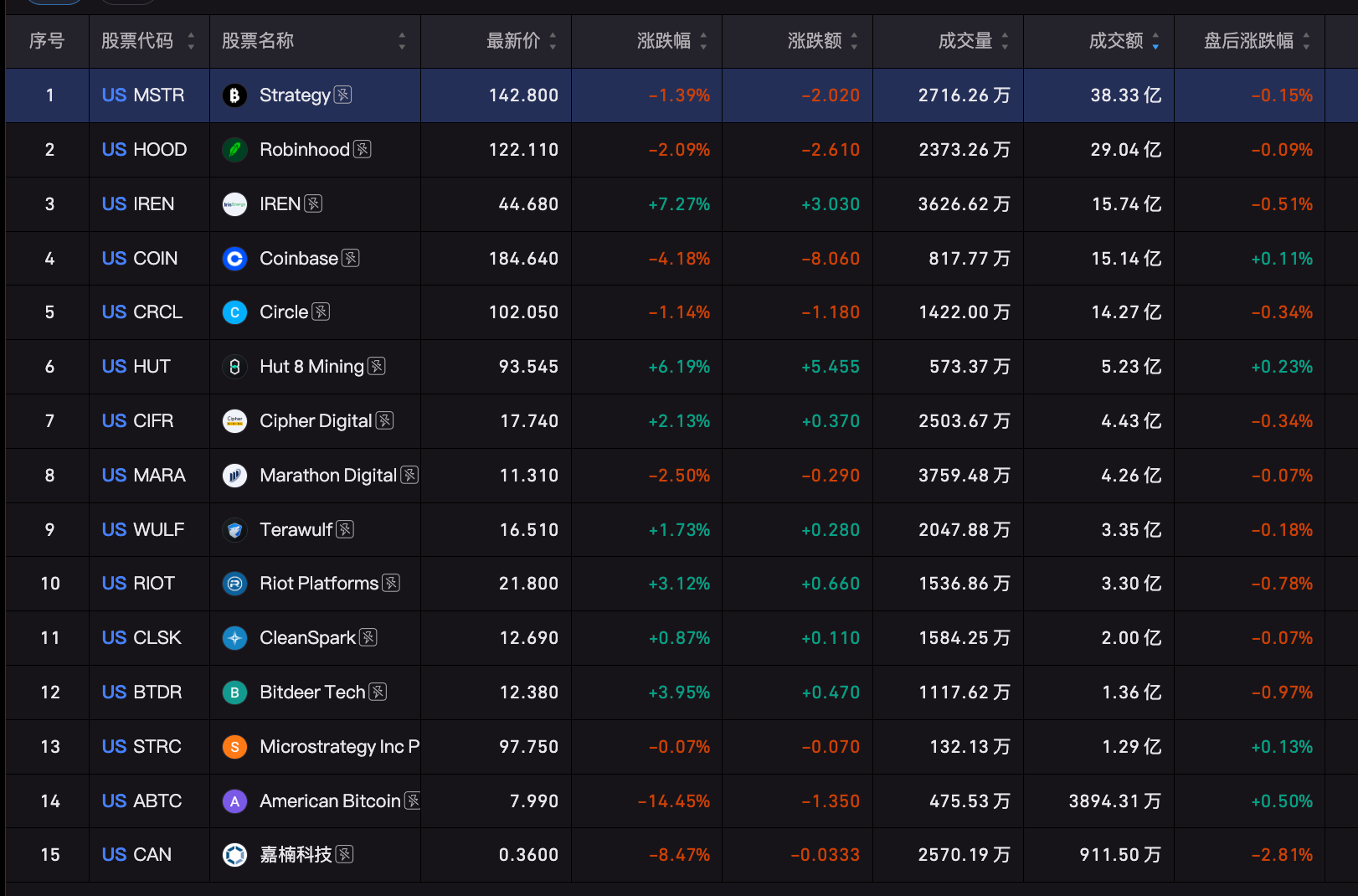
Cryptocurrency concept stocks had mixed performance, according to BIT American Stocks data, Circle fell 1.14%, Strategy decreased 1.39%, Robinhood dropped 2.09%, and Coinbase plummeted 4.18%.
In the mining sector, IREN topped the gains, rising 7.27%, Hut 8 Mining rose 6.19%, Bitdeer increased 3.95%, Riot Platforms grew 3.12%, Cipher Digital rose 2.13%, Terawulf increased 1.73%, Marathon Digital fell 2.50%; Canaan Creative dropped 8.47%; American Bitcoin plummeted 14.45%.
Japan and South Korea Celebrate Memory Chips, Hong Kong's Optical Communication Surges Against the Trend
The brightest stories in the Asia-Pacific market today come from South Korea and Japan, with South Korea's KOSPI index closing up 4.6% and Japan's Nikkei 225 index closing up 2.1%, while the Tokyo Stock Exchange Index rose 0.6%.
The core narrative in the South Korean market is that “the AI storage cycle is not over yet.” Timothy Moe, Chief Equity Strategist at Goldman Sachs Asia-Pacific, maintains a target of 12,000 points for the KOSPI, believing the market has underestimated AI’s impact on the profitability cycle of storage chip manufacturers; he predicts that U.S. tech giants' capital expenditure may exceed $1.2 trillion next year, significantly higher than the previous forecast of about $800 billion. Samsung Electronics rose 5.68%, SK Hynix increased 8.26%, with funds betting on HBM and DRAM price increases and continued data center expansions. Goldman emphasized that valuations for advanced South Korean storage chip companies remain at historical lows, and if profits materialize, current market pricing does not fully reflect the sustainability of AI capital expenditure.
The Japanese market is driven by semiconductors and tech weights, with Kioxia rising 9.31%, SoftBank Group climbing 11.22%, and Lasertec Semiconductor increasing 7.26%, with semiconductor equipment, storage, and AI investment chains simultaneously strengthening. However, there is also an important variable in the Japanese market: foreign exchange reserves in August fell to $995 billion, and there are market suspicions that Japan sold some U.S. Treasuries to conduct record-scale yen interventions; if this behavior continues, it may further increase supply pressure on long-term U.S. bonds.
In the A-share market, the ChiNext Index rose 3.41%, the Shanghai Composite Index rose 0.07%, and the Shenzhen Component Index rose 1.91%. Approximately 3,100 stocks in the entire market rose, with funds concentrated on computing hardware, PCBs, CPOs, storage chips, and communication equipment. Computing hardware has become the strongest main line in A-shares, with stocks like Cambridge Technology, Jingan Electronics, Zhongjing Electronics, and Shennan Circuit rising sharply, creating a surge of over 10% in the market capitalization of Zhongji Xuchuang. Goldman has given Zhongji Xuchuang a “buy” rating, with a target price of 2,645 RMB, and is covering its H-shares for the first time with a target price of 3,267 HKD; Citigroup is also covering Zhongji Xuchuang’s H-shares for the first time with a “buy” rating, claiming it benefits from demand for AI optical communications, bandwidth upgrades, silicon photonics technology, and capacity expansions.
The Hong Kong market was generally weak, with the Hang Seng Index down 0.93%, the Hang Seng Technology Index down 0.92%, and most tech stocks declined, including Baidu down 5.74%, Xiaomi down 3.94%, Meituan down 2.02%, and Tencent down 0.72%. Yet the computing chain surged against the trend, with Cambridge Technology rising 21.06%, Zhongji Xuchuang up 13.22%, Huiju Technology up 7.73%, and Longfei Optical Fiber Cable up 7.40%; in the PCB sector, Guanghe Technology rose 13.69%, Tongqi Microelectronics up 11.35%, Shenghong Technology up 11.09%, and Jiantao Laminates up 7.73%.
On the policy front, there is a strengthening narrative for communication and domestic computing power as the Ministry of Industry and Information Technology proposed to fully build a new generation communication network by 2030, timely launch commercial 6G, and promote pilot projects for 10G optical networks. Huawei released the Mate XT 2, a foldable phone featuring a new Kirin 9050 Pro chip, marking Huawei's return to launching a new high-performance Kirin chip in flagship showcases after six years.
The financial sector, however, showed pressure, with the Ministry of Finance's issuance of 300 billion yuan in special government bonds to fund central financial institutions, benefiting entities such as Industrial and Commercial Bank of China, Agricultural Bank of China, PICC, reinsurance, China Life, Taiping, Export-Import Bank, and Export Credit Insurance Corporation through capital supplementation. CITIC Securities believes this will help stabilize credit and expectations, but in the short term, funds clearly prefer AI hardware.
Next, We Need to Pay Attention To:
September 7 (Monday)
U.S. Stock Market and Canadian Stock Market Closed for Labor Day: U.S. markets will be closed for one day, with trading in gold, silver, and oil ending early, leading to a significant drop in global liquidity. In a low liquidity environment, geopolitical tensions in the Middle East, oil gaps, and dollar fluctuations may be magnified, placing more burden on Asian and European trading sessions for price discovery.
Huawei Mate XT 2 (2:30 PM), Xiaomi 18 Fold Launch Event (7:00 PM): Huawei's new generation of foldable flagship will premiere HarmonyOS 7, while Xiaomi's 18 Fold will feature the玄戒O3 AI flagship processor. The foldable screen, hinge, panel, storage, precision components, and side AI industry chains may receive emotional boosts.
Expansion of Hong Kong Stock Connect Effective: Baidu Group-W, Qunhe Technology and other stocks officially entered the Hong Kong Stock Connect target list. Whether southbound funds flow in will affect the short-term performance of related stocks.
September 8 (Tuesday)
0:00 Canadian Counter-tariffs on $20 Billion worth of U.S. Goods Take Effect: Renewed trade frictions will increase cost uncertainties in the North American supply chain. Automotive, agricultural, industrial products and cross-border supply chain-related companies may experience emotional disturbances.
9:20 Jiangbolong Lists on Hong Kong Stock Market: The company plans to raise no more than 6.28 billion HKD, with a significant discount from H-share issuance price compared to A-shares; initial performance will test the sentiment of the storage industry chain and new semiconductor IPOs.
11:00 U.S. August New York Federal Reserve 1-Year Inflation Expectations: If inflation expectations rise, it will be more difficult for the Fed to pause rate hikes; if they fall, pressure on U.S. bond yields and the dollar may ease.
September 9 (Wednesday)
0:00 U.S. Treasury Department's Expanded Bond Buyback Program Takes Effect: The maximum buyback size for each transaction will be raised at least doubled to over $4 billion, continuing until November 4, aimed at improving liquidity in the long-term U.S. Treasury market. If buybacks enhance market absorption capacity, 10-year U.S. Treasury yields may drop temporarily; if long-term bond demand remains weak, the risk of yields nearing 5% will continue to suppress tech stock valuations.
1:00 $58 Billion 3-Year U.S. Treasury Auction: This is the first key test of the three-day auction window.
September 9-10, U.S. Republican Midterm Election Conference: Markets will pay attention to statements by Trump and the Republican Party on tariffs, fiscal, immigration, and energy policies. If policies lean towards a hardline position, it could affect the dollar, energy, defense, manufacturing sector repatriation, and global trade chain pricing.
September 9-10, Paris Space Summit: It has been reported that U.S. companies such as Blue Origin, SpaceX, StokeSpace, and Starcloud will be absent; attention should be paid to whether political or commercial friction appears in U.S.-European aerospace cooperation, which may create emotional disturbances in commercial aerospace and satellite communications concept stocks.
September 9-10, 11th Belt and Road Forum: This will be held at the Hong Kong Convention and Exhibition Center, and Chief Executive Lee Ka-chao will attend.
Youdi Robotics Lists on Hong Kong Stock Market: The heat of the new robotics IPO will affect the sentiment of robotics, automation, and AI hardware sectors.
免责声明:本文章仅代表作者个人观点,不代表本平台的立场和观点。本文章仅供信息分享,不构成对任何人的任何投资建议。用户与作者之间的任何争议,与本平台无关。如网页中刊载的文章或图片涉及侵权,请提供相关的权利证明和身份证明发送邮件到support@aicoin.com,本平台相关工作人员将会进行核查。


