Author: Jae, PANews
A wave of shutdowns has swept through public chains. After Lisk, an old public chain that has been running for 10 years, and the once-famous gaming subnet DFK Chain went offline, Harmony, which once made a name for itself with sharding technology, also came to an end last night.
On the evening of September 6, Harmony released two non-binding proposals: to plan the shutdown of its mainnet, which has been running for nearly seven years, to migrate its native token ONE to Ethereum, bidding farewell to the public chain track; at the same time, to shift its business focus from infrastructure to the AI video "mixed-cut economy."
In the announcement, Harmony provided the reason: the security threats posed by nation-state attackers and AI agents have reached an alarming level. About a month ago, the project encountered a significant vulnerability attack, where hackers forged 30.1 trillion ONE tokens with just six transactions. The team had to roll back two shards, thereby erasing over one hundred thousand normal on-chain transactions.
In other words, Harmony believes its capabilities are insufficient to maintain the security of the network and must turn to the next battlefield.
The mainnet ends, ONE migrates to Ethereum seeking rebirth
The Harmony mainnet launched in 2019, telling a technical narrative of sharding expansion at its inception, hoping to carve out a niche in the public chain red ocean with high throughput, low fees, and cross-chain interoperability.
However, competition in the public chain arena has become increasingly fierce. Ethereum completed its scalability upgrades and continued to dominate the market; high-performance public chains like Solana, Sui, and Aptos have been continually eroding developers and liquidity; waves of new public chains like Robinhood Chain have swept in, with the continuously iterating technical paradigms further squeezing the space for traditional independent L1 chains. The cost of maintaining a public chain has been rising, and Harmony's early narrative on sharding gradually lost its appeal.
What is more deadly in the competitive race is the security crisis.
In June 2022, Harmony's Horizon cross-chain bridge suffered an attack, resulting in a loss of $100 million in assets, which the FBI later confirmed to have originated from the North Korean hacker group Lazarus Group. In August of this year, disaster struck again. The attacker exploited a cross-shard receipt verification vulnerability, repeatedly processing valid receipts and creating ONE out of thin air without asset deduction. The team initially estimated the total number of abnormal tokens at 4 billion, only to later discover that hackers had forged 30.1 trillion ONE with just six transactions.
To patch the vulnerability, Harmony chose to roll back Shard0 and Shard1. The vulnerability has been fixed, but the cost is also heavy: over 100,000 normal transactions were wiped out as well. This action raised the eternal question in the decentralized world: when a major crisis occurs, how should one balance security governance, community interests, and immutability?
Under the pressure of multiple layers, continuing to bear the high security and operational costs to maintain an independent public chain has become increasingly less cost-effective. Shutting down the mainnet is essentially an act of severing a limb to survive: stripping away the manpower and financial resources consumed on infrastructure and redirecting them to a commercial space with larger opportunities - the AI content track.
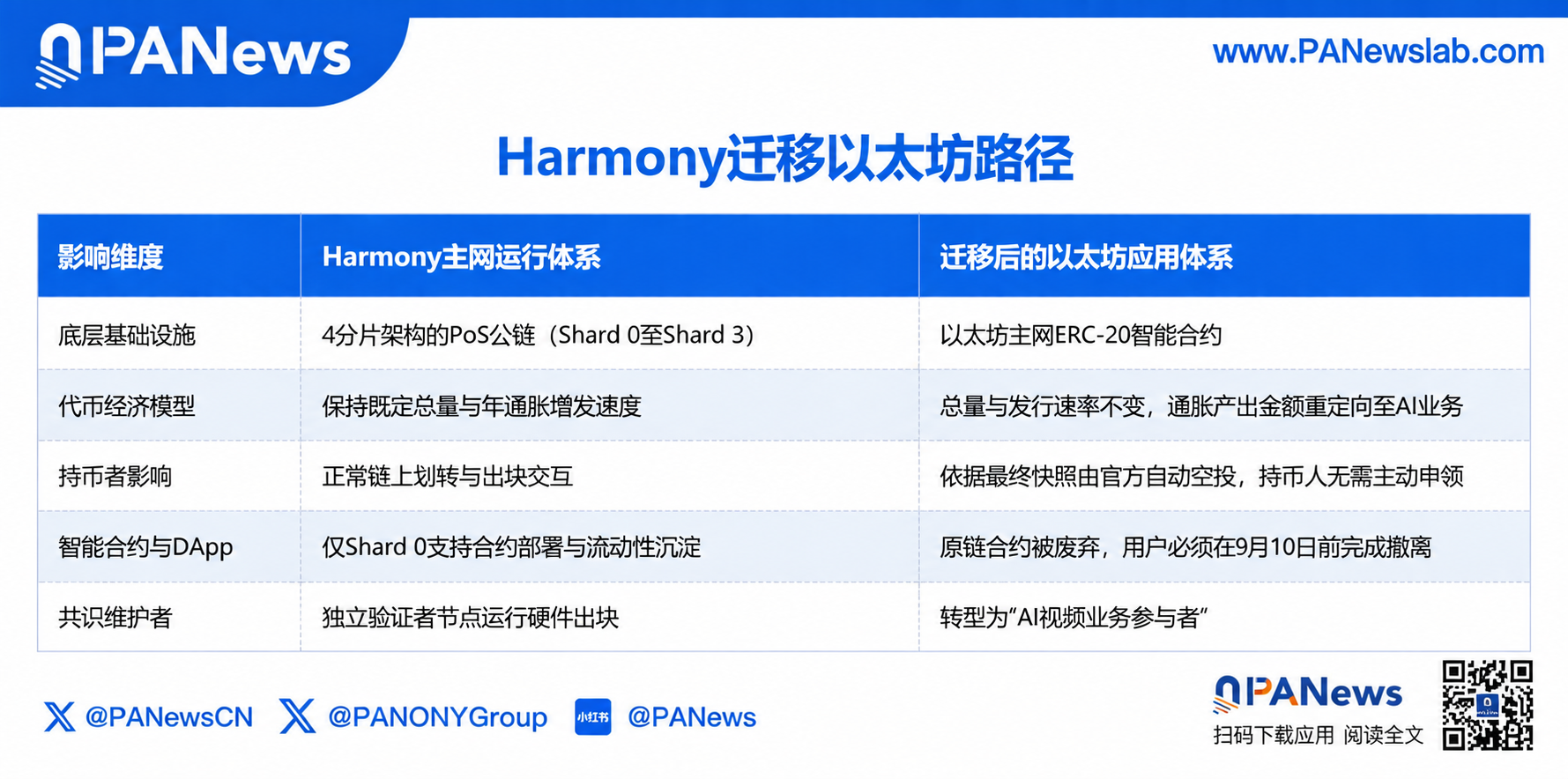
As the mainnet comes to an end, Harmony's token ONE will be transferred to Ethereum, and new tokens will be airdropped to corresponding holding addresses. Holders are not required to actively claim but multi-signature wallets, liquidity pools, and on-chain applications cannot be migrated.
The project promises that the total supply of ONE and the token release rhythm will remain unchanged, and any future new token supply will be used entirely for new AI video business. Once ONE is converted into an ERC20 token, it will be able to tap into the entire Ethereum ecosystem's traffic and tools. Retaining ONE will also, to some extent, continue the community, brand, and token economic system.
This design reflects Harmony's idea of separating "public chain networks" from "token economies."
In the past, the foundation of ONE came from ecological activities such as gas consumption, transactions, and staking on the mainnet. If the mainnet is shut down, the original value capture mechanism naturally becomes ineffective. Migrating to Ethereum is essentially looking for new use cases for ONE.
Harmony enters the AI video field, ONE faces the question of value
Harmony's answer is: make ONE an incentive and governance asset in AI video business.
According to the proposal, Harmony aims to establish a content economy revolving around "original material → secondary creation → AI expansion → distribution and monetization":
Creators upload videos, prompts, and original materials;
Fans or other users perform "remixes" of the original works;
AI agents continue to extend the plot and generate more videos based on users' secondary creations;
Operators are responsible for video generation, content distribution, and quality review;
Users earn income through subscriptions, advertisements, and other methods;
ONE undertakes functions like incentives, staking, and governance.
The project also plans to provide GPU subsidies for video operators, but they need to stake ONE to earn rewards based on online service duration.
The commercialization path is also written into the proposal: set a subscription fee of $10/month, providing content promoters with an initial maximum of 30% continuous commission. Once staking and online rates are met, the revenue target for operators in the first year is up to approximately $1 million. In an optimistic scenario, when reaching a million-level user scale, the advertising business could generate tens of millions of dollars in revenue.
In the transformation, Harmony has not abandoned the long-term accumulation. The existing community, brand, and validator network can serve as intangible assets for the cold start of the new business, and the AI content field possesses vast market space.
Among them, validators will stop running nodes starting September 10, but can participate in the new project as governors. Harmony will establish a one-time compensation pool of $1.372 million, distributed over four quarters to qualified validators and delegated stakers.
At the same time, some validators can also transform into AI video operators, promoters, or other new business participants. This indicates that Harmony hopes to retain its network effects to the greatest extent.
In the past, validator earnings came from protocol hard-coded block rewards, rules written in stone on-chain; in the future, if they transition to AI video business, income will depend on end-user demand and orders. Transitioning from deterministic on-chain rewards to the highly uncertain AI consumption market will be a test for this identity transformation.
From a product logic perspective, Harmony's AI video business resembles an AI-driven UGC secondary creation platform. The problem it needs to solve is how to allow a piece of original content to be continuously recombined by users, AI agents, and operators, thus forming a scalable content supply.
Behind the concept lies a vast capability gap.
Harmony's past accumulation of experience modules has focused on consensus protocols, sharding architecture, and node operations as blockchain infrastructure, while the AI video arena competes on model capabilities, computational power scheduling, content distribution, copyright management, user growth, product operations, and commercialization. The two sets of capability stacks have almost no natural migration relationship.
Particularly, the AI video field is already a red ocean, and Harmony needs to contend with competitors that hold large models, vast funds, and mature products. Merely relying on the combination of "AI+tokens" cannot create a moat.
This brings forward the most critical soul-searching question of the entire transformation: why must users use ONE?
Ordinary consumers can generate and watch AI videos using fiat currencies or stablecoins. GPU operating service providers can also accept payments in fiat or stablecoins. If ONE is just an additional incentive tool attached to AI products rather than a necessary medium for business operation, then the token will struggle to capture the value of business growth.
The economic model currently proposed by Harmony resembles an early experiment: incentivizing operators through ONE, constraining service quality through staking mechanisms, and then achieving revenue through subscriptions, advertisements, and other traditional internet models.
What Harmony needs to demonstrate is that the growth of the AI video business can feed back into the demand for ONE, otherwise, the token could become a new layer of narrative packaging.
It should be noted that both proposals are currently non-binding and may still be adjusted based on governance feedback in the future.
Rather than defining Harmony's proposal as "abandoning the public chain to transform into AI," it is better viewed as a rare project reboot trial: a public chain that once depicted a blueprint for sharding expansion chooses to proactively shut down its mainnet and strip the token away from the public chain, venturing into the unfamiliar AI video field.
Ethereum has become its settlement base, and ONE must complete a transformation: from a gas token of the sharded public chain to a value carrier of the AI content ecosystem.
For token holders, what needs more attention are execution details: the final snapshot height of the mainnet, asset accounting rules, migration support from major exchanges, and the audit results of the new ERC20 contract.
For Harmony, another question awaits an answer: in the fiercely competitive AI content field, how to prove that blockchain and ONE are indispensable parts of this business model?
Closing the mainnet does not mean rebirth; true rebirth begins with whether the new business can generate real demand. The result of this transformation still awaits time to reveal.
免责声明:本文章仅代表作者个人观点,不代表本平台的立场和观点。本文章仅供信息分享,不构成对任何人的任何投资建议。用户与作者之间的任何争议,与本平台无关。如网页中刊载的文章或图片涉及侵权,请提供相关的权利证明和身份证明发送邮件到support@aicoin.com,本平台相关工作人员将会进行核查。


