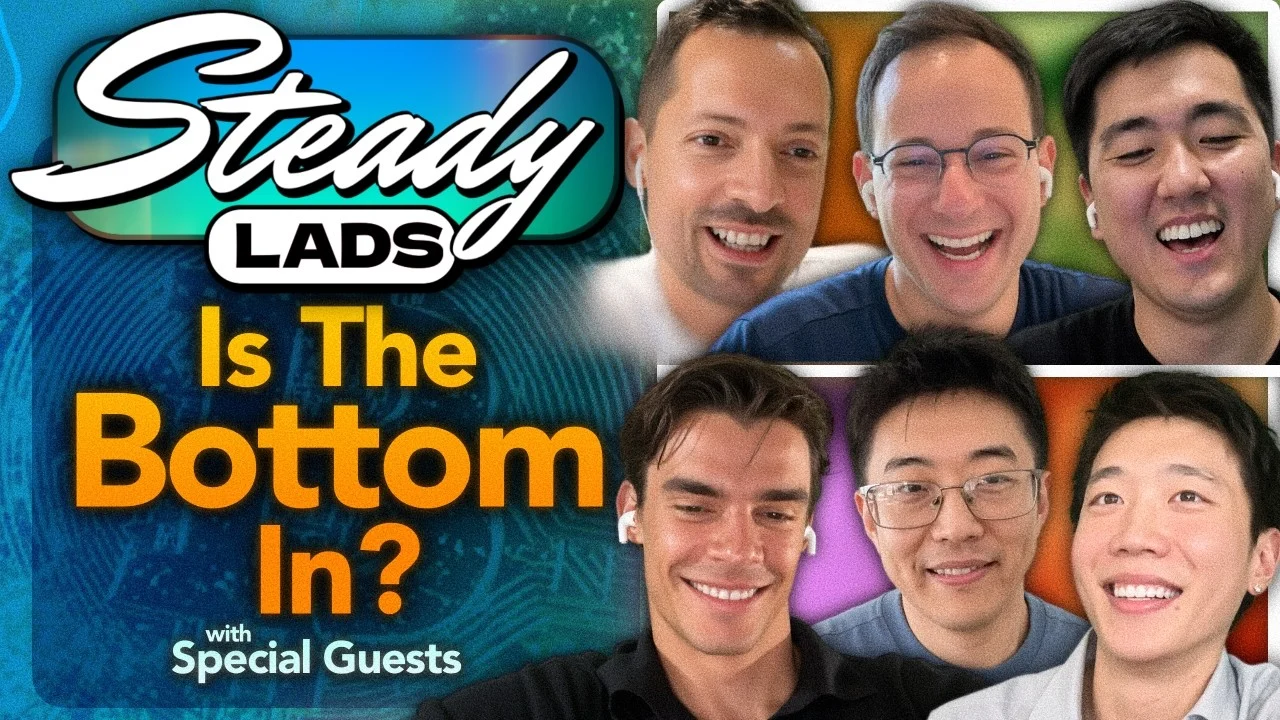
Podcast Source: Steady Lads Podcast
Compilation & Editing: Deep Tide TechFlow
Original Title: Is The Bottom In? What The Lads Are Buying!
Guests: Qiao Wang (Founding Partner of Alliance DAO), Se Yong Park (Co-founder of FOMO)
Regular Hosts: Jordy, Justin, Tiki, Dimma
Release Date: August 28, 2026
Disclosure Statement: All podcast guests have significant financial ties with the subjects discussed. Qiao Wang's organization holds a large number of early Web3 projects, and he personally invests heavily in US stocks, BTC, and Zcash; Tiki holds S&P 500, government bonds, and a large collection of Pokémon cards; Justin holds Zcash and airdrops from Lit; Jordy holds BTC and Hyperliquid (Hype); Dimma holds Near and Grass; Data shared by FOMO's co-founders has a strong emphasis on customer acquisition and product promotion. The content of this episode faithfully presents the guests' actual holdings and logic, and does not constitute independent third-party investment advice; readers should take responsibility for their own wallets.
Introduction: This is the comeback premiere of the Steady Lads podcast after a four-month hiatus, coinciding with Bitcoin's resurgence above the $80,000 threshold. Unlike previous discussions focused on market trends, the highlight of this episode is that several veteran hosts candidly reveal their current genuine positions (Portfolio). The results are surprising: in this circle often deemed full of get-rich-quick myths, the real smart money is retreating to traditional financial assets in large numbers, or pouring funds into a handful of highly certain targets, while most altcoins have been completely abandoned.
Key Takeaways
- The Real Holdings of 5 Industry Leaders: The main value of this episode lies in shattering the illusion of holdings within the circle. Qiao Wang has 70% to 80% of his funds in US stocks, retaining only BTC and Zcash in crypto; Tiki employs an extreme barbell strategy, holding S&P 500, government bonds, and Pokémon cards worth approximately $3 million, and explicitly states his bearish outlook on almost all other tokens; Jordy has a core position in BTC, retains some Hyperliquid, but admits its valuation has become too high; Justin bottomed out by purchasing spot Zcash and retained early Lit airdrops; Dimma holds Near, Grass, and other AI concept coins.
- The Decadal Bottom Consensus on Zcash: Zcash has become a common heavy investment for both Qiao Wang and Justin. The core logic lies in its decade-long consolidation which has completely eliminated the selling pressure from early investors. Chart-wise, it has formed a massive bottoming pattern spanning ten years. Compared to chasing high prices of BTC, Zcash offers an excellent risk-reward buying opportunity with the same supply but significantly lower price.
- The Truth About the Dwindling Liquidity of Obscure Tokens: Apart from a few top assets, most tokens have been blacklisted by guests. In stark contrast, data shared by FOMO co-founders shows that about 40,000 non-crypto-native users enter mobile for Meme trading daily. Retail money is being consumed through these low-threshold "social games," while traditional classic tokens have fallen out of favor.
- Discrepancy in Macroeconomic Bottom Judgment: Regarding the recent massive fluctuations in Bitcoin, Jordy believes that with the narrative of dollar devaluation, the correlation between gold and Bitcoin has reached a historic high, and funds are rapidly flowing back. Justin, however, strictly adheres to the four-year cycle theory, asserting that it is too early to call a bottom, and in cases of insufficient risk-reward ratio, chasing Bitcoin is less favorable than purchasing AI tech stocks in US equities.
Highlights of Perspectives
On Real Holdings and Defense: "About 70% to 80% of my funds are in US stocks, and in crypto, I only hold Bitcoin and Zcash. In this high-risk industry where prices can inexplicably plunge 50% in a day, you must remain rational." (Qiao Wang) "My strategy is the standard barbell strategy: one side is S&P 500 and government bonds, the other side contains Pokémon cards worth $3 million. I am extremely bearish on most tokens." (Tiki)
On the Decadal Bottom of Zcash: "The logic of Zcash hasn't changed in a decade; the most important point is that early investors who needed to sell have already sold out, and miner rewards have dramatically declined. Now the buying pressure finally exceeds the selling pressure." "Look at its long-term chart; it contains three rounded bottoms that have nested into a giant long-term bottoming structure lasting ten years—this is the most perfect chart structure you can find."
On the Nature of Mobile Trading: "Traditional match-3 mobile games can earn a billion dollars a year. Token trading on mobile is essentially a social game with real monetary incentives and lower barriers to entry." "Users do not care about which chain is underlying. Out of yesterday's 110,000 daily active users, 90,000 traded assets on the Robinhood chain, 100,000 on Solana, and the user experience is completely seamless."
1. The Real Cards of 5 Leaders: What Are They Buying Besides Bitcoin?
In the second half of the show, the hosts played a game called "Reveal Your Portfolio," where these seasoned veterans of the crypto market shared their current liquidity positions. This data brutally proves one point: smart money is no longer searching for treasure in the trash heap.
Qiao Wang (Founding Partner of Alliance DAO): His organization has broadly invested in numerous emerging Web3 projects, but his personal liquidity asset allocation is extremely conservative. He locks 70% to 80% of his position in US stocks. Among the remaining crypto assets, he has completely abandoned a variety of small and micro-cap coins, leaving only Bitcoin and Zcash. In terms of the risk-adjusted amount invested, the money he has spent on Zcash is even comparable to his US stock holdings.
Tiki: He employs the most extreme "barbell strategy" (one side is extremely stable, the other side is extremely high risk). His stable side consists of S&P 500 ETFs and US government bonds; the high-risk side consists of Pokémon cards worth about $3 million. When pressed by other guests, he candidly stated: "Unless I participate in early shares of a project, I am extremely bearish on all the tokens currently on the market."
Jordy: His absolute core position is Bitcoin, and he has accumulated a substantial amount. Regarding altcoins, he retains some positions in Hyperliquid (Hype), but he very clearly points out that Hype’s current P/E valuation has been overly inflated, and its price support relies more on retail sentiment buying, which is unsustainable in the long run, prompting him to take profits on spikes.
Justin: He executed tax-loss harvesting at the market's absolute bottom (around $1) and subsequently purchased a large amount of spot Zcash. Additionally, he still retains early Lit airdrops, currently holding about 80% of the initial distribution.
Dimma: He is one who relatively prefers hot narratives among the group. He holds some Near and Grass, which are supported by fundamentals, while also configuring a growing early-stage AI token venture capital portfolio.
2. Why Zcash? The Decadal Giant Bottom and Expectations for "AI Currency"
Among the holdings of the bigwigs, Zcash has become the most frequently mentioned and heavily invested single item. Qiao Wang provides a complete buying logic.
Fundamentally, Zcash's core functionalities of privacy and anti-quantum have undergone nearly a decade of market testing. In terms of chip structure, the lengthy eight to nine years of consolidation has allowed early institutional investors and teams to distribute their chips entirely. As the halving cycle progresses, miner selling pressure has also diminished significantly. Now, the market's new buying power has finally begun to overshadow the historical selling pressure. A few days ago, even when a whale crossed chains and sold off $50 million worth of ZEC, the market still stabilized, and prices did not experience a significant collapse.
From a trading technical perspective, Qiao points out that Zcash has formed an extremely rare long-term structure: several smaller rounded bottoms continue to nest, ultimately converging into a massive bottoming pattern spanning ten years.
Even more intriguingly is the valuation comparison. Bitcoin has become increasingly difficult to provide ordinary newcomers with a hundredfold return, while Zcash has the same total supply as Bitcoin but is currently priced at only about one-hundredth of Bitcoin. The podcast guests speculate that after Bitcoin occupies the "digital gold" ecological niche, the market urgently needs a native "privacy AI currency" to absorb new funds, and Zcash is quietly occupying this ecological position.
3. The Real Flow of Outside Funds: 40,000 Newbies Enter Mobile Games Daily
While insiders are still gazing longingly at various classical obscure tokens, FOMO trading app co-founder Se presented a set of data that delivers a powerful strike: they currently acquire about 40,000 genuine new users from the app store each day, the vast majority of whom are non-crypto native pure outsiders.
Their core customer acquisition strategy is UGC (User Generated Content) marketing, spending $100,000 to $150,000 monthly to sponsor social media creators, successfully breaking through regular people's information barriers by showcasing real trading records and material life.
In terms of product design, FOMO entirely abandons the complex concept of "public chains." Among yesterday's 110,000 daily active users, 90,000 traded assets on the Robinhood chain, 100,000 participated in Solana, and 60,000 engaged with Base. Users do not need to switch wallets or cross-chain; all assets are traded seamlessly on the same interface. Furthermore, FOMO only charges a 0.5% fee, significantly lower than Coinbase's up to 2.5% rate for retail.
Se's conclusion is sharp: these token trades on mobile are essentially a social game with real monetary incentives. Traditional match-3 games can earn billions of dollars annually, and the crypto space has packaged financial speculation as mobile games, creating a commercial closed loop that is much larger and more addictive than traditional games.
4. Macroeconomic Debate: In the Context of Rate Cut Expectations, Should We Chase Bitcoin or Embrace US Stocks?
In response to the recent massive $20,000 fluctuation in Bitcoin, the guests provided starkly different expectations.
Jordy believes that as the Fed's shift becomes clearer and macro-level signals of the dollar's devaluation emerge, the market can find no better safe-haven assets than gold and Bitcoin. Bloomberg data shows that the correlation between gold and Bitcoin has hit a historic high, with traditional institutions buying both concurrently.
Justin, however, is relatively cautious. He strictly follows the four-year cycle theory and believes that it is still too early to confirm a bottom. He calculates: if Bitcoin bottoms out at $60,000 and is bought at current prices, compared to the prior cycle's projected top of $125,000, the upward profit potential is less than onefold. Given the insufficient risk-reward ratio, he prefers to invest that portion of funds into AI tech stocks in US equities.
Regardless of whether the market moves left or right, this group of veterans ultimately reached a very consistent consensus: to place money in the most liquid top traditional assets, or concentrate it in a very few targets with solid logic, completely abandoning those marginal assets without genuine wealth generation capabilities.
免责声明:本文章仅代表作者个人观点,不代表本平台的立场和观点。本文章仅供信息分享,不构成对任何人的任何投资建议。用户与作者之间的任何争议,与本平台无关。如网页中刊载的文章或图片涉及侵权,请提供相关的权利证明和身份证明发送邮件到support@aicoin.com,本平台相关工作人员将会进行核查。


